
Work Health and Safety (WHS) Policy
Policy Statement & Commitment
Our Zero Harm Philosophy
The Akidamy is committed to a "Safety First" culture that prioritises the physical and psychological health of children, educators, staff, families, and visitors above all operational goals. We view WHS not merely as a statutory obligation but as a moral imperative.Management Commitment
The Approved Provider and Management are committed to:- Providing and maintaining an environment free of risks or hazards so far as is reasonably practicable.
- Implementing a proactive process of risk management and continuous improvement.
- Empowering all staff with the training, resources, and authority to stop unsafe work immediately.
- Notifying the regulatory authority (ECRU/WorkSafe) within 24 hours of any serious incident.
Legislative Authority & Governance
This policy is enforceable under the dual legislative framework governing our sector. Failure to comply may result in individual prosecution.Workplace Safety (Staff/Visitors)
- Legislation:Work Health and Safety Act 2020 (WA); Work Health and Safety (General) Regulations 2022.
- Regulator:WorkSafe WA.
- Key Duty (Section 28): Every worker has a legal duty to take reasonable care for their own safety and ensure their acts or omissions do not adversely affect others.
Education and Care Safety (Children)
- Legislation: Education and Care Services National Law (WA) Act 2012; Education and Care Services National Regulations.
- Regulator:Education and Care Regulatory Unit (ECRU).
- Key Duty (Section 167): To take every reasonable precaution to protect children from harm and hazard.
Duty of Care
A duty of care is the legal obligation to provide reasonable care while performing any acts or making any omissions that could foreseeably harm others.Scope of Duty - The Approved Provider and Nominated Supervisor will ensure all practical steps are taken to ensure the health and safety of all educators, staff, volunteers, children, families, and any other people impacted by School operations. This includes ascertaining and eliminating or minimising all realistically foreseeable hazards.
What the Duty Encompasses
This duty is not limited to physical safety but includes:- Supervision: Providing active supervision at all times (never leaving children unattended).
- Safe Premises: Ensuring grounds, premises, and equipment are safe for children's use.
- Bullying Prevention: Implementing strategies to prevent bullying and harassment.
- Medical Assistance: Providing medical assistance (if competent to do so) or seeking assistance from a medically trained person for any child who is injured or ill.
Zero Tolerance (Impairment)
To ensure the capacity to supervise is never impaired, and to fulfill our duty of care:- Prohibited: Educators and staff must not consume alcohol or be affected by alcohol or drugs (including prescription medication) while responsible for children.
- Smoke-Free: Smoking (including e-cigarettes) is prohibited on all School premises, including car parks.
National Quality Standard (NQS) Alignment
We operate in accordance with the National Quality Standard, specifically Quality Area 2 (Children's Health and Safety).| Quality Area | Element | Description |
|---|---|---|
| 2.1 | Health | Each child’s health and physical activity is supported and promoted. |
| 2.1.1 | Wellbeing and comfort | Each child’s wellbeing and comfort are provided, including appropriate opportunities to meet their needs for sleep, rest, and relaxation. |
| 2.1.2 | Health practices and procedures | Effective illness and injury management and hygiene practices are promoted and implemented. |
| 2.1.3 | Healthy Lifestyles | Healthy eating and physical activity are promoted and appropriate for each child. |
| 2.2 | Safety | Each child is protected. |
| 2.2.1 | Supervision | At all times, reasonable precautions and adequate supervision ensure children are protected from harm and hazard. |
| 2.2.2 | Incident and emergency management | Plans to effectively manage incidents and emergencies are developed in consultation with relevant authorities, practised and implemented. |
| 2.2.3 | Child Protection | Management, educators, and staff are aware of their roles and responsibilities in identifying and responding to every child at risk of abuse or neglect. |
Penalties for Non-Compliance
Breaches of these duties are taken seriously by the regulatory bodies (ECRU and WorkSafe WA) and can result in significant penalties for individual employees as well as the Service.| Legislation | Offence | Potential Penalty (Individual) |
|---|---|---|
| National Law (WA) | Failure to adequately supervise children (s165) | Up to $50,000 |
| National Law (WA) | Failure to protect children from harm/hazards (s167) | Up to $50,000 |
| WA WHS Act | Category 1: Gross negligence causing serious harm | Up to $680,000 and/or 5 years imprisonment |
| WA WHS Act | Category 2: Failure to comply with duty exposing individual to risk | Up to $170,000 |
| WA WHS Act | Category 3: Failure to comply with duty | Up to $57,000 |
Roles, Responsibilities & Accountability
Management Team
- Approved Provider:
- Holds ultimate liability for the safety of the service and ensuring systems are in place.
- Must notify ECRU (NQS IT PORTAL) and WorkSafe WA within 24 hours of any serious incident, death, or injury requiring an ambulance.
- Ensures resources (financial and physical) are available to rectify hazards immediately.
- School Director / Nominated Supervisor:
- Responsible for the day-to-day implementation of this policy and ensuring regulatory compliance.
- Audit & Review: Reviewing 1Place dashboards weekly to identify hazard trends and ensure checklists are completed.
- Culture: Fostering a culture where staff feel safe to report "near misses" without fear of reprisal.
- Approves all high-risk assessments (e.g., Bushfire, Lockdown are located in 1Place and summarised in the Governance, Risk, Complaiance GRC Master Directory: Filing & Evidence Guide).
- Responsible Person (RP):
- When the Nominated Supervisor is absent, the Responsible Person (RP) assumes legal responsibility for the service.
- The RP is required to be physically present at the service and be easily accessible to both staff and parents.
- Ensures educator-to-child ratios are maintained at all times and logs specific start/end times of their RP duty in Smartcentral.
- Acts as the Chief Warden during emergency evacuations or lockdowns.
Operational Team
- Studio Lead:
- Accountable for safety operations within their specific studio.
- Verification: Ensuring 1Place safety checks and Earlyworks daily communications are completed accurately by their team.
- Audits: Conducting key weekly audits and mentoring educators on safety practices.
- Studio Teacher (ECT):
- Ensures the educational programme and environment align with theEarly Years Learning Framework (EYLF) and safety standards.
- Designs learning spaces that support "Risky Play" within a safe, controlled environment.
- General Educators:
- Frontline Defence: You are the primary barrier between a child and harm.
- Procedures: Implementing all procedures, including 1Place daily checklists and Smartcentral headcounts.
- Mandatory Reporting: You must report hazards immediately via 1Place. Ignoring a hazard is a breach of your duty of care.
- Fitness for Work: You must not report to work under the influence of alcohol or drugs (prescribed or illicit) that impair your ability to supervise.
Contractors and Supply Chain
Contractors (e.g., cleaners, maintenance trades, gardeners) are classified as "Workers" under the WHS Act 2020 and are owed the same duty of care as employees.- Induction: All contractors must complete a Contractor Induction regarding site hazards and emergency procedures before commencing work.
- Verification: The Approved Provider must verify that contractors hold valid Working with Children Checks (WWCC), public liability insurance, and relevant trade licences.
- Coordination: Contractors must consult with the Nominated Supervisor to ensure their work does not impact the safety of children (e.g., securing tools, managing noise/dust).
Students and Volunteers
- Supervision: Students and volunteers must never be left alone with children or counted in educator-to-child ratios. They must be under the direct supervision of a permanent educator at all times.
- Induction: Must complete a full site induction regarding WHS and Child Protection before interacting with children.
Health and Safety Representative (HSR)
Staff are encouraged to elect a Health and Safety Representative (HSR) as per WHS legislation.- Election: Elected by staff for a 12-month term.
- Powers: An HSR can inspect the workplace, represent staff in safety interviews, monitor compliance measures, and enquire into risks.
- Support: The School will ensure HSRs are never prevented from their duties, are able to take paid leave for training, and will pay for course costs and reasonable expenses.
- Liability: HSRs are not personally liable for anything done or not done in good faith whilst carrying out their role.
Families and Visitors
- Families and visitors must take reasonable care of their own health and safety whilst visiting the School.
- They must report any health and safety issues to management.
- They must comply with all School policies, including the ban on smoking, drugs, and alcohol.
The Digital Safety Ecosystem
We utilise a "Single Source of Truth" approach. Verbal reports or paper notes are insufficient to discharge your legal duty. To ensure an audit trail that proves "reasonable care" was taken, all safety actions must be logged in our digital ecosystem.| Safety Action | Digital Platform (The "Where") | Specific Module / Template (The "How") |
|---|---|---|
Policies & SOPs | SweetProcess | Policy Library & Knowledge Platform (The Master Manual) 28 |
Hazard Reporting | 1Place Childcare | Template: AK - Potential for Someone Getting Hurt... 29 |
Daily Safety Checks | 1Place Childcare | Checklist: Daily Opening/Closing (Indoor/Outdoor) 30 |
Risk Assessments | 1Place Childcare | Master Risk Assessment Register (e.g., Excursions, Sleep) 31 |
Child Incidents | Earlyworks | Form: Incident, Injury, Trauma and Illness 32 |
Staff Incidents | Employment Hero | Tab: Compliance > Incidents |
Chemicals | 1Place Childcare | Risk Assessment: Physical Environment: Hazardous Substances 34 |
Operational Safety Protocols
Hazard Identification
A hazard is a source of potential harm or a situation that could cause or lead to harm to people or property. All hazards are to be reported in 1Place Childcare.| Potential Hazard | Includes | Example | Potential Accident |
|---|---|---|---|
| Physical | Floors, stairs, ladders, noise, heat, manual handling. | Wet bathroom floors, lifting children for nappy changes. | Slips, falls, back injury. |
| Mechanical/Electrical | Machinery, washers, dryers, appliances, vehicles. | Frayed power cords, lint accumulation in dryers. | Fire, electric shock, electrocution. |
| Chemical | Acids, poisons, cleaning agents, fumes. | Cleaning chemicals, medication. | Fire, explosion, poisoning. |
| Biological | Bacteria, viruses, mould, animals, vermin. | Sick staff/children, contaminated food. | Cross-infection, food poisoning. |
| Psychosocial | Workplace stressors, bullying, harassment, fatigue, and aggressive behaviours. | Bullying, children's needs exceeding educator skill, aggression from parents/visitors. | High stress levels, compromised care practices, psychological injury. |
Hazard Management (Immediate Action)
We treat every hazard as a potential incident waiting to happen.- Immediate Action: If a hazard presents immediate danger (e.g., broken glass, open gate), physically isolate the area before logging the report.
- Digital Log: Open 1Place > Select Hazard Identification > Log details + Photo. This creates a timestamped record that protects you.

- Elimination: Remove the hazard completely (e.g., dispose of broken equipment).
- Substitution: Replace with something safer (e.g., use non-toxic cleaning products).
- Isolation: Separate people from the hazard (e.g., lock the gate, barrier fencing).
- Engineering: Physical changes (e.g., install finger guards on doors, soft-fall ground).
- Administration: Policies, training, and rosters.
- PPE: Protective equipment (e.g., gloves, hats) – This is the last resort.
Risk Management (Prevention)
Risk Management is a systematic examination of potential risks. The process includes:- Identify hazards.
- Assess who or what might be harmed and how.
- Evaluate the risks and decide on appropriate control measures.
- Record findings in 1Place Childcare.
- Review the effectiveness of control measures regularly.
- Mandatory RAs: Water Safety, Sleep & Rest, Excursions, Transport, Bushfire/Emergency, New Equipment.
- Approval: The Nominated Supervisor approves all high-risk assessments.
- Staff Sign-off: Educators must read and sign off on RAs relevant to their daily work.
- Transport Safety: For any transport provided by the service (including excursions), a "look before you lock" procedure must be implemented to ensure no child remains in a vehicle.
To prevent "routine blindness", educators must rigorously complete Opening/Closing Checklists in 1Place before 7:00 AM.
- Scope: Perimeter fences (absconding risk), sandpits (sharps), and indoor environments (choking hazards).
- Verification: Studio Lead verifies checklist completion weekly.
Incident Management (Response)
Child Incidents (Earlyworks)- Immediate Action: Administer First Aid. Ensure the child is safe. Call 000 if life-threatening.
- Notification: Notify the Responsible Person or Studio Lead immediately.
- Documentation: Log the incident in Earlyworks under Incident, Injury, Trauma and Illness.
- Parent Communication: Parents must be notified as soon as practicable, but no later than 24 hours after the incident.
- Immediate Action: Administer First Aid.
- Documentation: Log the injury or "near miss" in Employment Hero (Compliance > Incidents).
- Reporting: Injuries requiring medical treatment or time off must be reported to the Insurer and WorkSafe WA within 48 hours.
- Injury Management: The Akidamy is committed to supporting injured workers through a Return to Work (RTW) program in consultation with the insurer and treating medical practitioners.
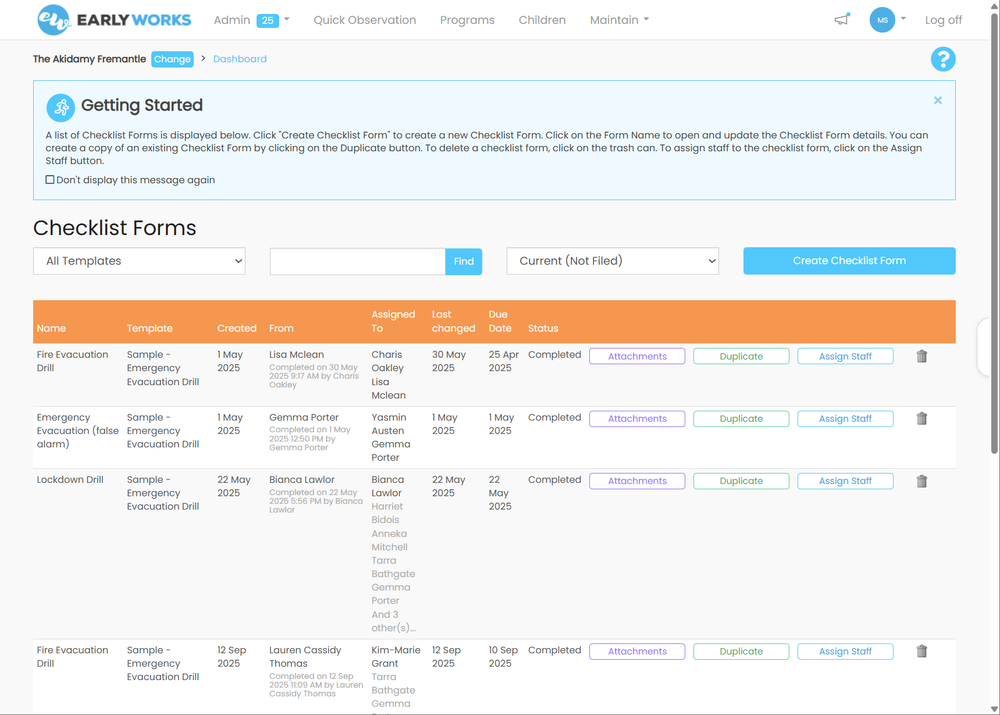
- Drills: Emergency evacuation and lockdown drills are practiced every three months.
- Log: The Responsible Person must log the drill (date, time, attendees, evaluation) in Earlyworks.
- Procedures: Staff must be intimately familiar with the Emergency Management Plan, Fremantle - Fire Evacuation Procedure & Perth - Emergency and Evacuation Policy, and Lockdown Procedure located in SweetProcess.
Specific Hazard Controls
Active Supervision (Life-Critical Control)
Supervision is not passive; it is an active, continuous process. All staff must employ Active Supervision techniques at all times:- Scanning: Continuously scanning the environment to know where children are and what they are doing.
- Positioning: Standing in positions that allow a clear view (e.g., corners, never with back to children).
- Listening: Using auditory cues to identify potential risks.
- Engagement: Interacting with children while maintaining situational awareness.
Manual Handling & Ergonomics
To prevent musculoskeletal injury, staff must:- Technique: Use the "semi-squat" technique (knees bent, core braced, feet apart).
- Lifting Children: Avoid lifting children where possible. Encourage them to climb into high chairs or changing tables using steps.
- Cot Safety: Never stretch over a cot rail. Drop the side first.
- Team Lifts: Request assistance for heavy or awkward loads.
Hazardous Materials
- Register: A Hazardous Chemicals Register and current Safety Data Sheets (SDS) are maintained digitally in 1Place.
- Storage: All chemicals must be stored in locked cupboards, in original labelled containers, inaccessible to children.
- Selection: We provide the least hazardous chemical or product for the task without jeopardising hygiene.
Hygiene & Infection Control
- Hand Washing: Strict hand washing procedures are followed upon arrival, before/after eating, and after toileting.
- Exclusion: Children and staff with infectious diseases are excluded in accordance with the Staying Healthy in Early Childhood guidelines in Early Childhood guidelines.
Medical Conditions & Administration of Medication
To ensure the safety of children with diagnosed health needs (QA 2.1.1):- Medical Management Plans: Any child with a specific health care need (e.g., Anaphylaxis, Asthma, Diabetes) must have a current Medical Management Plan and Risk Minimisation Plan uploaded to Earlyworks.
- Communication: A copy of the Medical Management Plan must be displayed in the studio (privacy protected) and readily available to all staff.
- Medication Administration: Medication is only administered by educators in accordance with Regulation 92 (written authority, accurate dosage, and witness verification logged in Earlyworks).
Zero Tolerance (Drugs & Alcohol)
To ensure the capacity to supervise is never impaired:- Prohibited: Educators and staff must not consume alcohol or be affected by alcohol or drugs (including prescription medication) while responsible for children.
- Smoke-Free: Smoking (including e-cigarettes) is prohibited on all School premises, including car parks.
Environment & Facilities
- Evacuation Diagrams: Compliant evacuation diagrams are displayed at each exit and main thoroughfare. These must not be obstructed by artwork or furniture.
- Electrical: Equipment is tested and tagged annually. Power points must have safety plugs.
- Housekeeping: Gates must be closed/locked after entry. Spills must be cleaned immediately. Hot drinks are strictly prohibited around children.
- Maintenance: All maintenance issues must be reported in 1Place immediately.
Risky Play
We support "Adventurous Play." No play space is risk-free. Educators assess risks to encourage children to test their capabilities within a safe, controlled environment.
Consultation, Training & Review
Reading and Understanding Policies
- Induction: All new staff must read and sign off on the WHS Policy and key SOPs in SweetProcess during their probationary period.
- Annual Refresher: All staff are required to re-read and re-sign critical policies (e.g., Child Protection, WHS) annually via Employment Hero or SweetProcess.
- Staff Meetings: WHS is a standing agenda item. Educators are consulted on changes to policies, new equipment, or changing work conditions.
- HSRs: Staff are encouraged to elect an HSR to represent their views on safety matters to management.
- Responsibility: The Approved Provider and Nominated Supervisor are responsible for updating policies.
- Triggers for Review: Policies are reviewed annually, following a serious incident/near miss, upon legislative change, or following feedback from staff/families .
- Notification: Any changes will be communicated to all staff and families at least 14 days before implementation (Regulation 172).
Further Resources & Sources
WorkSafe WA: commerce.wa.gov.au/worksafeSafe Work Australia: safeworkaustralia.gov.au
ACECQA: acecqa.gov.au
Poisons Information: 13 11 26
Emergency: 000
Staying Healthy: Preventing infectious diseases in early childhood education and care services.
Guide to the National Quality Framework (2017).
Work Health and Safety Act 2020 (WA).
Did this answer your question?
If you still have a question, we’re here to help. Contact us