
Emergency Management Plan
-
1Emergency Response Team
Designate a specific team that will be entrusted with managing all emergency situations. Known as the Emergency Management Team (SOAPE), this team plays a critical role in ensuring an immediate response whenever emergencies occur.
The 'Nominated Supervisor' takes the lead in this team, and in her absence, the assigned 'Responsible Person (RP)' takes charge. All members of the Emergency Management Team, including the 'Nominated Supervisor' and 'Responsible Person', must obtain thorough training in different emergency response procedures. This mandatory training guarantees their overall understanding of their roles in the team and their efficiency in carrying out their respective responsibilities during actual emergency situations.
-
2Emergency Contact Information
Gather and organise critical contact details, which should encompass local authorities, emergency service departments, and primary team members. This crucial information can be found on Smart Central. Additionally, all emergency phone numbers are conveniently displayed on our office phones for quick access.
Spread this information amongst all members of the team. It's paramount that everyone is able to access these details with ease, particularly in emergency situations. -
3Emergency Communication
Develop a communication plan for emergencies.
Whistle: Fire
"Lockdown" / "Hammertime" - emergency lockdown from a threat outside the school.Identify primary and secondary communication channels, such as phone, email, and messaging apps. The use of paper rolls with Childrens information in case of emergency.
Establish a protocol for notifying team members and coordinating communication during emergencies. (Emergency words as listed above)
-
4Emergency Procedures
Begin by formulating an extensive array of emergency procedures, with a heightened focus on lockdown and fire drill measures. These procedures are fundamental in providing a swift and coordinated response in times of crisis.
For further guidance, you can refer to the following detailed procedures:
- Perth's Fire Evacuation Procedure
- Fremantle's Fire Evacuation Procedure
- The school's Lockdown Procedure
It's paramount these procedures encapsulate systematic actions to investigate the ongoing situation, activate the Emergency Response Team, and keep all necessary parties appropriately informed.
In addition, it's important to delineate explicitly the steps to be taken in the face of diverse emergencies such as fire outbreaks, natural disasters, or medical emergencies. This specificity will equip the team with the knowledge needed to promptly and effectively handle any emergency scenario.
-
5Emergency Drills and Training
Regularly schedule and conduct emergency drills to ensure all team members are familiar with the stipulated procedures. We recommend doing this every three months, making sure to vary the drills to cover all potential scenarios including real-time simulations if necessary.
Additionally, we're committed to empowering all team members with necessary skills such as first aid and CPR. To this end, Akidamy offers financial support for staff to undergo this significant training.
Lastly, assess the outcome of these drills and training sessions to evaluate their effectiveness. If any area for improvement is identified, adjustments should be made accordingly. It's vital for these evaluations to be carried out upon each drill or training session's completion.
Please ensure to meticulously record all these drills, their date and outcome in the EarlyWorks system for future reference and compliance purposes.
-
6Emergency Resources and Equipment
Make certain that the appropriate resources and equipment needed for dealing with emergencies are readily accessible. This includes, but is not limited to, fire extinguishers, first aid kits, and emergency lights.
Perform regular checks and maintenance on these resources to guarantee they are operational and ready for use when an emergency situation arises.
Document a comprehensive record of every piece of emergency resource and equipment. This record should include crucial details such as their specific locations and the expiration dates when applicable.
-
7Emergency Evacuation Plan
Initiate the development of an evacuation plan and ensure its effective communication to all concerned parties. The plan is crucial during incidents that necessitate an immediate evacuation. You may refer to the following links for Perth's Emergency and Evacuation Policy, or Fremantle's Emergency and Evacuation Policy for guidance.
Identify the main and secondary evacuation passages and gather points. It's essential to have alternatives in case the main route is inaccessible.
Maintain up-to-date floor plans with clearly marked emergency exits. This ensures swift and safe evacuation of all personnel and children under care. The floor plans are to be created by EMT and Sliver Leaf Investments for The Akidamy and need to be approved by the authorized provider.
-
8Emergency Notifications and Updates
Formulate a comprehensive system to maintain communication with the key stakeholders during emergencies. Use this protocol for efficient interaction during crisis management.
This should encompass distribution strategies of important information to our team members, children's parents, our food suppliers, and, when applicable, the press.
In particular, appoint either the 'Nominated Supervisor' or an 'RP' tasked with this role, to manage all external communications. They will act as the main point of contact, ensuring the delivery of accurate and timely information.
-
9Emergency Response Evaluation
Once an emergency situation has been resolved, it is pivotal to assess the performance of our response. This assessment should cover all constituents of our emergency response and should be methodically documented within the 'Earlyworks' system.
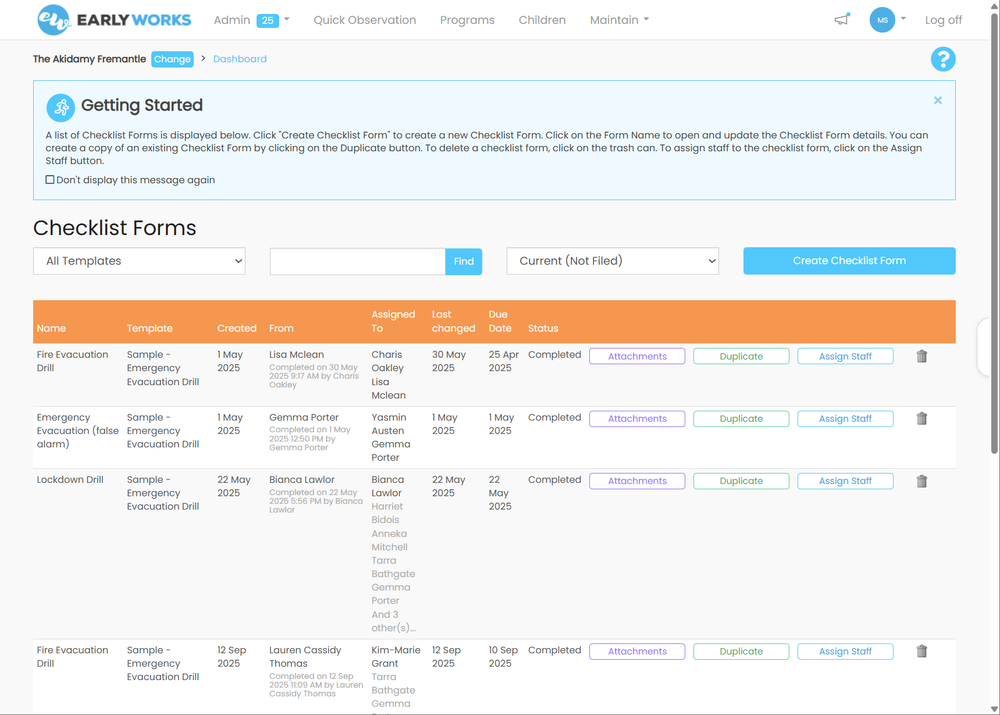
Through this thorough analysis, we can highlight any areas that could be improved or optimised. This resolution should trigger appropriate revisions or enhancements in our emergency response strategy.
By sharing the insights and successful practices gathered during this evaluation process with the rest of the team, we continue to bolster our efficacy and readiness for any future emergencies.