1. INTRODUCTION
This document has been prepared to assist the Developer/Owner / Lessor/ Landlord (referred to Lessor or Developer), the Designers and Fit out Contractors, to understand the requirements and criteria which must be followed in the design and
fit out of current and future locations of "The Akidamy Early Learning School" (as referred to as the Lessee or "the Akidamy" henceforth).The final character and atmosphere of the development will depend upon the quality of the design and fit out and the successful integration of the school in the development. The completion of the design and fit out will require the coordinated efforts of many people. This document has been prepared to assist all parties to ensure that built form is completed accordingly.
Please note that the information contained in this document is intended as a guide and should be read in conjunction with the Lessee’s Agreement for Lease (AFL) and the Tenancy Plans. In the event of any inconsistency, the Agreement for Lease shall prevail.
Design Standards and Responsibilities
The quality of the design, built-form and fit out is expected to be of a high standard and all parties must ensure that appropriately qualified and licensed professionals are used at every stage of the process.
The Lessee will provide experienced consultants to check and coordinate the Lessor’s design documents, however these documents must be submitted in a timely manner and be of sufficient standard, and in CAD / PDF, so they can be reviewed appropriately. Design meetings are to be attended by all parties, and amendments or suggestions to improve the quality of the design of the built-form are to be adhered to by all parties.
Design meetings are to be attended by all parties, and amendments or suggestions to improve the quality of the design of he built-form are to be adhered to by all parties.
The Lessee’s intention is to create highest quality childcare centre that contribute to the overall, holistic development as a destination.
Disclaimer
The Lessee reserves the right to change these requirements at any time in the event to ensure compliance with the applicable regulations and standards for childcare centres.
All descriptions, dimension statements and other particulars in the information are provided in good faith and are believed to be correct at the time of publication. However, any intending or existing Lessor should not rely on them as statements of fact.
It is imperative that the Lessor satisfy itself by inspection or otherwise as to the correctness of the information prior to entering into any legally binding obligations.
The design and graphics shown/described within the document are examples only and are included as a guide to indicate to the Lessor the intentions in regard to the various requirements, including styling and finishes. The Lessor should only rely on and comply with the design provisions of this document.
The Lessee and its agents/representatives/consultants disclaim any liability and responsibility for any damage suffered by any person which arises out of any person’s reliance on the requirements, design and graphics provided in this document.
Under National Building Code an
early childhood centre and
school age care facility must be designed and constructed to provide a safe environment and provide for the health, safety and well-being of the children, parents and staff using the centre.
Early childhood centre is any any premises or part thereof providing or intending to provide a centre-based education and care service within the meaning of the Education and Care Services National Law Act 2010 (Vic), the Education and Care Services National Regulations and centre-based services that are licensed or approved under State and Territory children's services law, but excludes education and care primarily provided to school aged children in outside school hours settings.
This document is the intellectual property of The Akidamy, with all rights reserved. Use beyond the intended purpose as defined under this document and making copies of the document or parts thereof is not permitted without the strict written approval of The Akidamy.
General Terms & Definitions
At The Akidamy word childcare centre or other reference we use term School as in the wide community it has a negative perception. Also we have school teacher in ever Studio Employed and to ensure the highest educational standards.
ACECQA is the defined and
described in this reference.School is used as the term to refer to industry as the following industry wde as the Childcare or Long Daycare or Early Learning Centre or Service or Service Provider or Centre-Based or Approved Provider as defined by ACECQA.
Studio's is classroom for children's teaching and instruction. (licenced Activity Space).
Sleep room is space that children use solely for sleep. (Non-Licenced Space).
The Akidamy School of Early Learning is referred to as The Akidamy or School.
SQM is square metres area or m^2.
2. THE AKIDAMY who we are
Our School Vision
To provide an inspiring environment that sparks a life of learning and allows every child to flourish.
Our aim is to provide a "Space to Flourish."
Therefore, we are positioned in the market as:
A premium brand that focuses on innovative early learning practices, supported with next-level ‘surround sound’ services that amplifies the ‘nothing but the child’ ethos.
The Akidamy, we are inspired by the Reggio Emilia approach with RIE and Pikler values. We consider the child as strong, competent, resilient, and full of curiosity and wisdom.
Our Education Philosophy & Approach
At the Akidamy, we are inspired by the Reggio Emilia approach with RIE and Pikler values. We consider the child as strong, competent, resilient, and full of curiosity and wisdom.
Our curriculum encourages children to investigate, create, improvise, and invent. We are committed to implementing the National Quality Framework, National Regulations, and National Quality Standards to guarantee our school exceeds the best quality and standards.
Our school is committed to building strong relationships with families and supporting the growth of their children. We value a team approach and collaborate closely with experienced child practitioners to ensure the best possible outcomes for each child.
Informed by individual and group observations, our educational programs take into account each child's unique qualities. The developmental milestones of the National Early Years Learning Framework guide our Educators in setting realistic objectives for children as they engage in immersive learning experiences.
Our Core Values
- Children and families first
- True to our promise
- Genuine Relationships
- Compassionate Learning
- Always evolving and innovating
Core Offerings
- Bring ‘Nothing but the child’. We aim to make life easier by providing everything your child needs
- Inspired Reggio Emilia Approach, and elements of the RIE and Pikler philosophies
- School Readiness Programme delivered run by qualified Early Childhood Teachers and Occupational Therapist
- We are inspired by the O-Soji - おそじ principles where children are developing lifelong habits.
- Signing Hands programme provides skills which allow children, educators and families to communicate
- Delivering experiences with Italian language, yoga, mindfulness, sustainability, arts and music
- Homemade, nutritious vegetarian meals from local, seasonal produce.
Confidential Information
Confidential Information (e.g. drawings, maps, ideas and information) and Intellectual Property(IP) of the Akidamy with respect to the Akidamy's own fitout design, brand, business strategy and service offering will stay with the Akidamy, regardless of any termination of this Offer to Lease or the Agreement Lease. "Confidential Information" means any information relating to the business or affairs of the Tenant, its clients or its Related Bodies Corporate (as defined in the
Corporations Act 2001 (Cth)). The Landlord and his associated agents, builders, suppliers and consultants must:
- keep all Confidential Information secret and confidential including this document;
- take all reasonable and necessary precautions to maintain the secrecy and prevent the disclosure of any Confidential Information;
- not disclose any Confidential Information to any third party; and
- not use any part of or make copies of any Confidential Information, except to the extent required by law.
The parties agree that the design specifications and internal designs are not the Landlord's property and the Landlord may not use those internal plans and specifications in connection with any other development of the Premises if the lease does not proceed.
The Landlord and Tenant must keep confidential and not allow, make, or cause any public announcement or other disclosure of or in relation to:
- the terms of this Offer to Lease and any related documents (including written or oral agreements, negotiations or information in relation to those documents); and
- any documents which are, or information which is, confidential to the other party,
without the prior written consent of the other party.
3. PROJECT GOALS FOR SCHOOL DEVELOPMENT
Our project's objective is to provide a School (Early Childhood centre) that exceeds the expectations and experiences of the Akidamy's families and children. The building and its surroundings must accurately reflect our identity, values, and commitments to the children and their families.
When discussing the Akidamy, the message that best characterises the anticipated experience is:
“It is the warm and welcoming feeling you get from the moment you step out of your car to bring your child into the Akidamy. From the beautiful layout of the foyer areas to the free flowing indoor and outdoor environment, to the beautiful textures and inviting sounds, smell and feeling of the Akidamy”
The School is positioned as Premium Brand which the design philosophy needs to reflect in all areas.
The Fit Out Assumptions
- Bespoke
- Innovative warm design
- Stimulating environment
- Recognisable
- Natural Light
- Good heat management
- Easy to clean
- Every detail on purpose
- Non-plastic/sterile feel
- Natural feeling – use of wood
- Veggie garden
- Smart Storage
- Home furnishings
- Free flowing
- 3 barriers to escape
- Flexibility
- Sounds of nature
- Engaging layout
- Glass & transparent
- Always on show
- Parent’s area
- Greenery & natural material
- Able to display creativity of children
- Unsightly items areas hidden
The Feeling
- Tranquil and calm
- Comfortable
- Wow factor
- Unique and custom
- Warmth
- Welcoming
- Energy
- Little touches
- Visual stimulation
- Natural smells
- Like a breath of fresh air
- Recognisable and familiar
3. DESIGN NOTES
Our key objectives for development/site are as follows:
Meeting the needs of our Primary Customer
Parents, often mothers. Ambitious for their children. Time-poor, working parents who want to give their children the best possible start in life. Happy to pay a premium for the right outcome. They have high standards for themselves and, by extension, their family. These parents want an early learning school that raises the bar; they seek the exceptional. Education is about investing in their child’s future and setting them up for success. Cost is secondary to quality. With busy careers and limited spare time, they want clear and open communication that details exactly how their child is progressing and learning.
So this translate to the Dayspa Experience for Mothers.
The use of natural light
The space should be as warm, inviting and natural as possible with a strong emphasis on the use of natural light and the creation of a sense of warmth.
The use of free-flowing spaces – Indoor and Outdoor
All children (and to a lesser extent those under 12 months) should have the ability (in line with the Reggia Emilia philosophy as above) to explore their environment on a daily basis by utilising the “creative spaces” (classrooms or studios) of the School. Children will be able to move from their “home zones” to the music area, yoga, art room, and outdoor play spaces.
As outdoor play spaces will be available to the children via the building surrounds on two sides ideally (left, right, and back), we want the children to be able to access their outdoor environment at any time from their indoor play areas. Basically, we want each Studio (where possible) to face the outdoor play areas of the building.
Space efficiency
The space of all the studios, play areas, administration areas, common walkways, wet areas, and storage areas will need to be maximised. Further, all spaces must incorporate the needs of children and staff into their design and be focused on creating a sense of warmth.
As much as possible, unsightly fixtures need to be concealed.
Covered walkways and shade cover
This will be for the surrounding areas of the building to provide shade and shelter to maximise outdoor play areas and to accommodate the seasonal weather conditions in Perth. Outdoor shade also provides the opportunity for the children to have meal times outdoors. External garden and play areas, shade structures (including the installation of permanent awnings (which must be insulated) over at least 30 to 35% of the part of the Premises that forms the playscape area), gardens, and fencing to a design and layout agreed with the School. No shade sails will be used. Near the nursery areas Synthetic Grass should be used allseasonssyntheticturf.com.au/products/summer-cool-hd-35mm/ to meet all weather conditons for childcare.
The use of natural and sustainable materials
Unlike many other childcare centres, we do not like the use of plastics or sterilised materials (other than kitchen appliances and kitchen work surfaces). The use of wood, glass, rocks, water, ceramics, and carpet needs to be incorporated into the design.
Our aim is to create a calm and tranquility and warm environment not hospital or state high school environment.
Design Hall, Reception and Walkways
These need to multi-use in design with nooks and areas for children and families to site and also areas for hidden storage.
Internal and External Educational Spaces and Play Areas and the General Use of Colour Accross the School
We do not want the use of too much colour in the building fit-out, as this overstimulates young children and takes away from the natural feel we are trying to achieve, but its also critical that the school does not look like sterile hospital either. Overcrowded play spaces minimise the opportunity for children’s imaginative play.
Landscaping and Outdoor spaces
As each room will (ideally) have a view towards the outside of the building, the landscaping and design of outdoor spaces should be unique (i.e. each room should have its own perspective of space), bespoke in their creative offerings to the children, and inviting. Therefore, all external play areas to be predominantly natural finishes, e.g. grass, plants, stones, timber etc.
Outdoor spaces must allow children to explore and experience nature, such as trees, sand and natural vegetation (regulation 113).
Approved providers must ensure their education and care program is based on – and delivered in accordance with – an approved learning framework (section 168(1)). The two nationally approved learning frameworks that outline practices that support and promote children’s learning (regulation 254(1)) are:
- The Early Years Learning Framework for Australia (EYLF) – for children from birth to five years of age; and
- The Framework for School Age Care in Australia (FSAC) – for school age children.
These frameworks detail outdoor learning environments as follows:
- The School outdoor learning spaces must offer a vast array of possibilities not available indoors. Play spaces in natural environments include plants, trees, edible gardens, sand, rocks, mud, water, and other elements from nature. These spaces invite open-ended interactions, spontaneity, risk-taking, exploration, discovery, and connection with nature. They foster an appreciation of the natural environment, develop environmental awareness, and provide a platform for ongoing environmental education.” (EYLF, p.18)
- “In childhood, dexterity and flexibility in physical development is evident in the wide range of activities children are able to perform.
Their coordination allows children to undertake tasks such as needlework and playing a musical instrument, and ball sports and bike riding. They undertake more complex physical activities, particularly in the outdoor environment.” (FSAC, p.30)
4. GENERAL REQUIREMENTS, REGULATIONS, STANDARDS AND COMPLIANCE
Compliance
The design of the School is to be in accordance with the following:
- National Construction Code (NCC)
- With either option, the building must meet certain requirements of the National Construction Code, including the Building Code of Australia (BCA) for a class 9b building.
- All relevant Australian Standards
- Education and Care Services National Regulations
- ACECQA National Quality Standards, National Regulations and Laws
- WAPC Planning Bulletin 72, 2009: Child Care Schools
- Local Authority Planning Schemes and Policies.
Facilities and physical environment
Information required with an application for service approval includes:
- site and floor plans prepared by a building practitioner showing the location of all buildings (including entries and exits), structures, outdoor play areas, shaded areas and boundary fencing, gates and elevation plans of the premises
- detailed floor plan indicating all encumbrances and facilities provided, such as toilet and handwashing facilities, nappy-changing bench and bath, food-preparation areas, including details of how the rooms will be used
- calculations carried out by a building practitioner of the unencumbered indoor and outdoor space
- plans of the outdoor learning environment specifying the landscaping and natural environments that will be provided.
In addition, a Certificate of Occupancy must be submitted to us. In this, the building certifier needs to sign off that the premises complies with 9b of the Building Code. In particular, it must meet the requirements for:
- toilets,
- handwashing,
- Bottle Preparation
- nappy-change and bath facilities
- natural light and window requirements.
The relationship of rooms and the interaction between the indoor and outdoor environments is an important factor in the design. The design of the building should:
- facilitate effective supervision
- allow children to easily move between spaces
- provide convenient access to toilet and handwashing facilities.
Before The Akidamy can get it service approval is granted, we will conduct a departmental pre-approval visit to the service premises to assess whether it is suitable and safe for the education and care of children. This visit is to confirm that the approved provider has taken every reasonable precaution to protect children being educated and cared for by the service from any harm and hazard likely to cause injury.
At this stage of the approval process, the education and care service should be ready to commence operation. All building works, fit-out and development of outdoor play spaces should be finalised before the pre-approval visit.
Note: The above listed standards are regularly updated and amended from time to time. The current version of each is to be verified and employed accordingly. The Lessor is fully responsible for ensuring absolute compliance with all required standards associated with the building works of which are necessary for the Lessee to obtain the licence to operate the childcare centre.
The definition of indoor and outdoor Space is well defined by the following reference document outlined in Queensland and reference document South Australia contain a good list of information that apply also to Western Australia. 4.1 Applying the National Regulations and other considerations
Regulations Indoor Activity Space (Licenced Space)
The Education and Care Services National Regulations stipulates that the school must provide at least 3.25 square metres of unencumbered indoor space for each child. In calculating the area of ‘unencumbered space’
the areas outlined under section 107(3) of the regulations are to be excluded.
(2) The approved provider of an education and care service must ensure that, for each child being educated and cared for by the service, the education and care service premises has at least 3.25 square metres of unencumbered indoor space.
(3) In calculating the area of unencumbered indoor space--
    (a) the following areas are to be excluded--
        (i) any passageway or thoroughfare (including door swings);
        (ii) any toilet and hygiene facilities;
        (iii) any nappy changing area or area for preparing bottles;
        (iv) any area permanently set aside for the use or storage of cots;
        (v) any area permanently set aside for storage;
        (vi) any area or room for staff or administration;
        (vii) any other space that is not suitable for children;
    (b) the area of a kitchen is to be excluded, unless the kitchen is primarily to be used by children as part of an educational program provided by the service.
Regulations Outdoor Activity Space (Licenced Space)
The Education and Care Services National Regulations stipulates that the School must provide at least 7square metres of unencumbered outdoor space for each child. In calculating the area of ‘unencumbered space’
the areas outlined under section 108(3) of the regulations are to be excluded.
Space requirements—outdoor space
(1)  This regulation does not apply in respect of a family day care residence.
(2)  The approved provider of an education and care service must ensure that, for each child being educated and cared for by the service, the education and care service premises has at least 7 square metres of unencumbered outdoor space.
Penalty: $2000.
(3)  In calculating the area of unencumbered outdoor space required, the following areas are to be excluded—
    (a)  any pathway or thoroughfare, except where used by children as part of the education and care program;
    (b)  any car parking area;
    (c)  any storage shed or other storage area;
    (d)  any other space that is not suitable for children.
(4)  A verandah that is included in calculating the area of indoor space cannot be included in calculating the area of outdoor space.
(5)  An area of unencumbered indoor space may be included in calculating the outdoor space of a service that provides education and care to children over preschool age if—
    (a)  the Regulatory Authority has given written approval; and
    (b)  that indoor space has not been included in calculating the indoor space under regulation 107.
(6)  In this regulation a reference to a child does not include—
    (a)  a child being educated or cared for in an emergency in the circumstances set out in regulation 123(5); or
    (b)  an additional child being educated or cared for in exceptional circumstances as set out in regulation 124(5) and (6).
4.2 Regulations Interpretation of Spaces
General
When interpreting a provision of the National Law relating to indoor and outdoor space, the interpretation that will best achieve the purpose or
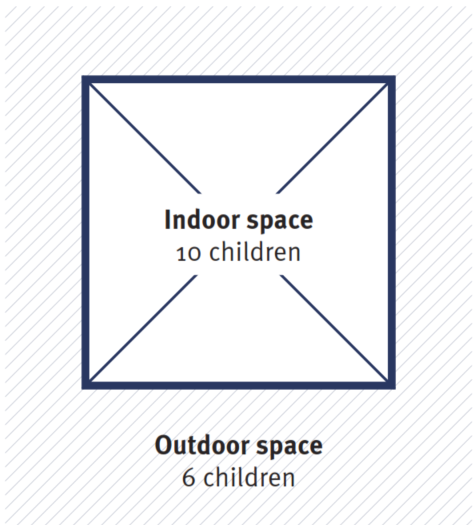
objectives of the National Law will be preferred to any other interpretation (schedule 1, clause 7). Where the total amount of unencumbered indoor and outdoor space per child allow for different numbers of children, the lower number is the maximum number that a service may educate and care for.
When applying for service approval for a centre-based service, you will need to provide a number of documents, including:
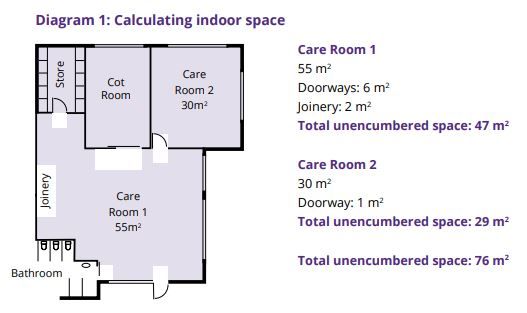
- a floor plan prepared by a building practitioner showing the unencumbered indoor and outdoor spaces to be used at the service; and
- unencumbered square metre calculations carried out by a building practitioner of these spaces (regulation 25(1)(b)).
These can be separate or combined documents (e.g. one document containing shaded plans, clearly identifying the included unencumbered
spaces from the excluded spaces and their unencumbered measurements).
Space requirements are based on total unencumbered space available at a premises, not per room or outdoor space. However, you may be required to provide detailed measurements for each room and outdoor area in order to identify spaces that may not be considered unencumbered.
Programming should make the most of available spaces to achieve quality outcomes for each child. All spaces must be safe, suitable, well-maintained, and appropriate for a child’s development. Indoor space 10 children Outdoor space 6 children, therefore the maximum: 6 children
Indoor space requirements
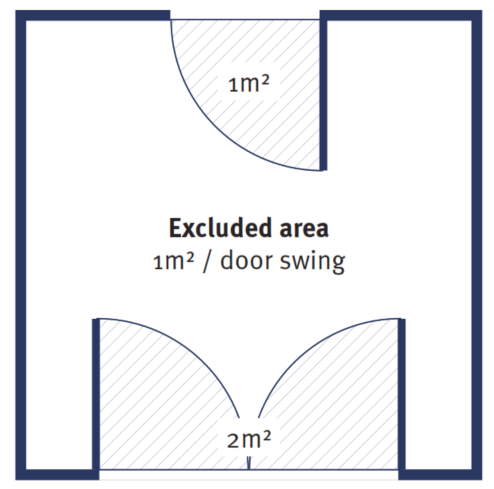
Excluded areas for passageways or thoroughfares should be calculated by a building practitioner. To be compliant, a minimum of 1 square metre per door swing into a play/activity room is to be excluded from unencumbered indoor space (i.e. 2 square metres for double door swings).
No express exclusion exists for thoroughfare areas around sliding doors but precautions must be taken to protect children within areas of
traffic, regardless of the type of door (swing, sliding or otherwise). Any space unsuitable for education and care should be excluded from measurements.
A deduction is not needed for high shelves, which are inaccessible for children and do not encroach on play space. Items such as fixed or movable
cupboards; shelving or lockers; walkin store rooms and refrigerators are considered storage, as these items or spaces are considered functional, rather than space where children can play and use as part of the program.
Children’s moveable furniture items (e.g. tables and chairs, small bookshelves or cabinets for storing equipment and toys) are not considered storage.
Kitchen areas cannot be counted as unencumbered space, unless they’re primarily to be used by children (i.e. the kitchen is an educational kitchen).
The area of a kitchen is also to be excluded, unless the kitchen is primarily to be used by children as part of the educational program of the service. As prescribed in the Building Code, the kitchen facilities must be protected by a door or gate with childproof latches to prevent unsupervised access to the facilities by children younger than five.
Passageways or thoroughfare areas, including door swings, are not counted as play spaces. They are entry/exit spaces: to allow for the movement of adults or children. In these circumstances, 1 sqm for each single door opening (and 2sqm for double doors) is deducted from the total space that can be counted for capacity purposes. This applies to all thoroughfares into and between children’s rooms regardless of where the thoroughfare is located or how doors are configured.
Where the thoroughfare is between children’s activity areas, 1 sqm is deducted from both activity areas because the single door impedes use of both areas, resulting in a deduction of 2 sqm. Also, if the door is a double door, then 2 sqm is deducted from both areas.
The
ACECQA Guide to the National Quality Framework (NQF) provides a number of factors to determine whether a kitchen is primarily used by children as part of an educational program. Kitchen facilities and food preparation areas should be protected by a door or gate with childproof latches to prevent unsupervised access by children younger than five. These barriers, doors and gates indicate the area to be excluded from unencumbered space measurements.
To be considered unencumbered indoor space, the space must be used exclusively by the education and care service at the time it is operating – not shared with other ad-hoc care facilities or schools.
A verandah that is included in calculating the area of outdoor space cannot also be included in indoor space. Only with the written approval of the regulatory authority may a verandah be included in calculating the area of indoor space (Regulation 107(4)). This is subject to evidence from a building practitioner demonstrating that the verandah meets the requirements under the relevant building code to be classed as indoor space. For further information see the
Using a verandah as indoor play space fact sheet. A Childcare Centre must be designed to facilitate supervision: Reg
115. The design and configuration of the outdoor play area should ensure that children can be actively supervised at all times. Children should not have free access to areas behind structures, such as storage sheds, cubby houses and water tanks.
Cot and Nursery Sleep Room Requirements
- Design, Function and Capacity,
- Function to provide sleeping accommodation
Note: The above listed standards are regularly updated and amended from time to time. The current version of each is to be
verified and employed accordingly.
The Lessor is fully responsible for ensuring absolute compliance with all required standards associated with the building works
of which are necessary for the Lessee to obtain the licence to operate the childcare centre.
- Number (n) for children who require a sleep during the day, generally those up to 2 years of age.
- planning, you should refer to Refer to the DECD Children’s Services Licensing and Standards Fact Sheet Cot Room.
- Sleep Room area will be as scheduled in the project Facilities Brief of the School being designed. (Under South Australia Regulations) One piece of bedding shall be provided for each child under 2 years of age (with 2/3 being cots and the remaining mattresses/stretcher beds, i.e. 15 under 2 years of age, therefore we require enough for places = 10 cots and 5 mattresses/stretcher beds). Rooms shall be designed to accommodate a maximum of six cots each.
Under Tasmanian Class 5 Childcare legislation the Sleep space for children aged from birth to two years:
- Sleep space, in addition to the required play space, is to be maintained in accordance with the following:
- Each required sleep room/area, must:
- for children up to the age of 12 months, provide 2 sqm of sleep space for the total number of children under 12 months present at any one time; and
- for children aged one year, provide 2 sqm of sleep space for at least half the number of children present at any one time.
- Cots/age-appropriate bedding are to be arranged to ensure:
- direct access to each child;
- adequate space between cots; and
- accessibility to the exit at all times (refer to Standard 11.11: Fire Safety).
- Supervision of sleep room
Where the sleep space is not directly adjacent to the playroom in use, or where visibility
cannot be easily maintained, then:- a supervision policy must be in place; and
- where the carer does not remain in the room, there must be an operating baby
monitor.
The layout shall maximise the efficiency of provision of cots with a minimum of 700mm clear access between each. Cords from all blinds shall be inaccessible to children in cots. Adequate supervision of children in the sleep room shall be facilitated by positioning of the cots
and viewing provided into the room. Staff shall be able to directly observe all children from the viewing windows.
Single door access from the Main Activity Area and a viewing window in the wall between two adjoining sleep rooms is recommended for additional visual supervision by staff. Convenient access to the children’s toilet is required but not necessarily direct access.
Sleep and rest areas or rooms:
- Consider children’s need for calm, comfortable and secure surroundings as they rest.
- Provide ways of supervising children under 15 months as they sleep, e.g. are children able to be observed through a window?
- Ensure the temperature, lighting and ambience of the sleep room or area encourage sleep and rest.
Cots, beds and bedding equipment:
- Ensure cots, beds and bedding equipment meet mandatory Australian safety standards and are labelled accordingly.
- Adhere to all product safety advice relating to cots, beds and bedding equipment.
- Ensure cots, beds and bedding equipment are appropriate for the age and developmental stage of the children who will use them.
- Ensure cots and beds are assembled according to manufacturers’ instructions and that instructions are kept in a place known to the nominated supervisor and educators.
- Use mattresses that are the right size for the cot or bed and ensure they are firm, flat, clean and in good condition.
- Ensure cots do not contain toys, books, cot bumpers, doonas, pillows and other items that could be hazardous to sleeping babies and young children.
- Ensure all cots, beds and bedding equipment are clean, maintained and regularly checked for damage to safety latches and moving parts.
- Provide safe bedding for children according to their age and developmental stage.
- Avoid the use of bassinettes, as there are no Australian safety standards for bassinettes.
- Ensure babies are not left to sleep on mats or floor mattresses. The safest place for a baby to sleep is in a cot that meets the mandatory Australian Standard.
Location of cots and beds:
- Ensure there are enough cots and beds available for all children who require sleep or rest throughout the day.
- Ensure cots and beds are not positioned under or near windows, curtains, blind cords, or electrical appliances.
- Allow enough space between the cots or beds to ensure children using them cannot physically disturb one another while resting.
- Allow enough space between cots or beds for educators to move freely between children – educators must be able to tend to a resting child without touching another cot, bed or child.
- Ensure any area that is permanently set aside for the use or storage of cots or beds is excluded from calculations of unencumbered indoor space.
Toilet and hygiene facilities and nappy change facilities: Regs 109 & 112
Adequate developmentally and age-appropriate toilets must be provided. A minimum of one toilet and handwashing facility per 15 children is required. Ideally, toilets will be directly accessible from inside and outside play spaces by children.
Consideration should be given to maintaining the dignity and rights of children. This can be done by solid walls in children’s toilet cubicles and privacy from neighbours’ windows. Consider including doors on toilet cubicles for older children. However, there need to be windows into the toileting area for educators to supervise the children.
Soap dispensers and hygienic hand-drying facilities must be provided in children’s toilet areas. Foaming-type dispensers are recommended as their use presents less of a slip hazard than other liquid dispensers, which often drip.
Hygienic nappy-changing facilities must be provided. If a service accommodates children younger than three years, a properly constructed nappy-change bench is required with a bench-type baby bath and separate adult handwashing facilities located within 1 m of the nappy-changing bench.
Nappy-changing facilities must comply with the Building Code. The bench must not be less than 0.9 sqm in area, and at a height of not less than 850 mm, but not more than 900 mm above the finished floor level. The bench must have a space not less than 800 mm high, 500 mm wide and 800 mm deep for the storage of steps. It must be positioned to allow a staff member changing a nappy to see the play areas at all times.
In addition, there needs to be one shower, bath or shower–bath combination in each service.
Reg 112. Nappy change facilities - This regulation applies if a centre-based service educates and cares for children who wear nappies.
- The approved provider of the service must ensure that adequate and appropriate hygienic facilities are provided for nappy changing.
- Without limiting subregulation (2), the approved provider of the service must ensure that the following are provided —
- if any of the children are under 3 years of age, at least 1 properly constructed nappy changing bench; and
- hand cleansing facilities for adults in the immediate vicinity of the nappy change area.
- The approved provider of the service must ensure that nappy change facilities are designed, located and maintained in a way that prevents unsupervised access by children.
See also ‘Premises designed to facilitate supervision’ and ‘Stairs and stairways’.
Ventilation and natural light: Reg 110
Education and care services must be well ventilated, have natural light and meet minimum ceiling height requirements. Refer to the Building Code. They must also be maintained at a suitable temperature. It is best practice for sleep spaces to have natural ventilation and natural light.
Other considerations
Blind cords
Blind cords pose a strangulation hazard and must be made inaccessible to children at all times. Cords should be secured in a position that is out of children’s reach, which ordinarily is at approximately 1500 mm above floor level, but may be higher if adjacent to cots or other play equipment. The Akidamy would prefer the use remote controlled blinds to eliminate the potential dangers.
Bottle-preparation spaces
You need to consider where you will prepare the bottles. It is best practice to have bottle-preparation spaces close to children’s play spaces so children can still be effectively supervised. Kitchenettes can work well for this purpose and should be considered as part of the initial design. Ensure that any bottle-warming resources do not pose a risk to children, i.e. burns from hot water, and are inaccessible to children at all times. They should have hot water billi or Zip tap due the frequent nature of this activity.
Severe injuries to children’s fingers can occur in education and care services. This can include amputations and crushing injuries. These can be prevented by fitting finger guards to the hinge edges of doors that may be accessed by children. Finger guards are required on the hinged side of the door/gate and may also be required on the unhinged side depending on the risk to children.
Door finger guards must be fitted on new buildings and when undertaking renovations, as per this policy. Common rooms where door finger guards are applicable include doors to:
- children’s activity rooms
- toilet areas
- front entrances
- offices or store rooms
- staff preparation rooms
- laundries
- staff rooms.
This also includes children’s toilet cubicle doors, doors or gates to kitchens and reception areas. In some cases these doors may lead directly from children’s activity rooms or they may lead from corridors or passageways.
An alternative hinge arrangement can be used on children’s toilet doors, creating a larger gap to prevent fingers being caught on the hinge side.
Doors that children may access must be self-closing, adjusted to a slow close using a cushioning device. This allows children time to react.
Sliding doors should be fitted with stoppers that prevent the door being shut on a hand. They should be able to be secured in an open position and fitted with devices that prevent crushing of fingers.
Room dividers, such as bi-fold doors or foldable walls, should be effectively secured for adult operation only.
For doors located in high-traffic areas for children, it is recommended the doors are able to be secured in an open position, when required. For example internal and external toilet doors and doors leading from children’s activity rooms to outside play spaces. The recommended securing position is preferably out of children’s reach, e.g. a high cabin hook located at 1500 mm may be used.
Door handles are to be fitted at approximately 1500 mm from the finished floor level to doors leading from corridor areas to children’s activity rooms and to areas not to be accessed by children. For example, doors leading to:
- offices
- staff rooms
- storerooms
- kitchens
- staff preparation rooms
- staff toilets (except disabled)
- laundries
- front entrance doors.
For high-traffic areas, in particular to toilet and handwashing areas and to outside play spaces, door handles should be located at children’s height to:
- provide easy access
- avoid reliance on adult assistance
- foster children’s independence with toileting and handwashing.
Glazing
As in the Building Code, any glazing less than 1 m above floor height must be of safety glass standard in all areas accessible to children. For existing glazing, a qualified glazier may apply an approved film to achieve the same purpose.
Hot water
To ensure children’s safety, hot water delivered in areas accessible to children must be tempered to not exceed 45°C, with a recommended setting at Initial matters to consider Applying the National Regulations and other considerations 12 approximately 40–42°C. For example, hand-wash basins, bath taps, sinks, troughs and showers. See also ‘Bottle-preparation spaces’.
Stairs and Stairways
Stairs to nappy-change benches must be secured in a manner that is not accessible by children. The stair treads are to be non-slip. Hand rails should be provided for children where possible, to assist with children’s access. The Building Code specifies appropriate stair dimensions. See also ‘Toilets and hygiene facilities and nappy change facilities’.
- Additionally, stairways should be fitted with a childproof gate to prevent free access by children to upper levels.
- It is recommended that stairs to nappy-change facilities are able to be secured in the open and closed position to ensure the safety of children.
Storage areas and joinery
Storage and joinery are needed for the many things required to be stored at an education and care service. We recommend per child:
external: minimum of 0.3 sqm of external storage space internal:
- internal: minimum of 0.2 sqm of internal storage space.
Storage areas cannot be included when calculating the indoor space.
4.3 Regulations Outdoor Physical Environment
Fencing: Reg 104
Fences and gates must be of a height and design that prevent children of preschool age or under from going under, over or through. It is important to ensure effective fence heights are maintained at all times by not locating objects or structures close by. A minimum 1.2 m clearance should be provided. Any gaps in fences or gates are not to exceed 100 mm, including gaps under or adjacent to structures or between vertical bars.
All gates must be self-closing with a latching mechanism that prevents the egress of children.
Boundary fences need to be at least 1.8 m high. They must be constructed so that children will not be able to climb over them. This means they should not include a horizontal rail that might enable climbing. See the Kidsafe SA information sheet:
Fencing playspaces.
Self-closing and self-latching mechanisms on all perimeter gates should also be operating effectively. This can be tested by opening the gate to a variety of positions, such as approximately 25 mm open, half open and fully open positions. In all circumstances, upon release, the gate should subsequently close and latch properly.
If kept locked, emergency access gates must have a key readily available and accessible to all staff for use in the event of an emergency.
Outdoor space: natural environment: Reg 113
Children must have access to natural environments. There are great benefits for children being able to engage in free play in a natural environment.
We also recognise the value to children of exploring and experiencing natural environments and have a policy on this:
Outdoor play areas in education and care services. Kidsafe NSW and ACECQA both publish information sheets on the value of natural play spaces and safety considerations.
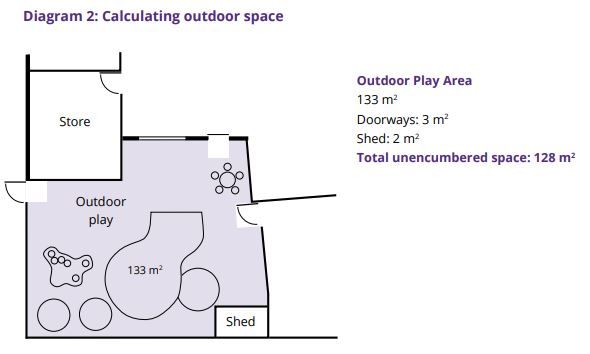
Similar to the calculation of indoor play space, either 1 sqm or 2 sqm is deducted per single or double thoroughfare opening to determine the total unencumbered play space. For example, gates, doors leading from indoor areas and storage sheds, etc. are considered as encumbrances.
Dense hedging and plantings should not be included in space calculations if it’s not accessible as play space. Fixed play equipment added in the future may affect outdoor space.
Learn more about an approved provider’s responsibility to create safe sleep and rest environments from the following:
5. GENERAL HEALTH & SAFETY
General
The health and safety of all staff, children, visitors, and other users must be a primary consideration in the design and development of Schools. Designers of the School should ensure the health and safety of persons (including those working in and maintaining the building) during construction and during occupation for the purpose of intended use.The following list is not exhaustive but highlights some key factors to be considered:
- Access to and within the perimeter, aiming to reduce trip hazards.
- Ventilation, in consideration with asthma.
- Noise and acoustics.
- Electrical; provide RCD protection to all Socket Power outlets. Refer to Electrical Consultant.
- All non-carpeted surfaces to have slip rating
- All stair treads to have contrasting, coloured, non-slip nosing edge strips.
The design and construction of the school should comply with Work Health and Safety Act 2011
Soil testing
Prior to construction the Developer is to provide the Akidamy. One of the following:
- a soil assessment for the site of the proposed childcare site & premises by licenced environmental or soil assessment consultant
- if relevant, a statement specifying the date of a previous a soil assessment
- a statement from the Developer that, to the best of their knowledge, the site history does not indicate the site is likely to be contaminated in a way that poses an unacceptable risk to the health of children.
In Australia, there is a national guidance document for the assessment of site contamination called the National Environment Protection (Assessment of Site Contamination) Measure 1999. It outlines the process for the assessment of site contamination.
Food Preparation:
- Any food preparation areas should comply with Australian Standard 4674-2004: Construction and fit out of food premises.
- Designers should ensure that all food preparation areas comply with relevant duty of care provisions relating to food preparation, hygiene, and safety standards.
- Ensure food premises:
- Have sufficient space, facilities, and storage to produce food safely.
- Are provided with services such as potable water, waste disposal.
- Have sufficient light and ventilation for food handling.
- Protect against contamination by:
- Providing facilities for staff to maintain hygiene standards and equipment cleanliness to protect against contamination.
- Select finishes and fittings designed to minimise risk of contamination i.e.. recessed lights.
- Choosing sealed joints and surfaced. Avoid adjustable height shelving under benches.
- Are proofed against harbourage of pests.
- Has a dedicated food preparation sink in close proximity to food handling area.
- Include insect screens for any external windows and doors.
- Each double socket power outlet should be wired to a separate electrical circuit.
- Kitchen to have installed Commercial Kitchen Fly Zapper/Insect Killer high and safe location (see reference product)
Termite Control
- Anti-termite treatment should be applied to all buildings, complying with relevant Australian Standards.
- In new builds, non-chemical barriers are preferred.
- In existing builds, the presence of chemical barriers may necessitate the retention of the chemical method of subterranean termite control.
- Any timber (stump or log) that may have been exposed to termites should be removed from the building site.
- All workmanship and materials should conform to the requirements of the relevant code. If chemical barriers are used, all necessary precautions should be taken to protect workmen from accidental poisoning.
Hazardous Substances
- Take precautions against asbestos when demolishing or disturbing any material.
- Any materials containing formaldehyde-based compounds should comply with ‘E0’ (Ezero).
- All materials and products should be low to zero VOC emission.
- NO timber treated with copper-chrome-arsenate (CCA).
- NO air conditioners with water cooled condenser type plants.
6. INCLUSIVITY & EQUITY
The School should allow individuals independence and equal opportunity to work, learn and play. The design should exceed the relevant requirements outlined in the NCC and the current Disability (Access to Premises- Buildings) Standard 2010.
Access & Egress:
- Entry doors to all Activity Rooms should open inwards.
- Avoid out swinging of Activity Room doors into corridor. A solution could be to recess the doors.
- Sliding doors should not be specified as the main entry door into rooms as they do not sufficiently act for emergency evacuations as per National Construction Code.
- All external doors should have a minimum 900mm deep continuous wet weather cover (i.e.. verandah roof, covered link or awning) to provide effective rain protection.
Handrails and Balustrades:
- As to comply with relevant Australian Standards and ACECQA requirements.
- Include child height handrails to all steps, stairs or ramps and avoid the use of plastic nosing.
Amenities:
- Children toilet areas should be located to allow direct access to both their relevant Activity Rooms and External Play Area.
- All amenities in the non-staff WC’s should be junior-orientated:
- Washing and drying facilities to be safe and convenient for children.
- Reachable flush heights.
- Half-height toilet cubicle partition, with no doors for children under 3 years old. with doors fitted for children old than 3 years.
7. SUSTAINABILITY & ENERGY EFFICIENCY
The Akidamy should actively demonstrate their commitment to the environment by:
- Minimising energy and water usage and maximising efficiency (E.g. Natural ventilation).
- Locating and orientating to minimise heat gain and loss.
- Utilising low-maintenance building forms, construction techniques and materials.
- Considering landscaping as a resource for environmental education
- Reduce or minimise the use of gas
- Low energy lighting and the use of timers on some rooms
- Solar Panels Power Supply and Onsite Batteries Storage - Selection by The Akidamy.
8. SITE SERVICES - GENERAL EXTERNAL SERVICE AND DESIGN
General all site services must:
- Ensure that all design, material used, workmanship, testing and commissioning of the site services comply and are in accordance with the latest relevant Australian Standards and statutory requirements.
- Consult with the relevant Local Authority to determine existing site service connections required for compliance.
- location and installation of services outside Activity and External Play Spaces are to be secured so access by children is mitigated.
- Parking Areas Stormwater containment is to be designed in accordance with Local Authority requirements by a qualified engineer.
The number of parking bays required for both cars and bicycles are determined by the relevant Local Authority. - Water Supply and Filtered System:
- All water used on site either obtained by the local government water authority and use on site bores will require the installation of water treatment and filtration at the supplied source and use in the building.
- All water at the school need to be portable standard. All portable water must be filtered at water supply to allow for high flow rate to meet the needs of the School. Its recommended that All-in-One Pump*, Ultraviolet Steriliser and Three-Stage Filtration System) at the source of supply to the building to ensure only filter water is entering the Premises.
- Bin store:
- A secure bin store is to be provided to accommodate a minimum of 2 x 660L bins each (Red and Yellow).
- Bin floor area to be concrete and graded to an industrial floor waste.
- A hose cock is to be provided for washing down bins.
- Suitable lighting is to be provided.
- If possible, bin store to be located separate from main building
- Bicycle Racks
- A secure set of racking is to be provided to accommodate a minimum of 4x staff bicycles. The racking can be either
wall or floor mounted to suit the available space.
Vehicular Access and Parking
- Car Park:
- Carparking areas need to ensure the safety of all visitors to the site. A safe environment for pedestrians is essential.
- Where carparks are near main entrances, a suitably sized fenced holding area is recommended with self-closing, self-latching mechanisms fitted to gates.
- If a service has a double gate to allow for vehicle access,the double gate must be effectively secured at all times children are in attendance— with no gaps greater than 100 mm.
- The car parking area is to be fully sealed and kerbed.
- Kerbing is to be semi−mountable concrete at a maximum height of 150mm.
- Parking bays are to be line marked in accordance with AS2890. The size of parking bays are to comply with Local Authority requirements for staff use with a width of visitor drop off bays to be 2.6m.
- An accessible parking bay and associated shared area is to be provided adjacent to School’s entrance in accordance with AS2890.6.
- Wheel stops are to be provided where parking bays are located adjacent to footpaths, walls, fencing, or playgrounds.
- Service Vehicles - Provide vehicular truck access for:
- Bin Store.
- Service and maintenance access to the building.
- Associated requirements by local authorities for reversing bays.
Physical factors affecting road safety
Approved providers need to consider a range of
physical factors such as the proximity of roads and road-related areas to children’s outdoor play areas, as well as the proposed location of pick-up and set-down areas, car parks and walkways. When assessing potential safety issues relating to vehicle access and how any risks will be managed, the approved provider should consider
relevant matterssuch as:
- speed limits of any adjoining roads. For example, a 60km/h adjoining road presents a higher risk than a 40km/h designated ‘School Zone’ adjoining road
- the flow and direction of traffic. For example, what direction do cars enter the service’s carpark? Is traffic congestion more prevalent at certain times of day
- any need to install adequate safety barriers and/or bollards to protect children’s outdoor areas/rooms adjoining carparks and roads
- the design and location of pedestrian access areas such as footpaths, entrance gates, access ramps and walkways to ensure the safe passage of children to and from the service to adjoining vehicle access areas such as ‘drop-off and pick-up zones’, car parks and roads
- proximity of the service to other public venues – for example, schools, early childhood services or entertainment venues such as restaurants, cafes, cinemas or sporting venues – which experience high levels of traffic and congestion at peak times which coincide with ‘drop-off and pick-up’ times at the service
- the location of other public amenities near the service, such as service stations, train and bus stations, shopping centres or storage facilities where heavy vehicles access the adjoining roads (such as trucks, buses and trains) and which may present additional road safety risks to children
- Car park design should include adequate water drainage to ensure to access safety for staff, families and children.
- the number of children attending the service. For example, a service with 80 or more children in attendance will require greater car-parking capacity and pedestrian access than a service with only 10 children in attendance
- use of signage, fencing, safety gates and barriers which affect the routes that children are able to take and encourage safer travel.
This is not an exhaustive list. Approved providers also need to consider whether there are any additional physical safety factors specific to their service premises.
Precautionary measures – addressing road safety
Approved providers should identify and implement precautionary measures to address the risks to children’s health and safety that carparks, roads and road-related areas may present. Examples of precautionary measures include the installation of:
- guard rails, bollards or barriers
- increased signage
- reinforced fencing, particularly for indoor or outdoor play areas that adjoin a busy main road or a carpark. Note: Although a concrete block fence may be intended to prevent an out-of-control vehicle entering an outdoor play area, would any new risks emerge from, for example, flying concrete if the fence was breached?
- Speed bumps on streets or roads in the immediate area.
- In relation to the above, the Regulatory Authority may seek through the approved provider, a statement from the engineer overseeing the installation of the relevant safety measure to ensure it is of a design to withstand the particular risk posed by vehicles and that it has been installed in accordance with the product safety specifications.
Hot-water services and air-conditioning units
Hot-water services and air-conditioning units are to be inaccessible to children at all times.
Sharp corners, edges and rocks
- Sharp corners and sharp edges on rocks and timbers must be made well rounded and smooth, e.g. sharp corners or edges on garden beds and borders, decking and boardwalks, balancing beams and sandpits.
- Timbers on structures, posts, equipment and garden beds may require sanding to make them smooth. Otherwise they may be rough and likely to contain splinters. Timbers used in the outside play areas are to be certified safe and free from any copper chrome arsenate (CCA) products.
- Any large rocks that may be unstable are to be secured. Protruding small branches with sharp ends are to be above children’s head height only.
Stormwater grates/drains
The diameter of grate holes of stormwater drainage should not be between 5–25 mm, as they could trap a child’s finger. See
Entrapment information sheet by Kidsafe SA.
Surfaces under play equipment
A suitable impact-absorbing surface must be provided in the impact (fall-zone) area where free height of fall is 600 mm or greater to meet current Australian standards. For example if wood chips are used, a minimum depth of 300 mm is to be maintained at all times (installed at 400 mm).
A suitable impact-absorbing surface must also be provided for fall heights less than 600 mm where equipment causes a forced movement on the body of the user, e.g. swings, slides and rocking equipment.
An appropriate fall space clearance is also required. To meet current Australian standards, the impact area clearances provided around play equipment require a minimum impact zone of 1.5 m. For example a fall height of 600 mm requires a minimum impact-attenuating zone of 1.5 m. This can increase proportionally as the free height of fall height increases, noting that the maximum fall height for an education and care service is 1.8 m. For such a height, the fall zone area must be a minimum of 1.7 m. Kidsafe SA has a useful information sheet called
Impact areas for further guidance.
The maximum free height of fall for moveable play equipment is 1.5 m. As per our
policy, woodchip softfall in outdoor play areas for children under two years of age must not be used, as this is a Initial matters to consider Applying the National Regulations and other considerations potential choking hazard. (See also ‘Children under two and small objects’.)
If a rubber impact-attenuating surface is used, attention must be given to the temperature of the surface on hot days. This product absorbs heat readily and can cause burns to children. It also needs to be maintained regularly, in line with manufacturer’s recommendations. A simple test is for an educator to hold their hand on the surface. If they can do so comfortably for five seconds, it is fine.
Seek guidance from
Kidsafe SA or a qualified landscape designer to meet the current Australian standards for playground safety.
Swings and fixed play structures
Swings and fixed play structures must be suitable for the ages of children, meet current Australian standards and be installed strictly in accordance with the manufacturer’s instructions.
Othe Consideration
The following musy be given to in the design:
- Security. Staff may work on their own in the evenings and Saturday sessions. Is a panic button necessary? Does the facility have adequate external lighting? Is there adequate vision to the front entry — vision panels in doors? Are differing levels of security access required, for example from foyer into waiting room and consultation area? Is an intercom for ‘buzz-in’ access required?
- Safety. Are door hinge guards necessary? Are thermostatically-controlled mixing valves installed to avoid scalding? Are table edges rounded and surface edges bull nosed for safety?
- Sound proofing. Importance of enabling confidential discussions to occur.
- Design that enables direct access to spaces as is required, rather than creating thoroughfares across other spaces.
- Appropriate external signage for the service.
- Secure internal pram storage.
- Dedicated parking with security lighting
- Pedestrian access zones into the building entry.
- Adequate rubbish collection areas.
- To ensure that there is enough space store bedding away from children e.g. in purpose build cupboards or storerooms.
9. LANDSCAPING AND OUTDOOR PLAYSPACES
Design Concept Playspaces Areas
The following design concept:
- Zenlike appearance and waterwise plants
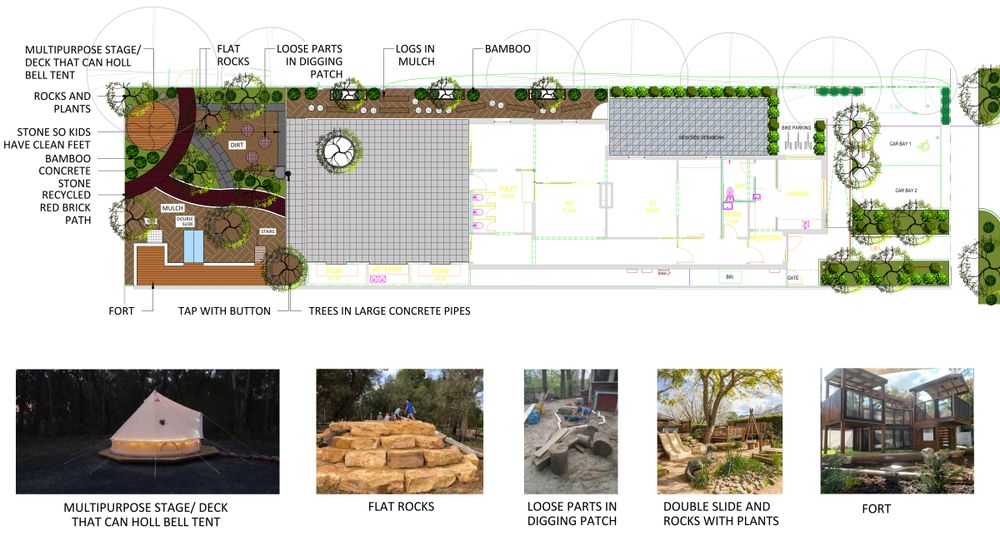
- Landscaping the concept should be based as per to Cheriton, Summers Site less is more and we would like to see more trees, lots of bamboo trees and mulch across most the play space
- The undercover area needs to free to allow eating tables but can have some indoor beds of plants
- Good play area and integration and simple design to allow children creativity:
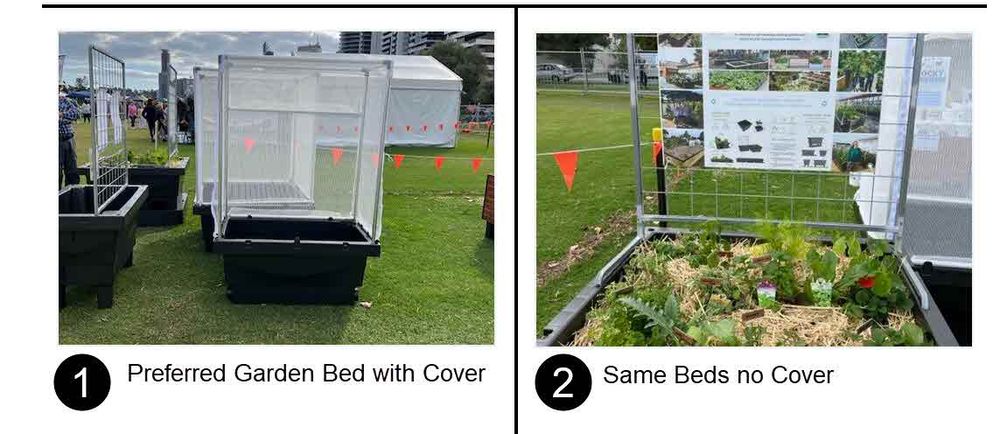
- Vegie Formal Garden
- Garden Path
- The playspace areas should be considered in three zones:
- Nursery (N1 and N2) age group of children 0 to 18 months
- Toddlers (T) age group of children 18 to 26 months children
- Kindergarten (K3 and K4) age group of children +26 months to max of 5year
- Each zone needs to be designed differently with some separation and barriers between them, especially the Nursery and Toddlers (i.e. they shouldnt mix). The Kindergarten children can share the zone with Toddlers, but not vice versa.
- Small water feature for K3 and K4 space.
- Design should have some level of contour/scale of material brick, mulch, wood etc. height not just things flat. We need balance synthetic grass with mulch and other materials
- No Grass areas if possible, otherwise mulch or compacted dirt or sand
- Sandpit Nursey and Toddlers (with solid edging
- A real mud,logs and loss parts area in K4 and K3
- Black board area for children to draw in any area other than N1 and N2
- Mature trees (at least two lemon trees, 1 Orange and four olive trees)
- Bambo plants and walking Logs
- Nature Play Structure with No plastic
Playspace Design Images
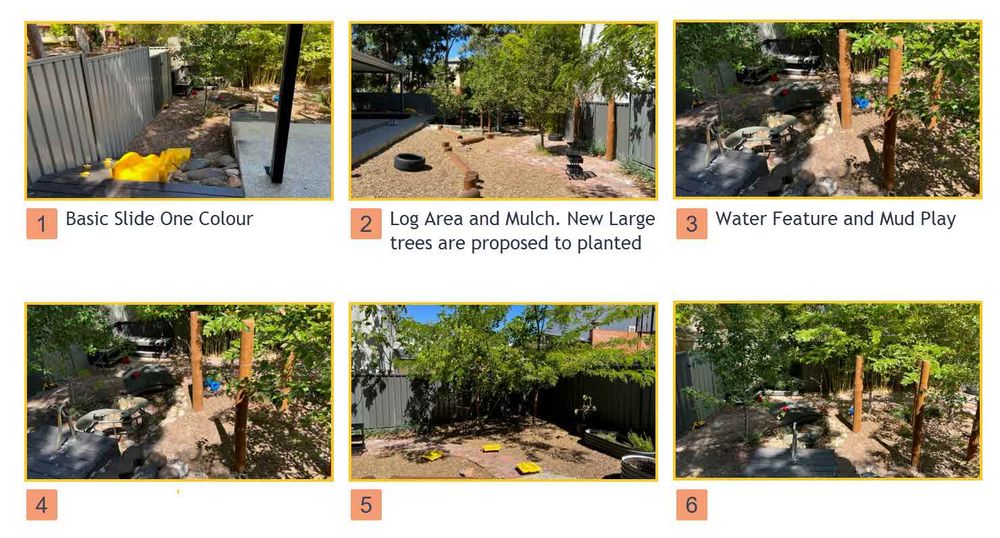
The following example are used as guide for play spaces design:
- Gordon Street Garage Back Yard – Simple and have incorporated Trees and vegies garden as inspiration at Mt Hawthorn
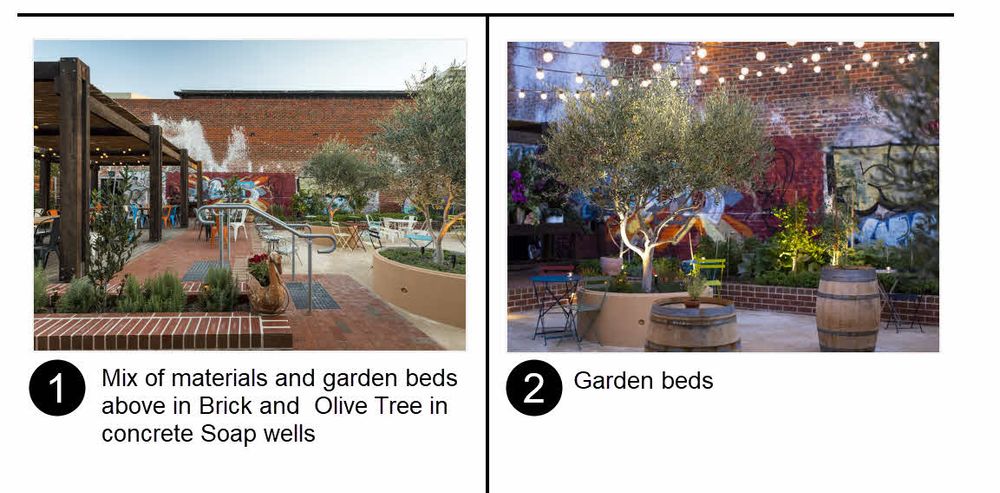
- Shelter Brewing in Busselton
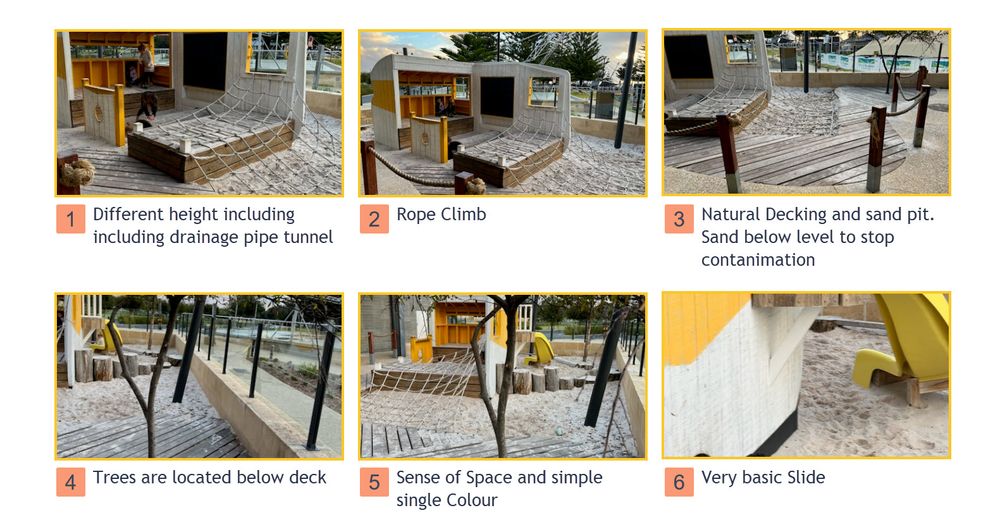
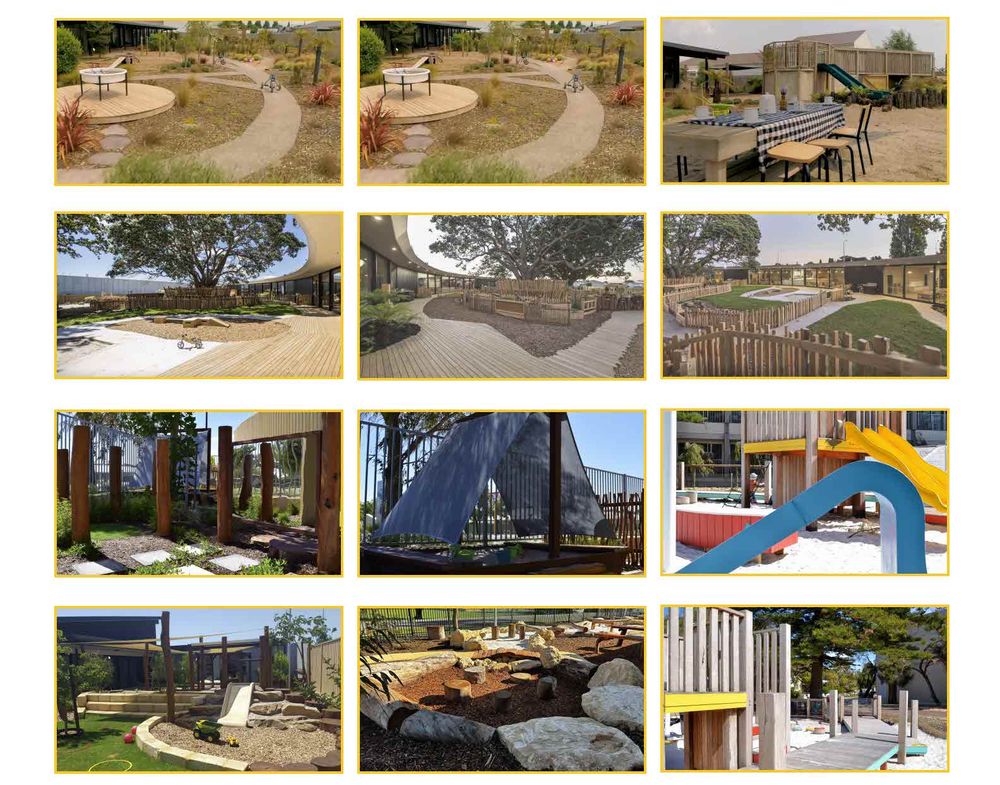
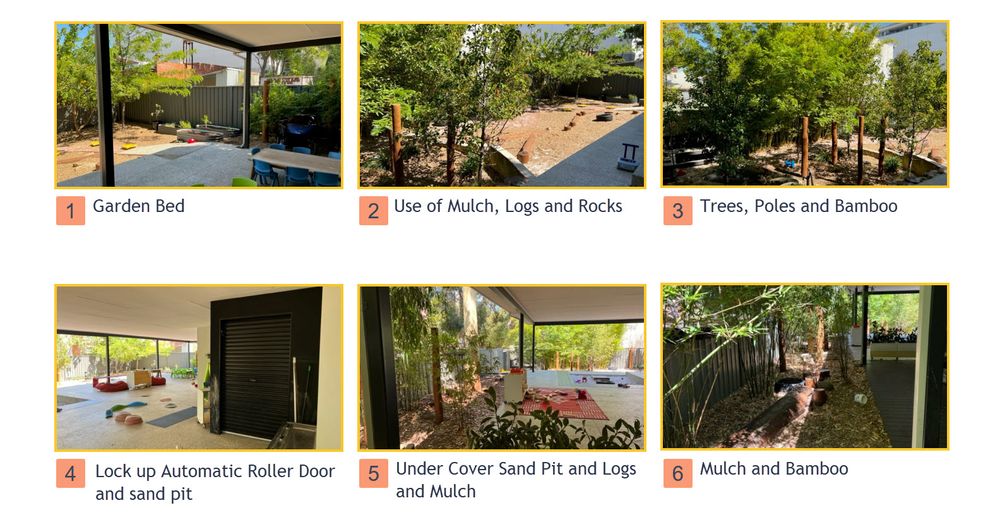
General Outdoor Play Area
The outdoor play area is to be designed by a qualified consultant with an emphasis on creating a natural environment for children's play experience (Refer to Appendix E - for examples of elements to be incorporated into the outdoor play area) and should include the following:
- Hard and Soft Landscaping
- Waterproof verandahs to be provided as undercover outdoor play areas and must be insulated, the Akidamy does not support the use of shade sails as form a shade.
- Drinking fountains - 2 x drinking fountains (Refer to perferred Supplier and Design) to be provides to the external building façade, adjacent to 2- 3 years and 3-4 activity rooms
- Include a water feature which allows children to play and is not unsafe enough to cause drowning
- Play Equipment
- Playscape and Cover lighting.
- The nursery areas Synthetic Grass should be used allseasonssyntheticturf.com.au/products/summer-cool-hd-35mm/ to meet all weather conditons for childcare.
- 3 x water points/hose cocks minimum that can be suitably locked are to be provided at 1500H AFFL along the external building façade
Hard and Soft Landscaping
- Hard:
- Pedestrian footpaths in carpark area to be in-situ concrete
- Verandah should be in-situ concrete or concrete aggregate material
- In-situ concrete to be anti-slip
- Loose gravel or rocks shall not be used as a surface treatment. Any pebbles or stones must be securely fixed.
- Capping blocks on retaining walls should be securely fixed with epoxy adhesive grout.
- Soft:
- Low-maintenance, Australian native and non toxic water wise plants are to be provided to garden beds and adjacent verges to Local Authority requirements.
- Landscaping beds are to have horticultural quality soil and be fully mulched.
- Plant species should not include sharp or ‘spikey’ elements that could present a risk to children.
- Tree species should not be prone to branch or limb drop.
- Planting should not be located under the roof or eave lines.
- To allow for visual termite inspections, planting should not be located against the building perimeter.
- Fruit trees of olive, orange and lemons and bamboo tree can be used.
- Mulch is the preferred material for soft land of slides.
Irrigation
- Water main supplied to the Building should split after main filter with one line supplying the indoor spaces and another line supplying the irrigation system to the school. This allows the water supply to the school is not effected by the use of irrigation in the operating hours. Both water lines should labelled to ensure no confusion.
- If bore water is used for irrigation, the inline pump is to be installed at level in the aquifer that will not cause any iron staining when used or if this cannot be achieved installed with water filter or treatment system to ensure that no water staining can occur when in use. This should not be connected to the school filtered system or used as drink water. Both water lines should labelled to ensure no confusion.
- All landscaped areas are to be reticulated, with enough stations to adequately and effective supply water to all gardan at desired industry rate to ensure plant life growth and development. All irrigation line supplied to all areas (i.e., plays spaces, general landscaping and vergers) with an automatic Wi-Fi controller fitted with a rain sensor to ensure a centralised and remote control of reticulation off site. (i.e. based a Hunter model wifi-based control and associated system). The WIFI system must be able to accessed remotely and programmed to meeting state and local government regulation water levels.
- A plan of all stations and irrigation lines is to be provided by the installer or landscape designer to ensure effective operational management.
- To prevent water being sprayed onto buildings and paved areas, the location, direction, and type of sprinkler heads are to be designed appropriately and to ensure that children cannot pull the line or sprays from the ground in play space areas.
- Garden beds are also to be connected to the automatic irrigation system.
Fencing
- The outdoor play area is to be fully enclosed by secure fencing.
- The minimum overall height of the fence to be 1800mm to the outdoor of the School property.
- The material and construction of the fence should prevent climbing.
- Solid fencing may be required adjacent to residential areas and the design dependent on the Acoustic Engineer’s assessment report.
- Directly under fencing, it must be stabilised and not be able to be dug under by children.
- Any fencing must be able to climbed by children or to provide a foot hold for children to climb over.
- No sharp edge at the top or side of fencing or can provide points to allow children to be hurt.
- Fencing material in areas of the play areas for nursey and toddlers cannot allow to get hot or have planting to prevent children getting burned.
- First or second storey developments with external areas that have ‘any change in level / fall risk’ must have a 1800 mm high wall
with viewing panels in security glass (Standard balustrades are not acceptable). The design solution in such areas is to reviewed, presented and confirmed/agreed with Lessee.
Gates
- All gates should have child-proof latches, with audible and flashing alarms (e.g. pool alarms gates) when not shut (reference product Magnalatch) and with heavy duty hinges. The fence design should prevent children ridding the gate, which will require perspex material open side to placed. Not the perspex material should be design ensure that it does not take away from the design and appearance of the the gate.
- Type of gate likely dependent on Acoustic Engineer’s assessment report.
- Pedestrian gates to be self-closing and fitted with Lockable Magna Latch.
- All gates accessible to External Play Areas to comply with AS1926.1 gates should not be 1500mm.
Storage Areas (Play Equipment Store)
- External stores are to be fitted with a remote operated Colorbond roller door.
- Suitable lighting is to be provided.
- Sealed broom finished concrete floor with durable type skirting.
- Storage shelving should be designed that allow for maximise use of the space and to ensure that all storage fixed to walls to ensure safety.
Retaining
- Retaining of the site may be required to ensure that car parking and outdoor play areas are as flat as possible.
Stormwater grates/drains
The diameter of grate holes of stormwater drainage should not be between 5–25 mm, as they could trap a child’s finger. See
Entrapment information sheet by Kidsafe SA.
10. GENERAL BUILDING DESIGN - INTERNAL SERVICE AND DESIGN
Number of Studios (Licenced Activity Areas)
The number of indoor activity rooms will be dependent on the number of children the School will accommodate. A typical configuration is outlined below for a school of 90 Children:
| Age Group | No. of Studio Rooms | No. of Places Each Room Maximum | No. Educator Ratios | Cots (Floor Mats) | Staff Members |
|---|
| Nursery (N1) 0 to 12mths | 1 | 8 | 1:4 children | 8 x Cots | 2 |
| Nursery (N2) 12 to 18mth | 1 | 12 | 1:4 children | 6 x Cots + (6 Floor Mats) | 3 |
| Toddlers (T1) 18 to 26mths Flexi | 1 | 15 | 1:5 children | (15 Floor Mats) | 3 |
| Toddlers (T2) 18 to 26mths Flexi | 1 | 15 | 1:5 children | (15 Floor Mats) | 3 |
| Kindergarten 3 (K3) 26 to 36mths Flex | 1 | 15 | 1:10 children | (15 Floor Mats) | 1.5 |
| Kindergarten 3 (K3) + 36mths Flex | 1 | 15 | 1:10 children | (15 Floor Mats) | 1.5 |
| Kindergarten 4 (K4) (3+ years) | 1 | 10 | 1:10 children | (10 Floor Mats) | 1 |
| School Director | | | | | 1 |
| Educational Leader | | | | | 1 |
| Chef | | | | | 1 |
| Office & Experience Coordinator | | | | | 1 |
| Total Children | | 90 | Total Staff | | 18 |
The table below outlines the required cot and sleep room size to meet the design capacity of 90 children:
| Description (State Recommendation) | Location | Required Cots** | Staff Space |
|---|
| Nursery Cots in Sleep Room Design (SA) | Adjoining N1 & N2.
Design either Shared 1 or 2 Rooms | 20 x 2/3 = 14 Cots and 6 Floor Mattress (Space to provided must address) | A single staff member to able to Sit and Observe in Room |
| Nursery Cots in Sleep Room Design (TAS) | Adjoining N1 & N2.
Design either Shared 1 or 2 Rooms | (8 Children* 100%+ 12 * 50%) * 2 square metres =
28 square metres therefore minimum 14 Cots 14/20 = 70% Full Size Cots | A single staff member to able to Sit and Observe in Room |
| Nursery Cots in Sleep Room Design (QLD) | Adjoining N1 & N2.
Design either Shared 1 or 2 Rooms | (8 Children* 100%+ 12 * 50%) * 2 square metres =
28 square metres therefore minimum 14 Cots 14/20 = 70% Full Size Cots | A single staff member to able to Sit and Observe in Room |
** Based on April 2023 the Akidamy attendance in the Nursery which had 45% of children 15 years and under attending during the month.
Ancillary Indoor Rooms and Studio
The following ancillary areas are required as part of the school:
- Waiting and Reception Area
- Utility Room
- Meeting Parents Room
- Planning Room
- Nursery Cot or Sleep Room
- Kitchen
- Bottle Preparation Room and Nappy Change Room with Mini Laundry
- Laundry
- Staff Room & Lounge
- Staff Toilet Facilities – UAT, Ambulant WC with Shower
- Sleep Room/s
- Child Toilet and Change Facilities
- Bed storage within each activity room
- Wet prep/store
- Communications cupboard
- Indoor & outdoor store rooms
- Bin Store and Play Stores
General
The design of the building as part of the external design of the building it’s recommended to incorporate the following elements:
- High level skylight windows to provide light into the Activity Rooms. Any skylight windows must have wide eaves or suitable shade devices.
- An entry statement to clearly identify the entry point. The entry should be located immediately adjacent to the carpark and provide adequate weather protection.
- Secure entry fence and gate to be provided and enough covered area to allow for the parking of prams.
- In cases where the layout of an Activity Room (Baby, Toddler) results in an obstruction of direct line of sight to a space, such as Bag Storage Area, a low wall at 1500m high with a Sliding door/s is to be added.
Floor
- The structural floor is to be reinforced concrete slab on ground to Structural Engineer’s specification.
- Prior to any flooring applications being applied, the concrete is to be cured and should receive a water membrane that is suitable and ready to accept any floor covering applications. Any defects on formed surfaces are to be rectified, including unlevel surfaces.
Walls
Internal Walls
- Internal walls are to be either timber or steel stud framed with acoustic insulation. Provide a suitable internal paint finish on all surfaces.
External Walls
- External walls to achieve the required fire and insulation ratings as required under the NCC. Provide a suitable external paint finish for all surfaces.
- All external masonry elements of fencing, retaining walls and the building where accessible to the general public are to be
treated with a suitable anti-graffiti coating.
Ceilings
- The ceiling height shall be a minimum of 2700mm with a desired height of 3200mm to allow for a sense of space and to allow for hanging cable for artwork and feature / track lighting in the school.
- We do not the use of ceiling fans at our school and preferer natural airflow from our outside environments.
Windows
With careful design, windows can make an aesthetic contribution to a room, increase connectedness with neighbouring spaces and aid supervision. In considering the design of windows in children’s services, regard to natural light, ventilation, safety and security is to be made. Regulation 42 as stated below, requires compliance with natural lighting, impacting window size, location and height.
Regulation 42 (4)  Children’s rooms, of the Children’s Services Regulations 1998, provides that:
The licensee must ensure that natural lighting is provided in a children’s room and that —
(a) windows providing natural light have an aggregate light transmitting area, measured excluding frames, glazing bars
or other obstructions, of not less than 10% of the floor area of the room; and
(b) windows providing natural light are open to the sky or face a court or other open space to the sky or an open
verandah, carport or other similar structure; and
(c) The sills of at least 50% of the required windows are located not more than 1000 millimetres above floor level.
The BCA also contains requirements regarding windows. Where this occurs, areas of glass and openable window areas should be measured accurately, exclusive of all framing members. The openable area is the free area available when the window is open. Doors should not be included in the calculation of the openable area. In regard to glazed assemblies in external walls, refer to BCA B1.4(h) which identifies what items will need to comply with AS 2047 — 1999 Window in Buildings. Design should consider the following:
- Powder-coated aluminium frames. All openable windows and sliding doors are to be fitted with stainless mesh security fly screens, if windows are able to be opened.
- Any windows located in an external fire rated wall are to have fire attenuation screens and shall provide a minimum of 40% attenuation when tested to AS1530.4.
- Every room with external windows should not have ideally one openable windows
- Outward opening windows should not be used where it may obstruct circulation space (for example: a corridor, pathway, or verandah).
- Clerestory windows to be fixed. If Clerestory windows are used then remote controlled roller blinds should be installed to allow for darking of the rooms for sleep times.
- The use of clear, not tinted or reflective glass to aid supervision by staff. (Exceptions include spaces such as adult toilets). Rather than using tinted glass as a solution to stop heat gain, consider external awnings or verandas to keep sun off the glass.
- Glass, within 750 mm where less than 1000 mm above the floor surface, must be safety glass to comply with AS 1288 — 1994 Glass in Buildings. Identification of safety glass should be clearly displayed on the panes (or evidenced by a suppliers order form).
- A preferred window sill height of 750mm (noting compliance with the Regulation 42 above) to give children better views.
- The inclusion in children’s rooms of at least one window glazed to floor level, allowing very young children to see out of
the room. - Use of either double-hung or sliding windows, as awning or casement windows opening into outdoor play areas are safety
hazards for children who may be injured by running into the edge of open sashes. - Protecting windows with appropriate sun control from direct summer sunlight. Where the solution includes roof overhangs, it is recommended that they not be so wide as to prevent penetration of winter sun.
- Design that protects windows from drafts.
- Fitting of darkening devices, for example, Holland blinds.
- Supplementing south facing window walls with windows on a side wall (except west walls, unless adequate sun control is
provided) to aid cross ventilation. - Reducing the reliance on artificial light by maximising total window area providing increased natural light.
- Consideration to windows of different height, size and shape
- Consideration of double glazing to reduce sound penetration from noise sources.
Design elements to be avoided include:
- Double hung windows that have an opening sash at floor level
- Use of sashless double-hung windows, unless the edges of the glass are clearly defined for safety
- Roof lights and clerestory windows in children’s room, due to difficulty of installing devices to darken the room.
Glazing
- Glazing to be safety glass in accordance with AS1288.
- Glazing to comply with Energy Efficiency requirements.
- Full height glass to have warning indicator strips applied.
- Glazing used should not be so dark that it dose allow for people for outside to see in during daylight hours as this required to allow for proper supervision.
Doors
- Door location and side clearance shall comply with building legislation for egress and access and with relevant Australian Standards.
- Door widths to achieve a minimum 850mm clear opening width.
- The main external doors to Activity Rooms are to be glazed, sliding doors with a double door opening. All other doors within Activity Rooms shall be 920mm wide, (unless stated otherwise) with ‘finger safe’ hinge door guards.
- Main entry doors shall be ether double swing with a minimum clear opening of 1640mm, or a single slider with a clear opening of 1200mm and commercial quality, fully glazed, aluminium and long hand for easy opening wheelchair-accessible sill or equivalent to AS 1428.1
- Self-closing doors to be used in the following areas:
- All activity rooms
- Meeting Room
- Director Office
- Staff Room
- Planning
- Kitchen
- Security doors from entry lobby to corridor
- All toilets
- Laundry
- All sliding doors are to have a low profile, wheelchair-accessible sill or equivalent to AS 1428.1. The recessed door threshold is to be detailed, showing the sill finishing at the same height as floor finish.
- The Akidamy does not use half height doors.
- See room layouts for door types to each room
- All door hardware to be a lever handle, mounted at 1500mm from finished floor
level. - A 600mm x 200 mm aluminium door vent is to be included in doors to Laundry & Comms Cabinet to ensure appropriate ventilation.
- All external windows and doors are to have stainless steel flywire screens, unless not request by School.
- All sliding doors to have low profile, wheelchair accessible sill or equivalent to AS 1428.1. Recessed door threshold is to be detailed showing the sill finishing at the same height as floor finish.
Acoustics
As noise levels in children’s rooms can be very high, attention to noise transmission between rooms and reverberation inside children’s room is desirable. The attraction of open planning for functional reasons may quickly sour if sound isolation or containment cannot be provided. All spaces shall have acoustic conditions that appropriately support the required teaching and learning activities, that comply with the requirements of Australian Standard AS/NZS 2107:2000 “Acoustics – Recommended design sound levels and reverberation times for building interiors”, and that comply with the requirements of the DECD Acoustic Performance Standards for Learning Areas.
For Early Childhood Facilities (children from birth- age 5) the reverberant acoustic conditions should be optimal, as children are involved in listening and language skill development during this stage of their life and need the best acoustic conditions possible.
It is recommended that floor to ceiling walls and full doors separate children’s rooms from each other. In addition separation from the entrance area, which tends to be noisy and distractive may be practical.If a feeling of openness and connection is desired, double doors which can be hooked back during some parts of the day may be preferable to clear openings. The balance of utilising doors solid enough to stop noise transmission when they are closed, yet light enough for ease of use by children, is to be considered. The use of internal glazing can reduce noise transmission while allowing a feeling of connection, and assist supervision. Noise-absorbing surfaces such as acoustic ceilings, noticeboards and carpet will help reduce sound levels within rooms. Buildings with framed timber floors are particularly noisy, however careful use of soft floor coverings can be effective in reducing noise transmission.
Therefore the following should be considered:
- Provision any bounding walls from the sleep rooms to external or adjacent rooms, except for the Activity Room or any rooms associated with the Activity Room, require an Rw50 rating.
- Ceilings in all occupied areas shall have acoustic properties in accordance with Australian Standards. The ceiling baffles are required to reduce noise transfer and internal reverberation. This can be achieved by: Bulk insulation in the ceiling space of the Cot Rooms and extending it to a minimum of 2m into the ceiling space of adjacent rooms or Roof sheeting.
Window Coverings
Holland blinds of a thick, lightproof quality are excellent for darkening rooms at rest time. If the window receives direct sunlight reflective blinds might be considered, however, this is not a substitute for effective external sunlight shading. Aesthetics and home-like environments are important. Curtains are not required to be treated with fire retardant under the BCA. Pull cords associated with window covered should be considered carefully in regard to safety.
Built-in Joinery
Manufactured and installed to Australian Standards and relevant codes. All drawings to be read in conjunction with the latest schedules & Specifications.
- All vertical dimensions taken from finished floor level (FFFL) and horizontal Dimensions taken from finished walls.
- All veneer and laminate finishes shall have appropriate compensatory Material to the otherside of low formaldehyde particle board or MDF.
- All cupboard doors, drawer fronts and open shelving (except where Indicated otherwise) to be constructed from 18mm MDF, finish as indicated.
- All shelving to be 25mm MDF, finish as indicated.
- Solid timber edge strips to be used in conjunction with veneer. Veneer to Wrap over and conceal sold timber edge strip unless otherwise specified.
- To all above and below bench wet areas for sink, zip and HWS enclosures Use moisture and heat resistant (MHR) low formaldehyde particle board or MDF to thickness and finish indicated on details and as specified.
- Refer to drawings for cupboard door and drawer hardware. Soft close Hinges and runners to all doors and drawers.
- Shelves where adjustable are to be mounted on (5) 6mm exposed stainless Steel supports. Lugs to be at 100mm centers (nom).
- All fixings to be concealed from view in finished work. Plastic caps only Acceptable where located behind cupboard doors.
- Use clear plastic bumpers to all cupboard doors and drawers fixed to Carcass edge.
- Ensure no glue marks are visible through glass where colourback glass is Adhesive fixed to low formaldehyde particle board backing.
- Supply and install all lugs, sleeves, screws, doorstops and other fixings As required to finished works.
- Provide all cutouts for sinks, cabling, GPO's and the like including plumbing Wastes from manufacturers templates.
- All joinery to be finished externally in polyurethane and internally in Melamine, unless otherwise indicated.
- ABS edging throughout for laminate finished items to match laminate. Iron On edges strips will not be accepted.
- All appliances to be checked and install as per manufacturers Specifications. Should any discrepancies occur, contact designer immediately. Joiner to ensure adequate ventilation where required.
- All benchtops, stone and stainless steel, to follow wall angle and to be Sealed adequately.
- All veneered units to have protective covering to be removed post-Handover.
- Standard benchtop shall be 32mm thick, high performance moisture resistant particleboard or MDF with a nominal mm thick high-pressure laminate (HPL) to both faces, with rounded edges.
- If Benchtop is designed to be Acrylic or Stone Benchtops should be 40mm as per joinery specification in the Appendix ?.
- Cable hole access to be indicated and dimensioned.
- A cabinet door, door panels should be designed for finger pull.
- All cupboard doors to have Cabinet Locks Child Safety, Slick Invisible Spring No Drill Baby Proof Safety Latches for Kitchen & Bedroom Cabinets & Cupboards Drawers with & 3M Adhesive.
- Cupboard gables, interiors and doors shall be minimum 16mm thick MDF, low pressure melamine (LPM) finished with 2mm PVC hot resin glue edging.
- Provide a bench with wheelchair access and a child height bench at the reception counter.
Shelves
- All cupboard doors, drawer fronts and open shelving (except where Indicated otherwise) to be constructed from 18mm MDF, finish as indicated. All shelving to be 25mm MDF, finish as indicated.
- Provide a 600mm or 900mm long (preferred) x 300mm wide shelf at 1500 high internally to each activity room adjacent to the main exit sliding door to the External Play Area.
- Each shelf is to have a DGPO with USB outlet.
- Shelves where adjustable are to be mounted on (5) 6mm exposed stainless Steel supports. Lugs to be at 100mm centers (nom).
Appliances
- The number of appliances required is dependent on the number of childcare places. If an appliance is not listed below there are no specific requirements.
- Oven:
- Less than or equal to 86 places requires 1 x600mm wide oven & 1x900mm wide oven.
- More than 86 places require 2x900mm wide oven.
- Microwave in the Kitchen - Where possible, specify the 44L microwave. Ensure appliance clearances are adhered to.
- Fridges and Freezer:
- Staff Fridge
- Baby Prep. Fridge
- Kitchen
- Mailbox:
- Provide a Noosa Parcel and Mail Charcoal Pillar (Large) with stainless stick on numbers, located at not near the entrance, but but near the carpark entrance (see image below:).
- Finish: Charcoal and Bark (milkcan.com.au or alterative Supplier).
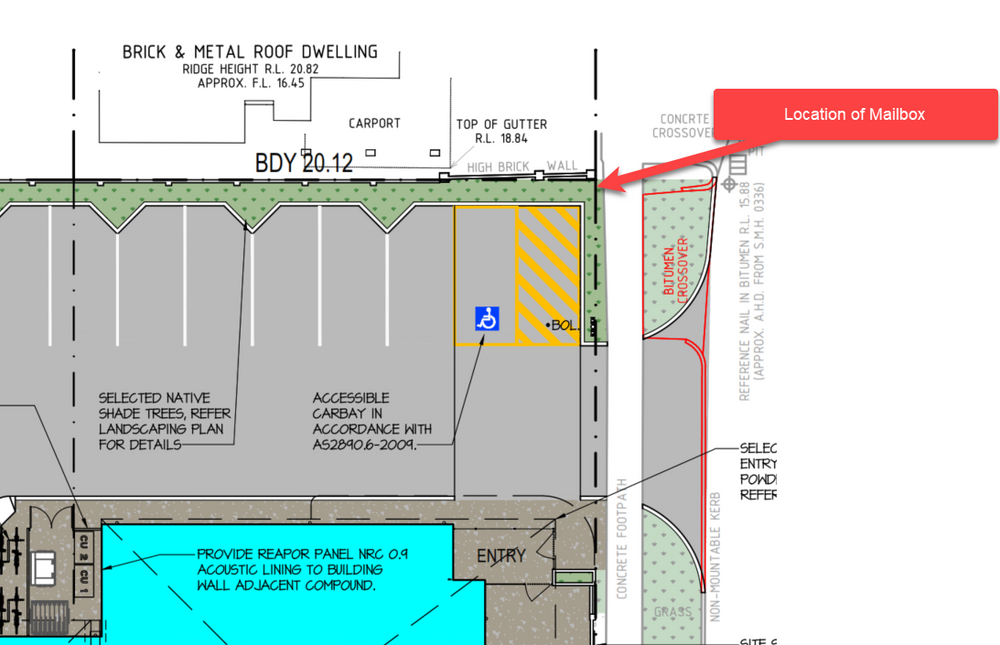
Children’s Lockers
Preferences for the location of storage for children’s personal items differ from centre to centre. Some prefer lockers to be in children’s rooms for supervisory reasons, so that children do not wander out to a corridor or foyer area when accessing items. Others prefer lockers to be in a common area near the entrance so the use of lockers does not distract children, or inhibit other uses for the space within the children’s room. While both locations are acceptable, consideration to wall space for either option should be made. Consideration should also be given to the use of moveable / mobile lockers.
If a location outside the children’s room is preferred, a room entry alcove - after entering the children’s room may be an option. Such an alcove could provide for lockers together with perhaps the attendance book recording the arrival and departure of children and pigeon holes and notice display boards for notices to parents.
If lockers are to be placed in children’s rooms, extra floor area may be required in these rooms to ensure that clear floor space of 3.25 sqm per child area is available exclusive of the lockers.
It is recommended that locker space be provided for each child, with spares available to cater for children attending on different days and sessions.
Lockers that provide sufficient space for hooks for hanging clothes and bags, space for shoes, room for personal items and toys, as well as a spot for notices work well. Locker doors are entirely optional. Lockers can be built-in or modular.
However lockers should be installed in a manner which will not allow them to tip over if climbed on by children. Where programs for school-age children are provided, it is recommended that suitable storage relevant to their needs be accommodated. Lockers for babies, for spare clothes, toilet articles, medications for individual babies are often located in the nappy change area.
Foyer / Entry / Reception
To provide a point of entry for parents and visitors including a reception counter and work station. A safe place where parents can collect notices, pay fees and where visitors can wait and be seen. It is required that visitors to the School have restricted access to children in the Activity Areas and no direct vision of children. Conversely children are not to have unsupervised access directly to outside of the building. Provide a display board for parent notices. This area is also should be multi-function to allow staff to undertake education programming and discussion on projects. As this areas can be used outside of dropoff and pickup hours. The areas is also used as place to show case the school projects and initiatives and communicate this to visitors and parents. The area should have space to fit three desktop PC with 32 inch computer screens, phone system and commercial size copier and printer. Allow for two Ipad to mounted in allow for parents, visitors and staff login.
11. KEY BUILDING SERVICES ENGINEERING (BSE)
11. 1 MECHANICAL SERVICES
When referring to mechanical services within a building, this commonly includes plumbing, electrical systems, HVAC, ventilation, elevators, and possibly even escalators. If moving components are involved, such as water, electricity, or gas, it is most likely a mechanical system.
- Firefighting Systems
- Elevators & Escalators
- HVAC Systems (heating, ventilation, and air-conditioning systems)
- Gas Supply Systems (such as for heating and cooking in residential buildings, or oxygen and nitrogen in hospitals)
- Compressed Air Systems used in industries (not required in Childcare)
Firefighting Systems
It is the responsibility of the Lessor to conform to the Local Authority, Department of Fire & Emergency Services (DFES) and applicable standards including the provision of fire extinguishers and other fire safety items. The Lessor shall provide the Lessee with a complete essential services certificate for all such installations prior to handover.
The size and configuration of a building will determine the requirement to comply with specific clauses of the Building Code of Australia in respect of fire services including fire hydrants, hose reels, extinguishers, smoke detectors, emergency lighting and exist signs.
Fire hydrants are not required for buildings under 500 sqm (refer BCA E1.3). If the building is a standalone facility greater than 500sqm then fire hydrants in the adjacent street may be utilised provided that the consent of the Fire Brigade is obtained before work commences on site.
Hose reels are not required for buildings under 500 sqm (refer BCA E1.4). However, if the building is situated where internal hydrants are installed or required, then a hose reel must be included (refer BCA E1.4). If a hose reel is not required, watercharged extinguishers must be provided in the ratio of at least 1 per 500 sqm or part thereof. Specialised extinguishers to cover switchboards, cooking oils & fats in kitchens as well as flammable liquids, in excess of 50 litres are also required (refer BCA Table E1.6).
Where the BCA requires fire extinguishers, they need to be located, signed and mounted in accordance with AS 2444.
Generally, smoke detectors are not required in a children’s service unless it is located in a building having a rise of more than 2 storeys (refer BCA Table E2.2a General Provisions).
Refer BCA E4 for any required compliance with emergency lighting and exit signs.
Fire Extinguishers:
- Portable fire extinguishers must be provided and must be selected, located, and distributed in accordance with AS2444.
- In areas accessible to children must be recessed into walls with appropriate signage: extinguishes should be mounted. When not recessed into walls eg in kitchen within a proprietary break-glass cabinet and associated signage.
- Each Activity Room should have access to an extinguisher from a Service Core or Corridor.
Fire Blanket:
- Dimensions of blanket: TBA.
- Keep blanket in a quick release red container.
- A fire blanket is to be provide in the kitchen with signage.
Fire Hose Reel:
- Provided as per Building Fire Safety Regulation 2008, relevant AS and NCC.
- Not to be located in an Activity Room
- Recessed into walls and in a cabinet where possible.
Fire Control System if required to be located near the Reception Area or Ground Level as per Australian Standards
Wayfinding & Signage:
- Ensure adequate areas for signage is available on the façade of the building. Wherever applicable wayfinding and signage should be vandal proof whilst maintaining readability.
Elevators & Escalators
If the design of the building is of single store there is no requirement for compliance.
If the School design is mutli-story the following key (TBA)
HVAC Systems (heating, ventilation, and air-conditioning systems)
Any appliance which has exposed surfaces that exceed 45°C must be guarded/ encased / enclosed so as to prevent access by children.
- A commercial grade Air−conditioning/heating system is to be provided throughout the School including kitchen. The air−conditioning is to comply with the NCC and all relevant Australian Standards.
- The Akidamy doesn't allow the use of split system air-condition, floor/ceiling units, wall mounted units or cassette units are to be used. Only ducted air-condition reserve cycle systems can be used. These system are powerful and adaptable, ducted AC systems are made to deliver optimum performance while being unobtrusive. Typically, they are concealed above a suspended ceiling or roof area. But given that the internal unit is positioned in the building’s roof and those duct grilles are needed to direct air into various parts of the structure, they do take a lot of skill and work to install. As a result, you can adjust the temperature more effectively. Due to their energy efficiency, modern ducted air conditioning units enable you to get the most benefit for the least amount of money. A copy of the air-condition ducting, flitter units and outlet plan is to be provided to the Akidamy and the location of control systems. Its important to note that different air temperatures are need to be monitored across the school especially in the nursery activity area, sleep room, reception and kitchen. A centralised controller needs to be located near the reception and main passage. The Controller needs to be WIFI enable to allow for remote access.
- Location of air-condition compressor are to be located in areas which reduce noise and impact to the operational of the school, especially nursery sleep and staff room areas. If this cannot be done then appropriate sound proofing and abatement is required.
- Ceiling fans are not recommended.
- Air Con Equipment controls must be inaccessible to children. Particular care needs to be taken to position any equipment controls in a sleep room so that the controls are not accessible to children in a cot.
- Non-habitable rooms: fixed grilled vents.
- Provide all air transfer grilles to Ambulant WC and Shower, UAT and staff WC.
- Extraction Ceiling Fans are to be installed in all toliet, bathroom and change tables rooms, kitchen and laudry areas. Areas to have mechanical exhausts flumed to atmosphere. All of the fans within this guide comply with Australian Standard AS 1668.2 – 2012 for ventilation rates when utilised correctly. The standard requires the minimum flow rate to be no less than 90m^3 /hr (25L/s) for a toilet, shower or bathroom area with a single fixture. To effectively exhaust water vapour (steam) from a shower, air flows of 270 - 360m3 /hr (75 - 100L/s) are required, depending on the climatic conditions and room size. Due to regular use these need to be silent and be to used continuously. (Suggested Supplier for reference)
- REGULATIONS FOR VENTILATING DIRECTLY INTO THE ROOF SPACE
As detailed below, in dwellings with a metal roof, or where the roof is lined with sarking, ventilating directly into the roof space is not permitted by building codes unless the roof space is adequately ventilated by open eaves or roof vents. The Fantech Trade range offers many ducted solutions to exhaust to atmosphere through the wall, roof or eaves to comply with the latest building codes. - PARAGRAPH 3.8.5.0 OF THE BUILDING CODE OF AUSTRALIA STATES:
Performance requirement P2.4.5 is satisfied for a mechanical ventilation system if it is installed in accordance with AS 1668.2 “Mechanical ventilation for acceptable indoor air quality”, except that any contaminated air from a sanitary compartment
or bathroom must: - - Exhaust directly to outside the building by way of ducts; or
- Exhaust into the roof space provided:
(i) It is adequately ventilated by open eaves, and /or roof vents; or
(ii) The roof is clad in roofing tiles without sarking or similar materials, which would prevent venting through gaps between tiles.
- BCA States Paragraph 3.12.3.4 states:
- An exhaust fan must be fitted with a sealing device such as a self closing damper, filter** or the like when serving -
- a conditioned space; or
- a habitable room in climate zones 4, 6, 7 & 8
** An exhaust fan is considered to be adequately sealed if it is fitted with a filter such as the type commonly used in kitchen range hoods.
Natural- promote cross ventilation:
- Habitable rooms of 15 occupants or more: Minimum open-able area as 10% of total floor area (mechanical ventilation required if minimum not reached).
- Habitable rooms of less than 15 occupants: Minimum open-able area as 5% of total floor area (mechanical ventilation required if minimum not reached).
- Natural ventilation shall be provided through permanent openings, windows, doors or other devices, including opening sashes in the windows.
Gas Supply System
On a single store building no gas supply is required. In multi-store gas supply is required unless directed otherwise by The Akidamy. Not having gas onsite reduce our the School Carbon emissions and maximise our use of solar power provided to the School.
11.2 ELECTRICAL SERVICE
Installation of all electrical fittings and wiring is to be performed by a qualified electrical contractor. In a Lessee/Lessor situation it becomes necessary to increase the supply capacity to the Lessee's requirements, this work will be carried out by the Lessor's contractor. Work shall be carried out in accordance with the standards and local supply authority requirements. Wiring shall not be installed directly onto ceiling tiles or grids. Any overhead cables (in particular mains) must be laid on cable trays.
Electrical Services:
- Power Supply
- Backup Power (such as diesel generators NA)
- Emergency Power (such as battery-based uninterrupted power supply if no main power supply is available)
Power Supply
Power will be supplied by both mains distributed power and solar panels generate at site. With mains distributed power as backup supply and source.
Solar Panels:
- Selection - Provider as recommended and supplier by the Akidamy to ensure consistency across the organisation and to allow for remote data gathering. The proposed system should have the following panels design for specific Commercial application:
- Q Cells Brand - Q.Boost ML-G2 415, 415 Watt Panels (Q Cells) (located on the building roof)
- Fronius Symo - 15.0-3-M Invertor (located internal or in the bin store area)
- For 90 Children probable around approximately 30 KW System Size and no less than 25KW but this must be based site inspection and required energy usage at the school with the ability to also provide capacity for 2 car charging stations (Charging Stations to be supplied and paid by the Akidamy - Perth PSW Energy).
- Installation of Inverter in ventilated area.
A Distribution Board to be supplied and fitted, wall mounted, and enclosed in lockable doors.
- Power and Data:
- The electrical distribution board where possible is to be located in the Utility Room within a secure electrical cupboard. Power and data points are to be installed as per TBA. The electrical distribution board is to be located in a secure cupboard and preferably ‘back of house’. This is to be used as a guide only. The number of outlets will be dependent on the size of the School. Power will also be required to supply air-conditioning units, hot water unit, hard wired appliances, Light, Kitchen Equipment, Commercial Laundry Equipment, Audio & Visual Equipment, Carchargers, and any illuminated signage.
- As power boards are a potential hazard, sufficient power outlets should be provided to cater for demand and be located
to suit the required tasks.
- Power Outlets
- The Australian Standard AS/NZS 3000:2000 Electrical Installations, requires residual current devices, commonly known as safety switches, to be installed to all electrical installation, alteration, and maintenance and repair work carried out.
- Power outlets should be located at a minimum height above the floor of 1500mm.
- As power boards are a potential hazard, sufficient power outlets should be provided to cater for demand and be located to suit the required tasks.
- Provide double power outlets at a number of locations throughout the areas. All power outlets shall be safety shuttered and RCD protected.
- Surge protection shall be provided on blue outlets for computer throughout the building.
- Lighting:
- All lighting is to be connected back to the switchboard through the safety switches. All light switches are to be located at 1500 mm AFFL.
- A ‘master light switch’ is to be provided typically adjacent the reception area in coordination with mechanical system control
panel of which enables all areas to be switched on/off upon entry/exit. - To avoid unnecessary use of electric lighting and promote natural daylight, it is recommended that lighting in children’s rooms be connected in two circuits (zones) so that lights near windows can be switched off when not needed. Such lighting can then be utilised to suit particular activities.
- A good quality, glare-free light is appropriate for working surfaces in children’s rooms. A general light intensity of 400 lux on the working surfaces is recommended, however, a lower level of 300 lux is sufficient for general illumination.
- Light fittings can include a mixture of low energy luminaries for general lighting, task lighting and some warmer lights for accent and atmosphere.
- Where flexible track systems for spotlights or other lighting is preferred.
- The installation of dimmers can assist to reduce lighting at sleep times, yet enable adequate supervision (Sleep, Nursery Studio, Meeting and Music Room, Reception, Staff Room and Kindergarten - K4 shared art space) .
- External Lighting:
- Adequate external lighting is to be installed to maintain satisfactory security, safety standards as events and training are general held at night, staff member have early commencement and later finish of shifts during winter months this generally occurs in darkness.
- Emergency and Exit Lighting:
- Emergency and exit lighting are to be installed where necessary. Emergency lighting and exit signage is to be in accordance with the NCC Regulations.
- Smoke Detection:
- Allow for a minimum of two (2) hardwired smoke detectors, plus a further set of units in each of the Nursery sleep rooms, nursery activity rooms (children below age of 2 years), reception area, staff room, and laundry space.
- Exhaust Fans
- Silent exhaust fans (or one commercial unit) in ceiling are to be installed in each nappy change rooms and children bathroom
- One each of the Landry area, staff bathroom, and UAT.
- Hot Water
- The thermostats of storage hot water systems shall be set at a minimum of 60 deg C to inhibit the growth of Legionella bacteria.
- Hot water set at 45 deg C (maximum) by a thermostatic mixing valve shall be provided to the kitchen sink, kitchen hand basin, staff and access toilet hand basin, nappy change hand basin, bath taps, shower rose, staff materials clean-up trough, and bottle preparation sink (if provided).
- A benchtop boiling water unit (ZIP HYDROTAP G5 B60 - Commercial) for tea/coffee shall be provided in the Staff Room.
- Consideration should be given to the use of instantaneous gas hot water heating for nappy change facilities, given their infrequent use in most preschool centres.
- Comms Rack
- Box to be sized to ensure Comms can fit the required use:
- Electrician to supply 16awg speaker cable from speaker location to comms rack for amp termination. Rack shelf and power for amp to be supplied by electrician. 3 rack shelves data required for termination (TBA)
- Data and Internet will require 4 rack shelves.(TBA)
- Security Cameras est. needs 1 or 2 racks (TBA)
- Room for UPS System installation
- All Service Metres
- To be located near the bin store with other service metres nearby.
11.4 DATA BASED SYSTEMS OR LOW-VOLTAGE SYSTEMS
These include the following items:
- Security Systems
- Fire Alarm Systems (TBA)
- Building Management Systems (TBA)
- Public Address Systems (TBA)
- Cable TV Antenna Systems - (NA)
- Data Networks
- Voice Networks
Security Systems
The commercial security system should have the following key features:
- Motion Sensors Smoke Detector and Siren Security Alarm Systems
- Perimeter Alam System, Smoke Alarms
- Video IP Camera (CCTV) Surveillance Systems
- IP Cameras, Infra Red (IR) and Pan Tilt Zoom Cameras (PTZ)
- Access Control (Door) and Partitioning System for staff and families entering the school
- Secure Door and windows design shall consider the need for adequate security against unlawful entry.
A monitored security alarm system combining smoke and movement detectors. Security system shall be zoned to enable separate functional areas to be alarmed as necessary. Secure storage is required for movable electrical equipment (Computers and IPADS). The security system should not be access via wireless network and should have its own backup power supply and communication system for remote monitoring. A monitoring of Camera should be able to be done on site and off site computers via web portal. The camera quality should be current to the industry standard at the time of installation Cameras should be atleast 4K Ultra high Definition + 8 Megapixel).
Door Locking and Hardware for all internal and external door hardware, locks and gates are to meet the compliance requirements for a childcare centre & compliant with fire standards and regulations. Entry door to be fitted with an electric strike and digital keypad, capable of storing numerous pin codes. All entry locks to comply with Australian fire standards.
Provide electronic site security (including digital access with manual option in the event of an extended loss of power)| Items | Description and Comments |
|---|
| Security Keypad at Entry | Weatherproof; Wiring to reception for door Release Button; Buzzer indicate door release; Timed Access Control System (during opening hours for parents; all hours for staff). |
| Intercoms | Use intercoms between front entry and display panels |
| Front door | Top rail of door leaf fully enclosed to conceal red switches, Manual opening option in case of a system failure. |
| Alarm System | Wireless Alarm Panel; Siren/Strobe; Internal Piezo Sounder; Backup Battery; Door Reed Switch; Wireless PIR Detectors as required to cover entry/exit points; Magnetic Single Door Lock, motion detection. Remote monitoring off site. |
| Door chime button | Mounted adjacent to ‘Security Keypad at Entry’; Alerts staff of visitors without security access |
| Lighting | Installed at intervals and locations to satisfy requirements at street pedestrian entry, internal roads, carparks, steps, ramps, gathering places; Time switch with manual override switch. |
| Security Screens | On double-hung windows |
| Reception Desk | Under desk button control |
| Display Screen | In reception, in hallway and passage near in logical location and outside of nursery |
| Security Camera | In all areas, excluding the bathrooms, baby change area, UAT and Staff Room. Otherwise camera will need to be installed with day and night vision, motion detection. Camera footage backup storage for up to 6 weeks onsite and in the cloud backup. The system needs to have remote access off site to allow for remote monitoring. |
| Lock Down | Bot's in all studio's |
Data Networks and Communication
Provision of 1 fibre connection for NBN site fibre to the node. Conduit must be in place for Tel−Co to be able to pull the lead−in cable into the building at Practical Completion or in a Lessee/Lessor situation before tenancy handover. Equipment to be located within a cupboard, (minimum dimensions 1.7m(w)x1.0m(d) x2.7m(h). Double doors to have smoke seals. Comms cupboards to be located along corridors and not in entry foyers.
Computer data points shall be provided in reception, meeting room and offices office areas in locations and WIFI wireless network should cover the entire school including outdoor and internal spaces. WiFi network should be able to provide two bands, 2.4GHz and 5GHz or 6GHz.
Voice & Phone Networks
Phone Network
Phone VOIP system connected to the with phone located in each activity room, staff room, meeting room, reception and kitchen areas. Three Cordless phones as Cordless phones allow for greater flexibility, and should be considered. If the phones are some distance from the outdoor play space, an extension bell may be desired — however removing of staff to attend to phone calls must not impact on the required staff/child ratios. Appropriate phone placement should therefore be considered.
Music/Speakers System (Voice System)
In Ceiling speakers to be installed in the following areas which include the outdoor plays space, all Activity Rooms, Music Room, Reception and UAT. Recommended Brand Sonos, with In Ceiling Speakers + Amplifier + Install + Setup. Outside speakers to have Marine Grade 6” In Ceiling Speakers, install speakers and configure the system. The system is to be design, supplied and installed by Audio System Contractor (Sound Lab Osborne Park).
- Pro Speaker Cable terminal ends - Black for Best performance. The installation of speaker pair & cutting out holes neatly and no marks or scratches to ceiling or timber paneling. Speaker wire crimping & Cable termination to speaker, should have 5 Year Warranty on all install work carried out.
- Soundlab professional final wire crimping & Cable termination to Sonos Amp & setup Sonos network connection and room sound optimization calibration for room, Installing Brush plate at wall penetration 5 Year Warranty on all install work carried out.
Notes: Electrician to supply 16awg speaker cable from speaker location to comms rack for amp termination. Rack shelf and power for amp to be supplied by electrician. 3 rack shelves data required for termination.
11.5 HYDRAULICS SERVICES
These include the following items:
- Water Supply
- Drainage of Wastes
- Storm Water Drainage
Water Supply
- All plumbing must be concealed so as not to be visible.
- Provide potable water service and meter to achieve required flow and pressure. Hot water system is to be electric system.
- Provide hot and cold water to all fixtures except for child hand basins which are to have cold water only. Tempering valves required for baby bath tapware only.
- Dishwasher requires access to hot water tap only. Dishwasher requires access to hot water tap only and ventilation suitable for a ‘steam operation’.
- All water points/taps must be connected to a suitable ‘water filter’. The preferred option for the ‘water filter’ is: Puretec Hybrid R11 Triple Stage Whole House UV Water Treatment System (120 LPM) 20" 1" Connection 120Lpm with Cartridges (refer to following item source)
- The bin store area is to have an external hose cock.
- The following fixtures to be provided to outdoor play area:
- 1 x hose cock on each wall in outdoor play area for each age group.
- 2 x Drinking Fountain
- 1x manual stainless steel water pump as a ‘play item’. Location to be determined on site in coordination with the
final landscape/playground design.
Drainage of Wastes
- Kitchen and other waste services need to be compliance with local and government regulations and codes.
Sewer & Storm Water Drainage:
- To be connected to the Minister Sewer system.
- Carpark and playscape areas should have enough sinkwell capacity to handle Storm Water from pooling on the surface.
- Waste drainage a “Trade Waste Arrester” is required where food is prepared. It is required where art sinks are provided.
12. OTHER ITEMS
General Signage
- Entry Signage
- Entry structure shall be of appropriate proportion and prominent location to promote the School.
- The main building sign should be incorporated into the façade design.
- Traffic directional signage plus identification of Entry and Exits points of the Carpark (Parents, Disable, Bike Storage and Staff Bays) should be communicated using propriety post-and-sign in addition to line-marking.
- Carpark should have the following signage:
- Signage for Bin Storage and General Metres Area
- "Emergency Assembly Point" Signage (300 by 450mm) (reference supplier Seton) mounted at height of 1200mm from above ground level in location as agreed by the School and Fire Management Consultant (refer below)
 Figure: Example of Evacuation Diagram
- Bin Store Area Signage
- Inside the Bin Store Area "Emergency Info Signs - Main Power Cut Off" 250mm by 180mm (reference supplier Seton). mounted at height of 1200mm from ground level location.
- Inclusive Signage
- Braille and Raised Tactile Signage.
- Comply with section D3.6 and specification D3.6 of the Building Code of Australia (NCC) with respect to design, manufacturing and installation.
- Locate at a height between 1200-1600mm above the ground or floor level.
- Sign Placement:
- Signage should be visible to both ambulant and non-ambulant people.
- Ideally placed at a height no lower than 1200mm and no higher than 1700mm above the finished ground or floor level.
- Fire Evacuation Plans & Signage
- Comply with Building Fire Safety Regulations 2008, NCC and all relevant Australian Standards.
- All Evacuation Signage should be in A3 Size with portrait black colour frame and placed no lower than 1200mm from Ground level
- Under ACECQA requirement A3 Fire Evacuation Signage should be in portrait black colour frame should placed near a each above emergency.
- Information Signage
- Reception to have nearby on wall 12 number of A4 frames in portrait black colour frame.
- Each Toilet Staff and UAT to have on the back door A4 frame in portrait black colour.
- Kitchen to have X number of A3 frames to be Advised.
- Each Activity/Studio should have it own set of standard signage TBA.
- Display Boards
- Generous provisions to display children’s artwork and posters are recommended.
- If there is insufficient display board space the temptation for displays to be fixed to windows and doors, decreasing natural light and vision may occur.
- A range of different finishes are available, for example, plastic laminated wainscotting whereby art work can be taped to the surface, easily removed without otherwise damaging the paintwork to the walls. Methods for securing art work should avoid pins or other hazards to children. Other materials such as Velcro, pegboards and magnetised boards should be investigated.
- Display board in the same colour as surrounding walls works effectively.
- Display boards or whiteboards may also be useful in other areas including the foyer, administration room office, staff room and kitchen. While messages, notices and children’s art may be on show in these locations, it is essential that the service displays such items as the weekly menu and that the licensee displays the license in a conspicuous place at the main entrance.
APPENDIX A - ROOM DATA SCHEDULE
Laundry
APPENDIX B - THE AKIDAMY EXAMPLES
APPENDIX C - DESIGN INSPIRATION EXAMPLES
APPENDIX D - SCHEDULE OF FINSHES, FITTING & FIXTURES
APPENDIX E - TECHNICAL AND SERVICES REQUIREMENTS
POWER & DATA SCHEDULE
The schedule below is to be used as a guide only as minimum requirements. The number of outlets will be dependent on the size of the centre. Power will also need to be supplied to air-conditioning units, hot water units and illuminated signage.
NOTE THE BELOW TABLE IS A MINIMUM REQUIREMENT. Refer to Electrical Layout for Details. | LOCATION | POWER | DATA | LOCATION |
|---|
| Reception / Waiting Room | - Under Reception desk 4x Double GPO with double USB charger (DXGPO2USB2)
- Behind the Reception Desk 2 x double GPO – to Suit
- Power to suit doorbell & speakers
- General Waiting area - 4x Double GPO with double USB charger (DXGPO2USB2)
| | |
| | | |
| | | |
| | | |
| | | |
| | | |
| | | |
| | | |
| | | |
APPENDIX f - LANDSCAPE DESIGN
