Scope
This policy delineates the obligations and requirements of Company, correlating strictly with the Australian Children’s Education and Care Quality Authority (ACECQA) and Western Australia's Education and Care Regulatory Unit (ECRU), with respect to the development and construction of childcare facilities in Australia.
Audience
This policy is applicable to all employees, key stakeholders, contractors, representatives, project managers, designers, and architects of Company involved in the construction and renovation of early childhood education centres.
Construction Requirements
Buildings should comply with ACECQA and ECRU guidelines, particularly in relation to building sizes, efficient usage of space, safety standards, adequate lighting, ventilation, clean and hygienic maintenance, suitable outdoor spaces, easy evacuation routes, availability of age-appropriate furnishings and proper cooking and toilet facilities.
All sites chosen for child care service projects by Company are required to conform with Australian Building Codes, state, and local council requirements.
Furnishing and Equipment
All furnishings and equipment utilised within the care facility should meet the guidelines stipulated by ACECQA and ECRU for safety standards and age-appropriate designs. They should also comply with Australian Standards where applicable.
Compliance
The design of the School is to be in accordance with the following:
- National Construction Code (NCC)
- With either option, the building must meet certain requirements of the National Construction Code, including the Building Code of Australia (BCA) for a class 9b building.
- All relevant Australian Standards
- Education and Care Services National Regulations
- ACECQA National Quality Standards, National Regulations and Laws
- WAPC Planning Bulletin 72, 2009: Child Care Schools
- Local Authority Planning Schemes and Policies.
Facilities and Physical Environment
Information required with an application for service approval includes:
- site and floor plans prepared by a building practitioner showing the location of all buildings (including entries and exits), structures, outdoor play areas, shaded areas and boundary fencing, gates and elevation plans of the premises
- detailed floor plan indicating all encumbrances and facilities provided, such as toilet and handwashing facilities, nappy-changing bench and bath, food-preparation areas, including details of how the rooms will be used
- calculations carried out by a building practitioner of the unencumbered indoor and outdoor space
- plans of the outdoor learning environment specifying the landscaping and natural environments that will be provided.
In addition, a Certificate of Occupancy must be submitted to us. In this, the building certifier needs to sign off that the premises complies with 9b of the Building Code. In particular, it must meet the requirements for:
- toilets,
- handwashing,
- Bottle Preparation
- nappy-change and bath facilities
- natural light and window requirements.
The relationship of rooms and the interaction between the indoor and outdoor environments is an important factor in the design. The design of the building should:
- facilitate effective supervision
- allow children to easily move between spaces
- provide convenient access to toilet and handwashing facilities.
Before The Akidamy can get it service approval is granted, we will conduct a departmental pre-approval visit to the service premises to assess whether it is suitable and safe for the education and care of children. This visit is to confirm that the approved provider has taken every reasonable precaution to protect children being educated and cared for by the service from any harm and hazard likely to cause injury.
At this stage of the approval process, the education and care service should be ready to commence operation. All building works, fit-out and development of outdoor play spaces should be finalised before the pre-approval visit.
Note: The above listed standards are regularly updated and amended from time to time. The current version of each is to be verified and employed accordingly. The Landlord is fully responsible for ensuring absolute compliance with all required standards associated with the building works of which are necessary for the Akidamy to obtain the licence to operate the childcare centre.
The definition of indoor and outdoor Space is well defined by the following reference document outlined in Queensland and reference document South Australia contain a good list of information that apply also to Western Australia.
Applying the National Regulations and Other Considerations
Regulations Indoor Activity Space (Licenced Space)
The Education and Care Services National Regulations stipulates that the school must provide at least 3.25 square metres of unencumbered indoor space for each child. In calculating the area of ‘unencumbered space’ the areas outlined under section 107(3) of the regulations are to be excluded.(2) The approved provider of an education and care service must ensure that, for each child being educated and cared for by the service, the education and care service premises has at least 3.25 square metres of unencumbered indoor space.
(3) In calculating the area of unencumbered indoor space--
(a) the following areas are to be excluded--
(i) any passageway or thoroughfare (including door swings);
(ii) any toilet and hygiene facilities;
(iii) any nappy changing area or area for preparing bottles;
(iv) any area permanently set aside for the use or storage of cots;
(v) any area permanently set aside for storage;
(vi) any area or room for staff or administration;
(vii) any other space that is not suitable for children;
(b) the area of a kitchen is to be excluded, unless the kitchen is primarily to be used by children as part of an educational program provided by the service.
Regulations Outdoor Activity Space (Licenced Space)
The Education and Care Services National Regulations stipulates that the School must provide at least 7square metres of unencumbered outdoor space for each child. In calculating the area of ‘unencumbered space’ the areas outlined under section 108(3) of the regulations are to be excluded.Space requirements—outdoor space
(1) This regulation does not apply in respect of a family day care residence.
(2) The approved provider of an education and care service must ensure that, for each child being educated and cared for by the service, the education and care service premises has at least 7 square metres of unencumbered outdoor space.
Penalty: $2000.
(3) In calculating the area of unencumbered outdoor space required, the following areas are to be excluded—
(a) any pathway or thoroughfare, except where used by children as part of the education and care program;
(b) any car parking area;
(c) any storage shed or other storage area;
(d) any other space that is not suitable for children.
(4) A verandah that is included in calculating the area of indoor space cannot be included in calculating the area of outdoor space.
(5) An area of unencumbered indoor space may be included in calculating the outdoor space of a service that provides education and care to children over preschool age if—
(a) the Regulatory Authority has given written approval; and
(b) that indoor space has not been included in calculating the indoor space under regulation 107.
(6) In this regulation a reference to a child does not include—
(a) a child being educated or cared for in an emergency in the circumstances set out in regulation 123(5); or
(b) an additional child being educated or cared for in exceptional circumstances as set out in regulation 124(5) and (6).
Regulation's Interpretation of Spaces
General
When interpreting a provision of the National Law relating to indoor and outdoor space, the interpretation that will best achieve the purpose orobjectives of the National Law will be preferred to any other interpretation (schedule 1, clause 7). Where the total amount of unencumbered indoor and outdoor space per child allow for different numbers of children, the lower number is the maximum number that a service may educate and care for.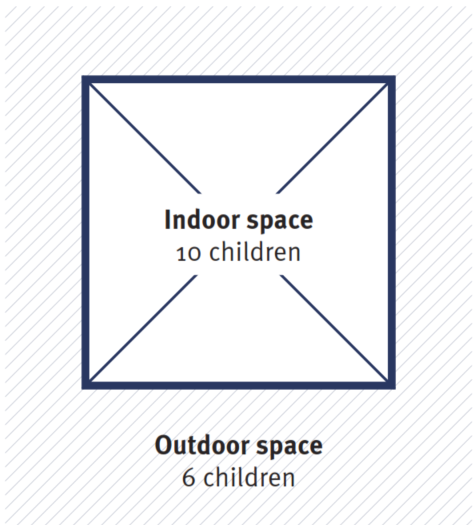 When applying for service approval for a centre-based service, you will need to provide a number of documents, including:
 - a floor plan prepared by a building practitioner showing the unencumbered indoor and outdoor spaces to be used at the service; and
- unencumbered square metre calculations carried out by a building practitioner of these spaces (regulation 25(1)(b)).
These can be separate or combined documents (e.g. one document containing shaded plans, clearly identifying the included unencumberedspaces from the excluded spaces and their unencumbered measurements). Space requirements are based on total unencumbered space available at a premises, not per room or outdoor space. However, you may be required to provide detailed measurements for each room and outdoor area in order to identify spaces that may not be considered unencumbered.
Programming should make the most of available spaces to achieve quality outcomes for each child. All spaces must be safe, suitable, well-maintained, and appropriate for a child’s development. Indoor space: 10 children Outdoor space and 6 children, therefore the maximum: 6 children.Indoor Space Requirements
Excluded areas for passageways or thoroughfares should be calculated by a building practitioner. To be compliant, a minimum of 1 square metre per door swing into a play/activity room is to be excluded from unencumbered indoor space (i.e. 2 square metres for double door swings).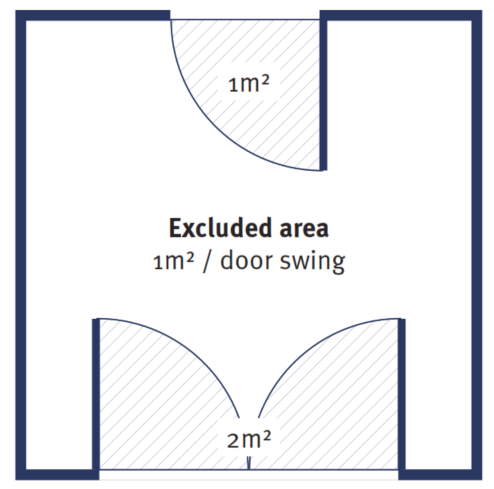 No express exclusion exists for thoroughfare areas around sliding doors but precautions must be taken to protect children within areas oftraffic, regardless of the type of door (swing, sliding or otherwise). Any space unsuitable for education and care should be excluded from measurements.A deduction is not needed for high shelves, which are inaccessible for children and do not encroach on play space. Items such as fixed or movablecupboards; shelving or lockers; walkin store rooms and refrigerators are considered storage, as these items or spaces are considered functional, rather than space where children can play and use as part of the program.Children’s moveable furniture items (e.g. tables and chairs, small bookshelves or cabinets for storing equipment and toys) are not considered storage.Kitchen areas cannot be counted as unencumbered space, unless they’re primarily to be used by children (i.e. the kitchen is an educational kitchen). The area of a kitchen is also to be excluded, unless the kitchen is primarily to be used by children as part of the educational program of the service. As prescribed in the Building Code, the kitchen facilities must be protected by a door or gate with childproof latches to prevent unsupervised access to the facilities by children younger than five.Passageways or thoroughfare areas, including door swings, are not counted as play spaces. They are entry/exit spaces: to allow for the movement of adults or children. In these circumstances, 1 sqm for each single door opening (and 2sqm for double doors) is deducted from the total space that can be counted for capacity purposes. This applies to all thoroughfares into and between children’s rooms, regardless of where the thoroughfare is located or how doors are configured.Where the thoroughfare is between children’s activity areas, 1 sqm is deducted from both activity areas because the single door impedes use of both areas, resulting in a deduction of 2 sqm. Also, if the door is a double door, then 2 sqm is deducted from both areas.
 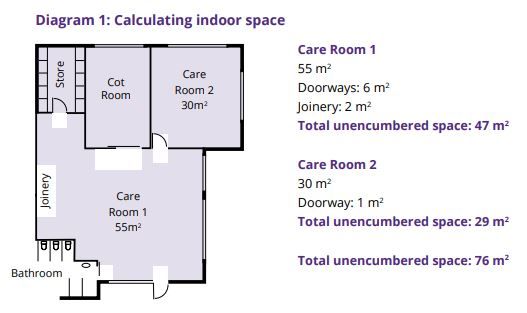 The ACECQA Guide to the National Quality Framework (NQF) provides a number of factors to determine whether a kitchen is primarily used by children as part of an educational program. Kitchen facilities and food preparation areas should be protected by a door or gate with childproof latches to prevent unsupervised access by children younger than five. These barriers, doors and gates indicate the area to be excluded from unencumbered space measurements.To be considered unencumbered indoor space, the space must be used exclusively by the education and care service at the time it is operating – not shared with other ad-hoc care facilities or schools.A verandah that is included in calculating the area of outdoor space cannot also be included in indoor space. Only with the written approval of the regulatory authority may a verandah be included in calculating the area of indoor space (Regulation 107(4)). This is subject to evidence from a building practitioner demonstrating that the verandah meets the requirements under the relevant building code to be classified as indoor space. For further information, see the using a verandah as indoor play space fact sheet. A childcare centre must be designed to facilitate supervision: Reg 115. The design and configuration of the outdoor play area should ensure that children can be actively supervised at all times. Children should not have free access to areas behind structures, such as storage sheds, cubby houses and water tanks.
Cot and Nursery Sleep Room Requirements
- Design, Function and Capacity,
- Function to provide sleeping accommodation
Note: The above listed standards are regularly updated and amended from time to time. The current version of each is to be verified and employed accordingly.
The Landlord is fully responsible for ensuring absolute compliance with all required standards associated with the building worksof which are necessary for the Lessee to obtain the licence to operate the childcare centre. - Number (n) for children who require a sleep during the day, generally those up to 2 years of age.
- planning, you should refer to Refer to the DECD Children’s Services Licensing and Standards Fact Sheet Cot Room.
- The sleep room area will be as scheduled in the project facilities brief of the school being designed. (Under South Australia Regulations) One piece of bedding shall be provided for each child under 2 years of age (with 2/3 being cots and the remaining mattresses/stretcher beds, i.e. 15 under 2 years of age, therefore, we require enough for places = 10 cots and 5 mattresses/stretcher beds). Rooms shall be designed to accommodate a maximum of six cots each.
Under Tasmanian Class 5 Childcare legislation, the Sleep space for children aged from birth to two years:- Sleep space, in addition to the required play space, is to be maintained in accordance with the following:
- Each required sleep room/area, must:
- for children up to the age of 12 months, provide 2 sqm of sleep space for the total number of children under 12 months present at any one time; and
- for children aged one year, provide 2 square metres of sleep space for at least half the number of children present at any one time.
- Cots/age-appropriate bedding are to be arranged to ensure:
- direct access to each child;
- adequate space between cots; and
- accessibility to the exit at all times (refer to Standard 11.11: Fire Safety).
- Supervision of sleep room
Where the sleep space is not directly adjacent to the playroom in use, or where visibility
cannot be easily maintained, then:- a supervision policy must be in place; and
- where the carer does not remain in the room, there must be an operating baby
monitor.
The layout shall maximise the efficiency of the provision of cots, with a minimum of 700mm of clear access between each. Cords from all blinds shall be inaccessible to children in cots. Adequate supervision of children in the sleep room shall be facilitated by the positioning of the cots and the viewing provided in the room. Staff shall be able to directly observe all children from the viewing windows.Single door access from the Main Activity Area and a viewing window in the wall between two adjoining sleep rooms are recommended for additional visual supervision by staff. Convenient access to the children’s toilet is required, but not necessarily direct access. Sleep and rest areas or rooms:
- Consider children’s need for calm, comfortable, and secure surroundings as they rest.
- Provide ways of supervising children under 15 months as they sleep; e.g., are children able to be observed through a window?
- Ensure the temperature, lighting, and ambience of the sleep room or area encourage sleep and rest.
Cots, beds, and bedding equipment:
- Ensure cots, beds, and bedding equipment meet mandatory Australian safety standards and are labelled accordingly.
- Adhere to all product safety advice relating to cots, beds, and bedding equipment.
- Ensure the cots, beds, and bedding equipment are appropriate for the age and developmental stage of the children who will use them.
- Ensure cots and beds are assembled according to manufacturers’ instructions and that instructions are kept in a place known to the nominated supervisor and educators.
- Use mattresses that are the right size for the cot or bed, and ensure they are firm, flat, clean, and in good condition.
- Ensure cots do not contain toys, books, cot bumpers, doonas, pillows, and other items that could be hazardous to sleeping babies and young children.
- Ensure all cots, beds and bedding equipment are clean, maintbeds, aired and regularly checked for damage to safety latches and moving parts.
- Provide safe bedding for children according to their age and developmental stage.
- Avoid the use of bassinettes, as there are no Australian safety standards for bassinettes.
- Ensure babies are not left to sleep on mats or floor mattresses. The safest place for a baby to sleep is in a cot that meets the mandatory Australian Standard.
Location of cots and beds:
- Ensure there are enough cots and beds available for all children who require sleep or rest throughout the day.
- Ensure cots and beds are not positioned under or near windows, curtains, blind cords, or electrical appliances.
- Allow enough space between the cots or beds to ensure children using them cannot physically disturb one another while resting.
- Allow enough space between cots or beds for educators to move freely between children – educators must be able to tend to a resting child without touching another cot, bed or child.
- Ensure any area that is permanently set aside for the use or storage of cots or beds is excluded from calculations of unencumbered indoor space.
Toilet and Hygiene Facilities and Nappy Change Facilities (Regs 109 & 112)
Adequate developmentally and age-appropriate toilets must be provided. A minimum of one toilet and handwashing facility per 15 children is required. Ideally, toilets will be directly accessible from inside and outside play spaces by children.
Consideration should be given to maintaining the dignity and rights of children. In children's restroom cubicles, solid walls and window privacy are both options for doing this. Consider including doors on toilet cubicles for older children. However, there need to be windows into the toileting area for educators to supervise the children.Soap dispensers and hygienic hand-drying facilities must be provided in children’s toilet areas. Foaming-type dispensers are recommended as their use presents less of a slip hazard than other liquid dispensers, which often drip.Hygienic nappy-changing facilities must be provided. If a service accommodates children younger than three years, a properly constructed nappy-change bench is required with a bench-type baby bath and separate adult handwashing facilities located within 1 m of the nappy-changing bench.Nappy-changing facilities must comply with the Building Code. The bench must not be less than 0.9 sqm in area, and at a height of not less than 850 mm, but not more than 900 mm above the finished floor level. The bench must have a space not less than 800 mm high, 500 mm wide and 800 mm deep for the storage of steps. It must be positioned to allow a staff member changing a nappy to see the play areas at all times.In addition, there needs to be one shower, bath or shower–bath combination in each service.
Nappy Change Facilities (Reg 112.):
- This regulation applies if a centre-based service educates and cares for children who wear nappies.
- The approved provider of the service must ensure that adequate and appropriate hygienic facilities are provided for nappy changing.
- Without limiting subregulation (2), the approved provider of the service must ensure that the following are provided —
- if any of the children are under 3 years of age, at least 1 properly constructed nappy changing bench; and
- hand cleansing facilities for adults in the immediate vicinity of the nappy change area.
- The approved provider of the service must ensure that nappy change facilities are designed, located, and maintained in a way that prevents unsupervised access by children.
See also ‘Premises designed to facilitate supervision’ and ‘Stairs and Stairways’.Ventilation and natural light: Reg 110
Education and care services must be well ventilated, have natural light and meet minimum ceiling height requirements. Refer to the Building Code. They must also be maintained at a suitable temperature. It is best practice for sleeping spaces to have natural ventilation and natural light.
Other Considerations
Blind cords
Blind cords pose a strangulation hazard and must be made inaccessible to children at all times. Cords should be secured in a position that is out of children’s reach, which ordinarily is at approximately 1500 mm above floor level, but may be higher if adjacent to cots or other play equipment. The Akidamy would prefer the use remote controlled blinds to eliminate the potential dangers.
Bottle-preparation spaces
You need to consider where you will prepare the bottles. It is best practice to have bottle-preparation spaces close to children’s play spaces so children can still be effectively supervised. Kitchenettes can work well for this purpose and should be considered as part of the initial design. Ensure that any bottle-warming resources do not pose a risk to children, i.e. burns from hot water, and are inaccessible to children at all times. Given the frequency of this activity, they should have a hot water Billi or a Zip tap installed.
Doors & Finger Guards
Education Standards Board policy outlines that severe injuries to children’s fingers can occur in education and care services. This can include amputations and crushing injuries. These can be prevented by fitting finger guards to the hinge edges of doors that may be accessed by children. Finger guards are required on the hinged side of the door/gate and may also be required on the unhinged side depending on the risk to children.
Door finger guards must be fitted on new buildings and when undertaking renovations, as per this policy. Common rooms where door finger guards are applicable include doors to:
- children’s activity rooms
- toilet areas
- front entrances
- offices or store rooms
- staff preparation rooms
- laundries
- staff rooms.
This also includes children’s toilet cubicle doors, doors or gates to kitchens and reception areas. In some cases, these doors may lead directly from children’s activity rooms, or they may lead from corridors or passageways.
An alternative hinge arrangement can be used on children’s toilet doors, creating a larger gap to prevent fingers being caught on the hinge side.
Doors that children may access must be self-closing, adjusted to a slow close using a cushioning device. This allows children time to react.
Sliding doors should be fitted with stoppers that prevent the door being shut on a hand. They should be able to be secured in an open position and fitted with devices that prevent crushing of fingers.
Room dividers, such as bi-fold doors or foldable walls, should be effectively secured for adult operation only.
For doors located in high-traffic areas for children, it is recommended the doors be secured in an open position, when required. For example, there are internal and external toilet doors and doors leading from children’s activity rooms to outside play spaces. The recommended securing position is preferably out of children’s reach, e.g. a high cabin hook located at 1500 mm may be used.
Door handles are to be fitted at approximately 1500 mm from the finished floor level to doors leading from corridor areas to children’s activity rooms and to areas not to be accessed by children. For example, doors leading to:
- offices
- staff rooms
- storerooms
- kitchens
- staff preparation rooms
- staff toilets (except disabled)
- laundries
- front entrance doors.
For high-traffic areas, in particular to toilet and handwashing areas and to outside play spaces, door handles should be located at children’s height to:
- provide easy access
- avoid reliance on adult assistance
- foster children’s independence with toileting and handwashing.
Glazing
As in the Building Code, any glazing less than 1 m above floor height must be of safety glass standard in all areas accessible to children. For existing glazing, a qualified glazier may apply an approved film to achieve the same purpose.Hot water
To ensure children’s safety, hot water delivered in areas accessible to children must be tempered to not exceed 45°C, with a recommended setting at Initial matters to consider Applying the National Regulations and other considerations 12 approximately 40–42°C. For example, hand-wash basins, bath taps, sinks, troughs and showers. See also ‘Bottle-preparation spaces’.Stairs and Stairways
Stairs to nappy-change benches must be secured in a manner that is not accessible by children. The stair treads are to be non-slip. Hand rails should be provided for children where possible, to assist with children’s access. The Building Code specifies appropriate stair dimensions. See also ‘Toilets and hygiene facilities and nappy change facilities’.- Additionally, stairways should be fitted with a childproof gate to prevent free access by children to upper levels.
- It is recommended that stairs to nappy-change facilities are able to be secured in the open and closed position to ensure the safety of children.
Storage Areas And Joinery
Storage and joinery are needed for the many things required to be stored at an education and care service. We recommend per child:external: minimum of 0.3 sqm of external storage space internal:
- internal: a minimum of 0.2 sqm of internal storage space.
Storage areas cannot be included when calculating the indoor space.
Regulations for the Outdoor Physical Environment
Fencing: Reg 104
Fences and gates must be of a height and design that prevent children of preschool age or under from going under, over or through. It is important to ensure effective fence heights are maintained at all times by not locating objects or structures close by. A minimum 1.2 m clearance should be provided. Any gaps in fences or gates are not to exceed 100 mm, including gaps under or adjacent to structures or between vertical bars.All gates must be self-closing with a latching mechanism that prevents the egress of children.Boundary fences need to be at least 1.8 m high. They must be constructed so that children will not be able to climb over them. This means they should not include a horizontal rail that might enable climbing. See the Kidsafe SA information sheet: Fencing playspaces.Self-closing and self-latching mechanisms on all perimeter gates should also be operating effectively. This can be tested by opening the gate to a variety of positions, such as approximately 25 mm open, half open and fully open positions. In all circumstances, upon release, the gate should subsequently close and latch properly.If kept locked, emergency access gates must have a key readily available and accessible to all staff for use in the event of an emergency.
Outdoor Space and Natural Environment: Reg 113
Children must have access to natural environments. There are great benefits for children being able to engage in free play in a natural environment.We also recognise the value to children of exploring and experiencing natural environments and have a policy on this: Outdoor play areas in education and care services. Kidsafe NSW and ACECQA both publish information sheets on the value of natural play spaces and safety considerations.Similar to the calculation of indoor play space, either 1 sqm or 2 sqm is deducted per single or double thoroughfare opening to determine the total unencumbered play space. For example, gates, doors leading from indoor areas and storage sheds, etc. are considered as encumbrances.Dense hedging and plantings should not be included in space calculations if it’s not accessible as play space. Fixed play equipment added in the future may affect outdoor space.Once constructed, the outdoor space will require a permit playscape certification from Kid Safe, this should be included as part of the landscape and outdoor play areas scope.Any corrects to be made will be at the cost of the Landlord. 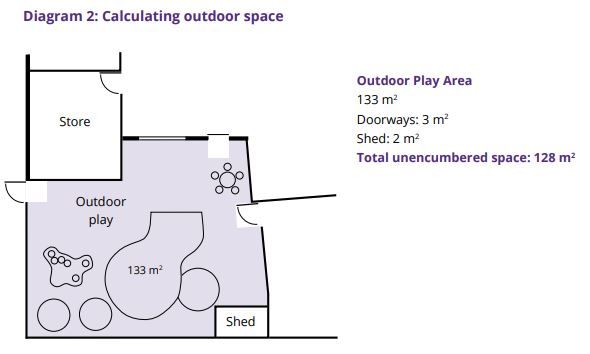
Learn more about an approved provider’s responsibility to create safe sleep and rest environments from the following:
General Health & Safety
General
The health and safety of all staff, children, visitors, and other users must be a primary consideration in the design and development of Schools. Designers of the School should ensure the health and safety of persons (including those working in and maintaining the building) during construction and during occupation for the purpose of intended use.The following list is not exhaustive but highlights some key factors to be considered:- Access to and within the perimeter, aiming to reduce trip hazards.
- Ventilation, in consideration with asthma.
- Noise and acoustics.
- Electrical; provide RCD protection to all Socket Power outlets. Refer to Electrical Consultant.
- All non-carpeted surfaces to have slip rating
- All stair treads to have contrasting, coloured, non-slip nosing edge strips.
The design and construction of the school should comply with Work Health and Safety Act 2011Soil Testing
Prior to construction, the Landlord is to provide the Akidamy. One of the following:- a soil assessment for the site of the proposed childcare site & premises by licenced environmental or soil assessment consultant
- if relevant, a statement specifying the date of a previous soil assessment
- a statement from the Developer that, to the best of their knowledge, the site history does not indicate the site is likely to be contaminated in a way that poses an unacceptable risk to the health of children.
In Australia, there is a national guidance document for the assessment of site contamination called the National Environment Protection (Assessment of Site Contamination) Measure 1999. It outlines the process for the assessment of site contamination.Food Preparation
- Any food preparation areas should comply with Australian Standard 4674-2004: Construction and fit out of food premises.
- Designers should ensure that all food preparation areas comply with relevant duty of care provisions relating to food preparation, hygiene, and safety standards.
- Ensure food premises:
- Have sufficient space, facilities, and storage to produce food safely.
- Are provided with services such as potable water, waste disposal.
- Have sufficient light and ventilation for food handling.
- Protect against contamination by:
- Providing facilities for staff to maintain hygiene standards and equipment cleanliness to protect against contamination.
- Select finishes and fittings designed to minimise risk of contamination, i.e, recessed lights.
- Choosing sealed joints and surfaces. Avoid adjustable height shelving under benches.
- Are proof against the harborage of pests.
- Has a dedicated food preparation sink in close proximity to food handling area.
- Include insect screens for any external windows and doors.
- Each double socket power outlet should be wired to a separate electrical circuit.
- Kitchen to have installed Commercial Kitchen Fly Zapper/Insect Killer high and safe location (see reference product)
Termite Control
- Anti-termite treatment should be applied to all buildings, complying with relevant Australian Standards.
- In new builds, non-chemical barriers are preferred.
- In existing builds, the presence of chemical barriers may necessitate the retention of the chemical method of subterranean termite control.
- Any timber (stump or log) that may have been exposed to termites should be removed from the building site.
- All workmanship and materials should conform to the requirements of the relevant code. If chemical barriers are used, all necessary precautions should be taken to protect workmen from accidental poisoning.
Hazardous Substances
- Take precautions against asbestos when demolishing or disturbing any material.
- Any materials containing formaldehyde-based compounds should comply with ‘E0’ (Ezero).
- All materials and products should be low to zero VOC emission.
- NO timber treated with copper-chrome-arsenate (CCA).
- NO air conditioners with water cooled condenser type plants.
Inclusivity & Equity
The School should allow individuals independence and equal opportunity to work, learn and play. The design should exceed the relevant requirements outlined in the NCC and the current Disability (Access to Premises and Buildings) Standard 2010.
Access & Egress:- Entry doors to all Activity Rooms should open inward.
- Avoid out swinging of Activity Room doors into corridor. A solution could be to recess the doors.
- Sliding doors should not be specified as the main entry door into rooms, as they do not sufficiently act for emergency evacuations as per National Construction Code.
- All external doors should have a minimum 900mm-deep continuous wet weather cover (i.e., verandah roof, covered link, or awning) to provide effective rain protection.
Handrails and Balustrades:- As to comply with relevant Australian Standards and ACECQA requirements.
- Include child height handrails to all steps, stairs or ramps and avoid the use of plastic nosing.
Amenities:- Children's toilet areas should be located to allow direct access to both their relevant activity rooms and the external Play Area.
- All amenities in the non-staff WC’s should be junior-oriented:
- Washing and drying facilities to be safe and convenient for children.
- Reachable flush heights.
- Half-height toilet cubicle partition, with no doors for children under 3 years old. with doors fitted for children old than 3 years.
Compliance Monitoring
Under all circumstances, the company will cooperate with ACECQA, ECRU, and related bodies for periodic reviews and inspections of the facilities' compliance with construction requirements. Non-compliance, if any, will be handled seriously, ensuring prompt corrections and preventive measures in the future.
Corrective Action
Any contravention of the outlined guidelines could result in immediate cessation of the construction activity and demand rectification of the violation. Failure to adhere to the policy may lead to severe consequences, including legal action as per Australian laws governing the construction of childcare facilities.
