
Employee Vehicle, Public Transport and Inter-Campus Travel Policy
Purpose
This policy outlines the guidelines, entitlements, and procedures for childcare educators and university-qualified teachers required to travel between company campuses or work locations during their workday. It explicitly ensures adherence to Modern Awards and the Australian Taxation Office (ATO) anti-double dipping regulations. [1]
-
1ScopeThis policy applies to all permanent and casual employees. Staff coverage is split into two award categories:
- Childcare Educators and Support Staff: Covered by the Children’s Services Award 2010.
- Early Childhood Teachers (ECTs): University-qualified teaching staff covered by the Educational Services (Teachers) Award 2020.
-
2General Principles and Eligibility
- Authorisation: Employees are only eligible to claim travel expenses or paid time if they have received explicit, written or digital authorisation from their Centre Manager or Director.
- During Working Hours: Eligible travel must occur after an employee has commenced their rostered shift at their first designated workplace and before they have finished their shift at their final designated workplace. [1]
- Exclusions: Daily commutes from an employee’s home to their first workplace of the day, and commutes from their final workplace back home, are strictly excluded and are not claimable under any award, company framework, or ATO tax law. [1, 2]
-
3Specific Inter-Campus Driving Entitlements (Perth ↔ Fremantle)For staff directed to drive their personal vehicle between The Akidamy Perth (105 Summers Street) and The Akidamy Fremantle (28 Cantonment Street), claims are based on the standard 24.1 km Canning Highway route:
- Paid Travel Time: The time spent driving between campuses is considered active hours of work paid at the ordinary hourly rate. This must not be deducted from the employee's scheduled break times.
- Award Vehicle Allowance (Car): Paid via payroll at $1.01 per kilometre across both applicable modern awards [MA000120 & MA000077].
- Pre-Calculated Car Allowance Rates:
- One-Way Trip (24.1 km): $24.34
- Return Trip (48.2 km): $48.68
- Teachers Award Limitation: For staff under the Educational Services (Teachers) Award 2020, the vehicle allowance is legally capped at a maximum of 400 kilometres per week.
-
4Alternative Transport Provisions
Public Transport (Transperth & SmartRider)
- Paid Transit Time: All time spent walking to the station, waiting for transit, and travelling on the train/bus counts as fully paid active working hours.
- The SmartRider Transfer Window Rule: Under Transperth network rules, a journey commenced within 2 hours of a prior tag-on is often treated as a continuous transfer, resulting in a $0.00 out-of-pocket cost to the cardholder. If the SmartRider system registers a $0.00 charge, the employee is not entitled to a cash reimbursement for fares, as no out-of-pocket expense was incurred.
- Valid Fare Reimbursements: If the 2-hour transfer window has expired and a fresh fare is deducted from the SmartRider (e.g., returning to the original campus later in the afternoon), the company will reimburse the exact out-of-pocket cost of that fare upon submission of a Transperth usage history log.
Rideshare and Taxis (Uber)- Mandatory Pre-Approval: Due to the higher cost of rideshare services, employees must obtain explicit, written approval from the Centre Manager before booking an Uber or taxi.
- Reimbursement Rule: If approved, the company will reimburse the full invoice cost of the ride upon receipt submission. The complete duration of the rideshare journey is counted as paid working time. [1, 2]
-
5Anti-Double Dipping & Sustainability Travel RulesTo maintain fiscal transparency and comply with Australian law, the company strictly prohibits double-claiming transport expenses:
- No Duplicate Claims: If an employee claims an internal workplace Sustainability Travel Subsidy or public transport fare reimbursement from company payroll, they cannot claim a vehicle kilometre allowance for that same trip.
- No Direct Reimbursement Double-Dipping: If an employee's public transport fare is reduced to $0.00 due to a Transperth SmartRider transfer window, no physical transaction occurred; therefore, no expense reimbursement can be claimed from the company.
-
6ATO Tax Compliance GuidelinesEmployees must understand how company travel reimbursements impact their personal income tax returns under ATO Guidelines: [1, 2]
- Reimbursed Expenses are Not Deductible: If the company directly reimburses you for a Transperth fare, an Uber receipt, or pays you a modern award vehicle allowance, you cannot claim these as a deduction on your personal tax return. The ATO explicitly states you cannot claim an expense that your employer has already covered or paid back to you.
- The ATO Cents-per-Kilometre Discrepancy: The ATO's standard deduction rate for personal tax returns in the 2026–27 financial year is $0.91 per kilometre. This is a tax calculation threshold only. It does not override or change the $1.01 per kilometre that your employer is legally required to pay you out-of-pocket under the modern childcare awards.
- Declaration of Allowances: Any ongoing or lump-sum travel allowances paid to you via your payslip must be declared as assessable income on your annual tax return. [1, 2, 3, 4]
-
7Employee Responsibilities and ComplianceEmployees utilising their personal vehicle for work duties must ensure they meet the following criteria: [1, 2]
- Hold a current, valid Australian driver’s licence.
- Ensure the personal vehicle is fully registered and roadworthy.
- Maintain comprehensive motor vehicle insurance or, at minimum, third-party property insurance. Proof of insurance must be provided to HR annually or upon request.
- Strictly adhere to all road traffic laws. The company is not liable for traffic, speeding, or parking fines incurred during work-related travel. [1, 2, 3, 4, 5]
-
8Claim and Reporting ProcedureTo receive payment for travel time, vehicle allowances, or fare reimbursements, employees must follow this process: [1]
- Maintain an Accurate Log: Record every trip immediately upon completion. The log must include the date, origin, destination, purpose of travel, and either the odometer readings (for personal vehicles) or the travel mode.
- Timesheet Entry: Log the exact travel duration on your weekly timesheet using the designated travel code to ensure correct hourly compensation.
- Expense Submission: Submit total travel kilometres or public transport/Uber receipts through the payroll system by the end of the current payroll cycle.
- Manager Approval: All claims require digital sign-off from the Centre Manager before being processed by payroll. [1, 2, 3]
This tutorial explains how to manage travel expense claims within Employment Hero. You will learn the necessary steps to properly claim travel expenses and comply with related Employee Vehicle, Public Transport and Inter-Campus Travel Policy. All claims should be made on a laptop or PC, not your smartphone, to ensure that you complete your application appropriately.Go to secure.employmenthero.com
1. Access Expense Claim Section
Like driving both schools for example. To do this you need to go into Employment Hero, into your school first of all, under 'Pay' and you’ll see ' Expense Claim ' here.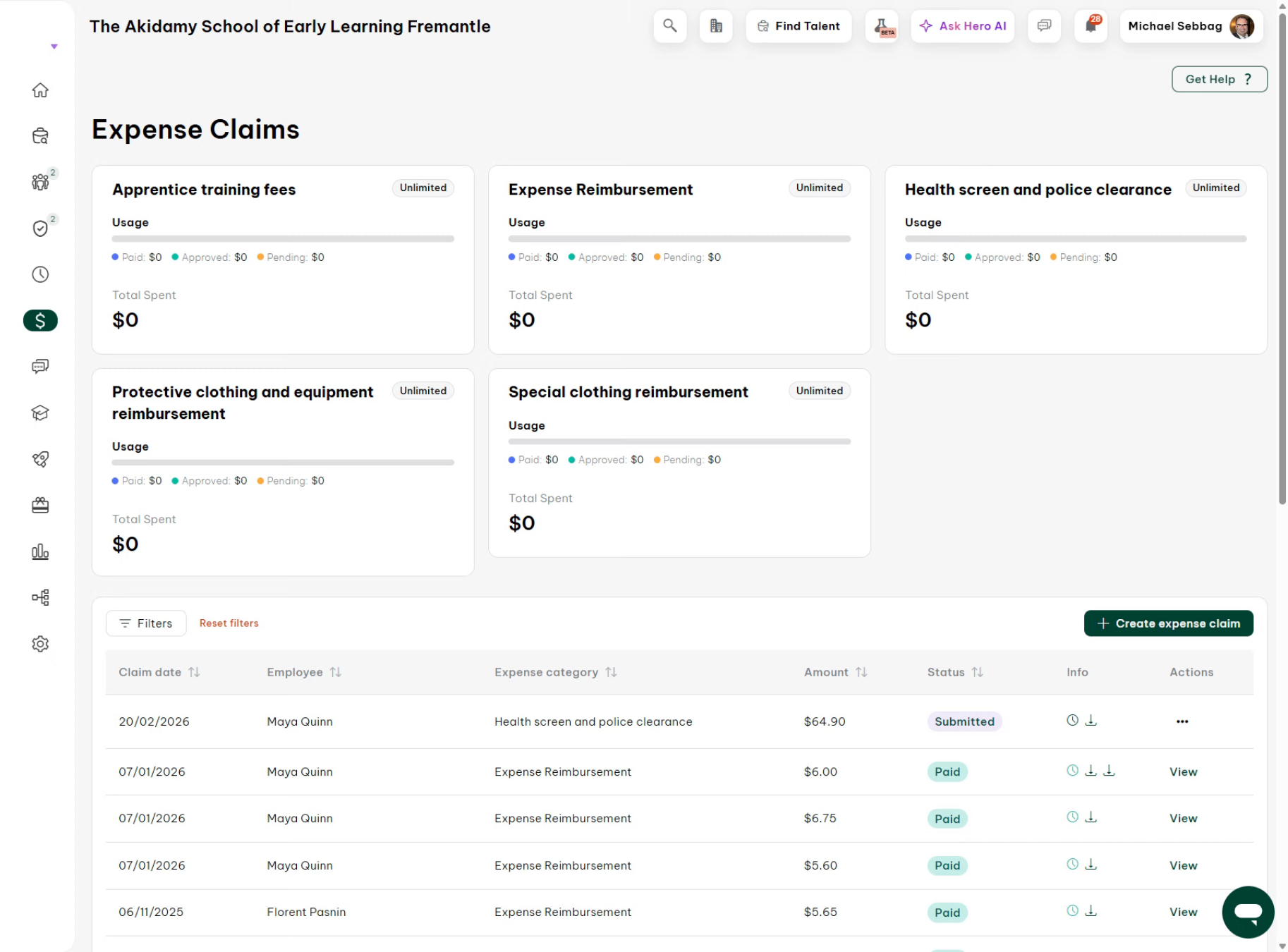
2. Create Travel Expense Claim
To create an expense claim, specify the type of expense (taxi, Uber, public transport or public vehicle). If it pertains to travel, include the amount and the distance.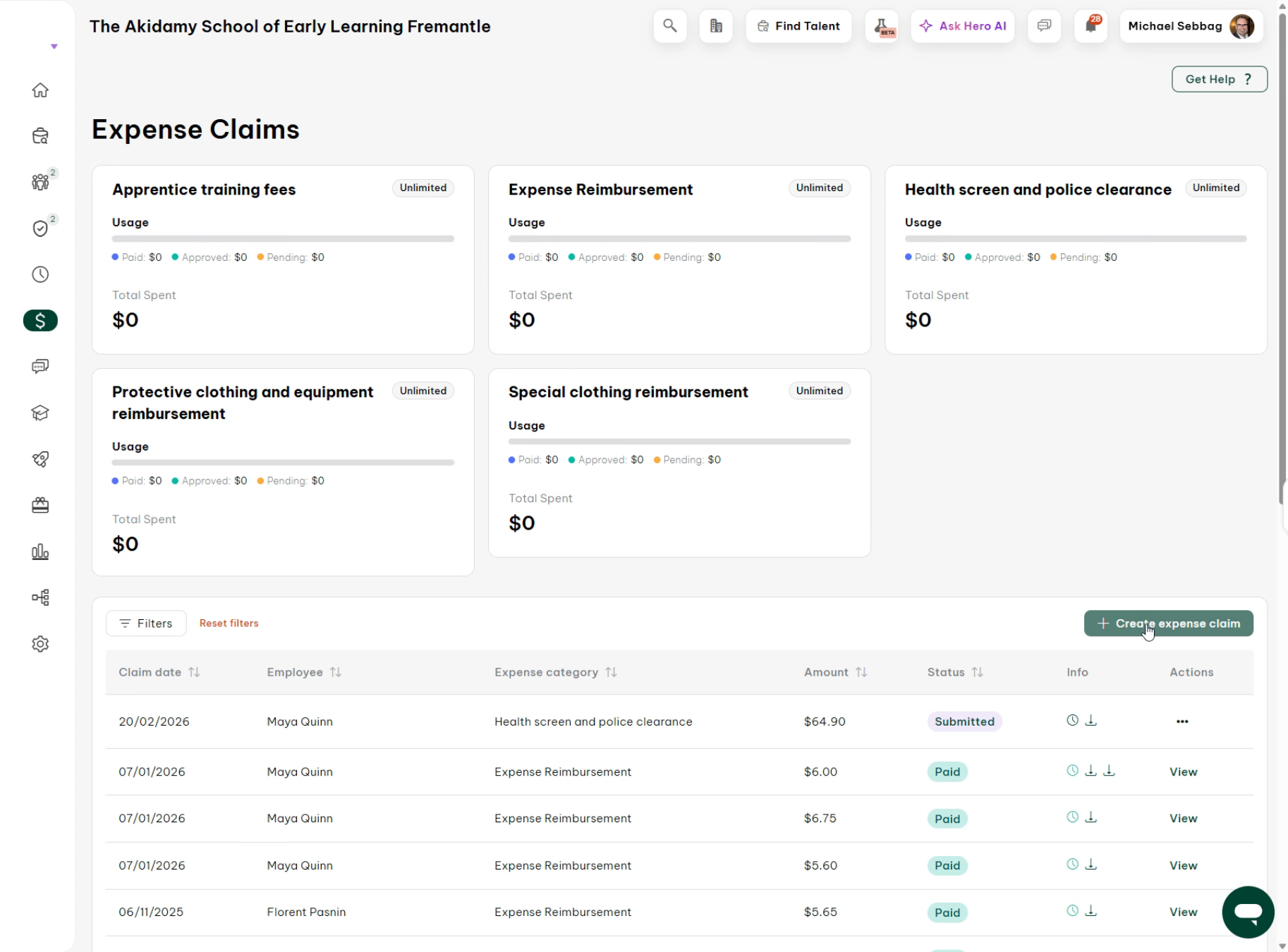
3. Log Travel In Roster
We need to ensure that you have logged it in your roster at the School you work at today, e.g., if you normally work at Perth and need to support Fremantle for the day. Please confirm that you completed the task on that day. You likely signed in as well. Please refer to the policy for details on how to claim, what can be claimed, and what cannot be claimed. There are specific rules governing this process.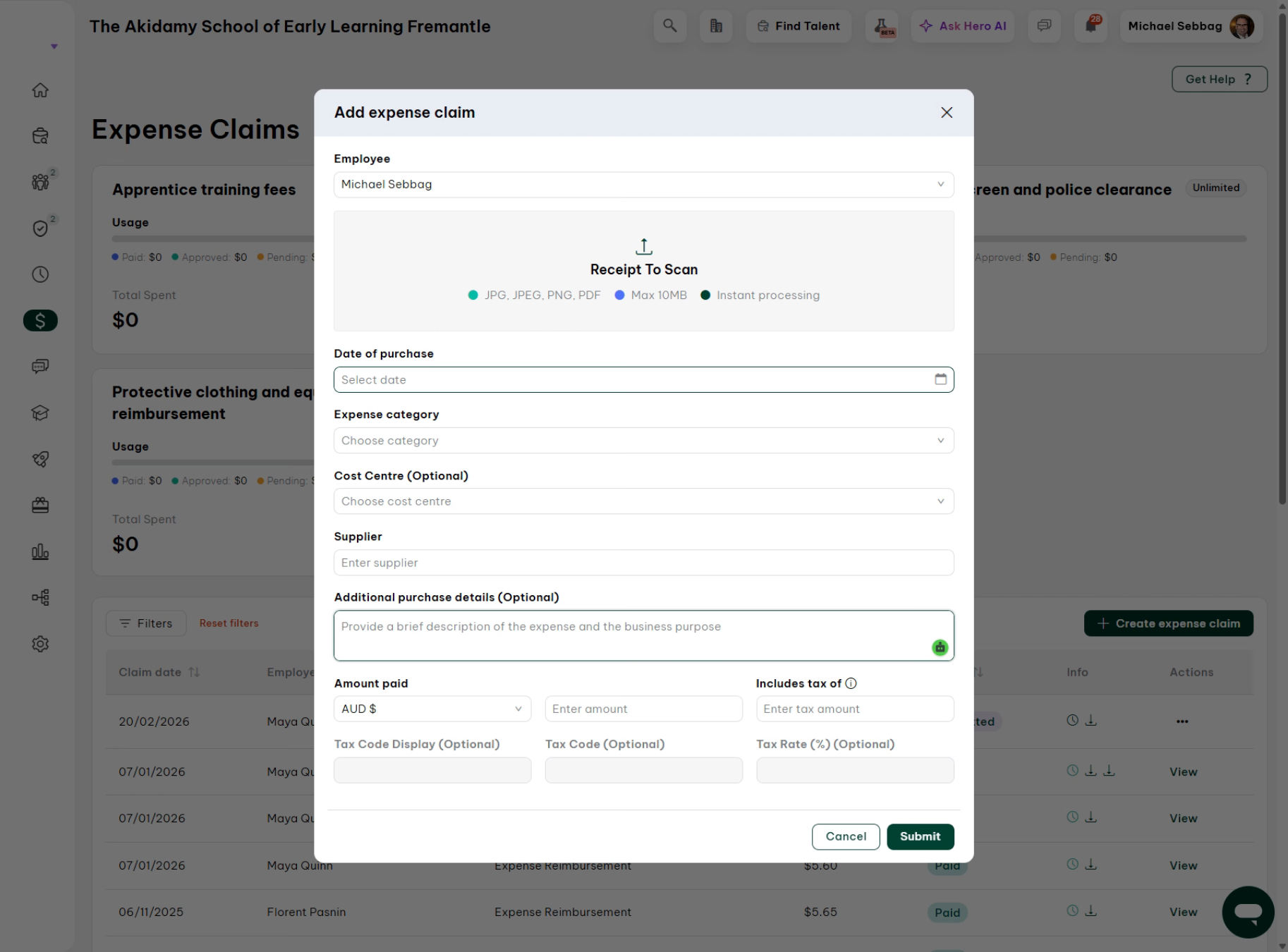
4. Understand Employment Location Rules
You must be employed at the location where you normally work or employed in a full-time arrangement. Therefore, if your employment is in Perth, it is considered as such. Additionally, you need to be directed. If your journey is less than 24.1 kilometres—the distance between the two schools—you can only claim the actual cost difference, capped at a maximum distance of 24.1km.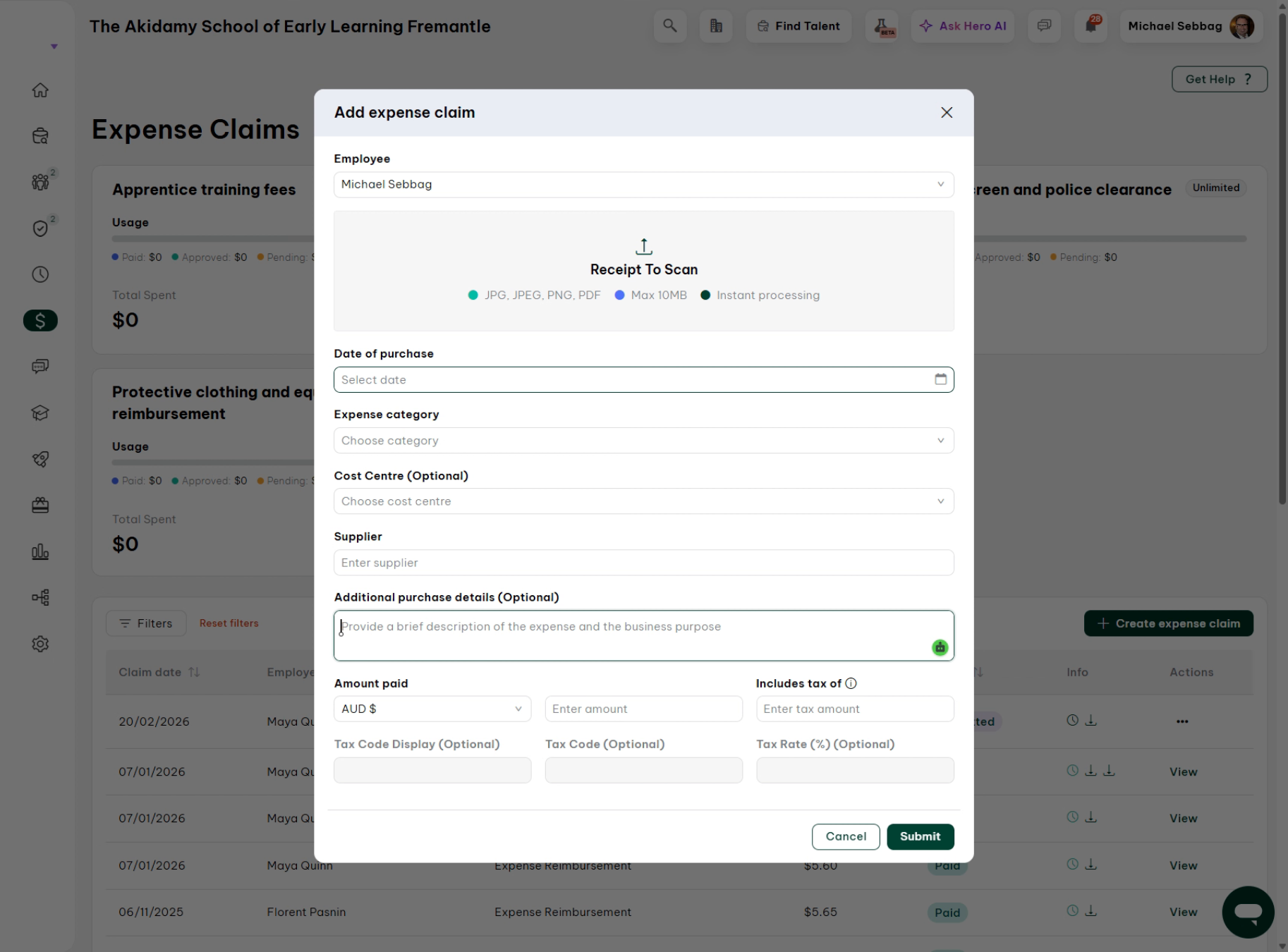
5. Calculate Kilometer Difference
I mentioned the 24.1 kilometres. Then you can only claim the kilometres for the difference.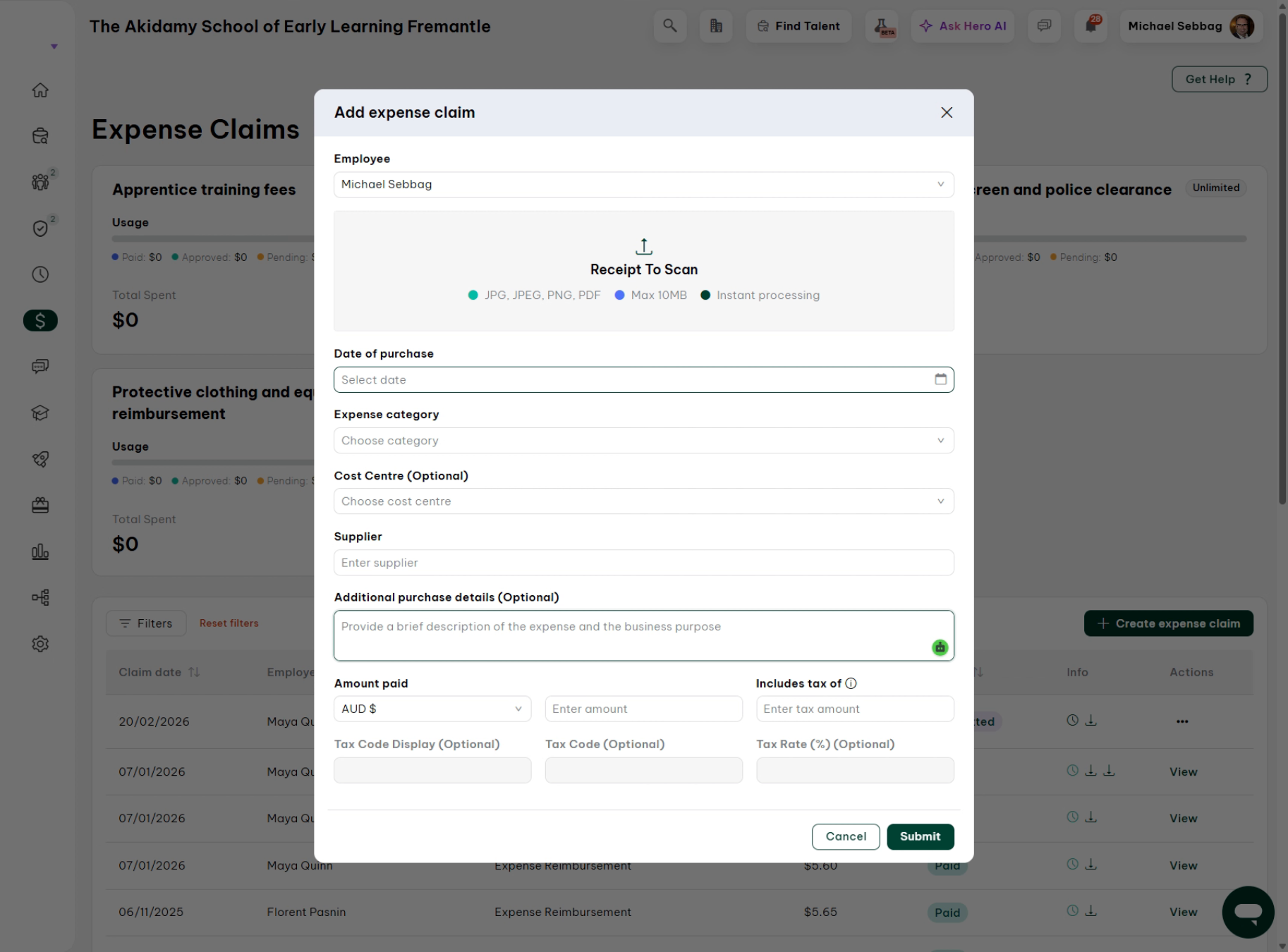 This tutorial guides you through accessing and creating travel expense claims in Employment Hero, logging travel in your roster, understanding employment location rules, and calculating claimable travel distances.
 -
9The End

Did this answer your question?
If you still have a question, we’re here to help. Contact us