Last Updated on November 4, 2026 by Owen McGab Enaohwo
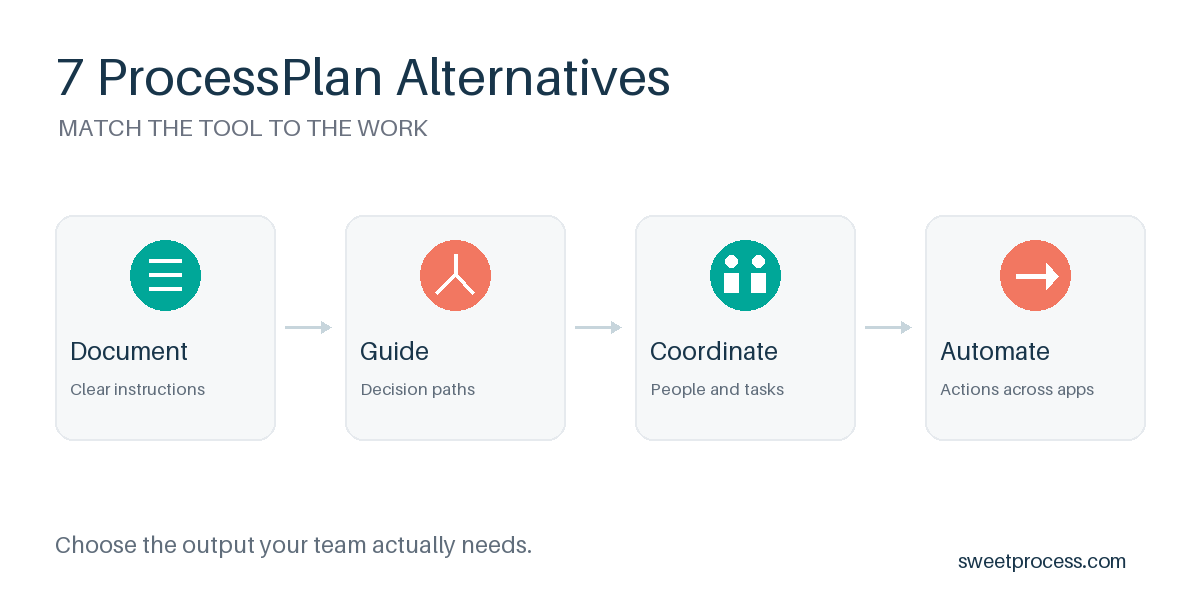
TL;DR: Choose a ProcessPlan alternative based on the work you need the software to handle, whether it’s to document instructions, guide decisions, coordinate people, or automate actions in other applications. SweetProcess is our first choice for maintaining and assigning procedures. Compare the tools based on the current plan, required records, and implementation work before switching.
Start your free 14-day trial of SweetProcess.
No credit card needed. Cancel anytime.
Looking for a ProcessPlan alternative without trading one workflow headache for another? Moving your processes takes time. The wrong fit can leave you rebuilding workflows while your team still needs help finding instructions or knowing what to do next. The right choice depends on the job you need done.
For documenting procedures and assigning work, start with SweetProcess. Compare it with six other options below, including current pricing, practical trade-offs, and the tasks each tool handles best. You’ll also get a checklist for testing one real process before moving the rest.
Publisher disclosure: SweetProcess publishes this article and is our top pick for keeping procedures current and turning them into work your team can follow and track. Choose a different tool when its visual guidance, application building, or automation model better matches the job.
Key Takeaways
- The best ProcessPlan alternative depends on the job. While documenting instructions, guiding decisions, coordinating work, and automating actions are related, they have different tool requirements.
- Process Street is built around recurring workflows, while Kissflow is suited to custom operational applications.
- Procedureflow and Zavanta address different guidance needs. While Procedureflow emphasizes visual, branching guidance, Zavanta focuses on structured procedures and acknowledgment campaigns.
- Alternatives like Decisions and Microsoft Power Automate are a good fit if you need a platform that addresses execution requirements.
- SweetProcess is a good fit for maintaining procedures and assigning work. It combines procedure documentation, task assignments, decision steps, form fields, and records for document review and sign-off. Start your free 14-day trial to test it for your organization.
Table of Contents
Quick Comparison of the Seven ProcessPlan Alternatives
How to Choose a ProcessPlan Alternative
7 Alternatives to ProcessPlan for Documenting SOPs
Decisions, Including ProcessMaker
How Much Do ProcessPlan Alternatives Cost?
How to Test a Migration Before Switching
Choose the Right ProcessPlan Alternative For Your Business
Quick Comparison of the Seven ProcessPlan Alternatives
|
Alternative |
Best Fit |
Main Output |
Pricing |
Selection question |
|---|---|---|---|---|
|
Maintained procedures, policies, and assigned work |
Instructions plus task and document records |
$99 per month for up to 10 users, or $990 per year; additional users cost extra |
Does your team mainly need a procedure that anyone can find, follow, and keep current? |
|
|
Process Street |
Recurring workflows with forms and conditional steps |
A workflow run and collected information |
Contact sales for Startup, Pro, and Enterprise |
What branching, approval, integration, and billable-role requirements must the quote include? |
|
Kissflow |
Custom operational applications and workflows |
A configured app or workflow |
Request quote |
Who owns the data model, governance, integration, and ongoing changes? |
|
Procedureflow |
Visual, branching guidance for frontline or service work |
Governed visual flows |
Enterprise plan starts at $33 per seat per month, billed annually |
Can users follow your real exception paths on the plan you choose? |
|
Zavanta |
Structured policies and procedures with acknowledgment programs |
Controlled documents and campaign records |
Request quote |
How much standardization and content-lifecycle control does your organization need? |
|
Decisions, including ProcessMaker |
Rules-led enterprise orchestration |
Executable workflows and decisions |
Request quote |
Which platform, deployment, connectors, and implementation scope are being proposed? |
|
Microsoft Power Automate |
Cross-application actions and desktop automation |
Automated cloud and desktop flows |
30-day free trial; Premium starts at $15 per user per month, billed annually |
Is the job attended or unattended, and which user, bot, connector, and hosting licenses apply? |
Competitor features and pricing checked October 30, 2026.
How to Choose a ProcessPlan Alternative
Before choosing a tool to replace ProcessPlan, decide what you need the new system to produce. Each tool handles a different type of job.
Documentation Software For Clear Instructions
Documentation software gives employees a place to find and follow the steps for recurring work.
For example, a client onboarding procedure might explain how to create a customer record, prepare a kickoff meeting, and notify the relevant team members. Consider selecting documentation software when your main problems are scattered instructions or difficulty keeping procedures current.
Visual Guidance Tools for Navigating Different Paths
While some procedures are straightforward, others depend on what the employee discovers along the way. For example, a support agent might need to follow different steps depending on the customer’s issue. A visual flow can show which question to ask, what answer to select, and where that answer leads.
ProcessPlan offers process diagrams and decision paths. If you’re looking for an alternative, tools such as Procedureflow emphasize this kind of branching guidance.
Visual process mapping is useful when employees must choose among several options without guessing which instruction applies. A diagram can explain the route through a process.
Workflow Software for Moving Work Between Teams
Workflow software coordinates work through tasks, forms, assignments, due dates, approvals, or other defined steps. For instance, if you have a client onboarding workflow, the sales team submits the signed-off scope, while operations checks the details, finance confirms the required billing information, and the onboarding lead schedules the kickoff.
A workflow system can help coordinate those activities and collect information as work progresses. Process Street and Kissflow are excellent options for this task if you need to manage recurring workflow runs.
Automation Tools for Performing Actions
With automation software, you can move information between systems or execute defined actions that would otherwise require manual work. A completed form might trigger a record update in another application. A tool like Microsoft Power Automate addresses cloud and desktop automation.
Decide on Output You Need
The right tool should leave you with the information you need. In some cases, one product may provide several outputs, such as visual guidance and automation; therefore, your business may need more than one product to cover them all.
For example, SweetProcess can document a procedure and assign it as a task. You can use it to create flowcharts as well as to document SOPs that your team can follow as work instructions.
SweetProcess is designed for teams that want to document their procedures, processes, and tasks in one place so they can concentrate on doing what drives real business growth. Sign up for our 14-day free trial to see how it works.
When ProcessPlan Still Fits
If you are looking at ProcessPlan alternatives, you can start by checking whether your current setup meets your requirements and whether another tool would provide a meaningful improvement.
ProcessPlan has capabilities that include:
- Reusable templates
- Live process instances
- Tasks
- AI strategist
- Diagrams
- Knowledge management
- Automation
- Mobile access
These features make it relevant when you need to map work, coordinate tasks, or explore automation. The important question is whether its approach fits the work you need to manage.
A management-consulting reviewer on G2, writing on February 3, 2022, valued ProcessPlan’s conditional visual options but found task creation and editing unintuitive. That is one historical user report, separate from the October 23, 2026 fictional-refund test; it does not establish a current product limitation.
It Offers Templates and Live Processes
A reusable template describes the process you want to run, while a live process instance represents a particular run of that process.
For example, you could create a refund-review template with eligibility checks, a decision about whether to approve the request, and different outcomes for approval and rejection. Each refund request could then have its own process instance.
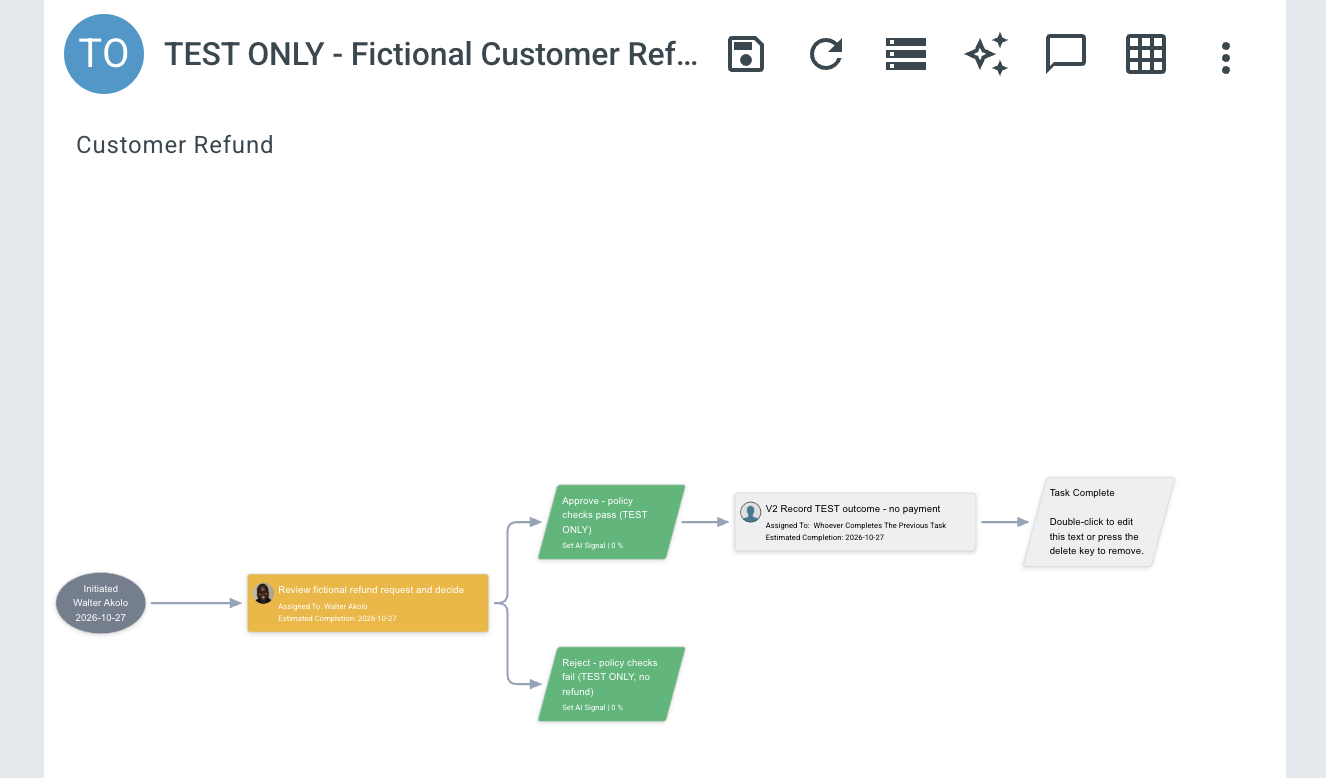
However, this distinction matters during migration. If you export this template, it might not preserve every record associated with previous runs. Therefore, if you want to maintain this format, ProcessPlan might still be a good fit for your business.
If your team already depends on its running processes, integrations, and exception paths, staying may be reasonable. The useful question is whether another product fits your required output, upkeep, and cost model better.
Check Whether the Pricing Model Fits
ProcessPlan’s pricing includes several components that should be evaluated separately:
- User licenses
- AI Employee working time
- Recorder and process diagrams
- AI strategist
ProcessPlan offers free recording and diagrams. Human licenses cost $29 per user per month with annual billing or $35 monthly. AI execution is priced separately: $0.20 per active working minute, plus a $99 monthly workstation fee per AI Employee. Fine-tuning is quoted separately, with a typical one-time cost of $400 to $2,000 per process. Compare the parts your workflow actually needs rather than treating the human-license price as the full automation cost.
Therefore, if your team mainly needs instructions that people can find, follow, and maintain, compare the complete cost of your current setup with documentation-focused alternatives. If ProcessPlan already handles the required work and records at an acceptable cost, staying may be the more sensible decision.
7 Alternatives to ProcessPlan for Documenting SOPs
Let’s look at the top seven ProcessPlan alternatives to help document your SOPs.
SweetProcess
SweetProcess is process documentation and management software. You write down how a job is done, publish it, assign it as a task, and see who completed it. It is built for owners and operations leads who want a standard operating procedure (SOP) their people can find, follow, and keep current. This tool comes in handy in business operations like progress reporting, employee onboarding, documenting SOPs, task tracking, and offers prompt customer support.
SweetProcess is a relevant alternative when instructions are scattered or their ownership is unclear. The client-kickoff example below illustrates how you could organize that work; it is not a completed onboarding test.
Key Features of SweetProcess
Document the Company’s Processes and Procedures
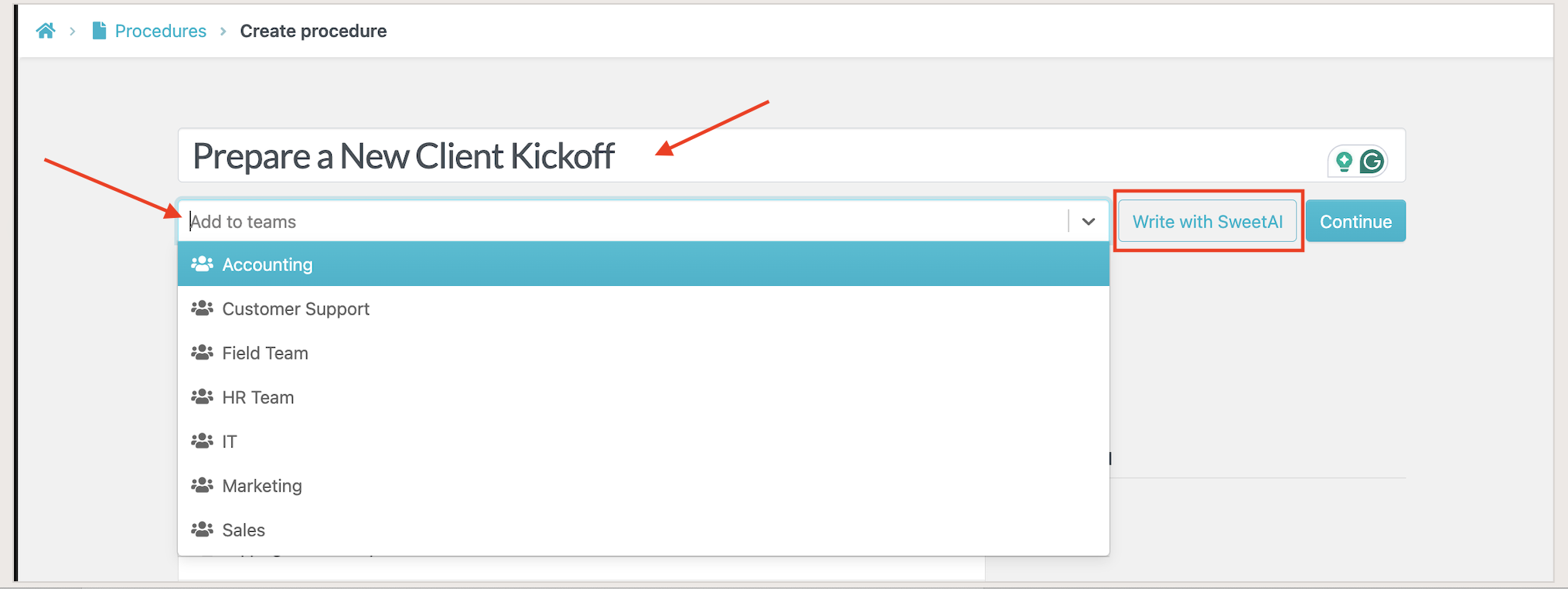
Use a procedure for the steps of a recurring job and a process to organize related work. For this example, name the procedure “Prepare a New Client Kickoff” and identify the onboarding lead as its owner.
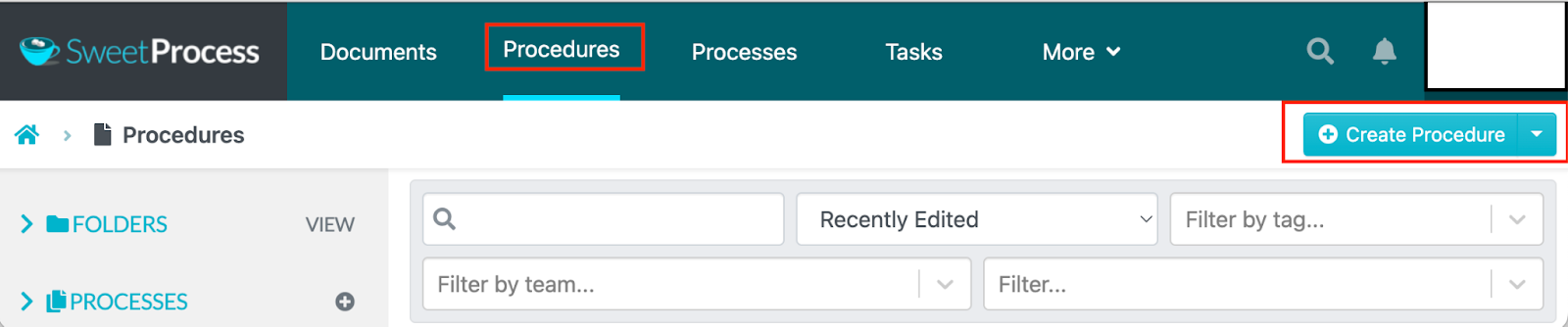
Once you add a procedure title, you can draft it manually or use SweetAI to generate the SOP much faster. You can also assign it to a team.
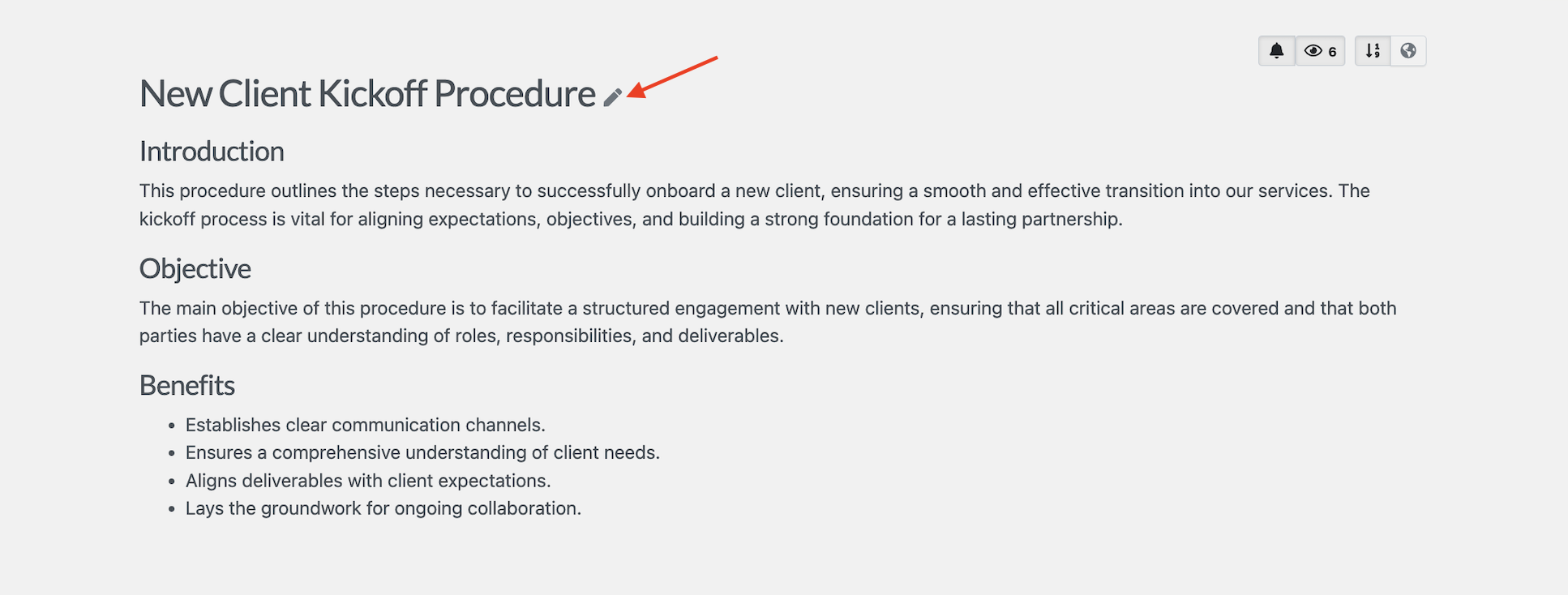
Once you generate a first draft with AI, you can refine it to align with your business.
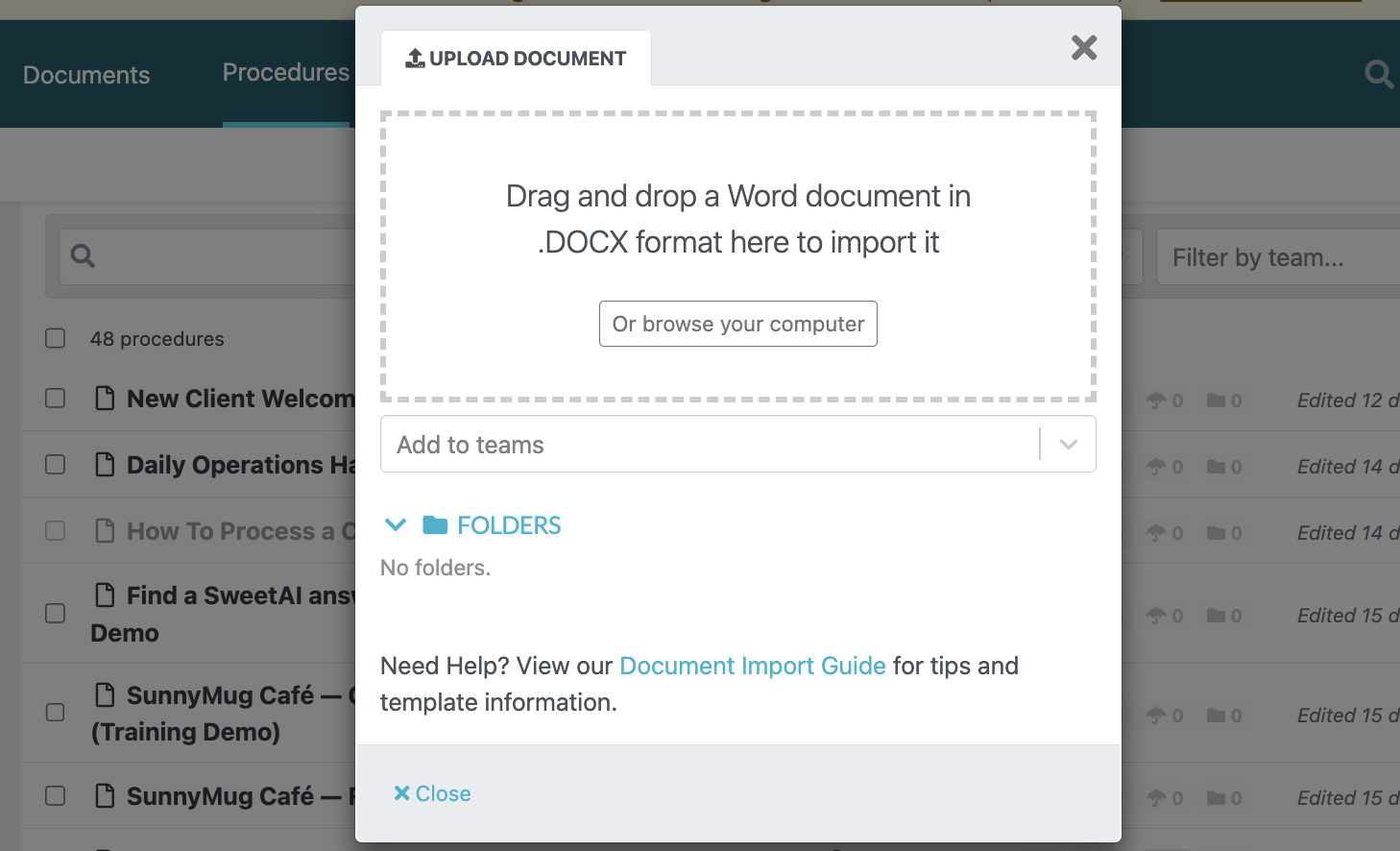
Alternatively, if you have the procedure on your device, you can import it to SweetProcess.

If your instructions are in Google Docs or Microsoft Word, prepare a properly structured DOCX file for import. Review the imported steps and formatting before approving the procedure.
This allows you to centralize all your procedures and make them accessible to all team members at any point in time. With reliable SOP creation software, you can standardize documentation effortlessly and ensure every process is clearly defined.
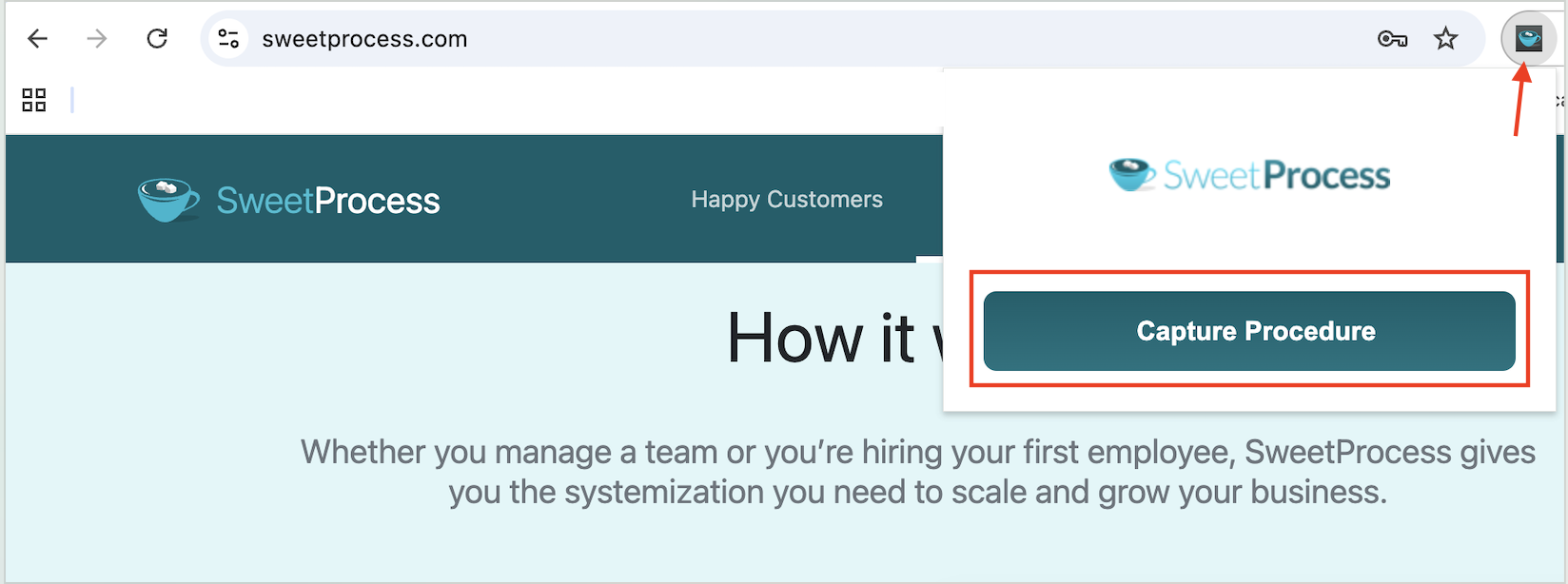
The SweetProcess Chrome extension captures supported browser actions as procedure steps with screenshots. Review the capture, remove unnecessary steps, and edit it for the people who will use the procedure before sharing it with your team.
SweetProcess is also a process mapping software that helps generate flowchart diagrams for users to visualize what they are documenting. As you create a procedure, it produces a graphic overview of what the procedure will look like when you’re done.
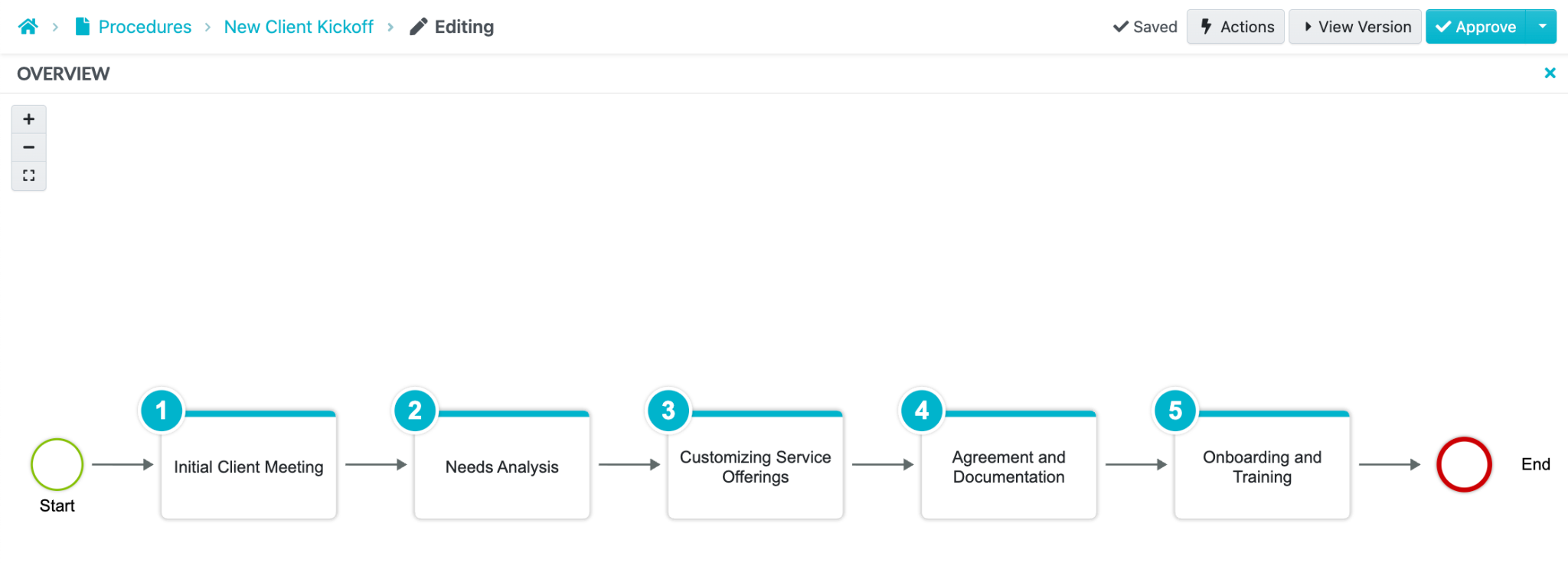
This feature is ideal for visual learners, especially when training employees.
You can add a decision point to your procedure. For instance, in this example, if the scope is incomplete, the employee follows the clarification path. If it is complete, the procedure continues to kickoff preparation.
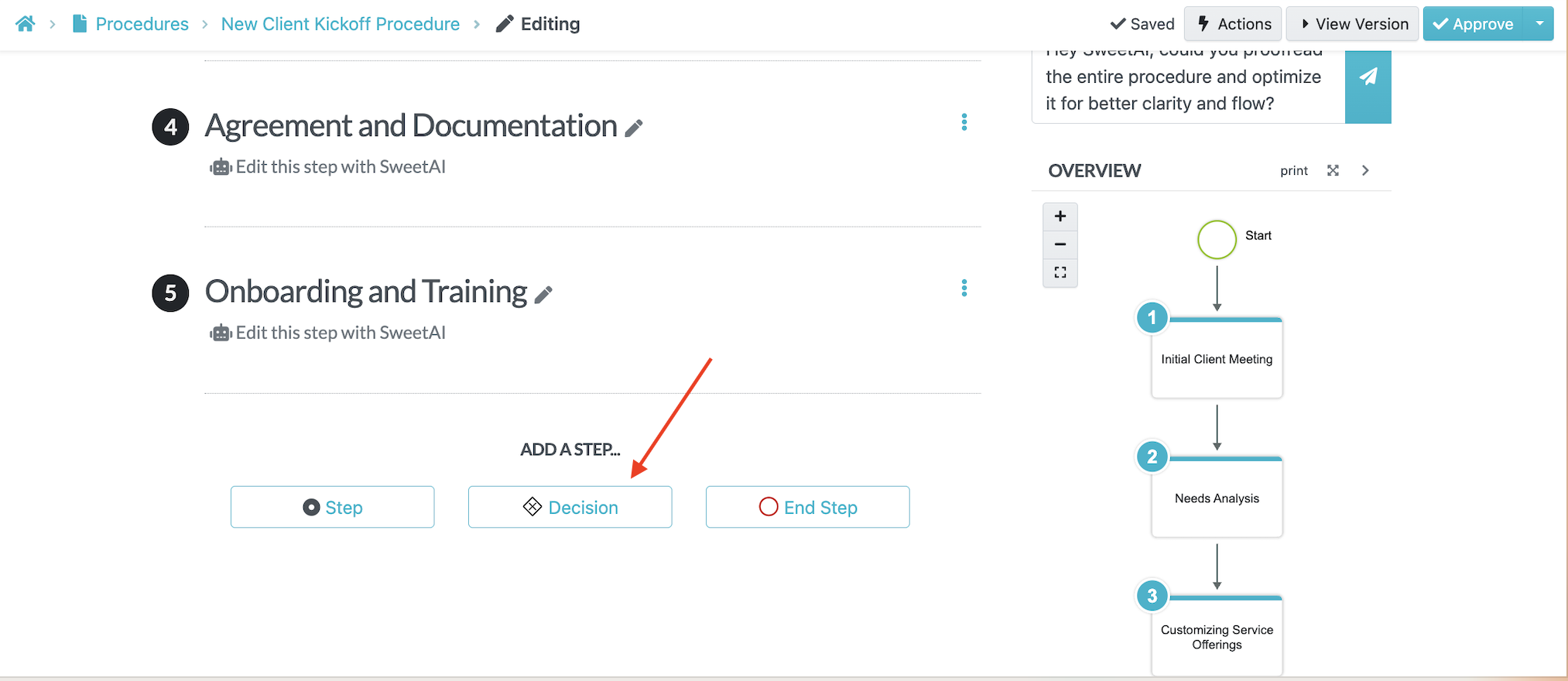
A decision step directs the employee through the documented process.
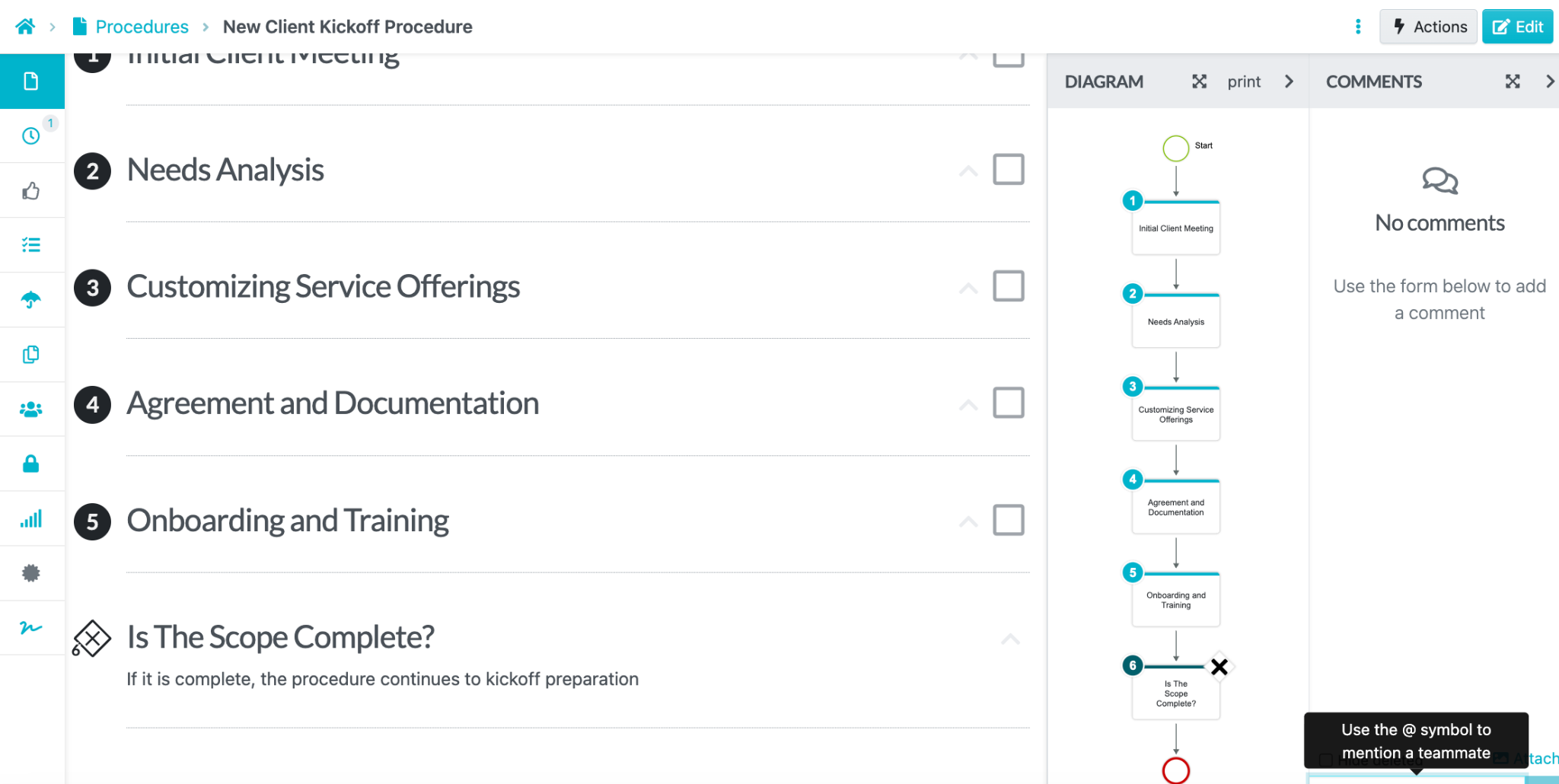
You can also create processes on the same dashboard.

Centralized Knowledge Base
A knowledge base is essential for new employee onboarding as it helps them get up to speed with company procedures without having to repeatedly ask the same questions.
A knowledge base can group instructions and FAQs for the people who need them. Decide which content belongs in an internal team resource and which is appropriate for customers.

Assign Procedures as Tasks
You can use this tool to assign tasks to your employees.
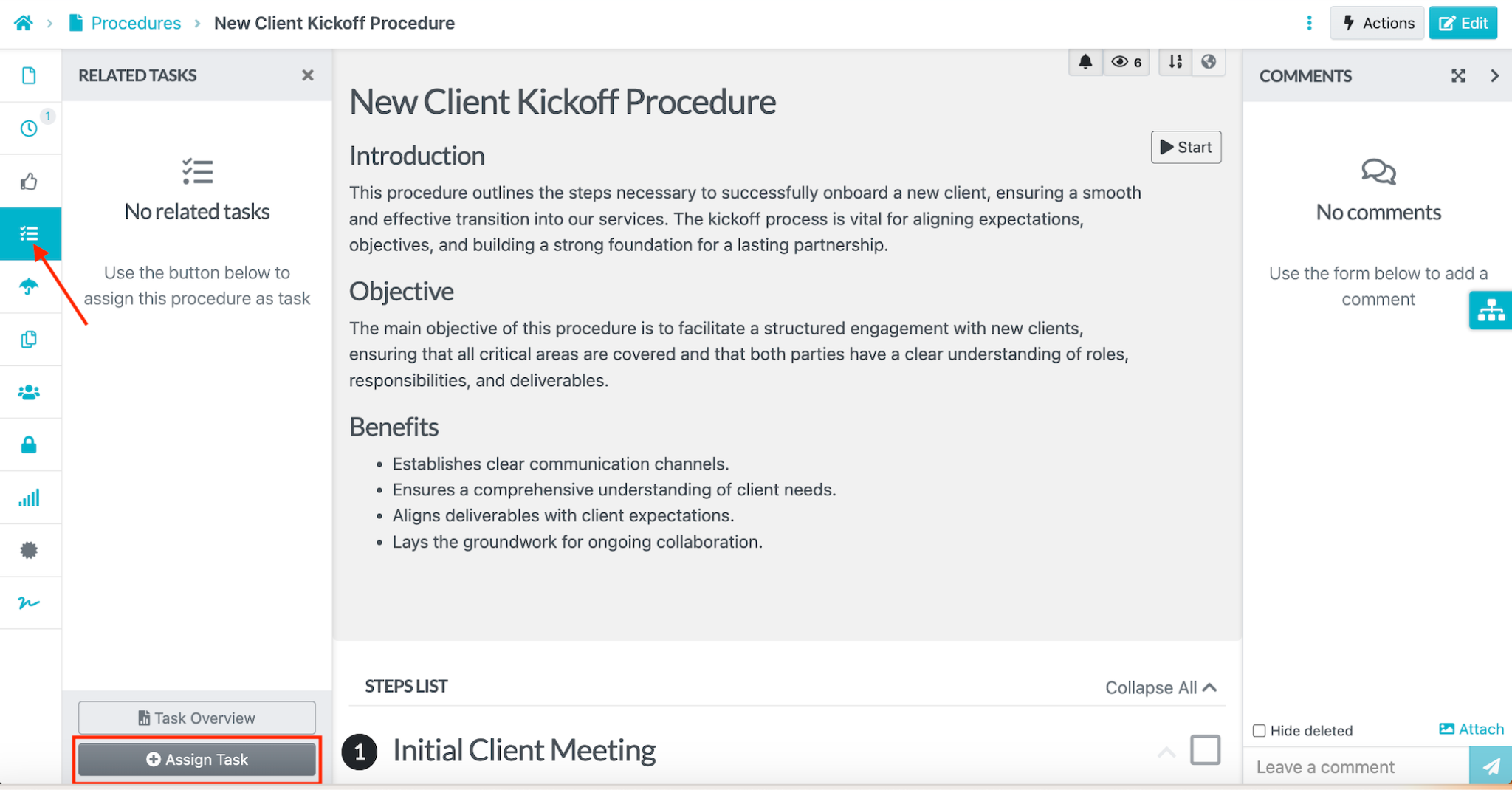
Choose the people responsible for the task, set its due date, and configure recurrence when the work repeats.
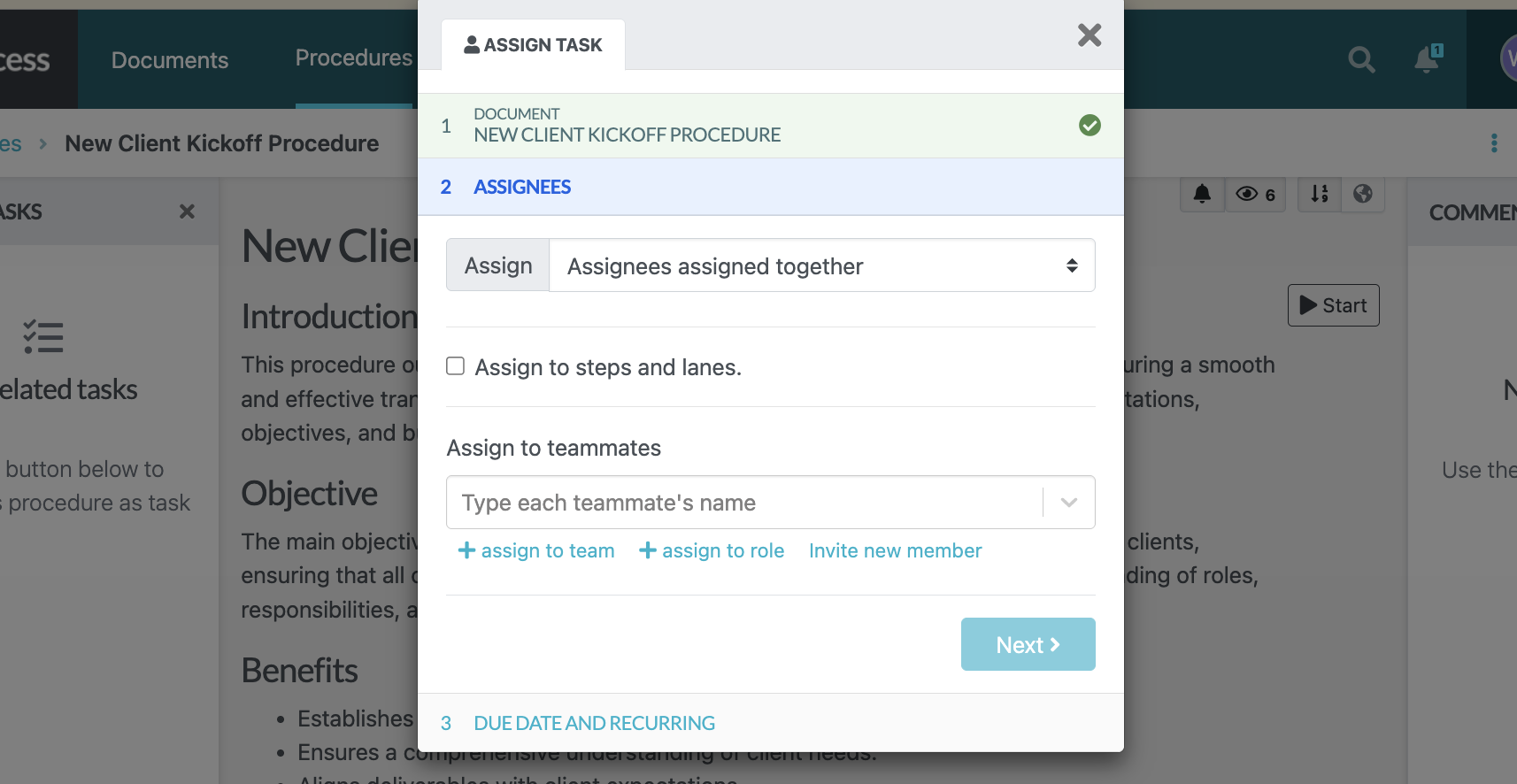
Use the “Tasks” view to inspect assigned-work status. A recorded completion shows what someone marked complete; it does not independently verify that a client meeting or another external action happened.
Review and Approve Procedures
When you edit a procedure, distinguish the draft from the approved live version. Version history shows the changes and who made them. A manager or super manager approves the draft to make it live; approving and notifying also alerts people who have access.
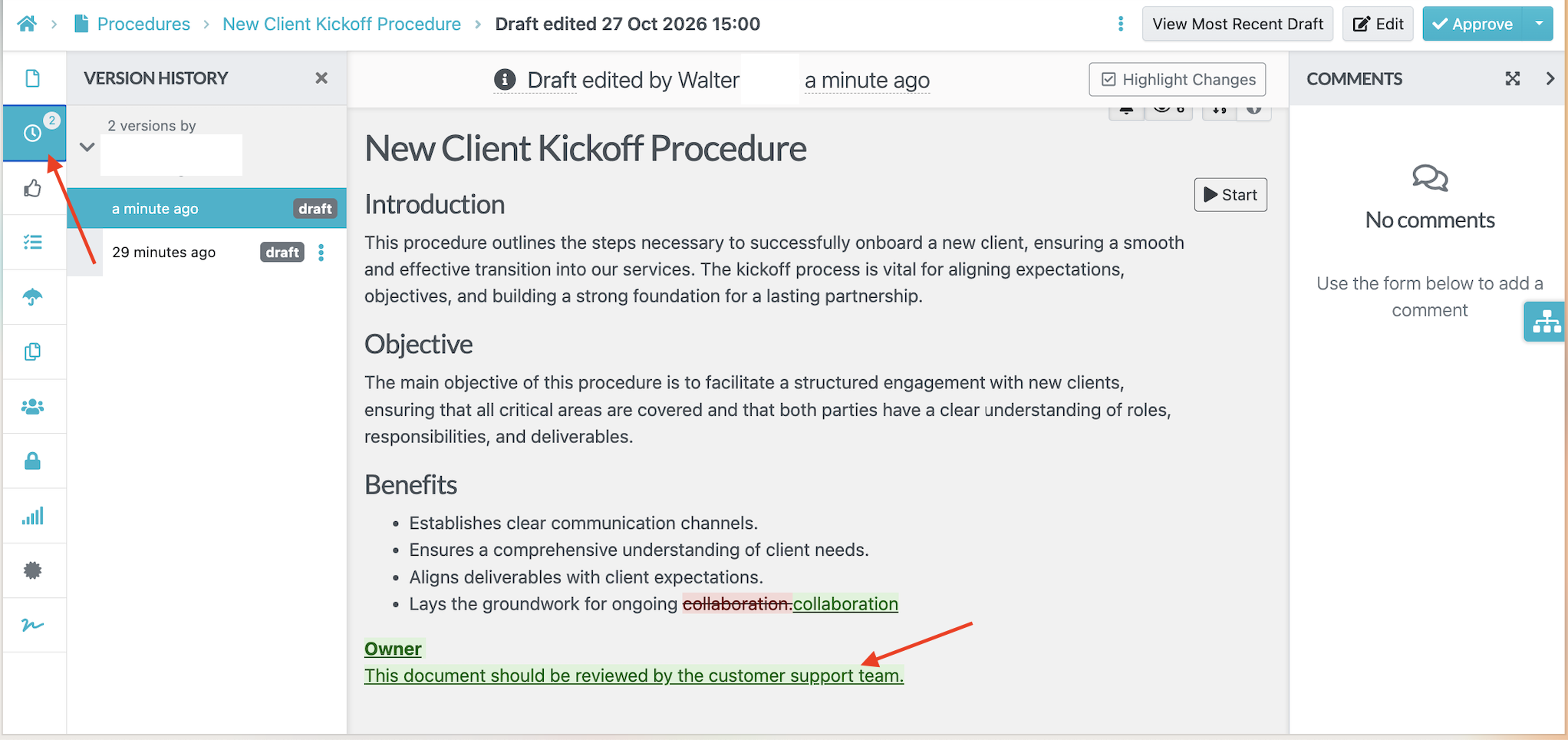
Review the changed instructions before approving the draft as the live procedure.
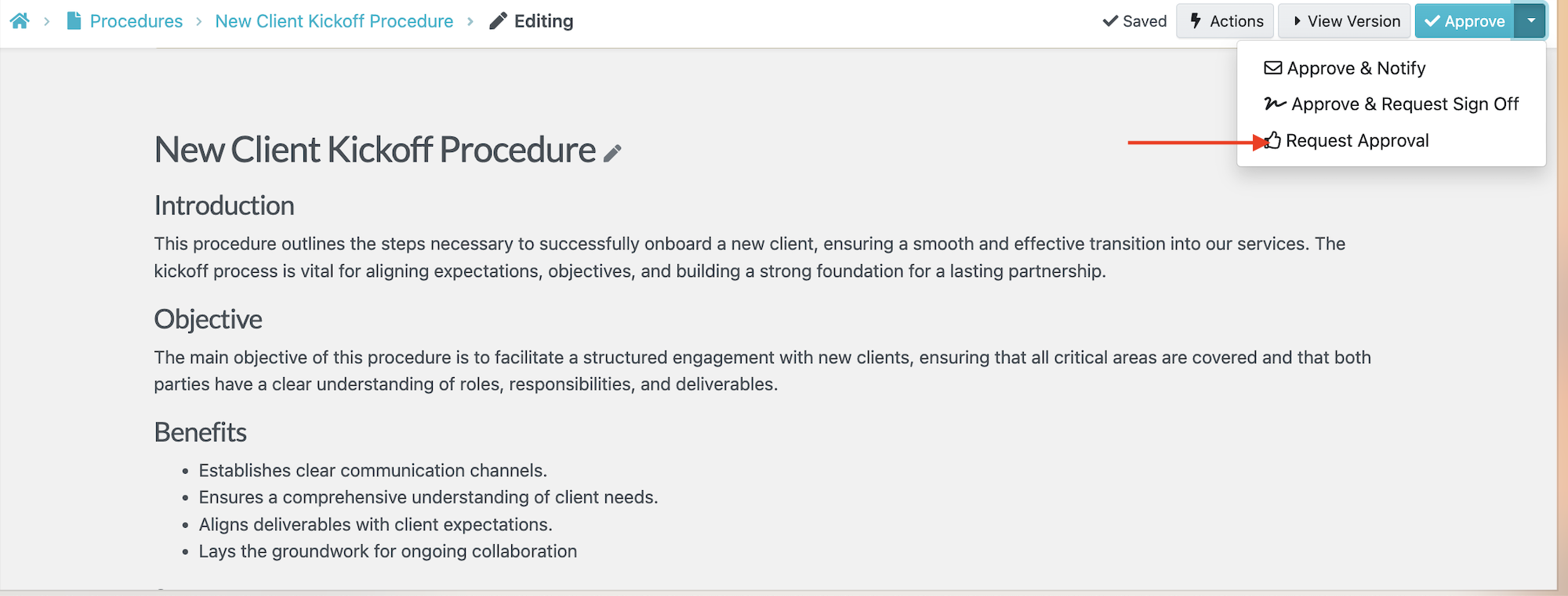
Request sign-off separately when employees need to acknowledge the procedure. The record identifies the document version and signing time; an acknowledgment is not a test of comprehension or proof that the work was performed.
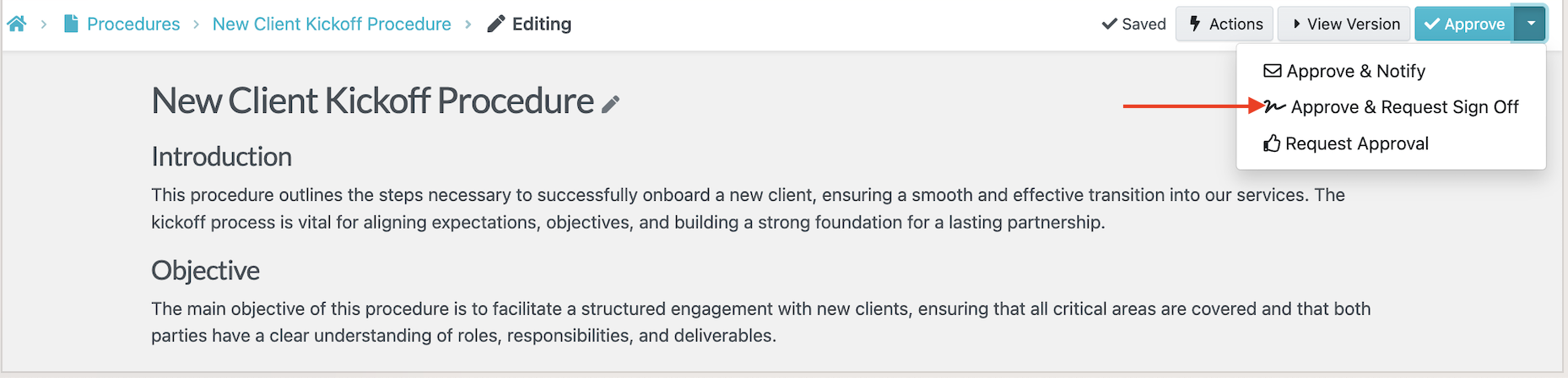
Employees will receive an email notification for this sign-off request, which makes it easier to collaborate.
Pros of SweetProcess
- Export procedures and processes: You can easily share a procedure in PDF or Microsoft Word format with anyone via email straight out of SweetProcess.
- Add images and videos to procedures: You can effortlessly add related images or videos to your procedures as you work on creating the step-by-step process. This will add clarity by helping your employees visualize the process instead of just using words.
- Collaborate on improvements: Team members can leave comments, give feedback, and suggest changes. Review their input before approving the next version so employees know which instructions to follow.
- One workspace for documented work: Use the document, procedure, policy, and process views to organize the instructions your team needs. Pilot a familiar task with the people who will use it before deciding whether the setup fits.
- Integrations through Zapier: Check that the trigger and action your workflow needs are supported. Confirm permissions, field mapping, usage limits, and any separate Zapier charges before relying on the connection.
- Mobile access: Check procedures and assigned work from a mobile browser. Test the actual tasks your team needs on its devices, especially screenshots, form fields, and longer instructions.
- 14-day free trial: You can easily sign up without giving out your credit card information for a period of 14 days. This free trial allows you to see how SweetProcess works and decide whether to continue or jump ship.
In SweetProcess’s published Belvidere Community Unit School District 100 case study, quality assurance director Sarah Brenner described procedures scattered across individual Google Docs, Word files, and handwritten notes. Centralizing them helped staff find departmental instructions when they needed them. This is evidence of a documentation use case, not a claim that the district migrated from ProcessPlan.
SweetProcess Pricing
SweetProcess costs $99 per month or $990 per year for up to 10 users. Each additional user costs $5 per month or $50 per year. The annual-only Small Team plan costs $495 per year for up to five users, plus $50 per year for each additional user. All plans include all features. Billing is based on users in the account, whether or not they have logged in. Removing a user provides a prorated credit for the next billing cycle. You can start with a 14-day free trial.
Review the current cancellation and refund terms before subscribing. Billing commitments and refund eligibility are separate from the free trial; do not assume a subscription guarantees business growth.
Process Street
Process Street is worth considering when your work follows repeatable workflows that use forms, conditional steps, approvals, assignments, and due dates. You can build a template and run it each time the work happens. Each run collects information from whoever does the work. This tool is ideal for a team that repeats the same multi-step job and wants each run to gather data and pass through approvals.
Key Features of Process Street
- Forms: Collect information from the person who runs each workflow.
- Conditional logic: Show or skip steps based on the answers given.
- Approvals: Route a step to a person for sign-off before the work moves on.
- Task order and dynamic due dates: Set the sequence of tasks and have deadlines follow the start date.
- Roles and scheduled workflows: Assign work by role and start runs on a schedule.
Pros of Process Street
- Define and assign processes: Create repeatable workflows and assign work to team members. Inspect the workflow’s activity and completion records to see what has been recorded, without treating a checked task as independent proof that an external action occurred.
- Work across devices: Check how the forms, instructions, and approval steps your team needs behave on its actual desktop and mobile devices. A short pilot is more useful than assuming every workflow will be equally easy to use on every screen.
- Recurring workflow management: Schedule repeatable workflows and confirm the assignments, due dates, and notification settings the team needs.
- Integrations: Process Street lists Zapier, Microsoft Power Automate, Tray.io, Make, and API options. Confirm connector availability, action limits, permissions, and any third-party charges for the selected plan.
Process Street Pricing
Process Street offers three plans: Startup, Pro, and Enterprise; however, you have to request a quote from the team. The Pro plan comes with a 14-day trial that you can use to test the tool.
Choose Process Street if: Recurring workflow execution and collected information are central to the job. If your primary need is a maintained library of procedures that employees can follow and use as the basis for assigned work, compare it with SweetProcess.
For a deeper two-product evaluation, read our SweetProcess vs. Process Street comparison.
Kissflow

Kissflow is for building operational applications and automating the workflows inside them. It’s more than an SOP editor. If your service business needs a request application with defined fields, routing rules, dashboards, and connections to other systems, this software will collect information and move the work.
Kissflow supports business-led application building, but the work still needs an owner for the data model, permissions, integrations, and ongoing changes. Confirm which business and IT responsibilities your deployment requires rather than assuming no-code means no implementation work.
Key Features of Kissflow
- Operational applications: Configure applications around business requirements.
- Workflow design: Route work through defined steps and responsibilities.
- Integrations: Connect relevant systems as part of the proposed workflow.
- Dashboards: Provide views of information associated with the application and work.
Pros of Kissflow
- No-code process creator: As a business or project manager, the intuitive Kissflow software lets you create processes for your team members without having to write a single line of code.
- Business process workflow creator: This BPM tool lets you create and automate process workflows for repetitive business procedures. In addition, it allows you to support process design for projects with customizable templates to build new processes or improve your existing ones.
- Workflow visibility: Use the application’s task and status information to see where work is waiting. Agree on the records the team needs to inspect before building the workflow.
- Forms and data: Build the forms needed to collect information for the workflow, then test required fields, permissions, and exceptional inputs with representative users.
- Workflow approval automation: You can use the workflow control feature to manage, automate, and approve workflow requests from team members to speed up productivity and increase accountability.
Kissflow Pricing
To use Kissflow, you have to request a quote from the team.
Choose Kissflow if: You need a configurable operational application and workflow rather than primarily a procedure library.
Procedureflow
Procedureflow turns text-heavy procedures into visual flows that people can navigate step by step. It’s particularly relevant when frontline or service work involves multiple decision points and different routes depending on the situation. As a knowledge management platform, Procedureflow comes in handy during onboarding and training.
Your office and field teams can use it to refer to company procedures since it provides a single source of truth.
Key Features of Procedureflow
- Linked visual flows: Connect branching flows so a reader moves through a procedure by choosing answers.
- Revision control: It keeps track of changes to each flow over time.
- Change notifications: Tell the right people when a flow changes.
- Permissions: You can control who can view and edit each flow.
- Offline backup and flow-data access: This feature allows you to keep a copy of your flows outside the platform.
Pros of Procedure Flow
- Flowchart creator: It helps in creating hyperlinked flowcharts to present expert knowledge in either visual or logical form. Managers can select different shapes, images/screenshots, and text to build sub-flows.
- User permissions: Decide who can view, edit, and maintain each flow. Confirm the access model for the employees who will use the guidance.
- Visual maps: ProcedureFlow gives users the chance to present professional insights with visual maps. With the content management feature, users can pick frames and add images and text to produce small hyperlinked flowcharts, which helps users to effectively study company procedures logically.
- Implementation and support: Ask what onboarding, training, and ongoing support the proposed package includes, and who will maintain the flows afterward.
Procedureflow Pricing
Procedureflow offers two pricing plans. The Enterprise plan costs $33 per seat per month, billed annually. It gives you access to user permissions, unlimited flows, revision control, and two power shapes. To access unlimited power shapes and the agentic API, you’ll need to contact the sales team for a quote for the Enterprise+ plan.
Choose Procedureflow if: Your employees need visual, branching guidance to navigate decisions during frontline or service work.
Zavanta by Comprose
Zavanta is an ideal ProcessPlan alternative if your policies and procedures need structured authoring, careful change control, and a record that people confirmed they read them. With this tool, you get review and approval workflows, version comparison, scheduled reviews, and acknowledgment campaigns.
Additionally, it centralizes all your policies and procedures, making it easy for employees to follow them.
Key Features of Zavanta
- Import features: You don’t have to draft documentation from scratch; you can import existing procedures to merge everything.
- Structured authoring: Your teams can write documents from consistent templates so they look and read alike.
- Document relationships: It allows you to link related policies and procedures together.
- Review and approval workflows: You can route a draft through the right people before it is published.
- Version comparison: You can see what changed and set reminders to check content again.
Pros of Zavanta
- Read Verify: Request and track employee acknowledgments of controlled guidance. Confirm the campaign schedule, reminders, and reporting your organization needs. A recorded acknowledgment does not establish comprehension.
- Automatic standardization: Inconsistencies tend to waste time and confuse readers. However, with the Zavanta “pick list” feature, managers and authors can quickly create content by picking items from the pre-defined standardized lists.
- Easy navigation: There is a drag-and-drop tool to instantly set up process instructions (steps) and reorder them for easy navigation. Zavanta’s structure helps authors avoid common procedure-writing mistakes. With a built-in search bar, readers can use their phones to scan QR codes and locate relevant content, input links to related docs, and bookmark specific steps and sections.
- Multimedia feature: In case you need to make your instructions clearer to your team members, Zavanta allows you to add and edit supporting media like screenshots, videos, and images to your process guide and training manuals.
- Content lifecycle: Route authoring, review, and approval work and retain version history. Assign owners for scheduled reviews and employee acknowledgment campaigns.
Zavanta Pricing
Request current pricing for the users and modules you need, including implementation and support.
Choose Zavanta if: Controlled document authoring, scheduled reviews, and acknowledgment campaigns are central to your requirements. You can compare its features and pricing against SweetProcess, which also helps document and assign everyday operational procedures.
Decisions, including ProcessMaker

Decisions and ProcessMaker merged in late 2025 and announced the unified Decisions brand in June 2026. The existing platforms, environments, and workflows remain supported. For a new purchase, confirm which platform, rules engine, integrations, and governance features the proposed package includes rather than assuming the products now share every capability.
Key Features of Decisions
- Workflow orchestration: You can coordinate defined steps across a business process.
- Rules engine: Decisions makes it easy to apply business rules to decisions and workflow paths.
- Integrations: You can connect the relevant systems within a proposed solution.
- Process building: Use the applicable platform’s process-building capabilities to define work.
- Enterprise workflow support: You can evaluate deployment and implementation options for more involved operational requirements.
Pros of Decisions
- Integration scope: Confirm the connectors, API work, permissions, and maintenance responsibilities for the specific Decisions or ProcessMaker platform being proposed.
- Reporting requirements: Ask the vendor to demonstrate the workflow status, exceptions, and service-level information your team needs in the platform being quoted.
- Data ownership: Decide which system holds the authoritative record and how information will pass between systems. Confirm reporting access, retention, and export requirements before implementation.
Decisions Pricing
Request a quote for the selected platform, deployment model, integrations, and implementation scope. Confirm which capabilities are included, which require an additional license, and who will configure and maintain the system.
Choose Decisions if: Your processes depend on rules, several systems, and an implementation partner or an IT team. Look at a simpler tool if your need is a set of clear instructions with assigned tasks. A platform built for enterprise orchestration brings setup work that a small team may not need.
Microsoft Power Automate
Microsoft Power Automate supports actions across connected applications and desktop automation. Cloud flows connect supported online services. Desktop flows automate defined actions on a computer using robotic process automation, or RPA.
It is a relevant option when the goal is to make software perform defined work rather than only document the steps a person should follow.
Consider Power Automate if the repetitive part of your work happens inside other applications and software can do it.
Key Features of Microsoft Power Automate
- Cloud flows: You can automate actions across connected applications and services.
- Desktop flows: It allows you to automate defined sequences of actions on a computer.
- Attended and unattended automation: You can run desktop automation with a person present or without anyone actively present at the computer.
- Microsoft ecosystem integrations: If you already use Microsoft tools, you can build automations around supported services, connectors, permissions, and licensing.
Pros of Microsoft Power Automate
- Automates repetitive business tasks: It allows teams to automate routine activities that would otherwise require manual effort. This reduces repetitive work and helps employees focus on tasks that require their attention.
- Integrates with Microsoft 365 and other applications: Power Automate works with Microsoft tools such as Outlook, SharePoint, Teams, Excel, and Forms, making it useful for businesses that already rely on the Microsoft ecosystem.
- Supports automated approvals: Teams can use Power Automate to route requests to the right people and track decisions without relying on long email chains. Approval conditions can also determine what happens next depending on whether a request is approved or rejected.
- Supports conditional workflows: It lets users build flows with conditions, branching, and other control actions to determine what happens when specific criteria are met. These rules help teams handle different scenarios without manually reviewing and forwarding every request.
- Provides monitoring and troubleshooting tools: Users can review flow run history to check whether an automation succeeded, identify failed runs, and investigate errors, making it easier to maintain automated workflows and address problems before they disrupt routine operations.
Microsoft Power Automate Pricing
You can start with a 30-day free trial. The Premium plan starts at $15 per user per month, paid yearly. Process costs $150 per bot per month, while Hosted Process costs $215 per bot per month, both billed annually.
Choose Microsoft Power Automate if: The main job is to perform actions across connected applications or automate desktop work.
How Much Do ProcessPlan Alternatives Cost?
As you evaluate pricing plans, keep in mind that some tools limit the number of users who can use specific plans. Other tools also have add-ons that come at a cost. Here’s a breakdown of all these ProcessPlan alternatives to help you decide what fits your budget.
|
Alternative |
Verified pricing |
What to confirm |
|---|---|---|
|
SweetProcess |
$99 per month or $990 per year for up to 10 users. Small Team costs $495 per year for up to five users. |
Additional users cost $5 per month or $50 per year each on Standard, or $50 per year each on Small Team. Confirm the total cost based on the size of your team |
|
Process Street |
Contact sales. Pro offers a 14-day trial. |
User, guest, and workflow limits |
|
Kissflow |
Quote based on your scope and user tier |
Implementation and support can be scoped separately |
|
Procedureflow |
Enterprise: $33 per seat per month billed annually. Enterprise+: contact sales |
Confirm seat minimums and required features |
|
Zavanta |
Request current pricing |
Required users, modules, implementation, and support |
|
Decisions, including ProcessMaker |
Request a quote for the selected platform and implementation |
Product, deployment, integrations, and implementation scope |
|
Microsoft Power Automate |
Premium: $15 per user per month; Process: $150 per bot per month; Hosted Process: $215 per bot per month, all paid yearly |
Execution model, connectors, bot requirements, hosting, and related licenses |
When you request quotes, it’s important to give every vendor the same scenario. You can indicate how many people write procedures, how many only read, whether guests need access, which applications must connect, and who will set it up. With this information, you can compare totals for the same scope.
How to Test a Migration Before Switching
Before switching from ProcessPlan, pilot one representative process to see what the new tool changes. Use the checks below before committing.
Inventory What You Have
Start by creating a list of the processes you currently manage in ProcessPlan. For each one, record:
- The process owner and the people responsible for completing it
- The reusable template and any related diagrams
- Instructions, attachments, forms, and required fields
- Decision paths and approval requirements
- Integrations and connected applications
- Permissions, roles, and access requirements
- Live process instances and outstanding tasks
With these records, you can identify what needs to be recreated and what needs to be retained.
Pick a Representative Process
Select one process that reflects the work your team actually performs. Avoid choosing only the simplest process. A good pilot should include at least one exception path and a record you can inspect after completion.
Rebuild the Procedure in the New System
If you choose SweetProcess, start by creating or importing the procedure. Whether you create the SOP with SweetAI or capture it with the Chrome extension, ensure that you add any decisions that require human judgment.
Test both the complete-scope and incomplete-scope routes with fictional data. Inspect the instructions, required fields, and recorded task status for each route. Describe only what the pilot actually shows.
Test Maintenance
Use the same client-kickoff procedure for the maintenance check. Change one instruction, inspect the draft and approved version, and confirm which version a new task uses. Request acknowledgment separately and inspect the document version and signing time recorded. A scheduled content review, an acknowledgment, and a completed task answer different questions; none alone proves that a client meeting or another external action happened.
Check periodic content reviews separately from task assignments and employee sign-off. A review record concerns the instructions; a task record concerns assigned work; a sign-off records an acknowledgment of a particular version.
Choose the Right ProcessPlan Alternative For Your Business
The right ProcessPlan alternative depends on what your team needs to document or automate. SweetProcess is the first choice for maintaining procedures and assigning work. Process Street suits recurring workflows, while Kissflow supports custom operational applications and Procedureflow provides visual guidance.
With Zavanta, you can manage and control procedures and acknowledgment; Decisions supports rules-led orchestration, and Power Automate handles cross-application automation.
Before switching to any of these ProcessPlan alternatives, ensure you test one representative process, review the records it produces, and confirm the total cost. If your priority is to give employees clear instructions they can follow and keep current, start by documenting one meaningful procedure in SweetProcess.
Start your free 14-day SweetProcess trial today. No credit card needed.
FAQs
What is the best ProcessPlan alternative for SOPs?
SweetProcess is a good choice for maintained procedures and assigned work. It supports procedure documentation, decision steps, form fields, task assignments, and records associated with document review and sign-off. The better fit changes if your core need is visual guidance, custom applications, or unattended automation. To pick the right alternative, determine the job you need to complete and run a sample procedure on the new tool.
Are there free alternatives to ProcessPlan?
ProcessPlan offers free recording and diagrams, while its 14-day trial includes access to additional capabilities. SweetProcess offers a free 14-day trial that gives access to all features. Microsoft Power Automate also provides a 30-day free trial that you can use to test its limits.
Can SweetProcess automate the same work as ProcessPlan?
SweetProcess does not provide equivalent autonomous desktop execution. It’s designed to document procedures, assign work, support decision steps and forms, and maintain relevant records. However, appropriate integrations may support actions in connected applications through Zapier. If your process requires software to perform actions in another system, test the specific integration or automation you intend to use. Confirm what happens when an action fails and which system records the result.
What should a 10-person team compare on price?
Compare the actual user count, billing commitment, required roles, implementation, and usage charges for each option. SweetProcess costs $99 per month or $990 per year for up to 10 users, with additional users charged separately. For other tools, confirm licenses and implementation costs for the same team and workflow.
Is ProcessMaker still an option?
Yes. The organization announced a unified Decisions brand in June 2026 following the late-2025 merger. Existing platforms, environments, and workflows remain supported. Before buying or migrating, confirm which capabilities are available in the specific platform being proposed.
How Do You Switch Without Losing Process History?
Inventory your templates, attachments, fields, permissions, integrations, and live process instances before moving anything. Confirm the available export formats and test representative content in the new system. Then decide how outstanding work will be completed and which historical records need to remain accessible.