Last Updated on November 13, 2026 by Owen McGab Enaohwo
TL;DR: Choose SweetProcess when your SOPs need to become owned, repeatable work such as approved procedures, assigned tasks, and a record of who finished what.
Choose ScreenSteps when employees need contextual guidance inside their working applications and structured training.
While SweetProcess costs $99 per month or $990 per year for 10 users with every feature included, ScreenSteps starts at $6,000 a year.
Start your free 14-day trial of SweetProcess.
No credit card needed. Cancel anytime.
ScreenSteps and SweetProcess both help teams document procedures and guide employees through work, but they approach the job differently.
While ScreenSteps focuses on contextual employee guidance, interactive decision trees, checklists, and structured training, SweetProcess helps you create, approve, maintain, and assign procedures, policies, and processes.
Your decision should depend on where employees need instructions, how managers maintain them, and what evidence you need after work is completed.
We’ll compare how the two tools deliver when it comes to creation, delivery, controls, recurring work, price, and migration, so you can match the tool to the job.
Key Takeaways
- ScreenSteps supports contextual employee guidance. It offers interactive decision trees, checklists, courses, and Sidekick, which provides contextual guidance alongside supported web applications.
- SweetProcess connects documentation to execution. You can create procedures, policies, and processes, assign owners, schedule recurring work, and inspect task activity.
- The pricing structures for the two tools differ. SweetProcess starts at $99 per month for up to 10 users or $990 annually for the same user allowance. ScreenSteps’ annual starting prices are $6,000 for Operations Standard and $9,000 for Operations AI.
- To determine the best fit for your business, test one real procedure, document it, assign an owner, request acknowledgment, assign the work, and inspect the record. To try out SweetProcess, sign up for a free 14-day trial here!
Table of Contents
- ScreenSteps vs. SweetProcess at a Glance
- ScreenSteps vs. SweetProcess Pricing, Trials, and Required Setup
- ScreenSteps vs. SweetProcess: Creating and Updating SOPs
- ScreenSteps vs. SweetProcess: Finding Guidance While Doing The Work
- ScreenSteps vs. SweetProcess: Approvals, Acknowledgment, and Freshness
- ScreenSteps vs. SweetProcess: Recurring Work and Completion Reporting
- ScreenSteps vs. SweetProcess: Integrations and Access
- Migrating Existing Documentation
- Fair Evaluation Pilot
- How SweetProcess Can Make SOP Documentation Efficient (Real-Life Case Studies)
- ScreenSteps vs. SweetProcess: Which Should You Choose?
- FAQs
ScreenSteps vs. SweetProcess at a Glance
|
Comparison |
SweetProcess |
ScreenSteps |
|---|---|---|
|
Best fit |
Documented procedures, policies, processes, and repeatable execution |
Contextual employee guidance, interactive instructions, and structured training |
|
Authoring SOPs |
Browser step capture, editing, SweetAI drafting help |
Screen capture, decision trees, checklists, and video on Operations Standard; AI capture and optimization on Operations AI plan |
|
Employee guidance |
Searchable documentation and assigned procedures |
Decision trees, checklists, courses, and contextual Sidekick guidance |
|
Document approval |
Sign-off and approval workflows |
Authoring assignments, permissions, and collaborative editing |
|
Employee acknowledgment |
Records that a team member read and understood a document |
Change acknowledgment |
|
Recurring work |
Assign procedures and processes with recurrence, due dates, and notifications |
Interactive checklists and completed-checklist reporting; demonstrate your required scheduling workflow |
|
Reporting |
Assignment activity, step timestamps, and completion records |
Search and completed-checklist reports |
|
Integrations |
API and Zapier connectivity with 1,000+ apps |
APIs, SAML, SCIM, iframe embedding |
|
Starting price |
$99 per month or $990 per year for up to 10 users; small team plan at $495 per year for five users |
$6,000 per year for Operations Standard |
|
Free trial |
14 days, no credit card required |
15 days, requested through a form |
Product details and pricing checked November 13, 2026.
How We Chose
SweetProcess publishes this comparison. It is our pick for teams that want to maintain procedures and policies, then assign repeatable work with clear ownership and completion records.
ScreenSteps is worth considering when contextual guidance inside working applications is the priority.
This recommendation does not mean ScreenSteps is unsuitable for managing business knowledge. It has vital capabilities if your employees spend the day inside web applications and need the right guidance to appear next to their work.
To compare SweetProcess and ScreenSteps, we examined the products across documentation, employee guidance, maintenance, accountability, recurring execution, integrations, migration, and pricing.
We also considered the practical work involved after an instruction has been written. A document is only one part of a repeatable process.
Someone must approve it, employees must understand it, managers must keep it current, and the work itself must be completed.
ScreenSteps vs. SweetProcess Pricing, Trials, and Required Setup
Both products publish starting prices. SweetProcess bills for users added to the account, including people who have not logged in.
ScreenSteps publishes annual starting prices by plan, but its visible pricing cards do not establish the included user allowance. Request a quote for your actual team.
If you are considering the two tools, you need to compare the price based on the same team size, the same billing period, and the same list of features.
You also need to consider the number of people who require access, whether your team needs advanced features, how much implementation work is involved, and whether you will need help migrating existing documents.
ScreenSteps Pricing
ScreenSteps offers three pricing plans.
|
Plan |
Published annual starting price |
Main capabilities |
|---|---|---|
|
Operations Standard |
$6,000 per year |
Decision trees, checklists, video, notices, certification, SSO, and one custom domain |
|
Operations AI |
$9,000 per year |
AI capture and optimization, AI search, courses, Sidekick, and audio recording |
|
Enterprise |
Custom |
Advanced AI authoring and governance, with five custom domains |
The Operations Standard plan is designed for teams that need structured procedural guidance and are looking to document tribal knowledge and scattered SOPs.
The Operations AI adds AI-supported capabilities and is ideal if you are onboarding teams. You can request a quote for the Enterprise plan if your business needs to manage compliance and operational complexity.
ScreenSteps also offers monthly billing; you can consult the team for a quote. Additionally, the platform offers different implementation plans once you pick a tier.
You can go for the self-serve option if you are comfortable building your own platform, or opt for the Standard or Accelerated, which come with more guidance from the ScreenSteps team.
If you want to test if the tool is a good fit for your business, ScreenSteps offers a 15-day trial that you can request through a form.
SweetProcess Pricing
SweetProcess offers monthly and annual billing, along with a smaller-team annual option.
|
Plan |
Included users |
Price |
Extra users |
|---|---|---|---|
|
Monthly |
Up to 10 |
$99 per month |
$5 per user per month |
|
Annual |
Up to 10 |
$990 per year |
$50 per user per year |
|
Small Team |
Up to 5 users |
$495 per year |
$50 per user per year |
Every option includes the same feature set and a 14-day trial without a credit card. SweetProcess advertises a 30-day money-back offer on its homepage. Renewal refunds follow a separate policy.
Monthly subscriptions receive a full refund within two days of renewal and a prorated refund afterward. Yearly subscriptions receive a full refund within seven days of renewal and none after that.
Confirm how the initial-purchase offer applies before subscribing. Cancellation and a full refund are not the same thing.
Questions to Ask Before Buying
Before choosing either product, write down your actual requirements.
- How many users will need accounts, and how are they billed?
- Which plan includes the authoring and delivery features we need?
- How many users does the base price include, and how are users counted?
- What happens when you add or remove users mid-term?
- Which features, including AI features, require a specific plan or add-on?
- Are there implementation, onboarding, or migration charges?
- What does monthly billing cost, if you need it, compared with annual?
- What is included in the trial, and what is not?
Compare a Written Total, Not Two Headline Prices
Start with a roster of the people who need access, including occasional readers, authors, managers, and people invited during onboarding. For SweetProcess, the billing guide counts users in the account rather than only people who log in.
Decide who needs an account before estimating cost; infrequent use does not make an added user free. Additional users are prorated during the billing period. Removing users produces prorated credit for the next billing cycle.
For example, standard SweetProcess pricing for 20 users is $149 per month or $1,490 per year. The monthly calculation is $99 plus ten additional users at $5 each; the annual calculation is $990 plus ten at $50 each.
These examples use published standard rates. Request a ScreenSteps quote for the same team size and features. The Small Team annual option starts with five users at $495 per year, with $50 per additional user per year.
Best for monthly billing: A team that wants a monthly subscription. Best for standard annual billing: A team comfortable paying for a year with up to ten users included in the base.
Best for Small Team: A smaller team considering an annual commitment with five included users. All three options include the same SweetProcess features.
Ask how cancellations, changes in headcount, and any migration service affect your actual payment schedule.
For ScreenSteps, request a written proposal identifying the plan, included users, implementation package, renewal terms, and any usage limits.
Operations Standard starts at $6,000 annually; Operations AI starts at $9,000 annually; Enterprise requires a quote. The published annual starting amount is not enough to calculate your per-person cost.
Keep software subscription costs separate from staff time spent cleaning up instructions, configuring access, and training authors.
ScreenSteps vs. SweetProcess: Creating and Updating SOPs
An SOP is useful only when it explains what someone needs to do, in the right order, with enough detail to handle the situations they are likely to encounter.
Both ScreenSteps and SweetProcess support documentation, but their authoring approaches have different strengths.
Capture the First Draft
ScreenSteps describes AI-assisted capture and content optimization on Operations AI, along with Sidekick authoring. The platform also supports decision trees and checklists.
Test a representative source document and verify that the resulting steps match your actual procedure before making them available to employees.
It also provides tools for creating decision trees, checklists, and other structured guidance. This can help a team turn existing knowledge into instructions employees can use.
Rather than relying exclusively on long-form articles, authors can organize information around decisions and actions.
SweetProcess captures browser steps into a procedure your team can edit and approve using its browser screen recorder.
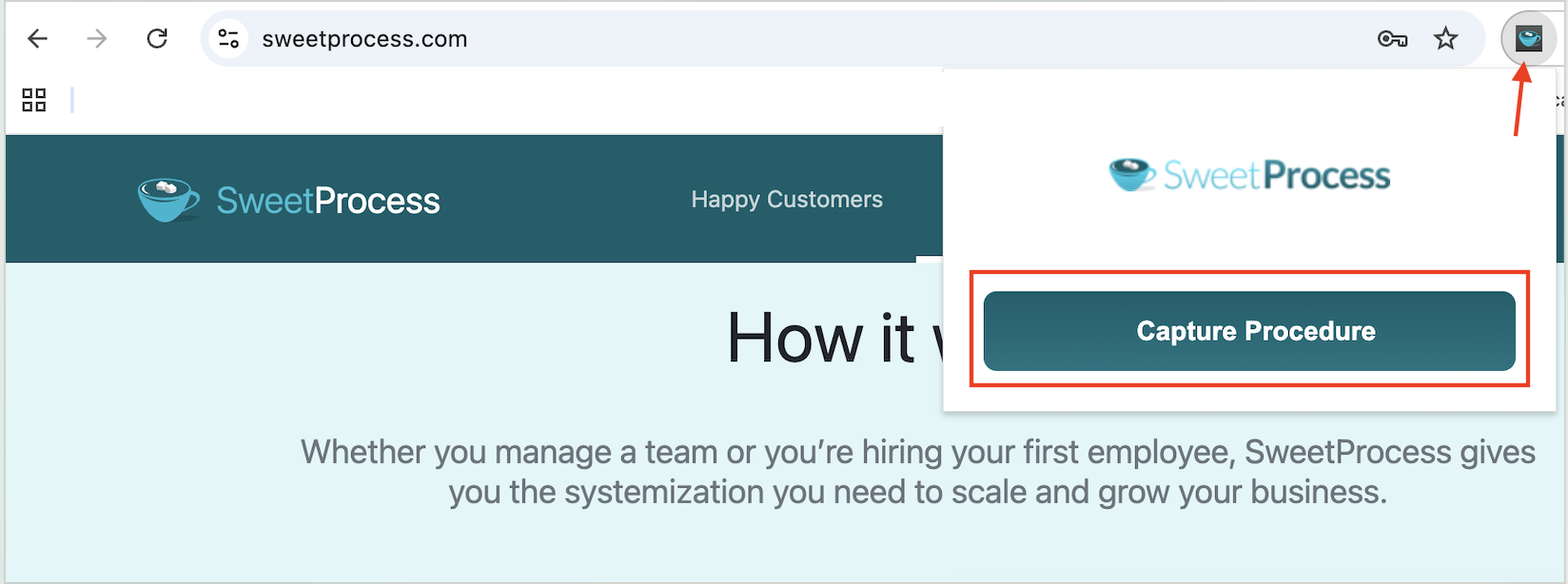
Once you record the work, you can clean up the steps, add notes, and assign someone to own the result.
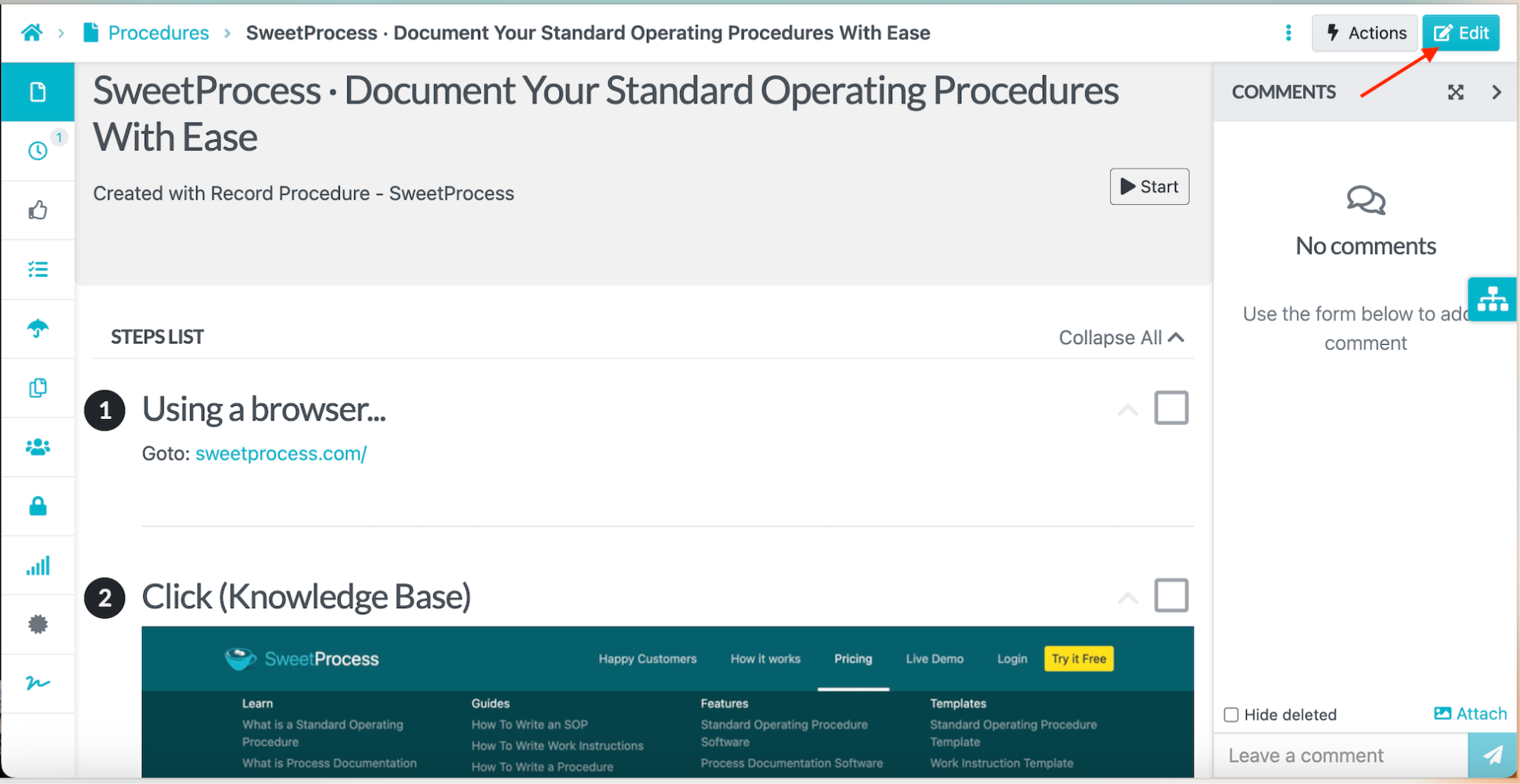
Alternatively, you can draft your SOPs using SweetAI.
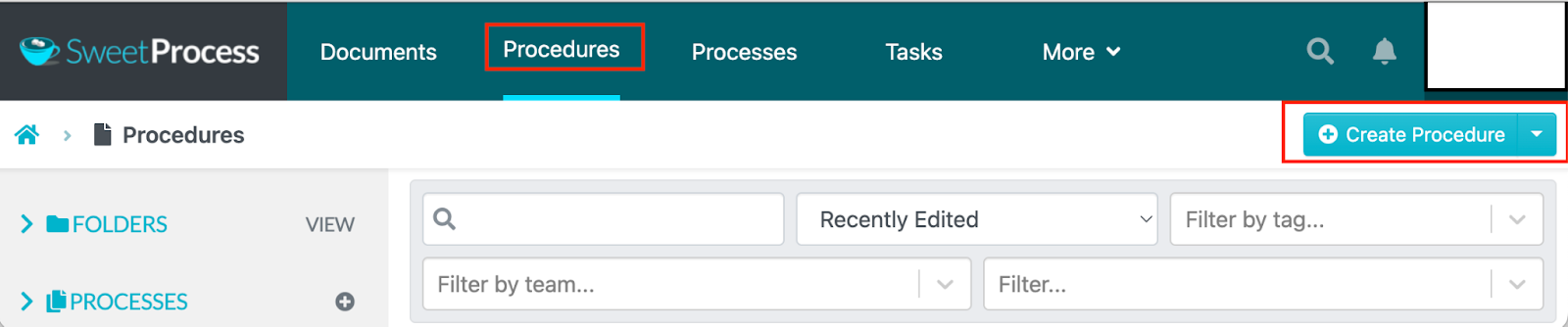
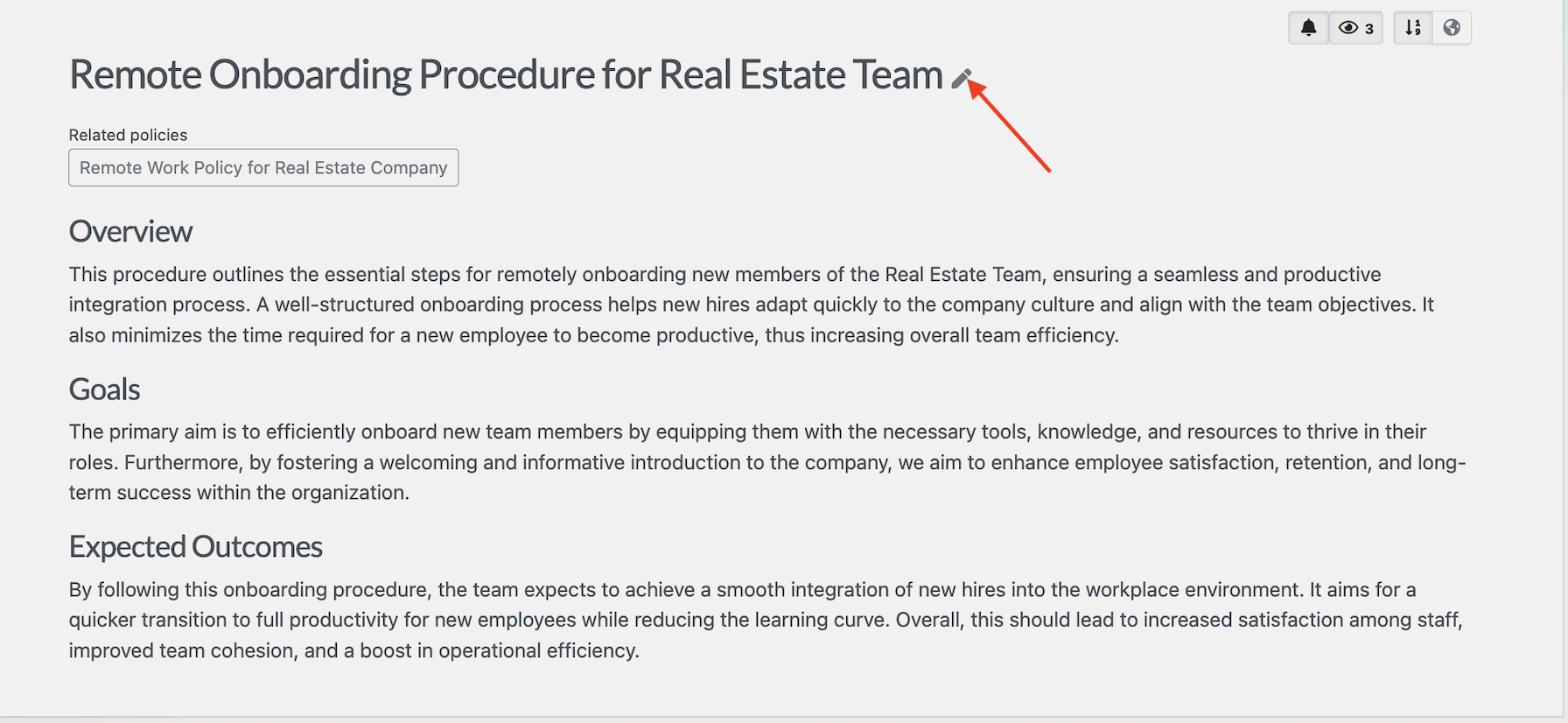
You just need to add a procedure title and select “Write with SweetAI.” SweetProcess generates a draft within seconds.
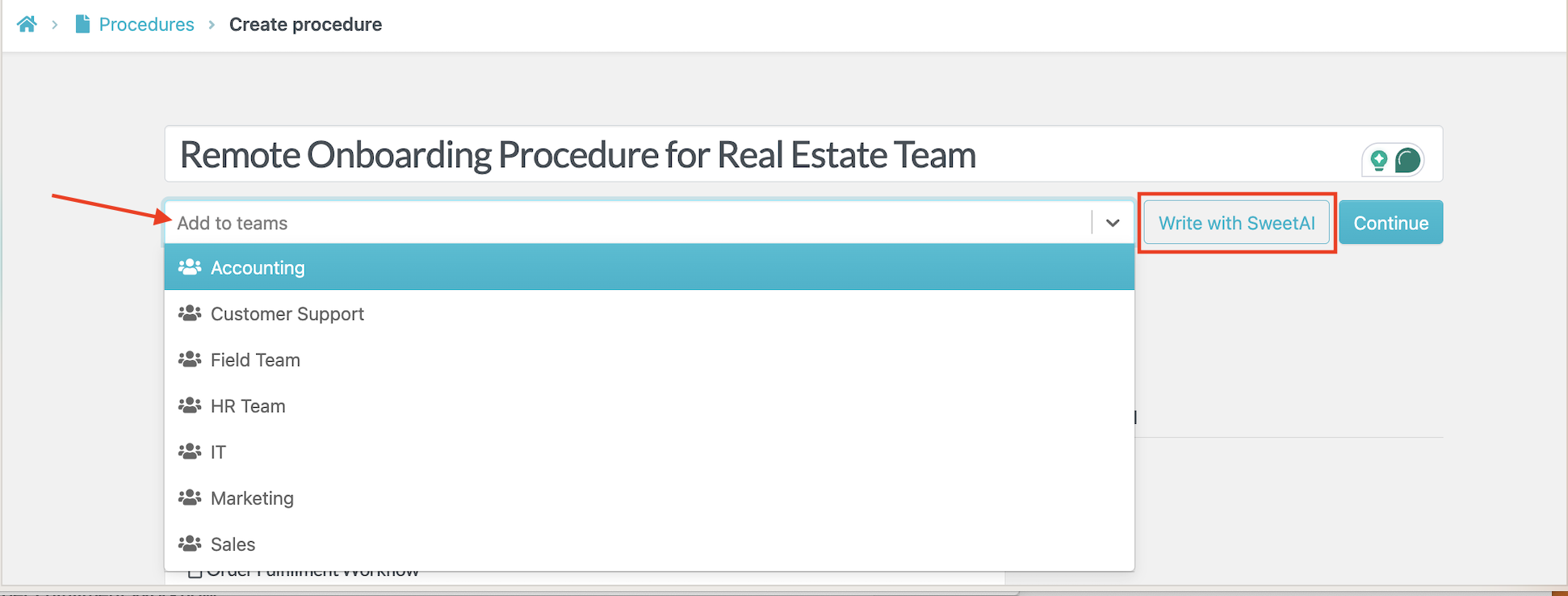
This draft is not the final SOP; you can refine it together with your team and ensure that it aligns with your business.
Handle Exceptions
Every real procedure has a “but what if.” For instance, if your team has an escalation procedure during new hire onboarding, the standard path is simple. The exceptions become necessary if issues appear during the onboarding process.
With ScreenSteps, you can create an interactive decision tree, which walks the reader through yes-or-no choices. This way, you can guide the employee toward the appropriate next instruction.
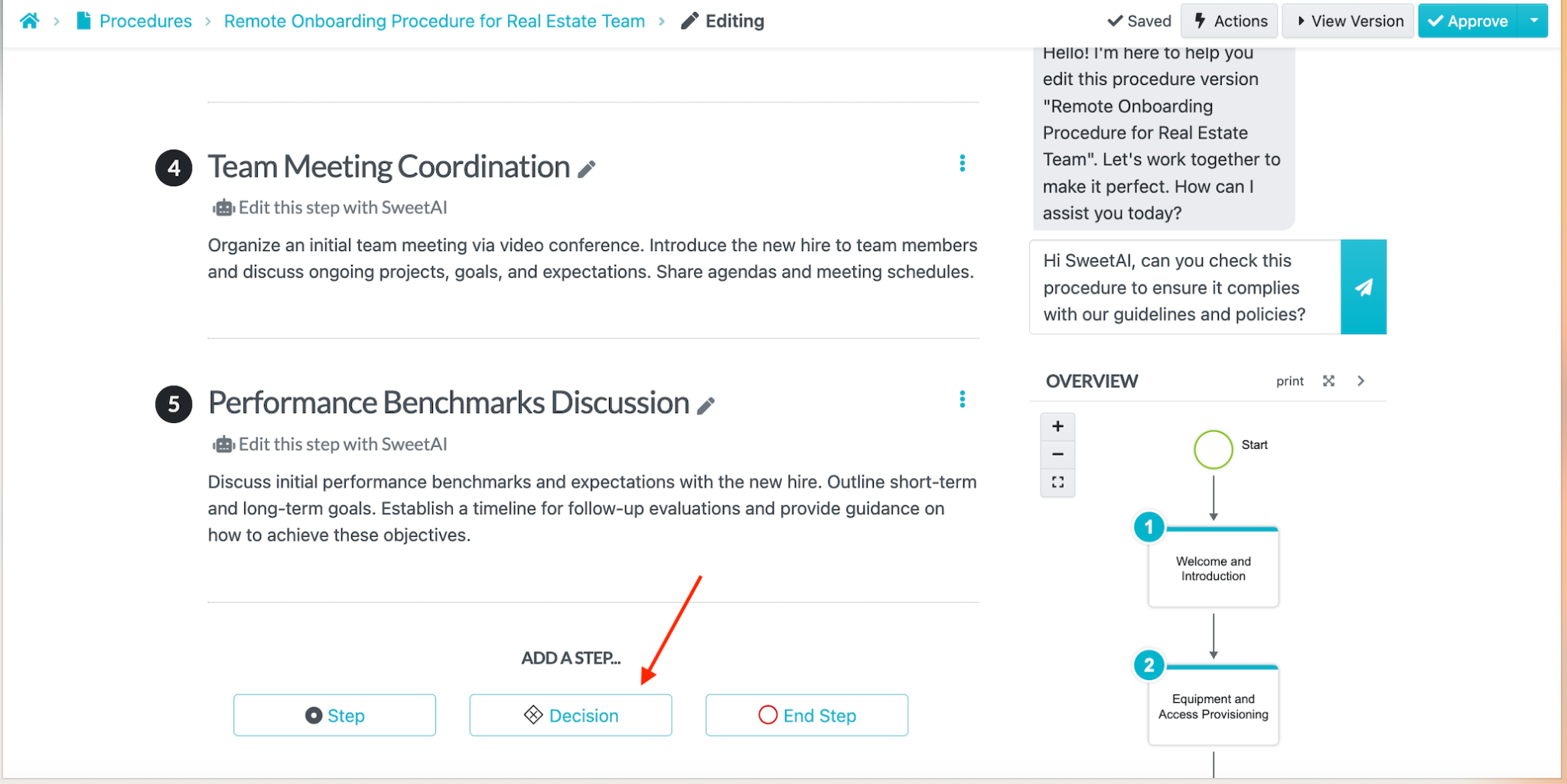
In SweetProcess, procedures are written steps. You can handle the exceptions by writing them into the procedure clearly and adding a decision point.
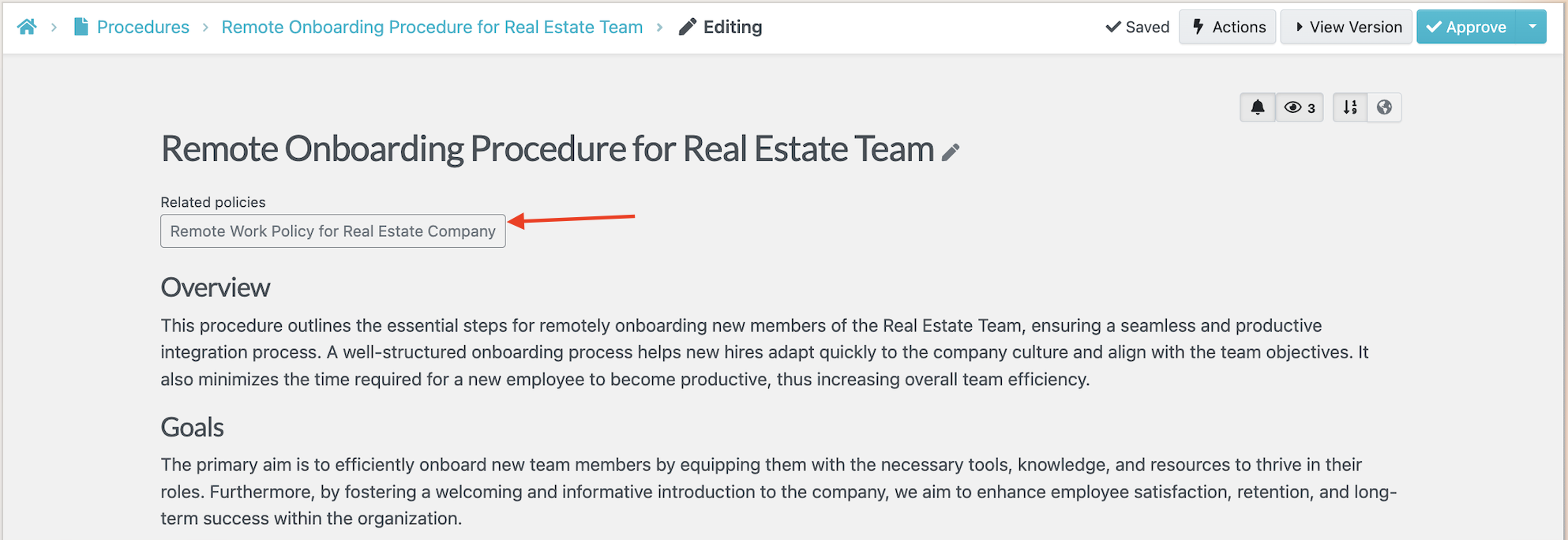
Alternatively, you can connect the procedure to the policy it supports and send it to its owner for review. An employee can open the policy and get more information about what they need to do at that step.
Approve a Usable Procedure
Before employees start using a new procedure, someone should check that it reflects the actual way the business operates. A manager might review a procedure and discover that the policy has changed.
ScreenSteps also supports authoring assignments, permissions, and collaborative editing. These capabilities help teams coordinate content creation and maintenance.
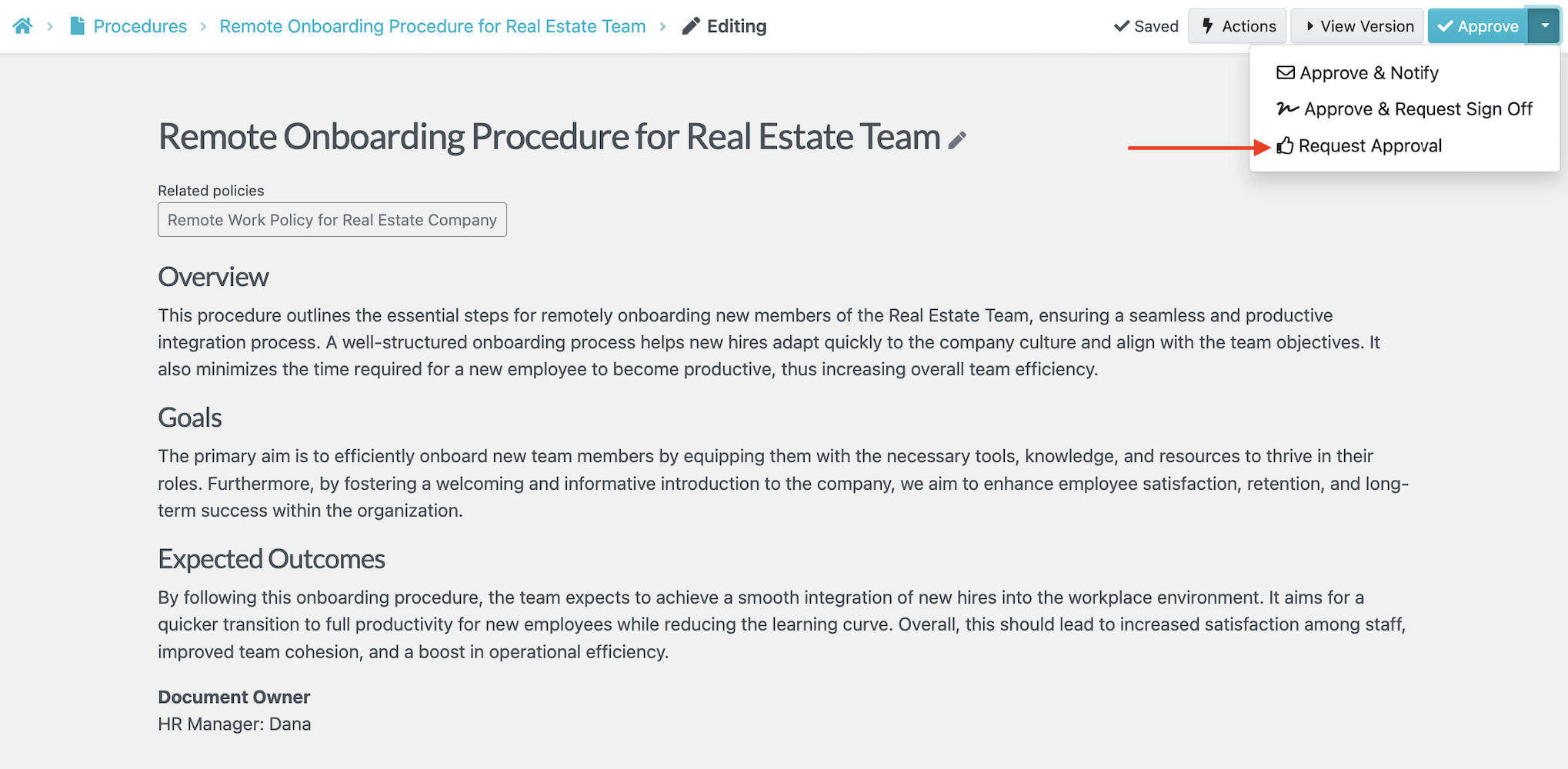
With SweetProcess, your procedures can also go through an approval process.
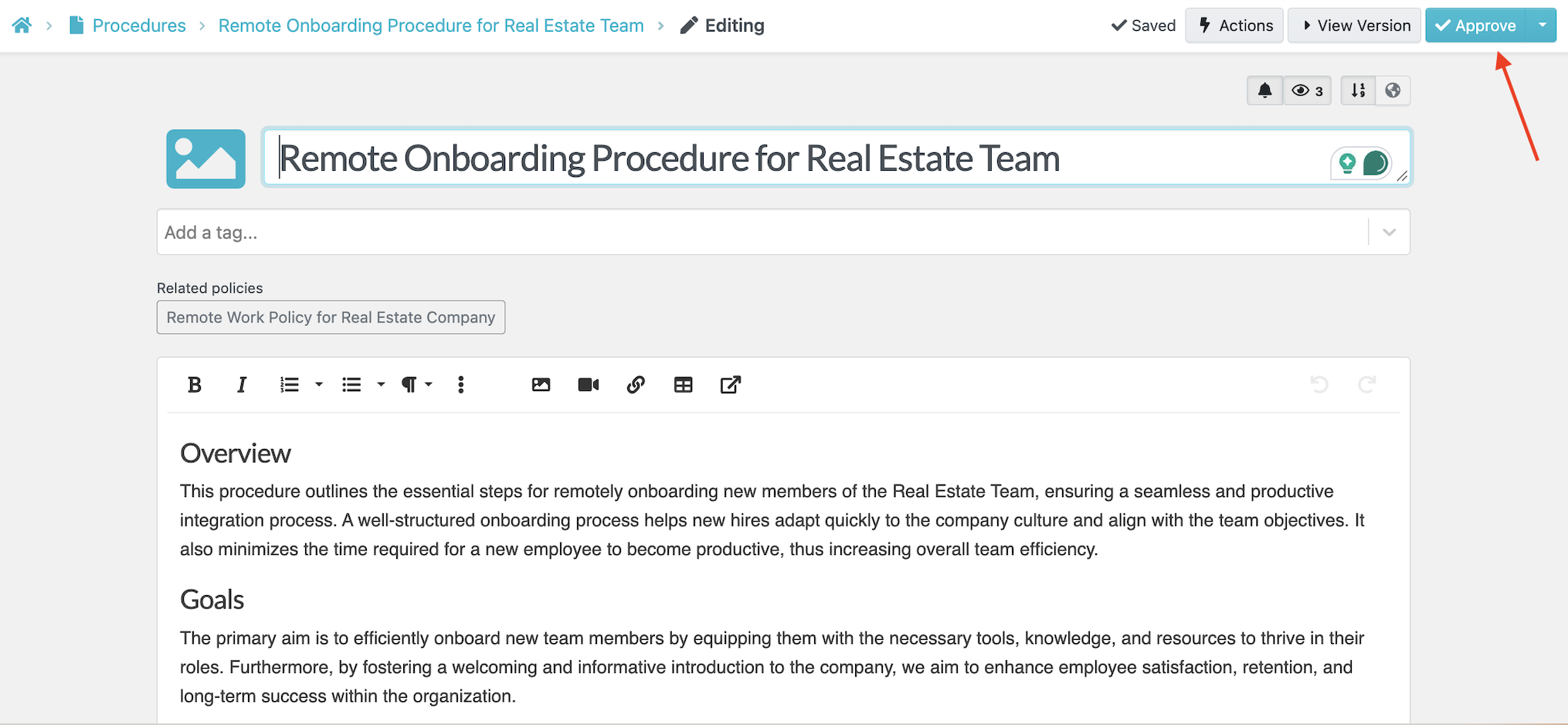
Once the author prepares the document, they can share it with a manager for approval before it goes live for everyone.
Use One Exception to Test the Authoring Model
Consider a fictional support-escalation procedure. The normal path asks an employee to identify the customer, record the issue, and send it to the responsible specialist.
The exception is an urgent request received when that specialist is unavailable. A useful instruction must identify the alternative owner, the information they need, and the point at which the employee should stop and ask for help.
A screenshot of the normal path alone would not answer that question.
In ScreenSteps, ask the author to represent that exception with the documented decision-tree or checklist capabilities.
In SweetProcess, ask the author to make the decision point explicit in the procedure, connect any relevant policy, and prepare the steps for approval.
The test is whether an employee can understand the next action, not whether the two editors produce identical-looking pages.
Give an experienced employee the first draft, then ask someone less familiar with the work to follow it using fictional data. Note missing prerequisites, ambiguous labels, and steps that assume background knowledge.
An AI-generated draft or browser capture can be a starting point, but neither establishes that the documented method is correct for your business.
The owner should correct it before approval and should know how to maintain it after the application changes.
ScreenSteps vs. SweetProcess: Finding Guidance While Doing The Work
Writing instructions is only half the challenge. Employees must also find the right information when they need it.
A procedure stored in a central library may be easy for a manager to maintain but difficult for an employee to locate during a busy customer interaction.
Find Answers in The Knowledge Base
ScreenSteps supports search and hierarchical content organization. Employees can browse structured knowledge and locate instructions relevant to their work.
With AI Smart Search, it becomes easier to locate company information once you centralize all your SOPs.
SweetProcess provides a central location for procedures, processes, and policies. Employees can search for documented instructions and access the material relevant to their responsibilities using the available filters.
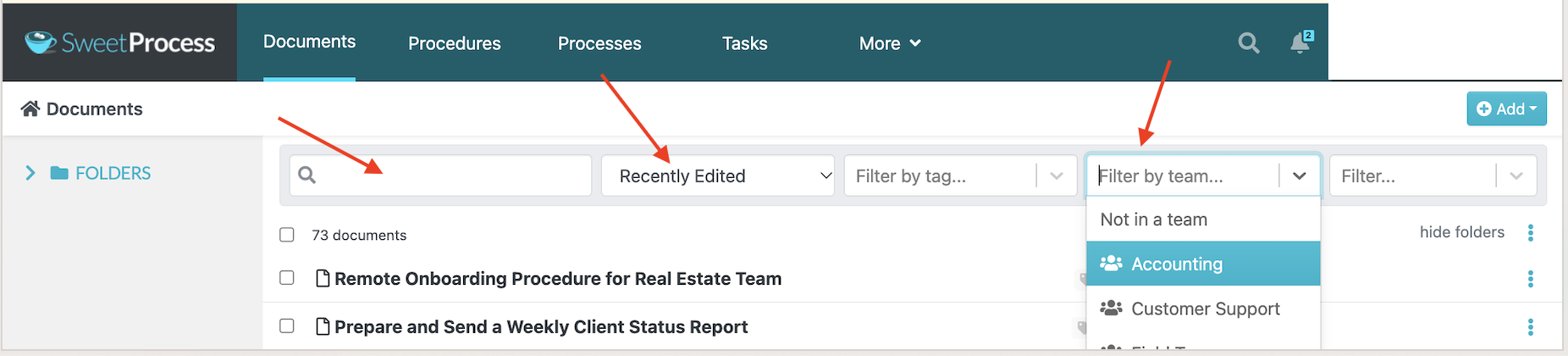
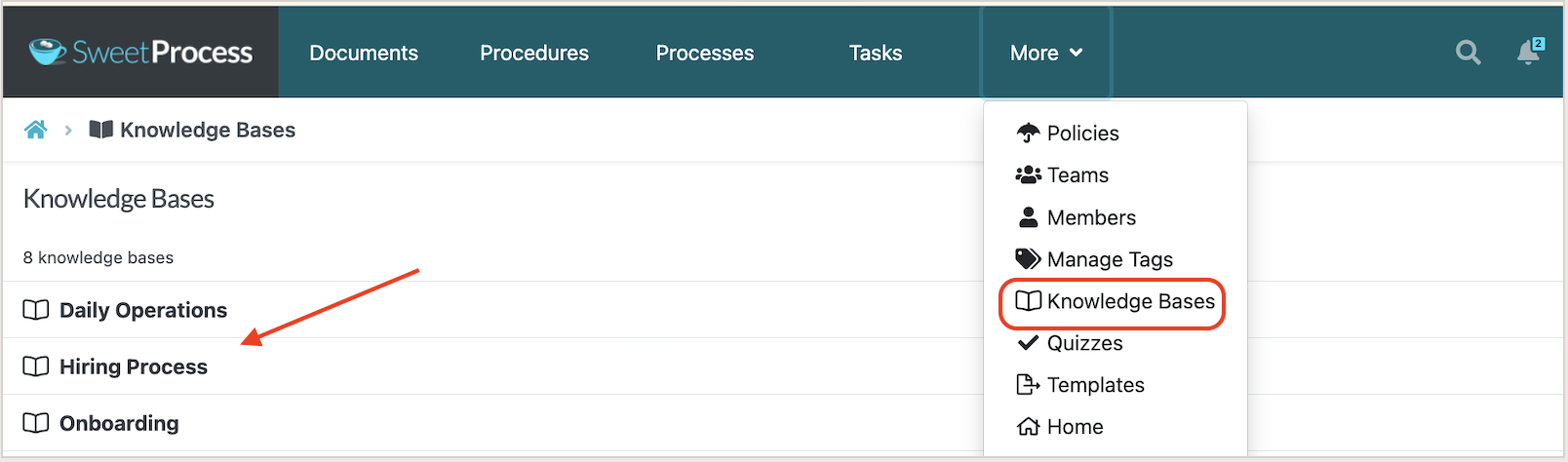
Additionally, SweetProcess organizes content into a searchable knowledge base. You can open the “Knowledge Bases” tab to access any information you need to execute the work.
Ask a new hire and an experienced employee to find the same instruction without coaching. Compare where they look, whether the result is current, and whether they can identify the relevant exception.
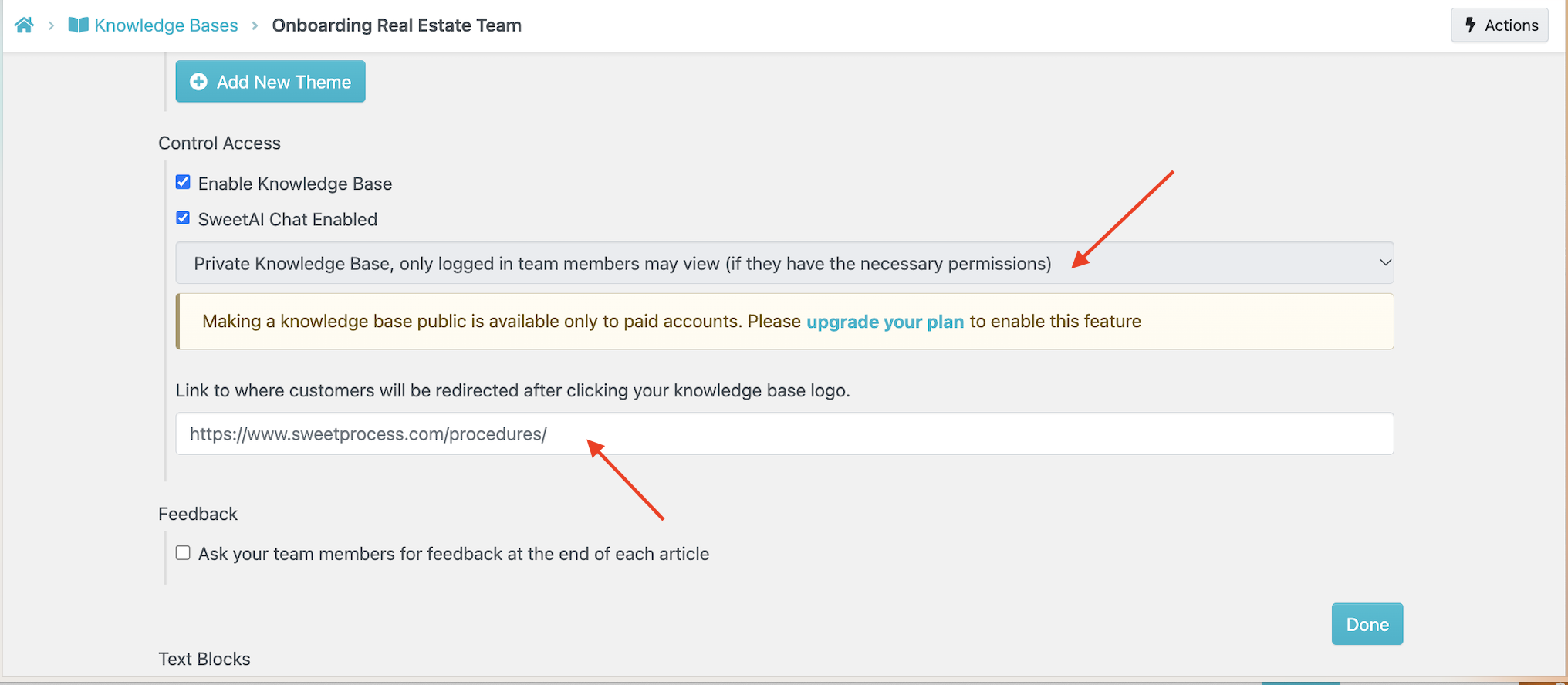
The SweetProcess knowledge bases can be made public-facing if you’re dealing with external stakeholders. You can add a link for people to access it. You can also make it private if it’s meant only for internal use.
Receive Contextual Suggestions
ScreenSteps has a more specific capability for employees who need guidance while using other applications. Its Sidekick browser extension can provide contextual SOP suggestions.
The Smart Suggestions feature automatically provides relevant knowledge base articles depending on the screen your employee is viewing.
With this context-sensitive capability, your team can access relevant SOPs without searching. This is particularly relevant for customer service, technical support, and other teams that move between several applications throughout the day.
SweetProcess offers document search, including exact-phrase and field-based operators, and task-dashboard search. Test the terms your employees use rather than assuming a particular search is faster.
Evaluate the Reader’s Actual Working Context
Choose a realistic starting point for the reader. A support employee might already be looking at a ticket, while a manager may start from a list of monthly responsibilities. Ask the employee to locate an instruction without providing its exact title.
Record whether they find the correct guide, whether they can identify its intended audience, and whether the next step is clear.
ScreenSteps Sidekick is relevant when guidance should appear beside a web application. Its vendor describes suggestions based on specific screens and URLs, as well as access to the knowledge base.
Ask for a demonstration using the web applications, user roles, and browser your team actually uses. Confirm which plan includes Sidekick and whether someone must configure the contextual rules.
For SweetProcess, examine how an employee reaches assigned work or searches the relevant documentation. Check the distinction between public and private knowledge bases using non-sensitive sample content.
A guide intended for a customer should not expose internal instructions, and an internal employee should not have to guess which of several similarly named procedures is current.
Include permissions and search terms in the pilot, not just the appearance of the knowledge-base homepage.
ScreenSteps vs. SweetProcess: Approvals, Acknowledgment, and Freshness
Your business procedures need more than a document library.
You need to define who is responsible for the content, whether the instructions have been approved, whether employees have acknowledged important updates, and when the procedure should be reviewed again.
Approve the Document
ScreenSteps supports authoring assignments and distinct Admin, Contributor, Reader, and API Access roles. Contributor permissions can allow review only, editing without publication, or management and publication.
Assigning an author is not itself a content-access restriction; configure the relevant viewing and authoring permissions separately.
With SweetProcess, an author can prepare an SOP and submit it to an authorized manager for approval. The available approval controls depend on that person’s permissions. Publishing a document and acknowledging that you read it are different actions.
Request Acknowledgment
Acknowledgment is about the reader. It records that a team member confirmed they read and understood a procedure, process, or policy. The acknowledgment is not an independent test of comprehension.
ScreenSteps offers change acknowledgment through its Sidekick feature. Once you make changes to a document, you can send change notifications and deliver messages to the employees.
Your team can then view and acknowledge them to confirm that they have seen the update.
SweetProcess has a sign-off feature for requesting and tracking a team member’s acknowledgment of a procedure, process, or policy.
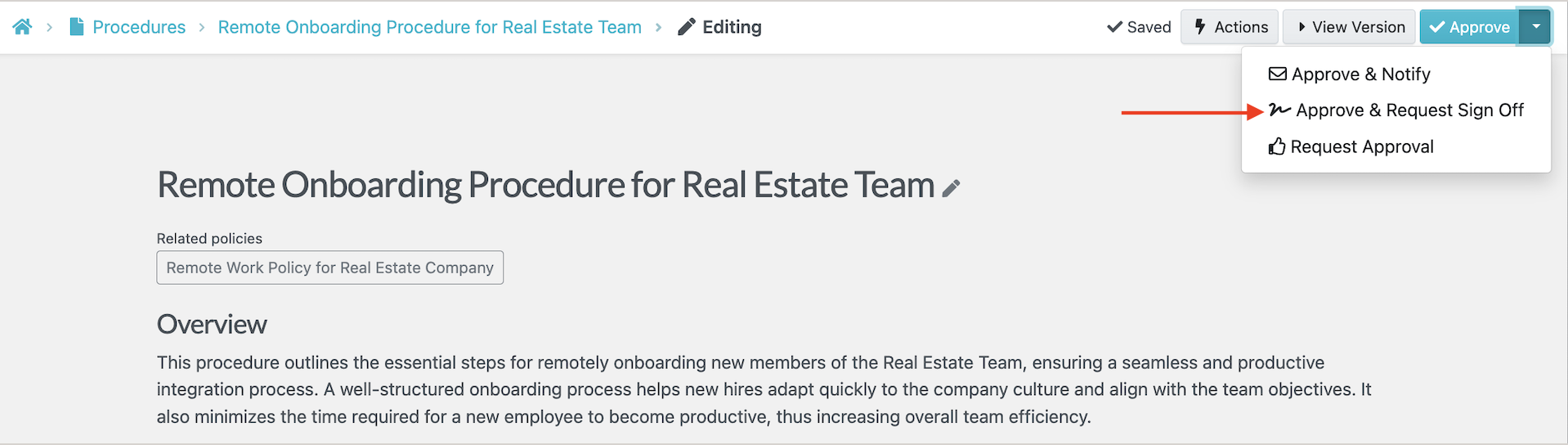
Once you request the sign-off, employees will receive an email to remind them to check the SOP or policy. This feature keeps everyone on the same page.
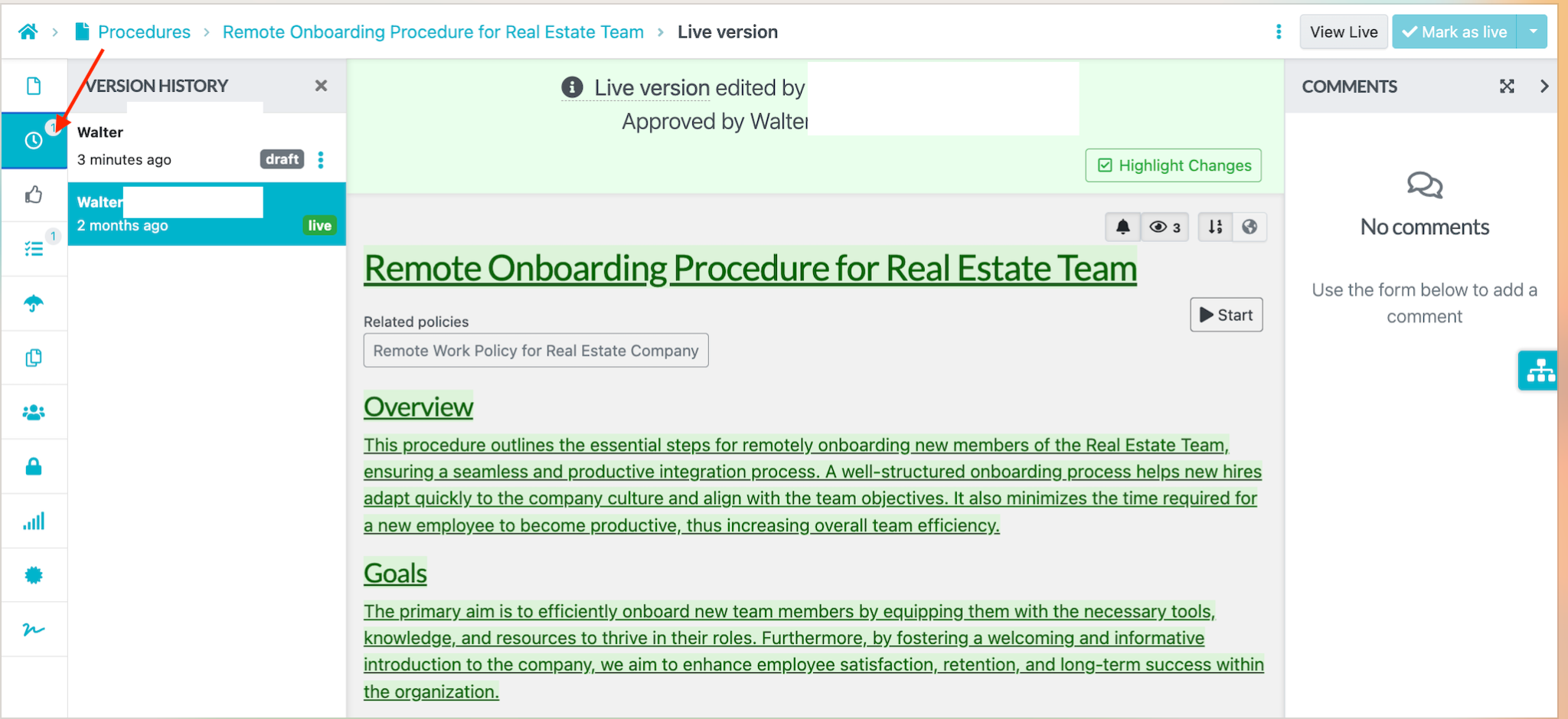
SweetProcess version history shows changes and supports returning to an earlier version. Treat version history as a record of document edits, not proof that every employee has read the latest version or completed the associated work.
Schedule The Next Review
Periodic reviews keep your information fresh. While a procedure may be accurate at the moment, it can become outdated in six months if there are policy changes or new plans in the organization.
ScreenSteps content certifications let you set a review cadence, assign process owners, send recurring review reminders, and inspect certification history.
Its documentation distinguishes certification from publication: An article can be published without being certified. Confirm the configuration in the plan you are evaluating.
SweetProcess makes it easy to schedule a periodic review for a procedure, policy, or process. The review records who checked the content and when, which gives you a trail of ownership.
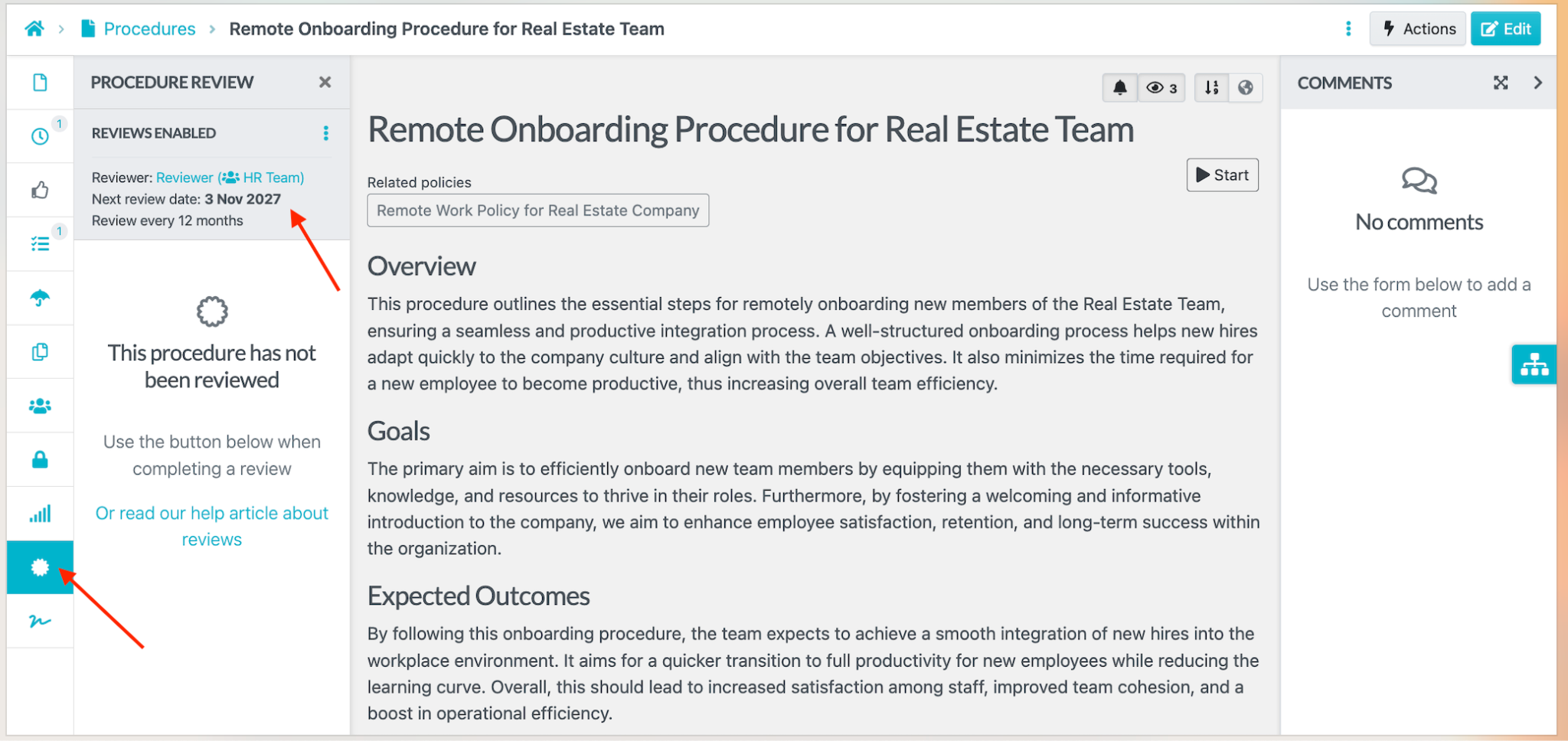
The person assigned to review the procedure should check the actual business practice on the set date to ensure that the team is using the most recent version.
Keep Four Accountability Events Separate
Use one fictional procedure to distinguish approval, acknowledgment, review, and execution. First, an authorized person checks the content and approves it for use. Second, a reader acknowledges the relevant version.
Third, the owner reviews whether the instructions still match current practice. Fourth, an employee performs an assigned run of the work. The same person might participate in several events, but the records answer different management questions.
Ask each vendor to show the person, document or task version, and date attached to the event you need. A version-history entry does not tell you that a reader saw the update.
An acknowledgment does not demonstrate that the employee performed the procedure accurately. A completed task does not prove that the underlying instructions were reviewed recently.
Keep these distinctions in your requirements so a checkmark is not mistaken for a broader guarantee.
For SweetProcess, use the documented sign-off and periodic-review workflows as separate tests. For ScreenSteps, demonstrate change notifications, acknowledgment, content certifications, and the governance controls available in the quoted plan.
Record any workflow that needs configuration or a manual step. Neither product removes the need for your organization to decide who is authorized to approve instructions and what review is appropriate for sensitive work.
ScreenSteps vs. SweetProcess: Recurring Work and Completion Reporting
If you have a recurring assignment, it tells the employee when that task needs to happen and who is responsible for completing it. This is particularly important for work that happens daily, weekly, monthly, or at another defined interval.
Both tools offer a way to check completion rates.
Assign A Task
SweetProcess procedures can be assigned as tasks to individuals or groups.
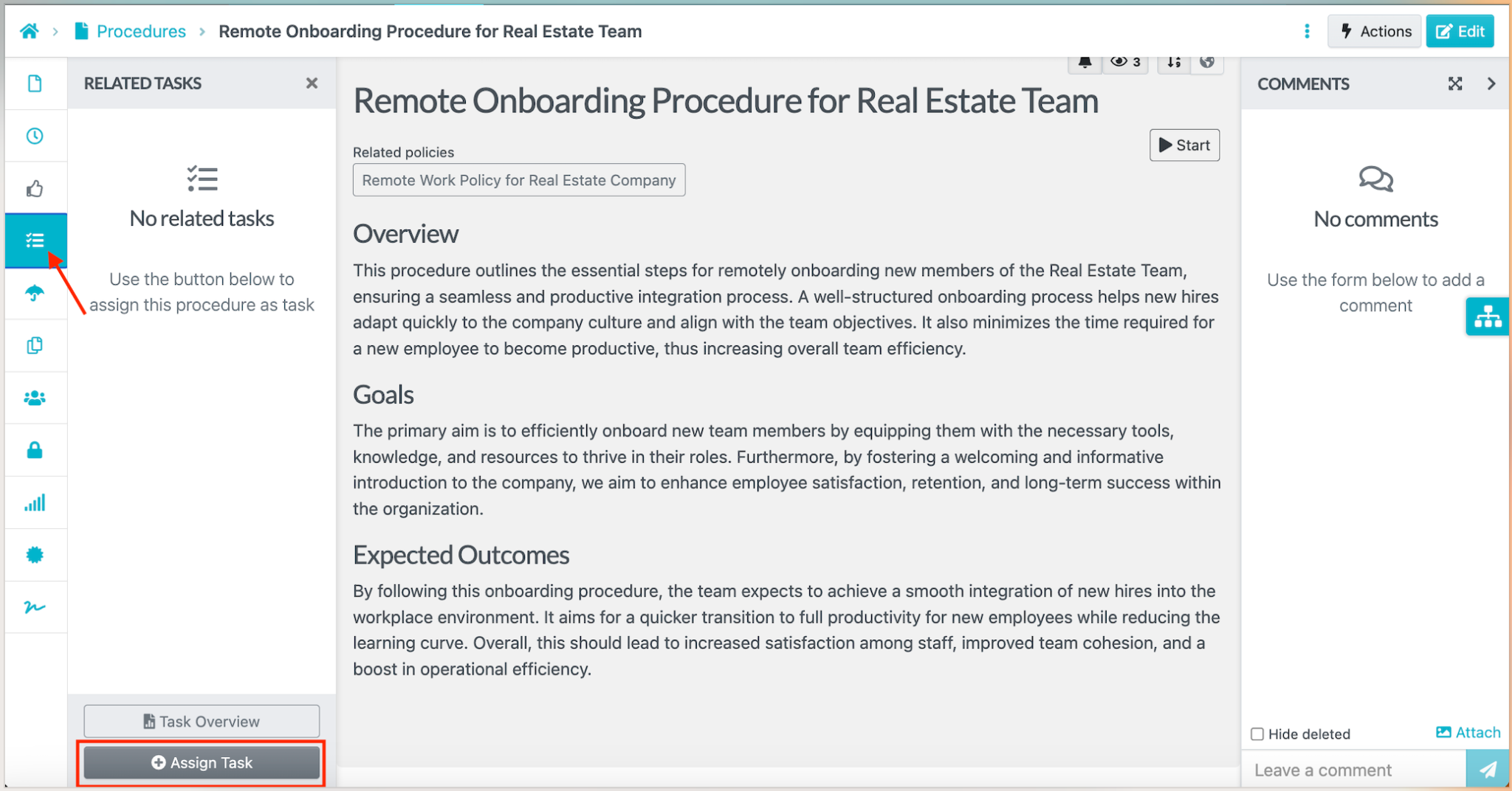
These assignments include the team member’s name or department, making it easy to track afterwards.
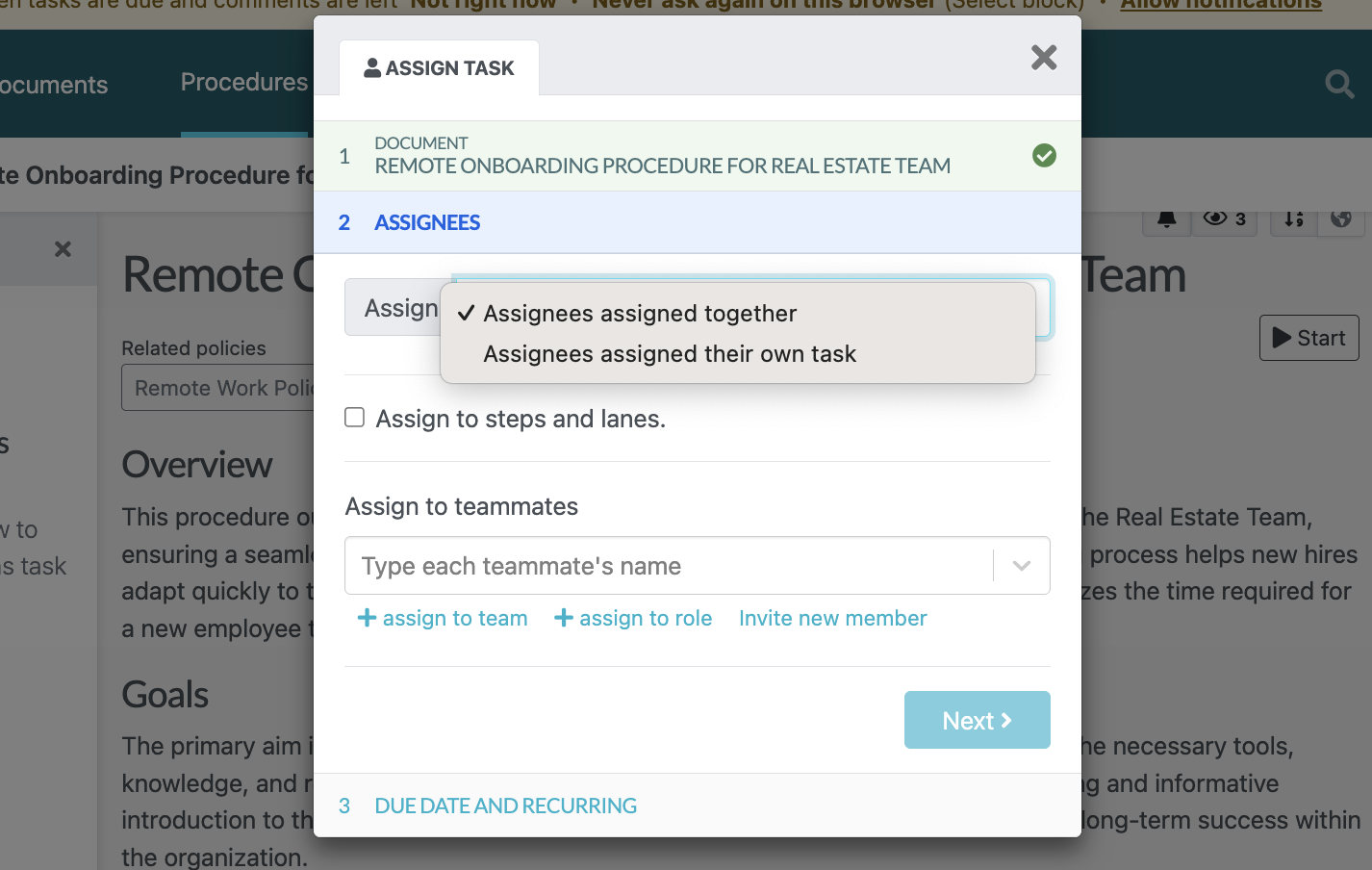
Some procedures involve several employees. For example, a purchasing process may require a purchasing assistant to collect supplier quotations, a department manager to approve the selected supplier, and a finance employee to process the payment.
Assigning the entire process to one person may not reflect how the work is performed. SweetProcess supports one task shared by several employees or separate tasks assigned in bulk.
Step lanes group related steps so a manager can assign responsibility for a portion of the procedure or process.
You can also add due dates and indicate whether it’s a recurring assignment.
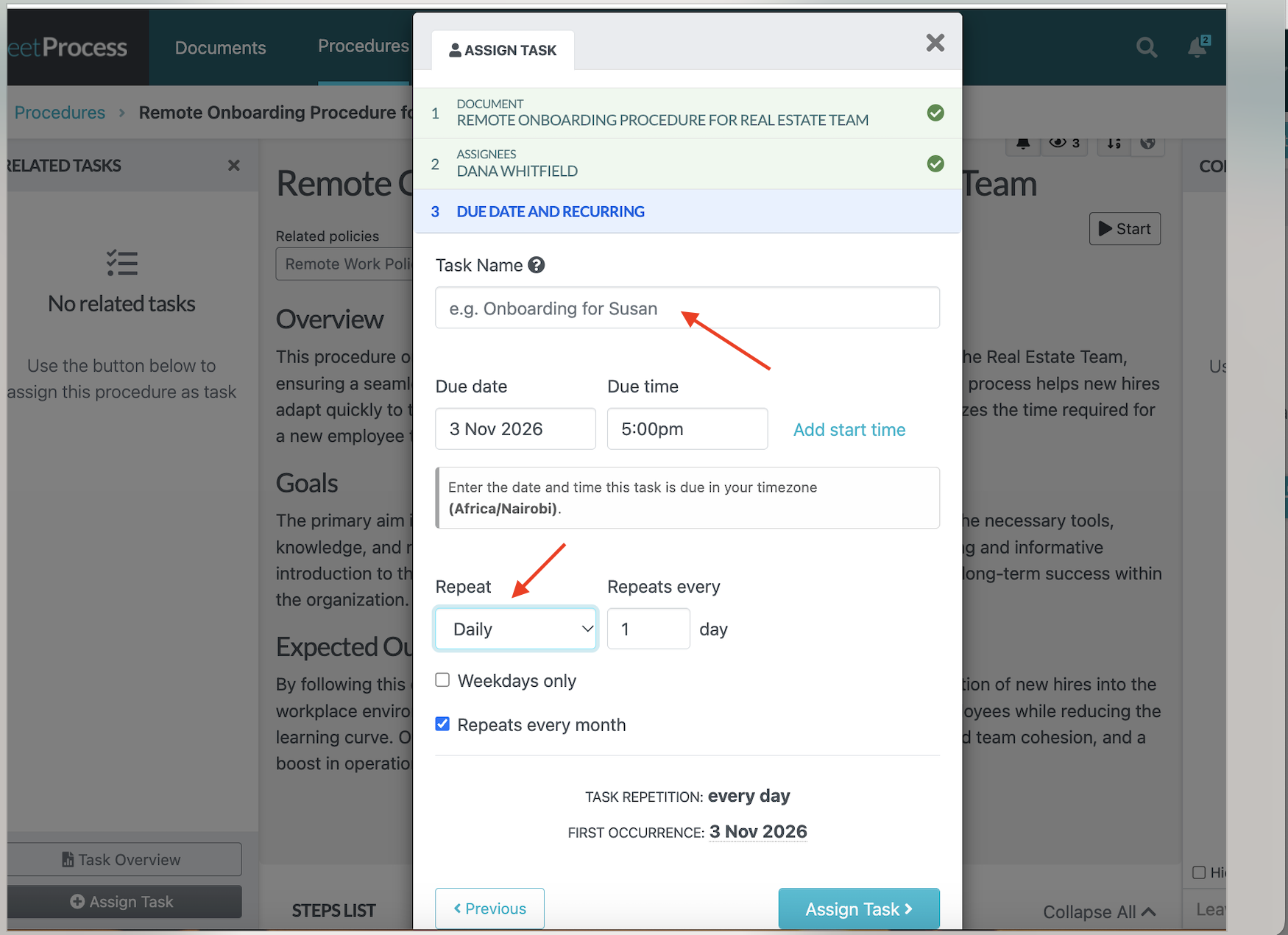
This feature allows you to connect the documented procedure with the actual work that needs to happen.
Inspect Progress
In SweetProcess, managers can inspect what happened during execution. You can view all the assigned tasks from the main menu to see what’s been completed and what’s pending.
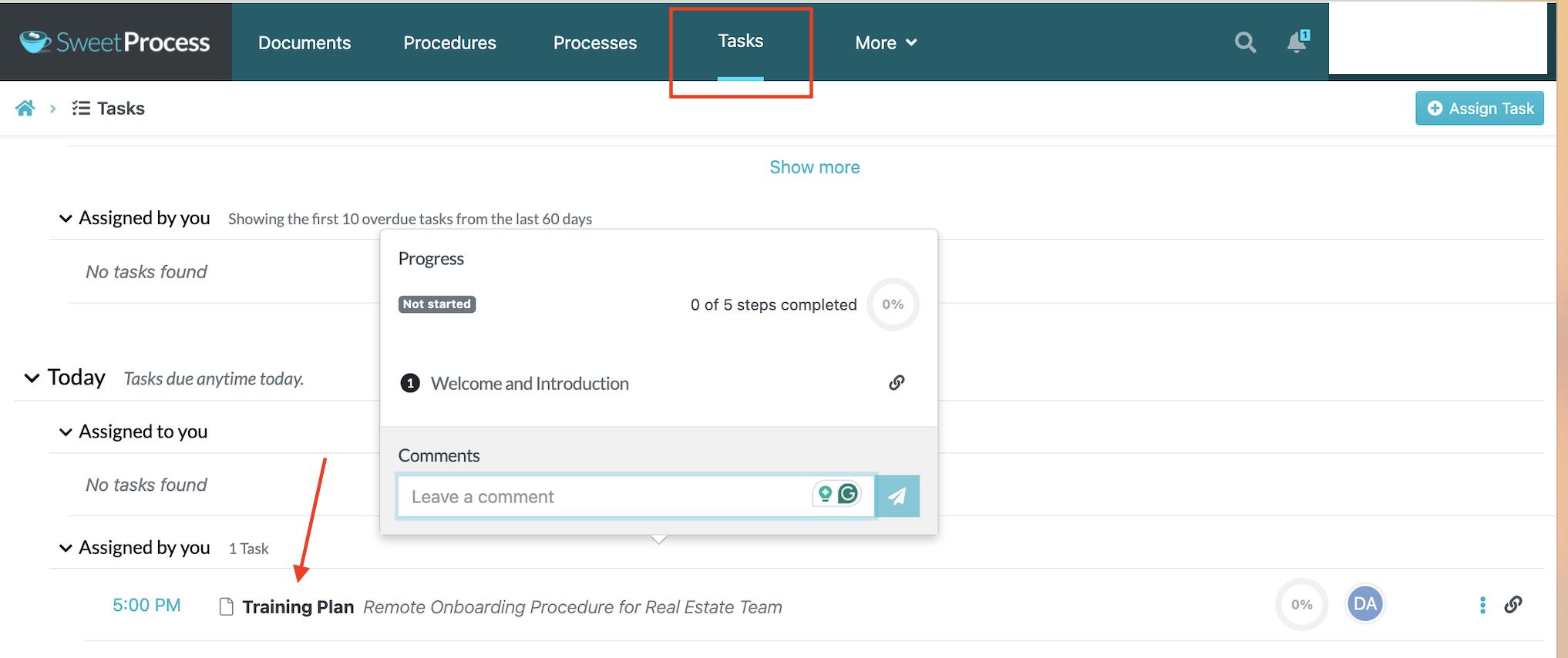
While these records are useful for operational follow-up, they should not be mistaken for proof of every business outcome. A completed step does not automatically establish that the work was accurate.
Managers still need appropriate checks and review procedures.
ScreenSteps also provides completed-checklist reporting. With the built-in reporting, you can see which articles in your knowledge base have been viewed and by whom. You can also see the search terms being used by your team or clients.
Test the Handoff, Not Just the First Assignment
A fictional month-end purchasing review makes the requirement concrete. An assistant collects outstanding purchase information, a department manager checks exceptions, and a finance employee records the agreed follow-up.
The written process should explain the handoffs and the evidence each person supplies. Use sample values rather than real supplier, employee, or financial information during the evaluation.
In SweetProcess, examine how procedures or processes become assigned tasks, how responsibility is grouped through step lanes, and how start times, due times, and recurrence match the intended schedule.
Ask the evaluator to inspect an incomplete run as well as a completed one. Determine who receives a notification, who follows up when a person is absent, and what a manager can learn from the task history.
These are evaluation questions, not claims that an untested configuration already meets your requirements.
ScreenSteps documents completed-checklist reporting, so do not exclude it merely because it presents guidance differently. Ask the vendor to demonstrate the exact combination of repetition, ownership, deadlines, and reporting you require.
Record which behavior is built into the proposed configuration and which depends on another system or a manual action.
Finally, decide what evidence belongs in a task. A timestamp may show when someone checked a step, but quality can require a separate review, an attached record, or another business control. Avoid collecting unnecessary personal data in sample forms.
The aim is a clear operating record that a manager can interpret, not a claim that software completion proves every real-world outcome.
ScreenSteps vs. SweetProcess: Integrations and Access
Your documentation platform needs to work with the tools your employees already use. You can connect systems by native integration, API development, or Zapier automation.
ScreenSteps documents several integration and access options, including:
- APIs: The ScreenSteps API allows you to manage your content and a third-party platform.
- Browser extension: If you need information from different web browser tabs, you can install the extension and capture guides that your team can use to complete tasks.
- IFrame embedding: With ScreenSteps, you can embed your site or specific articles.
- Single Sign-On (SSO): Employees and other users can log into ScreenSteps via your existing applications.
ScreenSteps documents SAML single sign-on, content and user-management APIs, SCIM provisioning, and iframe embedding. Confirm which route supports your application and which plan or development work it requires.
Displaying guidance inside an application does not mean that business records automatically synchronize between the two systems.
SweetProcess provides a public API and connects with other apps through Zapier. The Zapier dependency matters: It is not a native integration with every application.
Confirm the trigger, available action, authentication, data fields, and any separate Zapier charges before buying.
For either product, ask the person responsible for your systems to demonstrate the exact handoff.
Identity management, embedded guidance, and moving business data between applications solve different problems; one should not be presented as proof of the others.
Write a Small Integration Requirements Matrix
For each desired connection, record the originating event, destination, required fields, authentication method, responsible owner, and failure-handling process.
For example, “show instructions beside the ticket” is different from “create a task when a ticket changes status.” The first concerns delivery of guidance; the second concerns an automation that must pass business data and handle errors.
Ask whether the connection uses a native feature, a browser extension, an embedded page, Zapier, or custom API development. Confirm availability in the quoted plan and any separate service costs.
An application logo or a large integration count does not prove that the action you need is supported. Have the systems owner run the actual trigger with fictional data and inspect the result.
Test access independently. Single sign-on helps people authenticate; provisioning governs account creation or removal; content permissions determine what a signed-in person can view or edit.
Ask what happens when someone changes teams or leaves the business. Include the identity provider and the person responsible for maintaining the connection in the rollout plan.
Do not assume that configuring authentication also configures every document’s audience.
Migrating Existing Documentation
If you have existing Word files, shared drives, and old wikis, you can migrate them to an SOP documentation tool. Both ScreenSteps and SweetProcess have features that allow you to export your procedures.
ScreenSteps supports PDF export of published articles, chapters, and manuals. Interactive Workflow articles cannot be exported as PDF.
Its API can extract HTML for backup or publication elsewhere, but interactive behavior and design may not carry over. Include these limits in a migration pilot.
As you edit your procedure, you can also move it from SweetProcess.
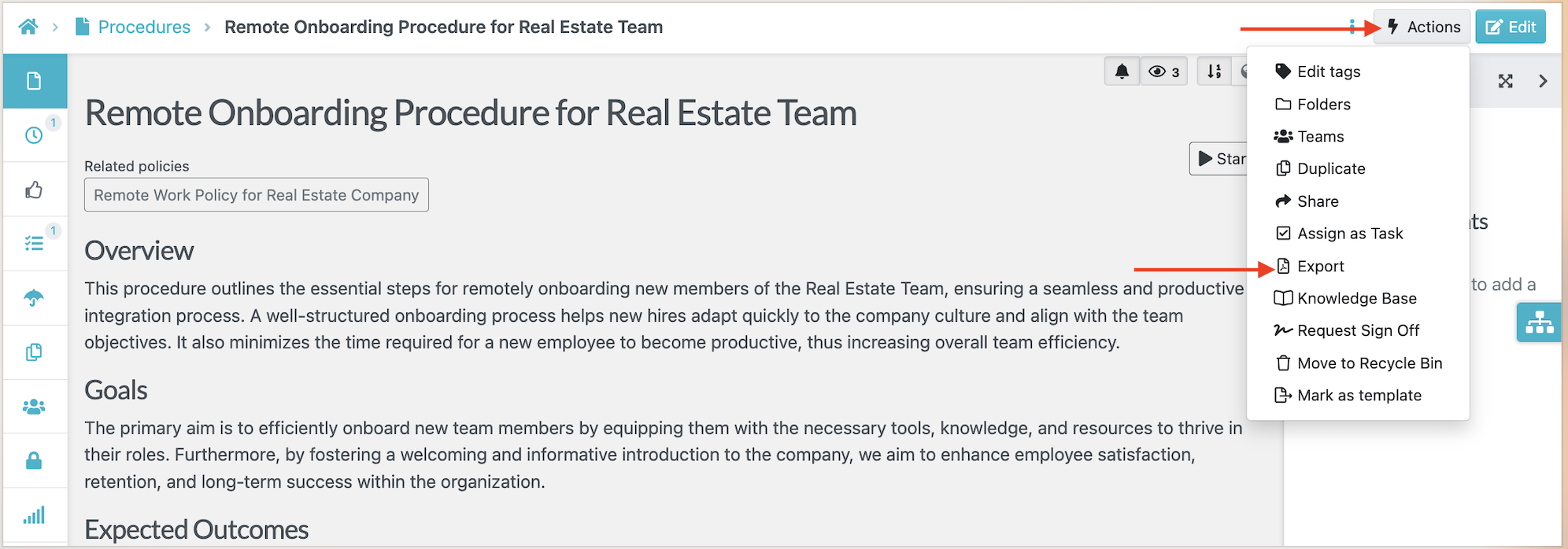
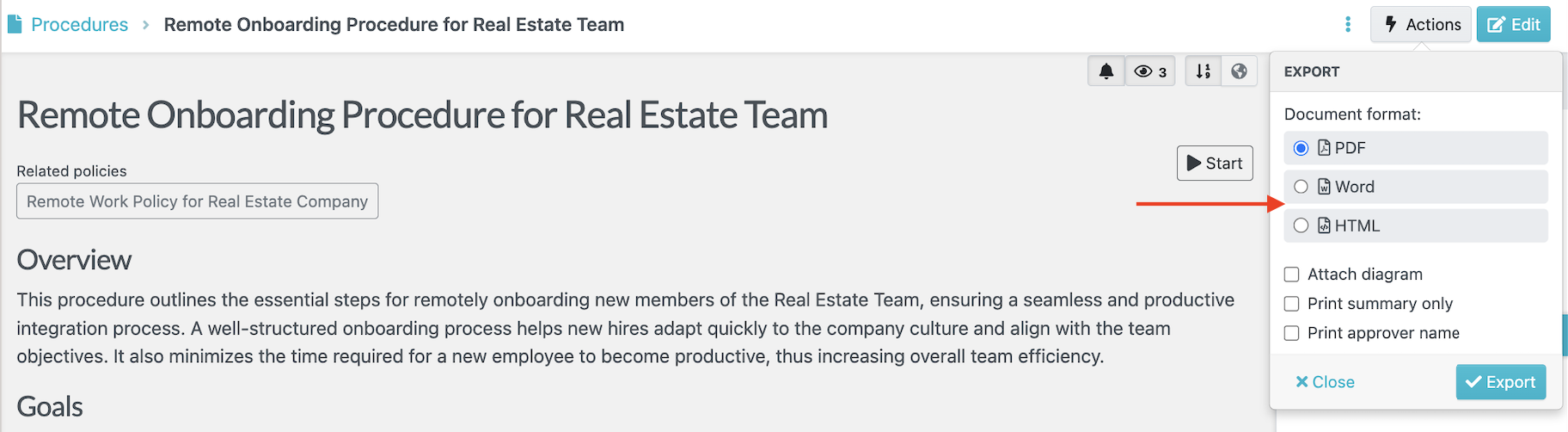
SweetProcess documents PDF and Word export for procedures and policies; processes export as PDF only. The account owner can disable export for teammates.
Confirm the format and permissions you need, including whether images and links survive the export. A downloaded manual is not an offline application with synchronized task execution.
Before migrating to either tool, you can use the free trial to test whether it’s a good fit. Here are the key things to do before the migration:
Audit the Existing Library
Start by listing the procedures, policies, and training documents your team currently uses. You can group them into instructions that are accurate and still relevant, and documents that contain useful information but need corrections.
You can also delete the duplicates or unnecessary documents that you no longer use.
Import the Documents
For SweetProcess self-service import, save the source as DOCX and follow the document-import heading requirements. Native heading styles, rather than merely bold text, identify the main title and steps.
Test a Pilot Procedure
Begin with a small, representative pilot rather than transferring your entire documentation library. Select several documents with multiple steps and at least one document with an exception path or embedded media.
After importing, check whether headings appear correctly, images and other media are preserved, the links still work, and the right employees can access the content.
This way, you can determine what needs to be edited before the employees can start using the procedure.
Have an Employee Revise the Procedure
You can then ask an experienced employee to use each product to create or update the instructions. Observe how they capture the steps, organize the content, explain exceptions, and prepare the document for approval.
For ScreenSteps, you can test the authoring experience, decision trees, checklists, and any AI features included in the proposed plan. With SweetProcess, you can evaluate browser-based capture, editing, policy connections, and the approval workflow.
Plan the Rollout
Once the pilot is complete, identify the employees who need access and the people responsible for maintaining the new library. Here, you can document the owners and define the time to review and approve their procedures.
Define Acceptance Before Expanding the Import
Choose a small set containing a straightforward procedure, a policy, and a document with an exception or image. For SweetProcess self-service import, follow the documented DOCX heading requirements.
Assisted migration is a separate service; sending files to that service is not the same as every file type being supported by the direct importer. Confirm the route before allocating staff time.
Compare each result with its source. Check title and heading levels, step order, images, meaningful alt text, links, tables, and any decision points. Then inspect ownership, access settings, and the approval state.
Ask a representative reader to follow the imported instruction. A successful upload only establishes that a file was accepted, not that its content is ready for employees.
Keep the original library available while the pilot is being checked. Agree who can approve each replacement and when staff should stop using the older version.
Roll out by a manageable set of procedures or team, with a clear reference point for questions. Avoid moving every document first and discovering afterward that the new structure, permissions, or authoring conventions need to change.
Fair Evaluation Pilot
To evaluate both ScreenSteps and SweetProcess, you can use one test to determine how each software handles it.
- Prepare the same source procedure: Draft a current SOP and include the purpose of the procedure, the employees responsible, tasks required, approval requirements, and the expected outcome.
- Ask employees to find a procedure: You can assign a procedure as a task or ask your team to find information in the knowledge base to determine how easy it is to use. Record how long every employee takes to find these documents.
- Test acknowledgment and completion: Have a manager update the procedure and request acknowledgment where relevant. This way, the manager can determine if the employee acknowledged the update.
- Record final findings: Keep track of every capability and whether it’s relevant for your business. You can indicate the limitations, administration effort required, and total cost of implementation.
Keep a Decision Record You Can Revisit
Use the same workflow, source material, exception, and employee roles for both products. Before the trial, write down the few requirements that would prevent adoption if they failed.
These could include finding guidance in the working application, assigning a recurring run, requiring a reader acknowledgment, or preserving a particular import structure.
Do not add an arbitrary numerical score after seeing which interface looks better.
Ask an experienced employee to author or revise the instructions, someone unfamiliar with the procedure to find the right action, and a manager to inspect the relevant record. Observe where they need assistance.
Keep notes on the plan used, configuration required, unresolved limitations, and any work that depends on another service. Separate a capability that was demonstrated from one described only in a sales conversation.
At the end, compare the evidence with the original requirements. Obtain written costs for the intended number of users and needed features. Name the person who will own updates after rollout and how they will learn that an instruction has changed.
If a critical requirement remains unverified, ask for a specific demonstration before making the commitment. A useful pilot ends with a defensible fit decision, not a promise that either product is best for every team.
How SweetProcess Can Make SOP Documentation Efficient (Real-Life Case Studies)
Two published SweetProcess customer interviews describe documentation problems worth considering in your evaluation.
XL.net: Make an Accumulated Library Usable
In the original XL.net interview, CEO Adam Radulovic described a library approaching 2,500 processes, procedures, and policies. Staff had difficulty identifying which instructions were relevant, and some documents had not been touched for years.
That figure describes the historical library in the interview, not the company’s current size.
The team migrated and simplified its material in phases. Leadership learned the system first, then department heads trained employees as relevant procedures came up. Radulovic also described using recurring procedures and completion alerts.
The useful lesson is to combine cleanup, ownership, and a manageable rollout rather than measuring success by the number of files imported.
For your own pilot, choose a procedure that employees currently struggle to find. Remove duplicate instructions, ask its owner to confirm the current method, and have someone unfamiliar with it follow the revised version.
Record what still needs clarification. The interview supports this practical focus on usable documentation; it does not establish a universal productivity percentage, comparative superiority, or guaranteed reduction in errors.
Cullen Insurance Agency: Establish a Shared Reference
The original Cullen Insurance Agency interview describes inconsistency after acquisitions. Employees brought different ways of working, and managers repeatedly explained procedures.
Zac Cullen emphasized clear, step-by-step visual instructions, searchable content, and a reference employees could consult before asking a manager.
Cullen also described the problems of maintaining separate document copies and coordinating updates. A shared cloud-based reference gave authorized people a place to update the procedure rather than leaving different versions in circulation.
His account focuses on finding and following the same instructions, not simply storing more documentation.
The buying lesson is to test a real handoff between locations or teams. Ask an employee to find the approved instruction, follow its steps, and identify what changed after an update. Have the owner explain how they will notify affected staff.
Use the interview as a prompt for your evaluation, not as a forecast of financial or training results. Your rollout still needs owners, clear instructions, and checks appropriate to your own work.
ScreenSteps vs. SweetProcess: Which Should You Choose?
ScreenSteps and SweetProcess both support documentation and employee guidance, but they solve different operational priorities.
If employees need guidance inside web applications as they work, along with structured training, ScreenSteps is built for that.
You can choose SweetProcess if your priority is creating and maintaining procedures, policies, and processes that employees can follow and managers can assign.
Its sign-off, periodic review, recurring assignment, and completion-record capabilities make it a strong candidate for teams that need to connect documentation with repeatable execution.
If you need both, be honest about which job comes first. A support team might want contextual suggestions beside its ticketing tool and also need monthly audits assigned and recorded.
In that case, rank the jobs and run the pilot migration with one real workflow to determine the best fit.
SweetProcess turns documented work into owned, repeatable tasks. Sign up for a 14-day SweetProcess free trial to gauge how the tool supports the work your team performs. No credit card is required!
FAQs
Which is better for recurring SOP tasks?
SweetProcess is worth prioritizing when you need procedures or processes assigned repeatedly with due dates, ownership, and completion records.
You can assign work to individuals or groups, configure recurrence, set start and due times, and use notifications to keep employees informed. ScreenSteps supports interactive checklists and related reporting, including completed-checklist reports.
Does ScreenSteps have decision trees and search?
Yes. ScreenSteps has interactive decision-tree guides and search capabilities. Its platform supports structured knowledge organization, checklists, and employee guidance.
With the Operations AI plan, you can access AI Smart Search, alongside other AI-supported capabilities.
Do both products offer a free trial?
Yes. SweetProcess offers a 14-day trial without requiring a credit card. Users can access all the features during this period. ScreenSteps has a 15-day trial that you request through a form. A trial is different from a permanent free plan.
Before beginning this trial, confirm which features, user allowances, and configurations are available during the evaluation period.
How much does SweetProcess cost for 20 users?
SweetProcess costs $149 per month or $1,490 per year for 20 users on standard pricing. The base monthly subscription costs $99 and includes up to 10 users. The additional 10 users cost $5 each per month, adding $50 to the bill.
For annual billing, the base subscription is $990 and includes 10 users. The additional 10 users cost $50 each per year, adding $500. These are calculations based on the standard rates.
Can existing Word documents be imported?
SweetProcess supports self-service DOCX import with a consistent heading structure.
Before importing your entire documentation library, prepare a small sample and check whether headings, steps, images, links, branches, and access settings are preserved correctly.
How should teams compare accountability records?
Start by asking what each record records. Document approval concerns whether authorized people approved the content. Employee acknowledgment records a reader’s confirmation, not an independent comprehension test.
Periodic review records who checked whether instructions remain current. A task or checklist record concerns an assigned run of the work, not guaranteed accuracy or compliance.