Last Updated on November 16, 2026 by Owen McGab Enaohwo

TL;DR: Choose SweetProcess if your priority is maintaining approved procedures, connecting them into processes, and assigning recurring work. Evaluate Trainual when structured onboarding, training paths, testing, and organizational context are central to your decision. Both platforms overlap in documentation and execution, so it’s important to compare the exact features, plan conditions, records, and migration effort you need.
Start your free 14-day trial of SweetProcess.
No credit card needed. Cancel anytime.
Trainual and SweetProcess both help teams document and share how work gets done. SweetProcess connects maintained procedures with processes and assigned work. Trainual combines documentation with structured onboarding, training paths, and operational tools. Your choice depends on which workflows you need to run and which records you need to keep.
Compare the complete sequence: create instructions, approve changes, train employees, assign recurring work, and inspect the resulting records. Pricing, permissions, and migration effort matter alongside the feature list.
Key Takeaways
- Trainual and SweetProcess overlap. Both document procedures, assign work, and keep records, so the better fit for your business depends on which job comes first.
- SweetProcess is built around operational documentation and recurring work. It organizes policies, procedures, and processes, supports document review and acknowledgment, and lets teams assign procedures and processes as work.
- Trainual centers on structured training and onboarding, with training paths, testing, and e-signatures. It also offers reusable checklists and a separate Operations suite.
- SweetProcess publishes prices that include up to 10 users, with additional-user fees. Trainual requires a quote and charges a one-time $1,000 implementation fee.
- Before switching to either tool, you need to test the workflow and see whether it fits your operational needs. To use SweetProcess, try it here. It’s free for the first 14 days.
Table of Contents
Trainual vs SweetProcess: At a Glance
Trainual vs SweetProcess: Procedure and Process Creation and Capture
Trainual vs SweetProcess: AI Assistance and Human Review
Trainual vs SweetProcess: Approval and Version Control
Trainual vs SweetProcess: Training and Acknowledgment
Trainual vs SweetProcess: Recurring Work and Tracking
Trainual vs SweetProcess: Knowledge Access and Search
Trainual vs SweetProcess: Security and Integrations
Trainual vs SweetProcess: Pricing
Final Verdict: Choose the Workflow You Need to Maintain
Trainual vs SweetProcess: At a Glance
What You Need | Trainual | |
|---|---|---|
Primary fit | Maintaining procedures, policies, and repeatable processes | Structuring employee training, onboarding, and organizational knowledge |
Authoring and capture | Write steps, import a .docx file, or record a workflow with the Chrome extension. Flowcharts generate automatically | Built-in editor and screen recording, flowcharts, and 500+ templates |
AI-assisted drafting and human review | SweetAI drafts procedures and policies for you to review and edit | AI-assisted documentation and AI-powered knowledge search with Q&A |
Approval and history | Supports manager approval, scheduled periodic reviews, and version history with rollback | Commenting, content verification reminders, and version history with restore |
Learning and acknowledgment | Quizzes, plus sign-offs that record the signed version and time | Testing on all plans; individual training paths and e-signatures on Pro and higher |
Recurring work | Assign procedures or processes as tasks with due dates and repeat reminders | Reusable checklists are available, and a separate Operations suite supports additional operational activities |
Version history | View the current version and restore older ones if necessary | Version history and restore are supported; retention varies by plan |
Search and access | Search by name, relevance, and tags. Teams limit who sees what. | AI-powered knowledge search |
Security | Review authentication, permissions, and access limits | Multi-factor authentication is documented on all plans |
Pricing | $99 per month or $990 per year for 10 users. Small team of five users charged $495 per year | Request a demo to get a quote. $1,000 one-time implementation fee |
Competitor features and pricing checked October 16, 2026. Confirm plan limits and quoted terms before purchasing.
What Is SweetProcess?
SweetProcess brings policies, procedures, processes, and assigned tasks into one workspace. We publish this comparison, and we recommend SweetProcess when your priority is keeping operating instructions current and using them to run repeatable work. The sections below also identify where Trainual may fit your requirements.
Core capabilities include:
- Helping you document step-by-step procedures so your staff members can perform tasks without relying on your input.
- Allowing you to combine multiple procedures to make an overarching workflow so that a single staff member can deliver a project from start to finish.
- Assigning procedures and processes as tasks so employees can follow the instructions and managers can review recorded progress.
- Allowing your teammates and managers to suggest improvements to a process or procedure and giving managers the power to approve them so that you’re not running the team in silos.
What Is Trainual?
Trainual is a standard operating procedure software that allows you to combine documentation with training. You build content, group it into subjects, assign it by role, and test comprehension. It also offers reusable checklists and a separate Operations suite for meetings, goals, scorecards, and action items.
Trainual fits best when your priority is structured onboarding, learning paths, and testing.
Which Tool Fits Your Work?
Before comparing individual features, decide what job you need the software to do. This could be for:
- Governed operating instructions: Procedures that someone owns, reviews, and keeps current.
- Structured training: Lessons, paths, and tests that move a new hire through a plan.
- Course administration: Hosting courses, tracking completions, and managing SCORM content.
- Additional operational modules: Meetings, goals, scorecards, and other tools around the documentation.
Choose SweetProcess If:
SweetProcess is a strong fit when you need a central place to create, review, maintain, and use your operating documentation. It separates policies, procedures, and processes so each serves a clear purpose.
- You need procedures that a named person owns, reviews, and approves.
- You want to assign a procedure or process as work and review recorded step completion.
- You want every feature on one plan with a published price.
- You want a public or private knowledge base built from the same documents.
SweetProcess can also support onboarding. A new employee can use the documented instructions to learn a recurring task, then follow an assigned procedure. If the instructions change, the owner can review and update the documentation and decide who needs to know about the change.
Choose Trainual If:
Trainual may be the stronger fit when you need to organize role-based learning. With this software, you can create a structured training path and assess what a learner has completed. It also has additional capabilities if you are looking for more than training resources. You can consider it if:
- You need e-signatures at volume, SCORM content, or a course library.
- You want meetings, goals, and scorecards alongside your documentation.
- You are comfortable with a quote and an implementation fee.
Start with the job, then compare the tools. Run your first real procedure through the SweetProcess free trial and review the assignment flow firsthand.
Trainual vs SweetProcess: Procedure and Process Creation and Capture
The SweetProcess dashboard provides access to your documents, processes, and assigned tasks. Start with the type of instruction you need to create.
Here’s what the dashboard looks like:
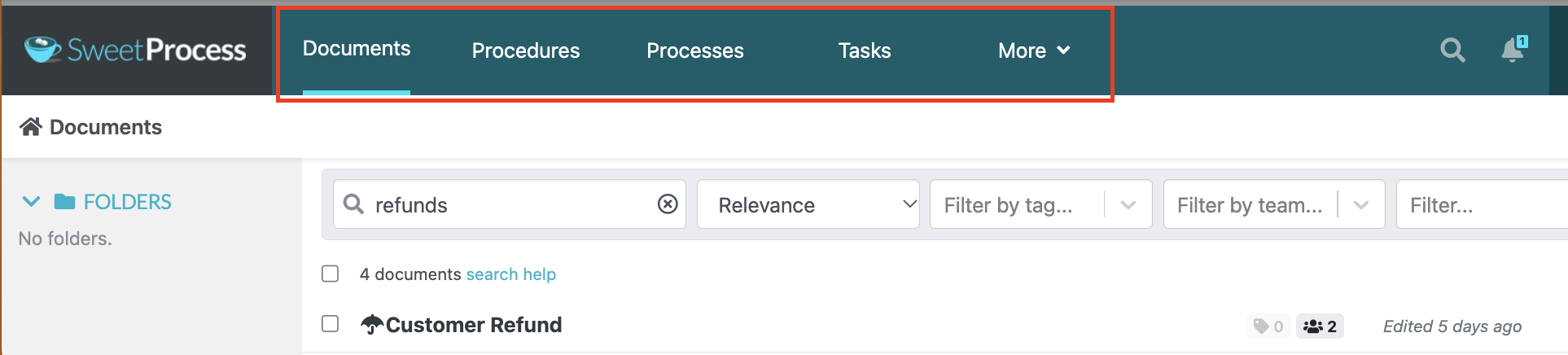
Use the main navigation to open procedures, processes, policies, teams, or members. Some options appear under “More.”
Use a procedure for step-by-step instructions, a process to connect related procedures, and a policy to explain a rule or expectation.
For a recurring customer request, document the steps, required checks, and escalation conditions in one procedure. When you assign that procedure as a task, employees can follow the instructions and record their progress.
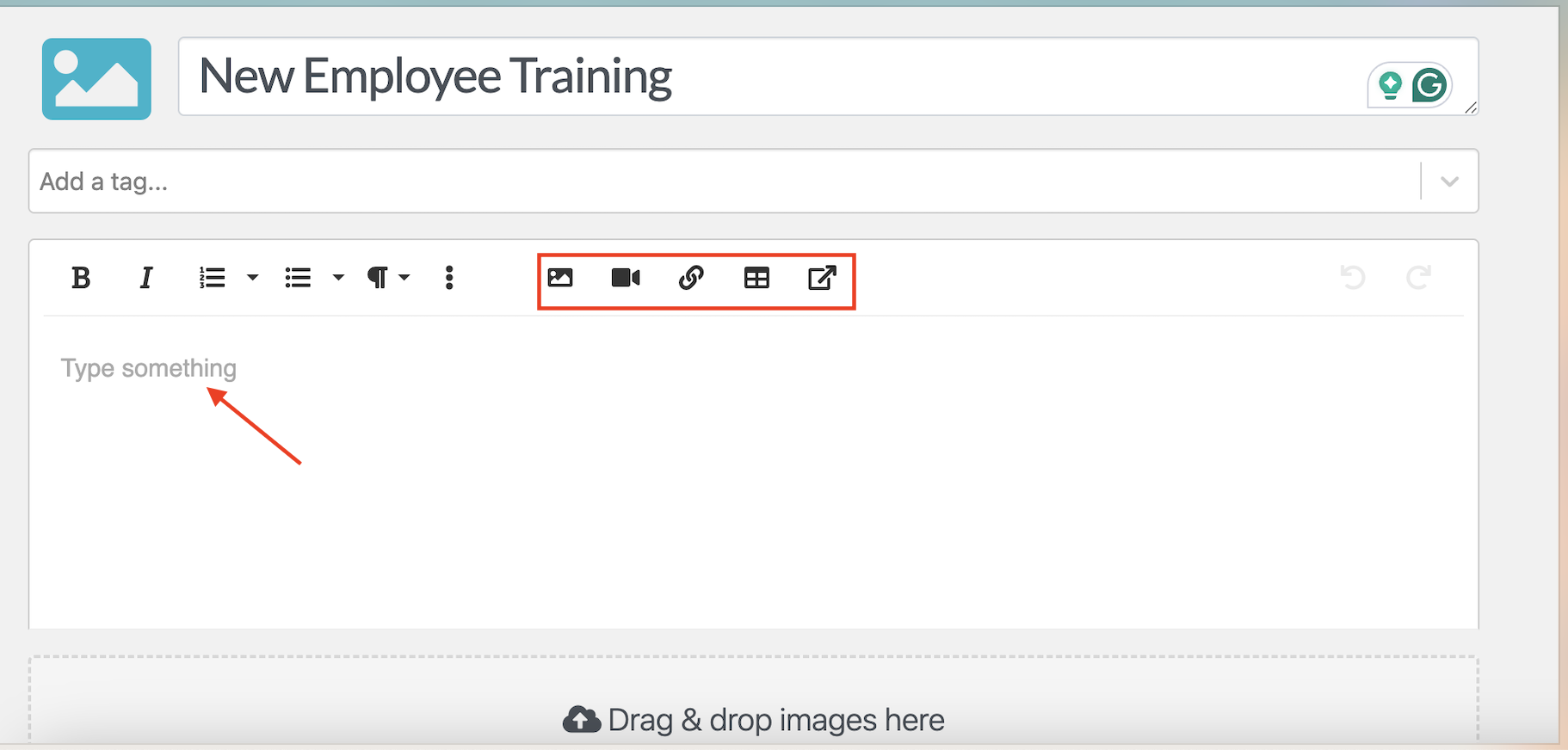
To create a procedure, click on “Procedure,” then “Create Procedure.”

Then, you can add your “Procedure Title” and the team members working on the project.
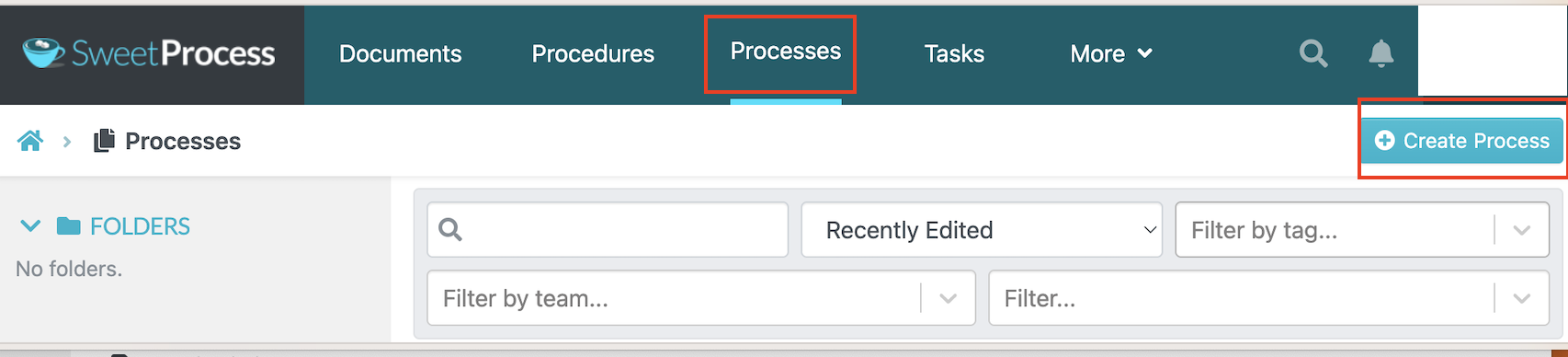
You can also create “Processes” from the same dashboard.
SweetProcess makes it easy to create comprehensive procedures and processes for self-learning. Perry Beebe, managing director at All Residential Real Estate, mentioned how SweetProcess is excellent for documenting procedures, policies, and processes.
Perry said, “If you’re working in a procedure-based business, have a look at SweetProcess. Have a look at the procedures and policies within SweetProcess and see how you could create those sorts of systems in SweetProcess.”
Additionally, with the SweetProcess Chrome extension, you can capture browser-based steps. This feature helps when a task involves navigating a web application where steps are easier to demonstrate visually than to write from memory.
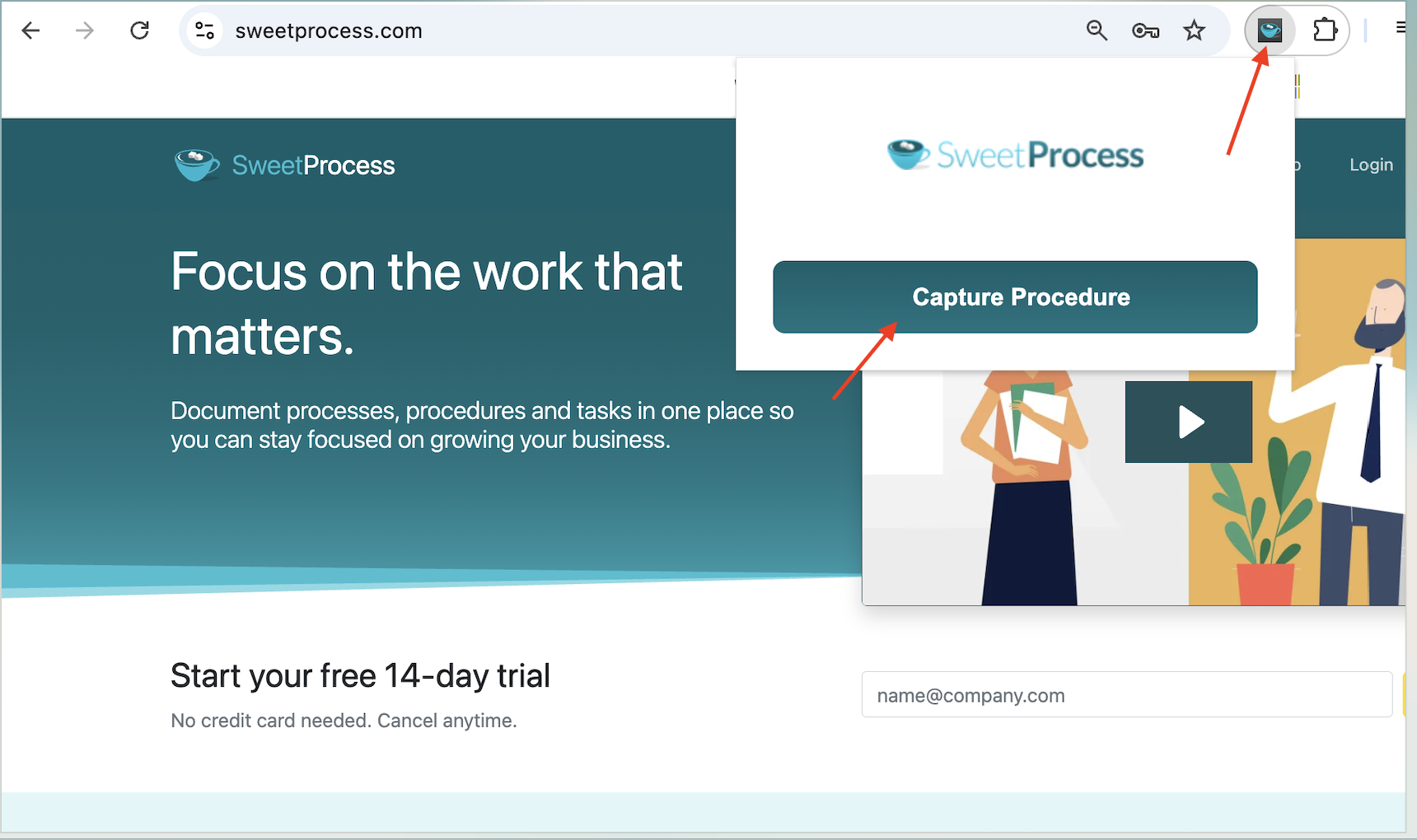
Review the captured sequence before approving it. Add decisions, exceptions, and checks that a screen recording cannot infer.
Trainual includes a built-in editor and screen recorder on every plan.
You can create processes and policies straight from the dashboard.
Trainual has 500+ customizable templates on every plan. These templates help when you are starting from a blank page.
Trainual also lets you upload existing documents and embed videos from other platforms, so a team with a library of older files can bring them in.
Trainual vs SweetProcess: AI Assistance and Human Review
AI can help structure a first draft. A person who knows the work still needs to check the instructions, exceptions, and approval requirements.
Trainual offers AI-assisted content creation and knowledge search with Q&A. Use generated drafts as a starting point and check answers against the source material. Premium and Enterprise also list custom AI agents; confirm their scope and access controls for your use case.
With SweetProcess, you can use SweetAI to draft procedures and policies. This feature gives an author a starting point, particularly when turning an existing explanation into a more organized document.
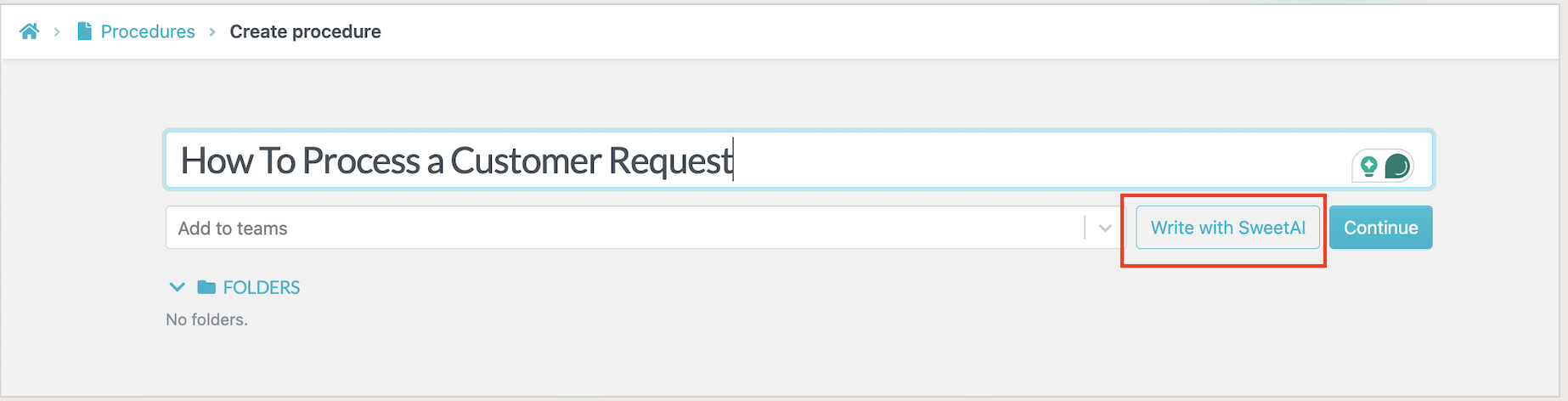
For example, an operations manager could use it to draft a procedure outline for handling customer requests. The manager should then add the company’s actual approval limits, systems, exceptions, and escalation rules. SweetProcess makes it easy to edit using SweetAI.
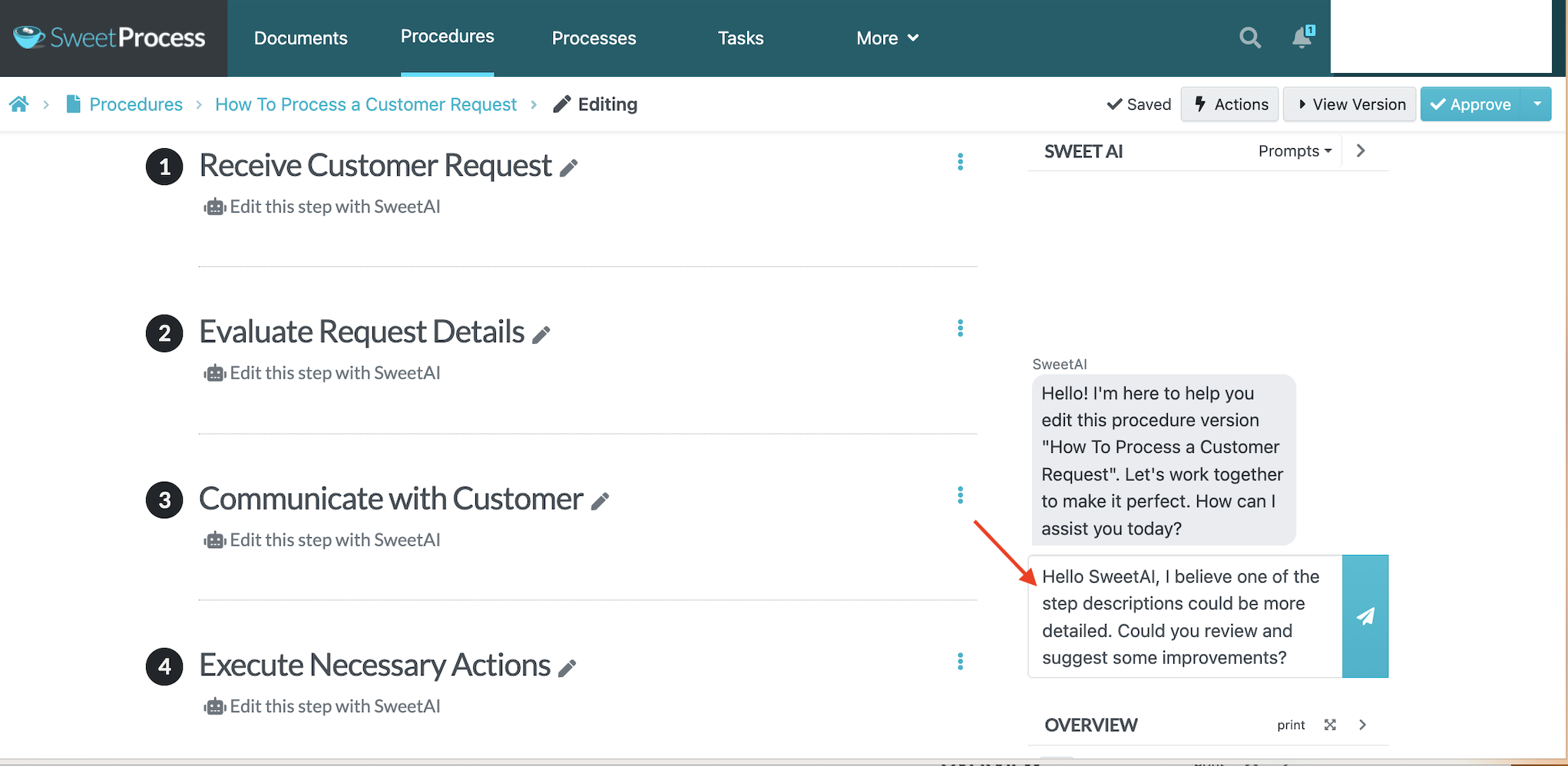
The person responsible for the procedure should check every instruction, confirm that it matches the actual workflow, and remove any unsupported assumptions before approving it.
Trainual vs SweetProcess: Approval and Version Control
In the course of your work, software interfaces change, and responsibilities change. All these details need to be added into your existing procedure. Version control enables you to see the current document and view changes that have been made over time and by whom. It also helps you achieve accountability and build trust in the team.
SweetProcess version history shows changes to procedures, processes, and policies and supports restoring an earlier version. Use the appropriate document permissions to control who can edit and approve changes.
You can revert to an older version if you need to use that for your operations.
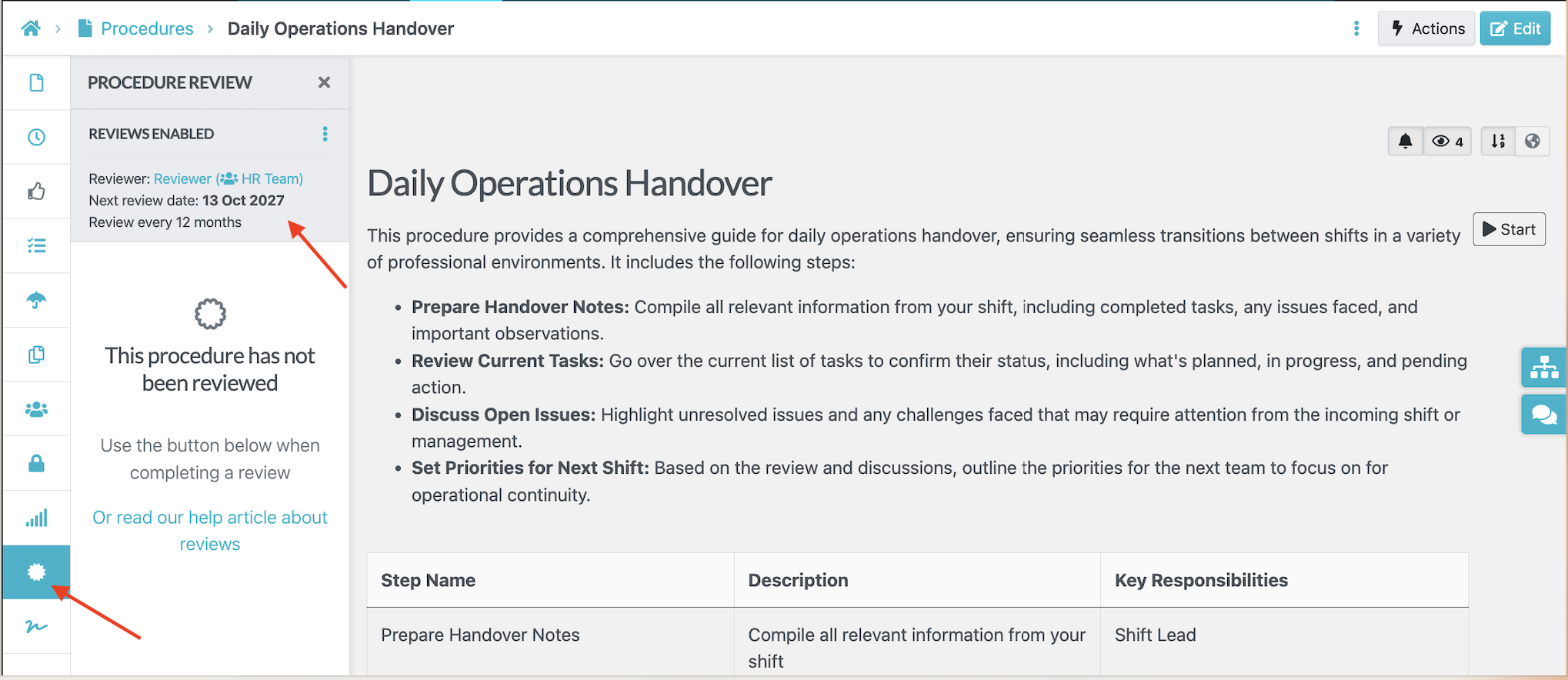
Schedule periodic reviews to prompt the responsible person to check whether the procedure still matches the work.
Trainual also supports version history and restoration. Retention is 30 days on Core, 90 days on Pro, and unlimited on Premium and Enterprise. Its individual version record does not identify the person who made the change. Compare the history available to your intended reviewers before choosing a plan.
Elian Levatino, certified financial planner, partner, and COO at Benchmark Wealth Management, discussed how SweetProcess provides a platform for the team to confirm that documented processes are actionable and usable rather than just documenting processes.
“After you write the processes, you have to execute them and make sure that you wrote them down right and then have a final product. Sarah created this review structure where somebody writes the processes, somebody goes behind and checks them, and then there’s a final review,” Elian explains.
Trainual vs SweetProcess: Training and Acknowledgment
Trainual supports testing, progress tracking, and training groups organized by role, department, or location. Pro adds individual training paths, training time estimates, 300 e-signatures per year, SCORM storage, and completion nudges. Confirm the storage and usage limits in your quote.
The Premium plan adds unlimited e-signatures and training path templates. A courses library is available as an add-on. If a required, tracked, scored onboarding program is your main goal, Trainual deserves a serious look.
You can assign onboarding content by role and monitor the required assessments. Build the sequence around what a new employee needs to know before taking responsibility for a task.
A completed training path records progress through the assigned material. The time needed to become competent still depends on the role, the quality of instruction, and supervised practice.
SweetProcess teaches through the procedures themselves. You can assign the procedures as tasks from the same dashboard.
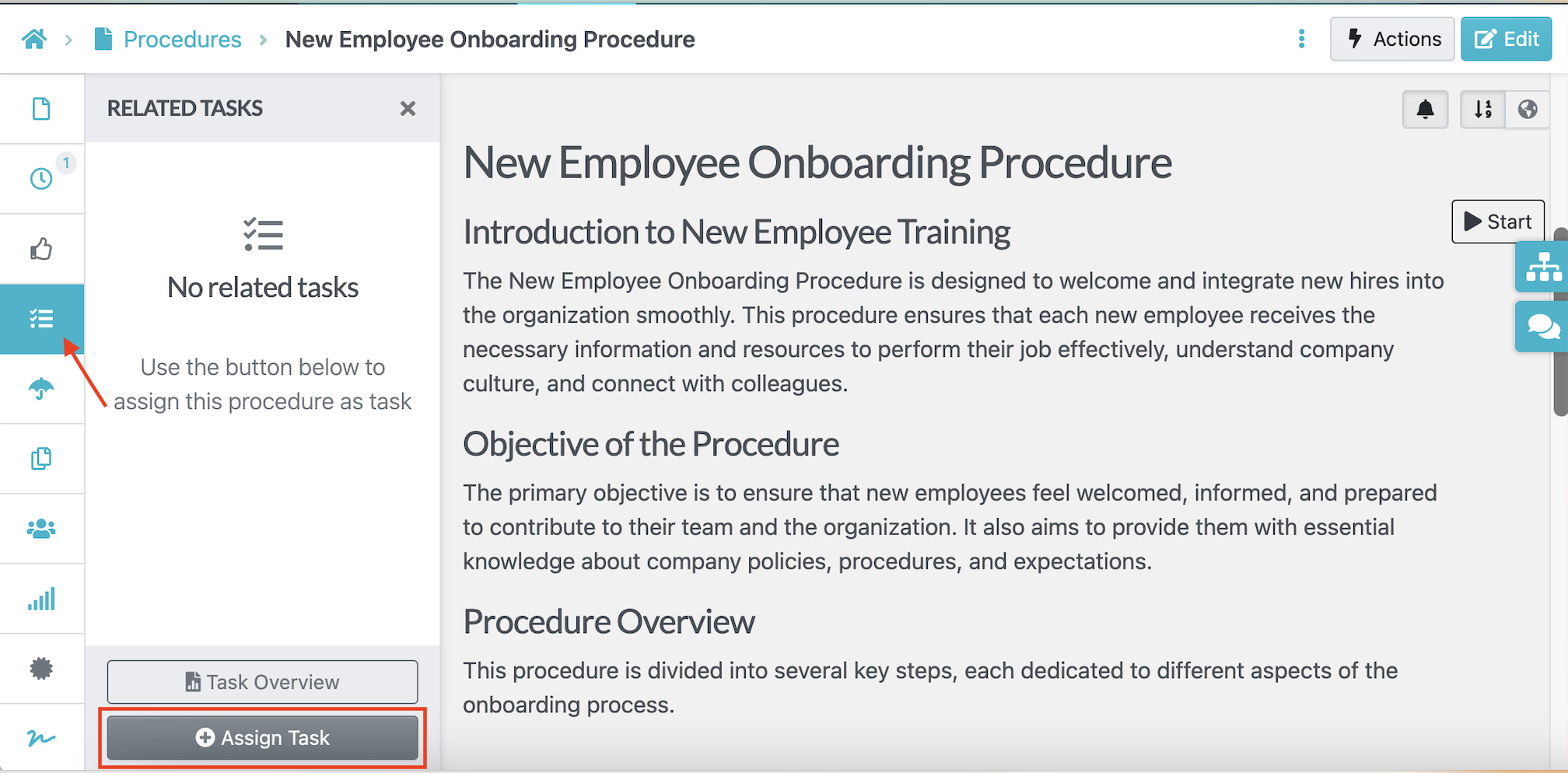
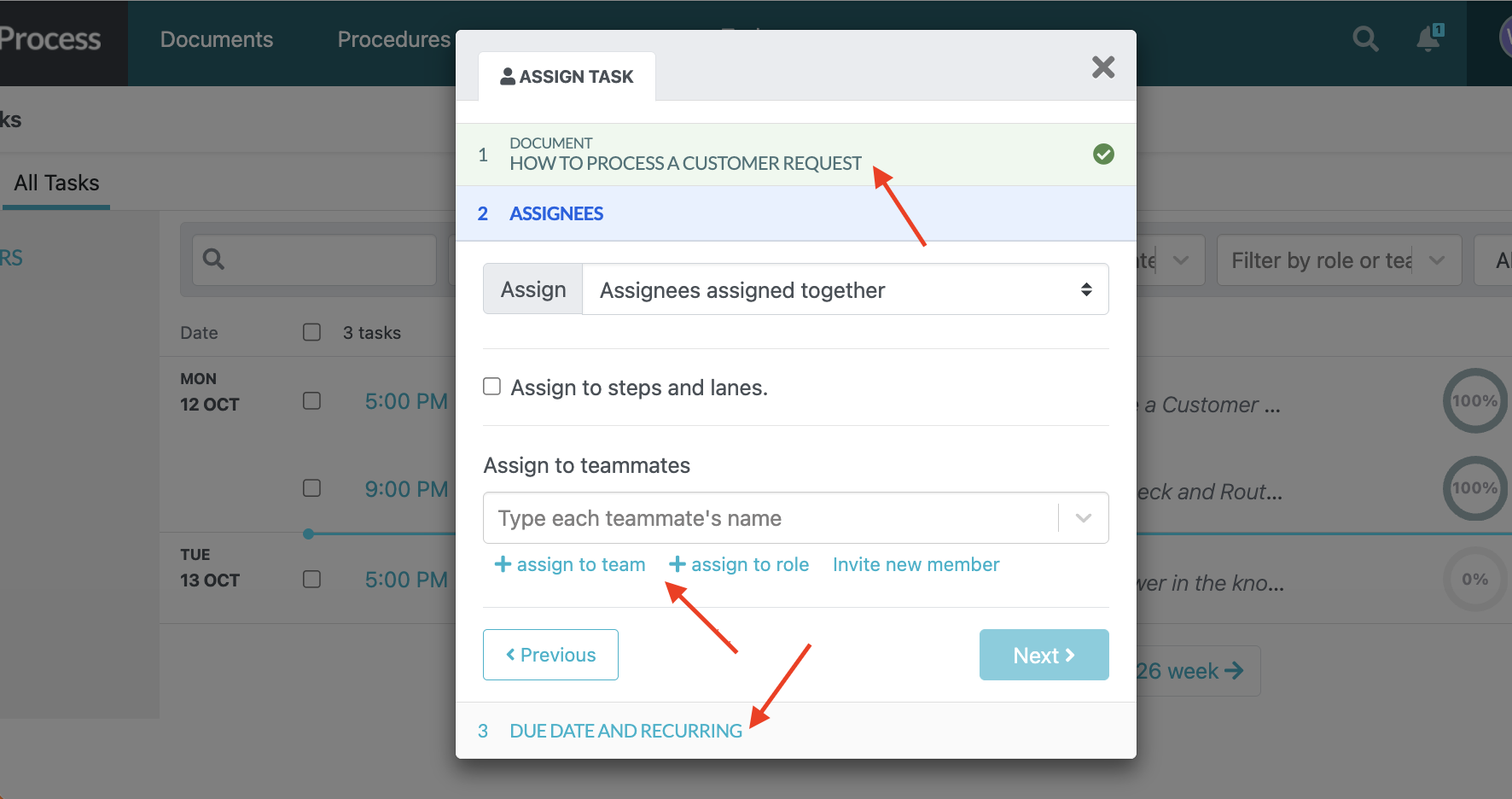
You can add the specific team member and due dates to keep the team accountable.
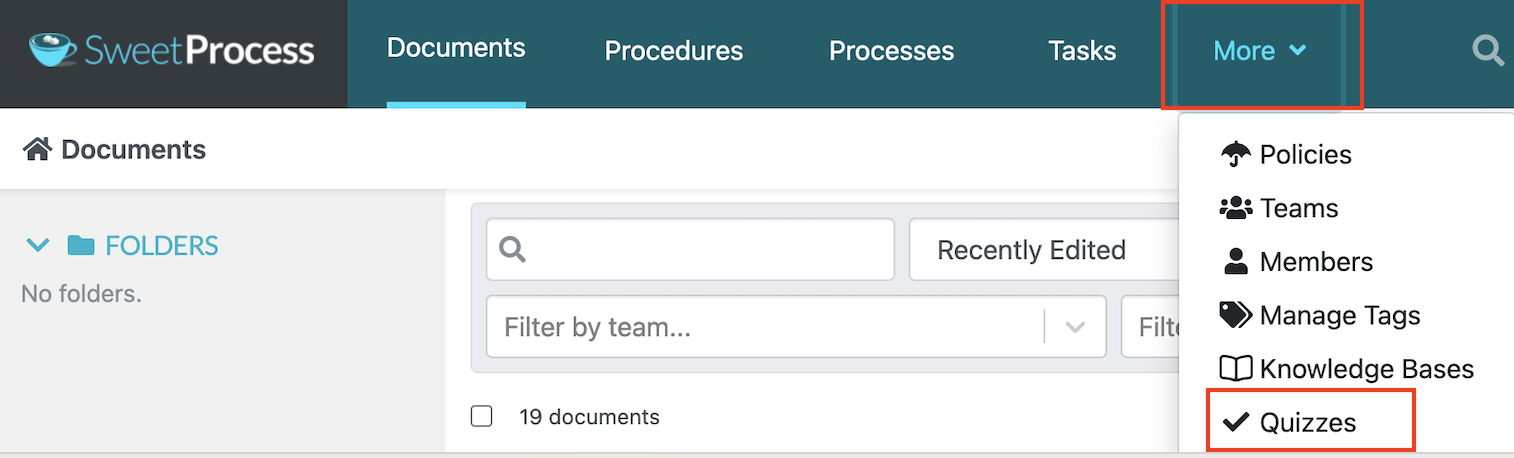
Additionally, you can also build quizzes to check understanding of a policy, process, or procedure.
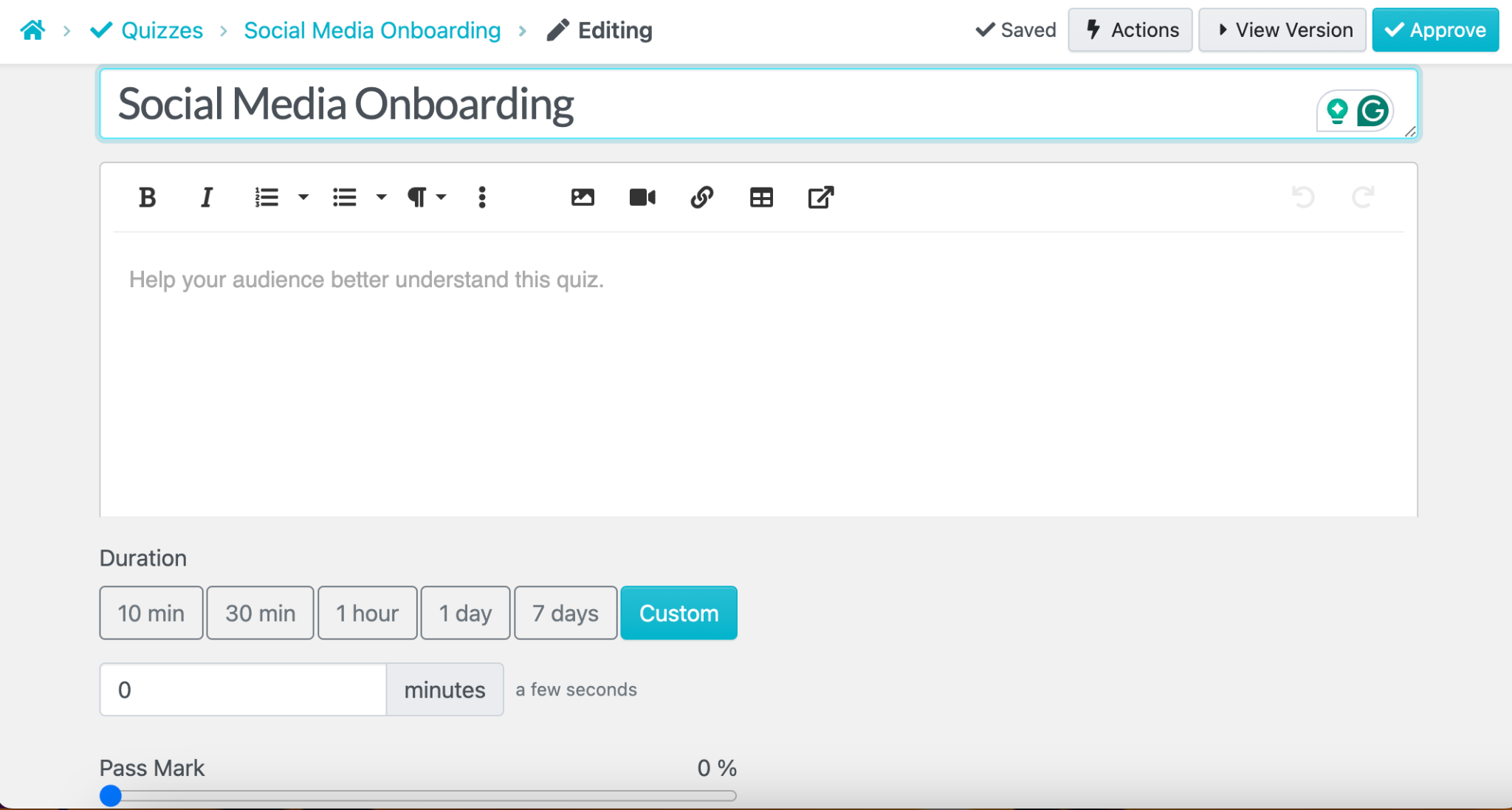
You can also add a pass mark, duration, and visuals to make the quiz more detailed.
On top of assigning training tasks, you can also ask your team to acknowledge that they have read and understood a document by requesting a sign-off.
It’s important to differentiate between these three things:
- Learning: a lesson completed or a test passed.
- Acknowledgment: a document signed, with the version and time recorded.
- Doing: an assigned task completed.
Therefore, a signed document or a passed quiz does not prove someone can do the work well. While documentation and sign-offs support your training, they don’t replace practical instruction or competency checks.
Trainual vs SweetProcess: Recurring Work and Tracking
Trainual offers reusable checklists for repeating work. Its separate Operations suite covers meetings and agendas, decisions and action items, goals, scorecards, KPIs, and team updates. Confirm which modules your quote includes.
Therefore, if your organization wants to combine employee training with these operational modules, you can request a quote for a plan that covers all these features.
SweetProcess lets you assign procedures and processes as tasks, connecting the documented instructions with the work an employee must complete. Use policy sign-offs separately when you need acknowledgment of a rule.
SweetProcess makes it possible to assign these tasks from the “Tasks” tab.

Managers can review recorded progress on assigned tasks, including which steps have been marked complete. Those records show task status; they do not independently verify the quality of every action.
Review the task list to identify assignments that need attention.
This capability is useful when the work repeats, and the steps need to remain consistent. The goal is to give employees current instructions and give managers a clearer view of assigned work.
Trainual vs SweetProcess: Knowledge Access and Search
A well-written procedure can fail to help if employees cannot find it when they need it. As you choose between these two tools, you need to evaluate how each platform organizes content, supports search, and helps people locate the correct instruction.
Trainual offers AI-powered knowledge search across training materials and organizational knowledge. Test common employee questions and check whether the answers point to the correct, current source.
Additionally, there’s a roles and responsibilities builder that enables you to group your team accordingly, so that everyone knows what they need to do.
SweetProcess allows you to organize and find documents easily. With it, you can search a pool of documentation based on the name, relevance, and tags. You can also filter by the documentation you contributed to and the approval level.
For example, a support employee covering a colleague’s queue can search for the approved refund procedure, check the approval limit, and find the escalation contact. The procedure provides a reference while the employee works within their assigned responsibilities.
Here’s how the search dashboard on SweetProcess displays:

Don Houk, president of Next7 IT, highlighted the value of adding screenshots to procedures:
“One of the things that’s very common with our types of procedures is the inclusion of screenshots. We mark them up. We make them fancy. We do all these things. But being able to very quickly and easily add screenshots, it was surprisingly difficult to find a product that would do that very well. That was one of the key features that SweetProcess did a really good job with implementation there.”
SweetProcess also lets you turn your existing procedures and policies into a knowledge base for your employees or clients.
For example, publish an approved answer to a common customer question in a public knowledge base. Keep internal troubleshooting instructions and sensitive account information in a private knowledge base for employees.
This gives customers a self-service reference while preserving a separate place for internal operating instructions.
The SweetProcess knowledge base includes search and feedback features so readers can find instructions and flag material that needs attention.
Here’s how to navigate to the knowledge base on SweetProcess:
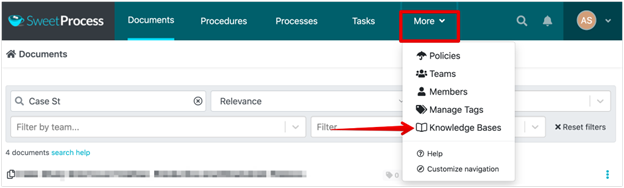
After clicking on the “Knowledge Base” icon, you’ll be redirected to a new page that looks like this:
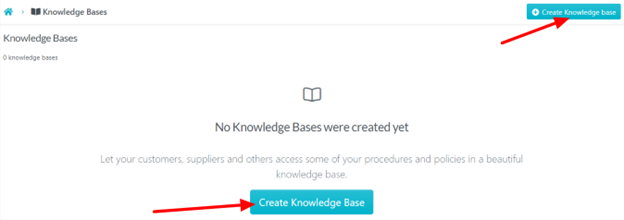
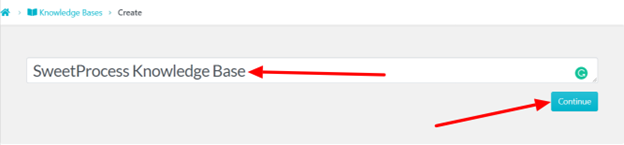
The next step is to name it. For the example below, we titled it “SweetProcess Knowledge Base.”
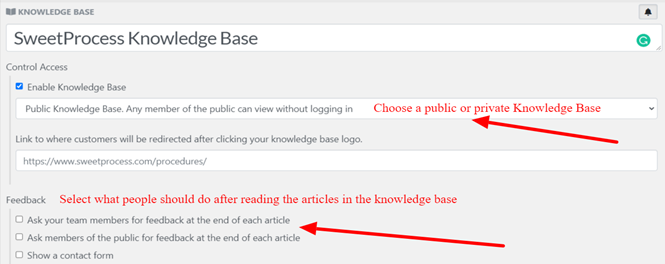
Once done, you can set up your knowledge base to be public or private. If it’s an internal knowledge base, you can make it private. If it’s a customer-facing one, you can make it public.
You can add as many categories as you want to your knowledge base. Also, you can include subcategories under a category. To add articles to a category, all you need to do is click on it, and it’ll prompt you to choose the procedure or policy you want to add as an article.
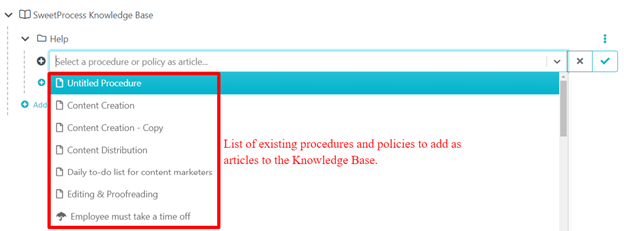
Before sharing the knowledge base, test its access settings and check that each article is in the right category. Ask a colleague to find a common answer without help.
Manny Cosme, president and CEO of CFO Services Group, mentioned how SweetProcess became his biggest game-changer, as he now has more time on his hands to oversee the entire operations of the company because his team members can find the information they need to be efficient in their jobs.
“Running 16 employees with several different departments, I don’t do the day-to-day accounting work anymore. Now I manage the entire company. And so there are a lot of processes that we have for every single aspect of the business. Just knowing and ensuring that things aren’t going to slip through the cracks, and not only in our bookkeeping work but also in our CFO or our sales and marketing work,” Manny says.
Trainual vs SweetProcess: Security and Integrations
Trainual’s available integrations and API options also depend on its current product offering and plan. For all plans, you get native integration with Human Resource Information Systems (HRIS) and payroll platforms such as BambooHR, Gusto, and Justworks. It also connects with other tools via webhooks and Zapier.
In terms of security, Trainual offers single sign-on (SSO) on the Premium plan, while its Enterprise plan includes API access and SOC 2 documentation access.
For SweetProcess, it connects to 1,000+ apps through integrations and routes such as API or Zapier. It also offers two-factor authentication, single sign-on through SAML or Active Directory, and SCIM for managing user identities.
For both tools, you get roles and controls that determine which employees can access specific documents.
Trainual vs SweetProcess: Pricing
Trainual offers Core, Pro, Premium, and Enterprise plans through custom quotes. It also charges a one-time $1,000 implementation fee. Include that fee when comparing first-year costs.
If you need the Operations or Performance suite, you can also contact the team for an actual quote.
SweetProcess costs $99 per month or $990 per year for up to 10 users. Each additional user costs $5 per month or $50 per year. The annual-only Small Team plan costs $495 per year for up to five users, plus $50 per year for each additional user. All plans include all features. Billing is based on users in the account, whether or not they have logged in.
For a 20-user SweetProcess account, the total is $149 per month or $1,490 per year: the base price covers 10 users, and the other 10 incur additional-user fees. Compare that with a Trainual quote for the same headcount, billing period, modules, and support requirements.
Migration Checklist
Pilot one representative workflow before moving your full library. Use the pilot to identify document cleanup, access changes, and training activities that need rebuilding.
Inventory the Existing Content
Start by listing all the material you currently maintain on your platform. You can separate operating procedures, company policies, training lessons, tests, checklists, and other operational content for easier management. Once you have all this, identify what should be migrated, what needs rewriting, what can be retired, and remove duplicated instructions.
Export a Representative Sample
Trainual can export supported content as PDFs when account settings allow it. Export a representative subject or document, then inspect the text, images, links, and embedded media. A PDF export is a reference copy, not a ready-to-import SweetProcess procedure.
Prepare the Documents for Import
SweetProcess accepts DOCX documents for procedure import. Use the Trainual PDF as a reference to prepare a structured DOCX file, then follow the document import guide. Check the resulting steps, screenshots, and links before approving the procedure.
You can also remove unnecessary formatting and confirm that images, links, and instructions remain accurate.
With SweetProcess, all you need to do is click on the drop-down button close to “Create Procedure” from your “Procedures” tab. Once done, it will prompt you to upload the document.
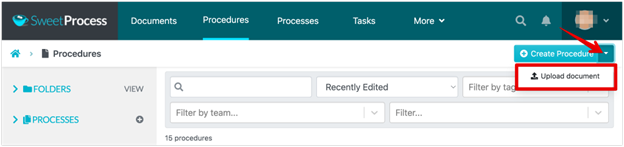
In the upload dialog, drag in a DOCX file or choose “Browse” to select it from your computer. Inspect the imported content before approving it.
Rebuild Roles and Permissions
List the people who need access to each category of information. This is the point to also decide who can create content, review it, approve changes, acknowledge documents, and complete assigned work.
You can also test the permissions with the actual roles you expect to use. Confirm what happens when a person changes roles or leaves the company. Don’t assume that importing a document automatically creates every related workflow, training assignment, or historical record.
Rebuild Training and Operational Workflows
Identify which training paths, tests, checklists, and other activities need to be recreated. Some content may be suitable for importing as a document, while other parts may need to be rebuilt using the destination platform’s own features. With this information, you can decide which records need to be preserved.
Test One Complete Workflow
Consider this illustrative pilot: Maya is joining a customer support team and must handle a refund request. The team uses one refund policy, one step-by-step procedure, and a short onboarding lesson.
First, assign Maya the lesson and a quiz about eligibility and escalation. Inspect the lesson-completion record and quiz result. These show what training she completed and how she answered the questions.
Next, request acknowledgment of the refund policy. Confirm that the sign-off identifies Maya, the policy version, and the time. This is a separate record from the quiz result or a completed customer request.
Then assign the refund procedure as a task using a fictional customer case. Maya checks eligibility, records the required details, and routes an exception to the manager. Inspect the recorded task progress and the manager’s review. A checked-off task alone does not establish competence; the supervisor should assess whether Maya applied the instructions correctly.
Now change the refund approval threshold. Have the document owner update the procedure, submit it for review, and approve the revised instructions. Check version history, confirm which version Maya can access, and decide whether the change requires another acknowledgment or refresher lesson.
Finally, repeat the task with the revised instructions. Test permissions with Maya’s account and the reviewer’s account, including whether Maya can see unrelated confidential documents. Keep learning, acknowledgment, task completion, and later document changes distinct when evaluating the records in either product.
Once you’ve identified what needs to move, test how SweetProcess can help your team organize procedures in one place. Try it here!
Final Verdict: Choose the Workflow You Need to Maintain
Trainual and SweetProcess both support documentation, knowledge sharing, and parts of the work that happens after onboarding. The choice is about which workflows matter most, how each platform supports them, and what evidence your team needs to retain.
Choose SweetProcess when you want to maintain approved policies and procedures, connect related procedures into processes, and assign repeatable operational work. Consider Trainual when structured training paths, testing, and organizational context are central, and evaluate its checklists and Operations suite if you need operational capabilities as well.
Before committing, test the same workflow in both products. Create or capture the instructions, review them, assign the work, inspect the records, check permissions, version restoration, integrations, and compare the total cost.
Use the trial to check the capabilities that matter to your workflow:
- Documentation of procedures, processes, and policies.
- Organize and find documents easily.
- Assign and track employees’ tasks based on documented procedures and processes.
- Monitor and track progress on tasks assigned to users
- Import existing procedures and policies
- Export documents offline in different formats.
- Create process maps and flowcharts automatically.
- Create a knowledge base for employees, customers, and clients.
- Supports the version history of documents.
Want to see the tool in action and build your company’s first procedure? Get started today by signing up for a 14-day free trial. No credit card required.
FAQs
Is SweetProcess better than Trainual for SOPs?
SweetProcess is a strong fit for maintaining approved procedures and turning them into recurring work. It includes manager approval, periodic reviews, version history, and assigned tasks, with all features available during the trial. Trainual may fit better when training paths, testing, e-signatures, and course content are the priority. Test one real workflow in each product and inspect the records.
How do Trainual and SweetProcess pricing compare?
SweetProcess costs $99 per month or $990 per year for up to 10 users, plus $5 per month or $50 per year for each additional user. A Small Team option costs $495 per year for up to five users. Trainual’s plans are quote-based and include a $1,000 one-time implementation fee. If you want to pay for Trainual, request a quote on your headcount and modules, and compare it against SweetProcess’s price for the same number of users, the same billing period, and the same support.
Can Trainual also handle operational work?
Yes. Trainual offers reusable checklists and a separate Operations suite with goals, meetings, action items, scorecards, and team updates. Compare the modules your quote includes. SweetProcess organizes policies, procedures, and processes, with procedures and processes assignable as tasks. Run the same recurring workflow in both products and inspect the records.
Can I migrate Trainual documents into SweetProcess?
Yes, by preparing suitable documents for import. Export supported Trainual content as PDFs, prepare and check a DOCX version, then test SweetProcess’s document import. This is not a direct Trainual migration connector. Rebuild or separately preserve training paths, permissions, quizzes, completion records, and version history as needed. Start with one representative procedure before moving a department’s library.
Does Trainual support MFA and version restoration?
Yes. Trainual documents email-based MFA on all plans. It supports version restoration, with history retained for 30 days on Core, 90 days on Pro, and indefinitely on Premium and Enterprise. The individual version record does not show who made the change.