Last Updated on November 4, 2026 by Owen McGab Enaohwo
TL;DR: Choose by the job. SweetProcess is a starting point for maintained SOPs and assigned work. Compare Dozuki, Augmentir, Redzone, VKS, and L2L for manufacturing workflows; MaintainX for maintenance; Tulip for custom frontline apps; and Manual.to or Knowby for visual instructions. Check the required features, billing unit, and migration records before switching.
Start your free 14-day trial of SweetProcess.
No credit card needed. Cancel anytime.
Which Poka alternative fits your team? Start with the record you need at the end of the shift. An approved instruction tells people how to work. An acknowledgment shows that someone has read it. A completed task records a particular run. A skills assessment or production record answers a different question. Choosing software by feature count alone can hide those differences.
SweetProcess is worth evaluating when the job centers on maintaining procedures and assigning work. If you also need operator qualification, equipment connections, or production data, compare the manufacturing-focused alternatives against those requirements. The test is not whether a tool looks simpler than Poka, but whether it preserves the work and evidence your operation depends on.
Disclosure: SweetProcess publishes this article and appears first because it is a useful starting point for teams that need maintained procedures and assigned work. If your decision depends on formal skills qualification, equipment connections, production data, or detailed shop-floor execution, compare the manufacturing-focused platforms closely.
Key Takeaways
- These 10 Poka alternatives have been compared across four jobs, including maintained instructions, training and skills records, maintenance execution, and connected-worker systems.
- Poka is an IFS company, and its current platform covers instructions, skills, communication, forms, issues, analytics, AI, and integrations. Keep it on your shortlist if these connected capabilities support the records and workflows you need.
- A procedure, a read-and-understood acknowledgment, a completed task, a skills qualification, and a machine-linked production record are different records. Pick the tool that produces the one you need.
- Billing units differ across vendors based on users, interfaces, sites, and modules. Confirm the exact scope before paying for a plan.
- If your main requirement is maintaining instructions and assigning work, try SweetProcess for free for the first 14 days. You can test a real procedure to see if the tool is a good fit.
Table of Contents
What Poka Does Now and When It Still Fits
How to Choose the Right Poka Alternative
The 10 Poka Alternatives, Compared
Illustrative Pilot: A Packaging-Station Shift Handover
Migration Checklist: What to Confirm Before Switching
Why Businesses Pick SweetProcess
Choose the System That Fits the Work
Poka Alternatives at a Glance
Tool | Best fit | Output | Billing model | Practical trade-off |
|---|---|---|---|---|
Maintained SOPs and assigned recurring work | Approved procedures, acknowledgments, task records | All features included; $99 per month for up to 10 users | Does not replace a full manufacturing execution or skills-certification system | |
Dozuki | Manufacturing work instructions and frontline training | Visual instructions and training records | Request pricing | Confirm package and services scope that comes with the quote |
MaintainX | Maintenance and asset-related work | Work orders, maintenance history with attached procedures | Per user, from $20 per user per month billed annually | Procedure-linked work orders are capped by plan |
Augmentir | Connected work and industrial workflows | Digital instructions and workforce insights | Request for pricing | Needs data and integration ownership |
QAD Redzone | Frontline learning tied to plant performance | Visual instructions, skills matrix, training records | Request for pricing | A broader program than a standalone procedure library |
Tulip | Custom frontline apps | Apps linking operators, devices, and systems | Essentials: USD 100 per interface per month billed annually; 10-interface minimum (USD 1,000 monthly equivalent or USD 12,000 annually) | Requires ownership of apps, interfaces, and integrations |
VKS | Visual guidance with data capture | Visual instructions, forms, production reports | Request for pricing and edition | Features vary by edition |
L2L | Connected plant operations | Maintenance, production, and skills records | Request for pricing | Broad rollout across systems |
Manual.to | Video-led visual manuals | Shareable visual instructions | Contact for team pricing | Free manual generation is not the same as ongoing team-platform access. Needs ongoing review |
Knowby | Step-based visual instructions | Instructions with approvals and completion tracking | Per user. Pricing starts at $5 per user per month | Public views billed separately |
Competitor details and pricing checked November 5, 2026. Confirm the required package, billing commitment, and evaluation terms before purchase.
What Poka Does Now and When It Still Fits
Poka is connected-worker software for manufacturing. It puts instructions, training, and plant knowledge in front of frontline workers. Poka is part of IFS, a provider of enterprise software for industrial organizations. Its vendor-described platform extends beyond a library of training videos or static instructions.
With this tool, you can access a broad set of capabilities including knowledge and work instructions, skills, communication, digital forms, issues, analytics, AI, and integrations. You can also use it for learning and development to train your workforce and use the skill matrix to see which certifications and level of training your employees have.
A move to another tool may also involve more than transferring documents. However, you may need to preserve training history, acknowledgments, permissions, issue records, equipment references, and integrations. A PDF export of a procedure will not necessarily preserve those associated records.
Keeping Poka may make sense if:
- Your organization already uses its connected capabilities and they support your current operating model.
- Your training managers rely on skills matrices.
- The frontline teams use the digital instructions, and your plant managers depend on linked operational workflows that a simpler documentation tool may not cover in the same way.
- You would lose useful records or integrations by leaving.
Evaluate alternatives when you can identify a required record, integration, or workflow that your current Poka setup does not support, or when another proposal better fits your budget and scope. Confirm the gap before replacing a system your team uses.
Individual reviews add context, not a product-wide verdict. An October 13, 2026 G2 manufacturing reviewer described Poka as straightforward for operators’ daily use, while noting that administrators could need training to understand new features. In a review dated February 9, 2023 with a July 22, 2026 update badge, Gemma S. valued the training matrix and QR-linked forms, but described difficulty authorizing additional licensing at plant level. That is her purchasing experience, not confirmation of current feature packaging; the update badge does not establish that every sentence was rewritten in 2026. Neither account establishes a present defect or a measured advantage over another product.
How to Choose the Right Poka Alternative
If you have decided to switch from Poka to one of the alternatives on this list, here’s a simple guide to help you choose the right alternative.
Identify the Record You Need
Start by distinguishing among five common requirements for your business.
- Maintained instructions: You need a clear procedure with an owner, a review process, and a current version that workers can find.
- Acknowledgment: You need a record that a person has read or acknowledged a particular instruction.
- Task completion: Your business needs a tool to assign work to a person, set a due time, and record completion or outstanding items.
- Skills qualification: If you train employees, you also need to assess or verify a person’s competency against a defined requirement. A signature or read-and-understood acknowledgment is not a substitute for a practical assessment.
- Production or equipment data: For businesses in manufacturing, you need operational records tied to machines, production activity, quality checks, or maintenance events. An SOP library alone may not provide the required machine connection or production record.
Once you’ve listed the record you need for your day-to-day work, you can narrow down your options. This approach will help you avoid paying for a broad platform when a focused tool is enough, or choosing a simple tool that cannot meet a manufacturing requirement.
Check How Instructions Are Created and Maintained
Work instruction software helps organizations create, distribute, and update instructions for specific jobs. The process may involve adding text, images, video, browser-based steps, looking at the version history, reviewing the documents, and requesting approval.
As you choose a tool, you should ask yourself:
- How does the software handle revisions?
- Can an authorized person update an instruction?
- Can workers find the current version?
- Does the platform preserve earlier versions or related acknowledgment records?
- What happens when a worker has already started a task and the underlying instruction changes?
If you need a simple documentation tool, consider whether you can write clear work instructions and maintain them in a shared library with clear ownership. For manufacturing environments, you’ll need to confirm whether instructions must capture in-process data or connect to equipment.
Determine Whether You Need a Connected-Worker Platform
A connected-worker platform brings instructions, communication, training, and operational workflows together for frontline staff. It may also connect to enterprise applications, machines, or plant data.
For instance, your plant might require skills-based work assignment, machine data, downtime reporting, quality checks, and escalation workflows. In that situation, manufacturing-focused platforms such as Augmentir, QAD Redzone, VKS, and L2L might be a better fit.
Check Access And Integrations
For your office team to work collaboratively with the team on a manufacturing floor, you need an integrated system. Before selecting a Poka alternative, test whether all the workers can access the required instructions, whether media is readable, and what happens when connectivity is limited. If your operation uses multiple languages, verify the languages available in the software you intend to purchase.
You should also determine whether the software connects to your current systems through an API or through a third-party automation service. For example, SweetProcess can connect with other applications through Zapier. This makes it easy to work from a centralized platform.
Calculate The Full Cost
Some tools charge per user, while others price their plans by module or interface. You need to know the total cost of purchasing a specific tool before committing to a plan. Since most of the platforms on this list require you to contact the team for a quote, remember to get a detailed breakdown of the:
- Subscription fees and the billing period
- The number of users or modules included
- Limits
- Additional charges
- Connectivity requirements
- Renewal and cancellation terms
The 10 Poka Alternatives, Compared
Here are the top 10 Poka alternatives and their key features and pricing that make them an ideal fit for your business.
SweetProcess
SweetProcess brings operational documentation and assigned tasks into one system. This standard operating procedure software is ideal for teams that need procedures, policies, and processes in one maintained library and then assign recurring work based on them. If your maintenance crew or packaging line has a shift handover procedure, they can document it on this tool and update it as the steps change.
A manager can review and approve the handover procedure before it becomes the approved version. Assign the procedure as a separate task when someone needs to perform the work. Access to drafts depends on permissions; approval and task completion are different records.
Key Features of SweetProcess
Centralized Procedure Documentation
With SweetProcess, you can create procedures, processes, policies, and supporting documents in a shared library.
In the “Documents” section, you can view all uploaded documents, the approval status of these docs, tags and members associated with the files, and the last edited date of the draft.

Users can filter their dashboard based on tags or team members, find the file through keywords, or sift through the dashboard based on which files were recently edited. This way, employees can find the instructions relevant to their roles and tasks. From the dashboard, you can edit, share, or delete your procedures.
Request for Document Sign-Offs
If you have specific work instructions that you need your team to follow, you can approve the procedure and ask your team members to confirm they read and understood a specific version.
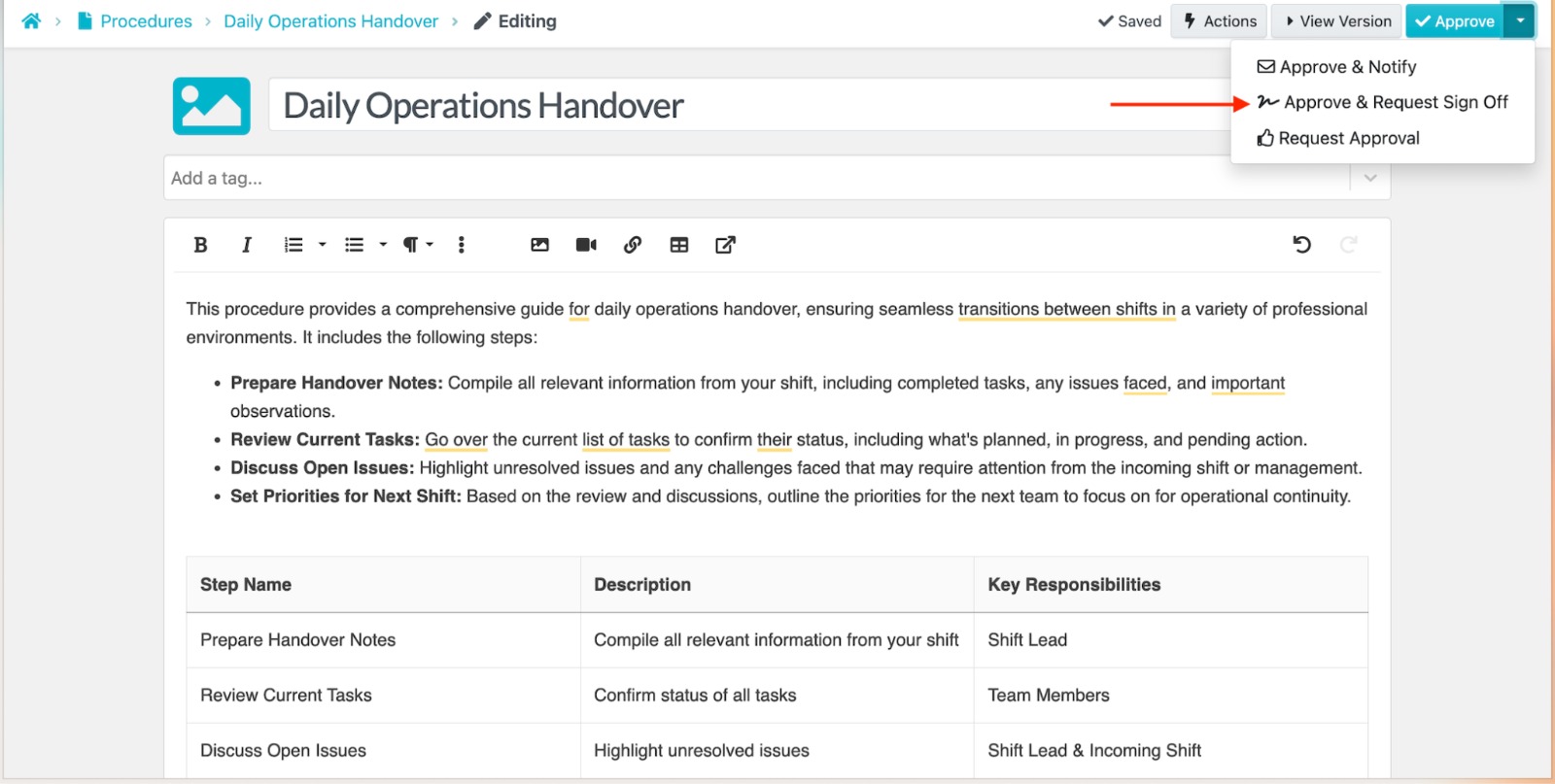
The sign-off log allows you to select the specific employees who should read the procedure. Once you send the request, they will receive an email notification.
While this creates an acknowledgment record, it’s not a practical skills assessment or proof that a team member can safely operate equipment.
Turning Documented Procedures into Assigned Work
With SweetProcess, you can assign the procedures you just created to a team.
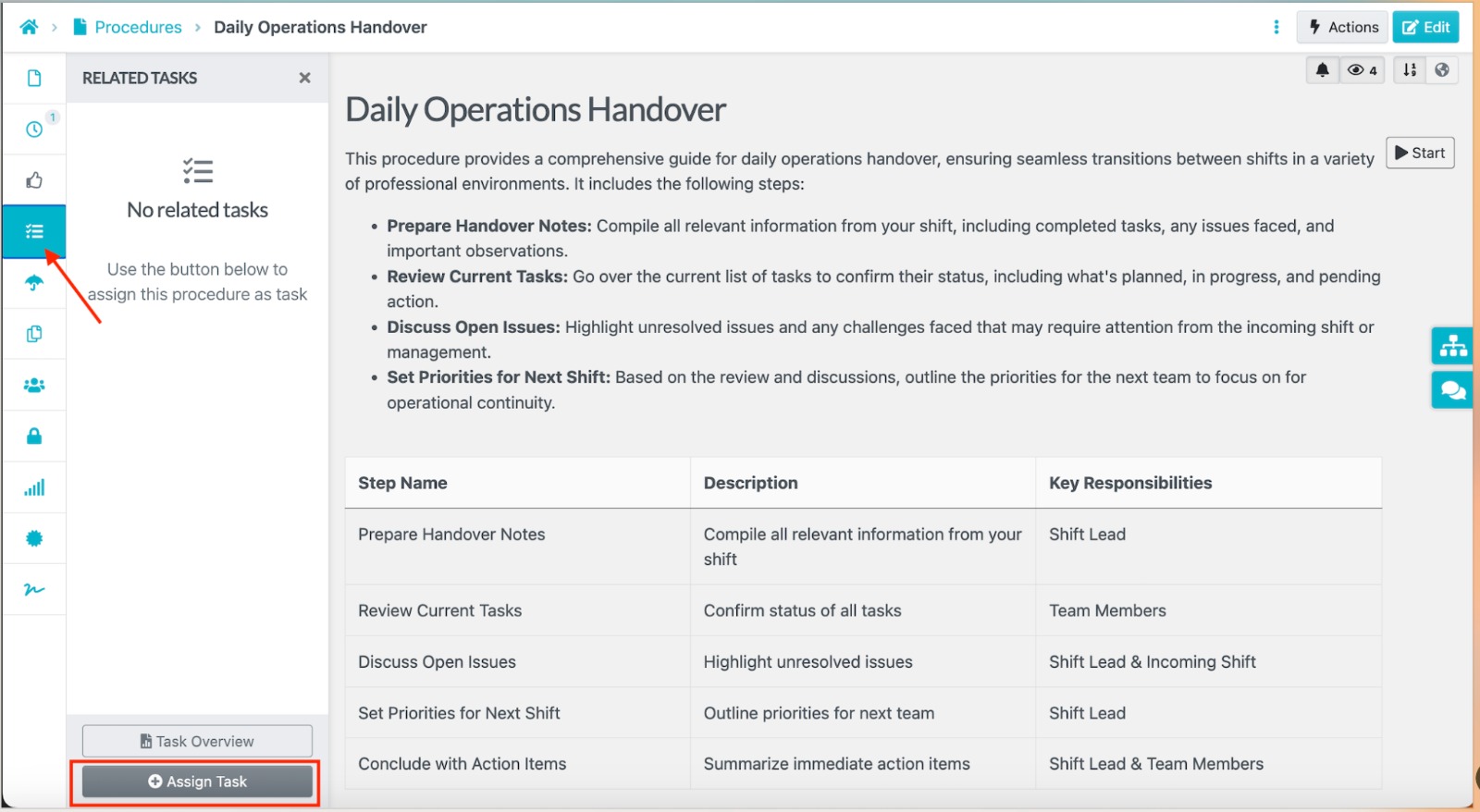
You can add the name of a specific employee or assign to a role.
You can then add due dates and define whether the task is recurring or occurs only once.
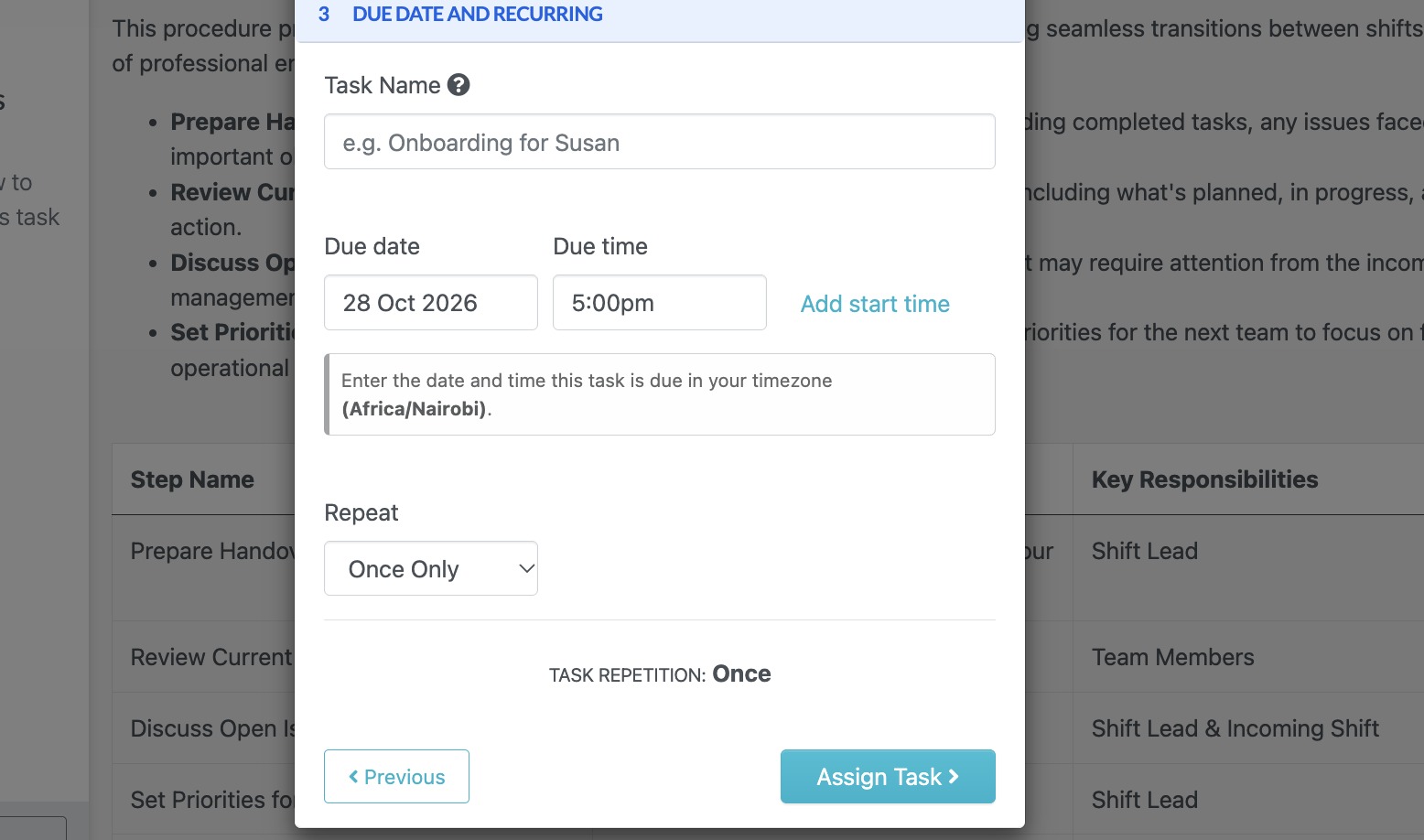
From the “Tasks” tab, you can review the progress and see the record of what has been completed or remains outstanding.
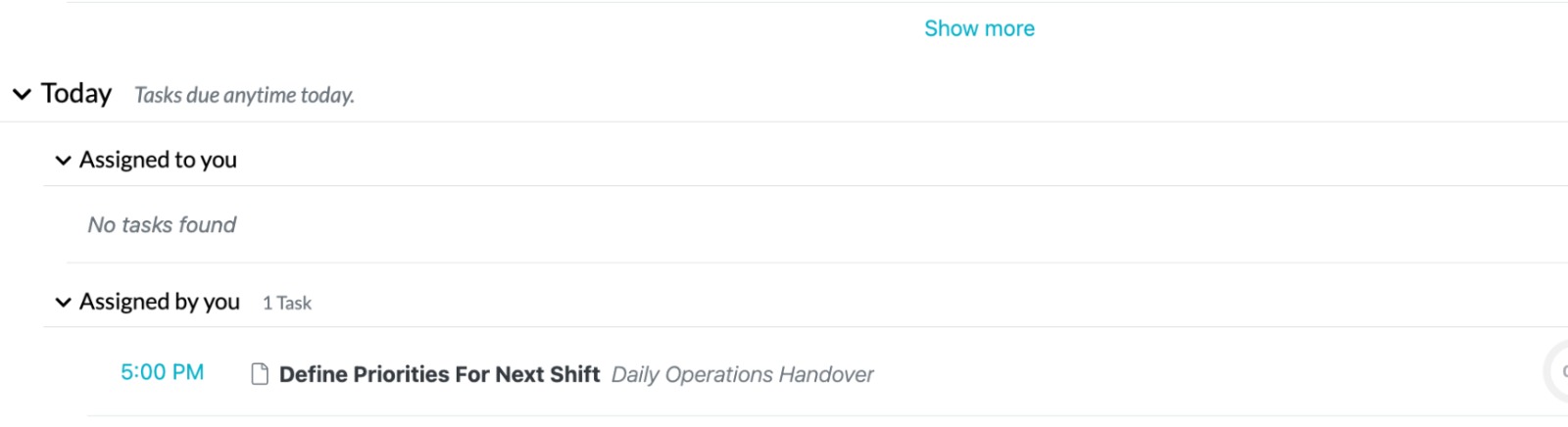
Since all these tasks are centralized, your team can collaborate more easily without switching between platforms.
Teams and Permissions
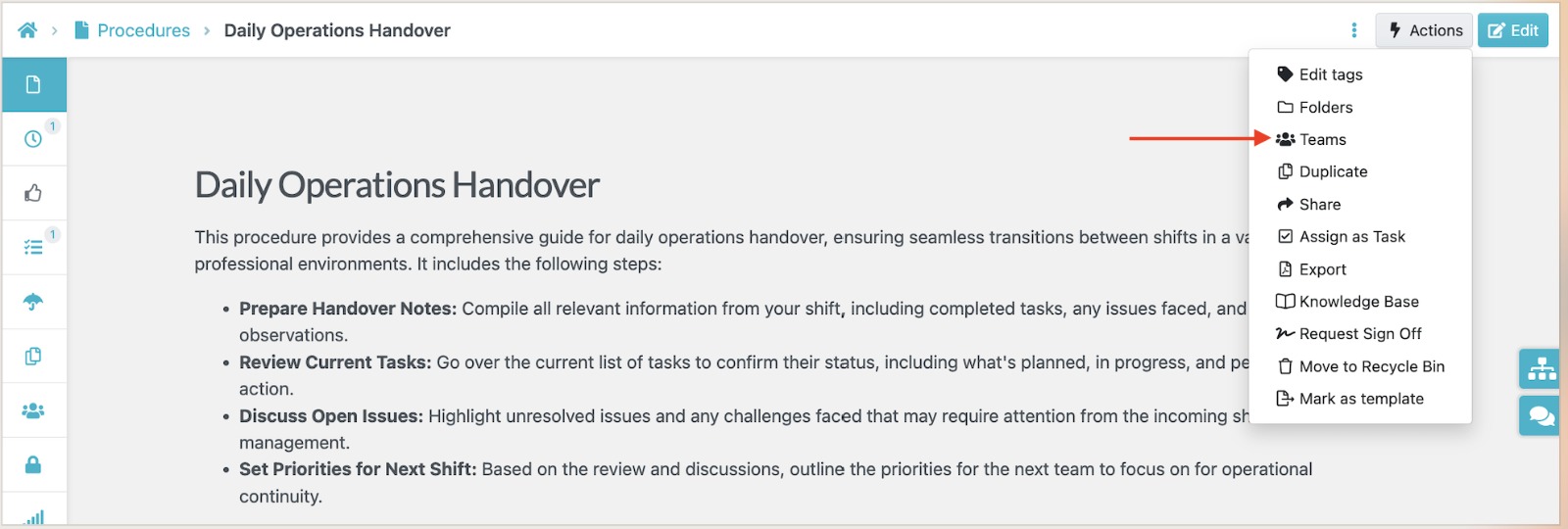
You can also control who can view, edit, and manage each document, which matters when a shift lead should read a procedure but not change it.
SweetProcess allows you to add the procedure to a specific team. Once you select the department, you’ll give them access to the document.
Browser-Based Procedure Capture
The SweetProcess Chrome extension can help capture browser-based portions of a workflow.
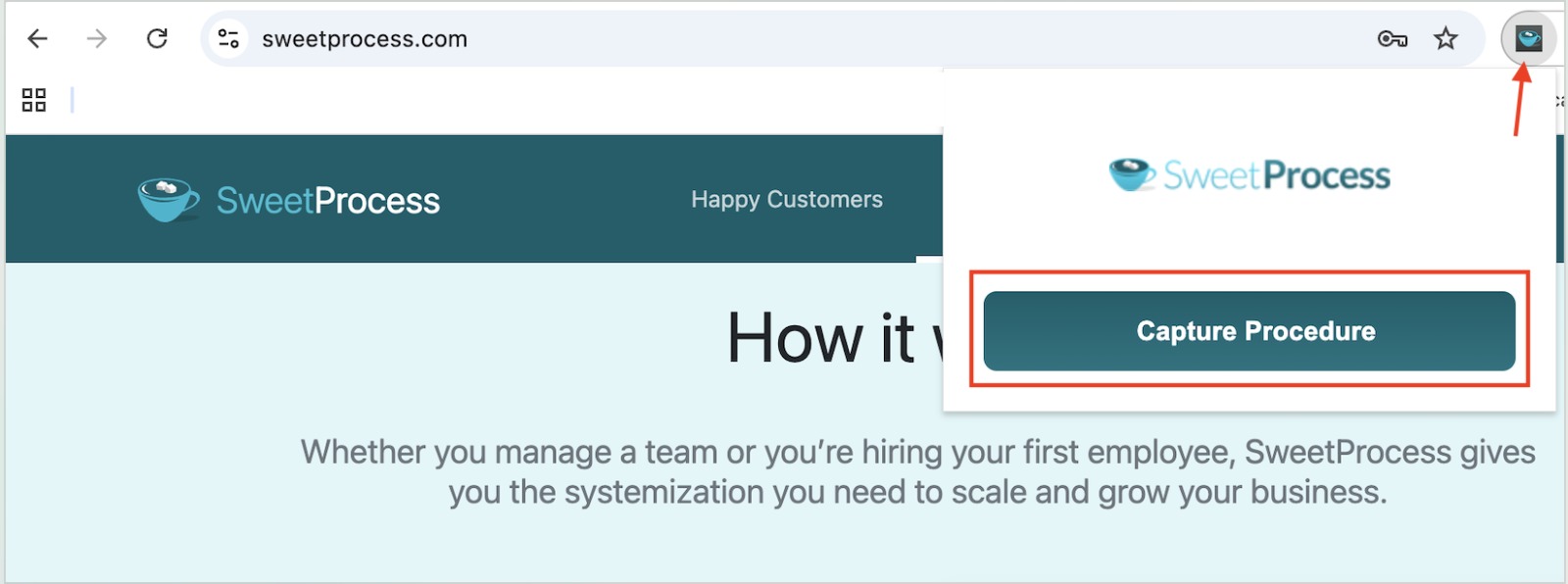
This extension does not observe physical equipment or automatically document every judgment a worker makes away from the screen. You’ll need to document off-screen steps and human decisions manually using the edit button.
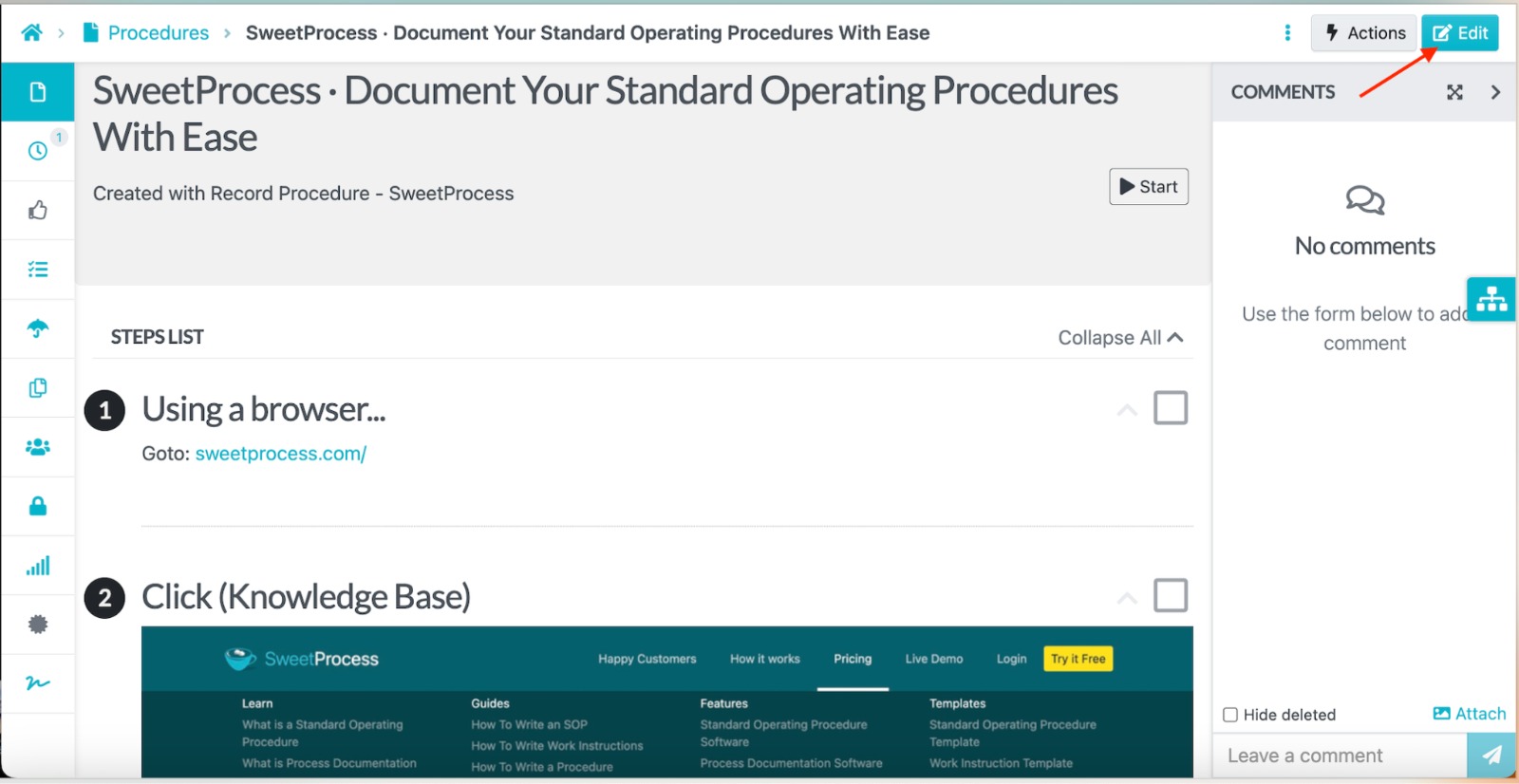
Afterward, you can have the appropriate subject-matter expert review the resulting procedure to ensure that it’s accurate.
Pros of SweetProcess
- All SweetProcess plans include all features. Team size and billing period determine the price, rather than a feature tier.
- Approval, acknowledgment, and task completion stay separate, which makes them easy to explain to a new hire or a new supervisor.
- Pricing is public, and all new users can take advantage of the 14-day trial to test one real procedure before you commit.
- SweetProcess supports integrations through Zapier and its API. Check the specific connection, data flow, and maintenance responsibility before relying on it for a handover.
SweetProcess Pricing
SweetProcess costs $99 per month for up to 10 users, plus $5 per month for each additional user. Annual billing costs $990 per year for up to 10 users, plus $50 per year for each additional user. The annual Small Team plan costs $495 for up to five users, plus $50 per year for each additional user. All plans include all features.
Review the current refund policy before subscribing; eligibility depends on your billing period and when you request the refund.
Trade-off: SweetProcess is a practical starting point when your priority is to document how work should be done and make sure responsibilities are clear. However, it is not a fully connected worker platform or a substitute for a quality management system (QMS) or a skills-certification system.
Dozuki
Dozuki is a manufacturing-specific option for teams that want controlled work instructions connected to training and in-process data. Its capabilities make it a relevant alternative when your instructions must reflect established work standards for the employees who perform the work. It’s a good choice if your work instructions change often; you can revise them on a centralized platform to keep your operations standardized.
Key Features of Dozuki
- Visual authoring: You can build step-by-step instructions with images and video, so a worker sees the task rather than reading a dense page.
- Revision history: Dozuki makes it easy to track changes to each instruction over time, so you know which version was current on a given day.
- Approval workflows: It can route a new or changed instruction through review before it reaches the floor.
- Data collection: Workers can enter values within the workflow to create an execution record. Confirm the required feature and package rather than treating analytics as the capture mechanism.
- Learning pathways: It allows you to connect training to the standard a worker is learning, rather than storing the two in separate places.
Pros of Dozuki
- It focuses on manufacturing work instructions rather than general company documentation.
- You can combine visual guidance with instruction control and training-related workflows.
- Dozuki offers a relevant option for organizations that need work instructions tied to operational data.
Dozuki Pricing
Dozuki doesn’t list pricing on the website. You have to contact the team for current pricing and confirm which features, implementation services, and training workflows are included.
Pilot question: When one step changes, how quickly can you find every worker who needs to see it, and where does the training record live? Run one real instruction through authoring, approval, and a data-capture field to see whether the product connects your training and execution data the way you need.
MaintainX
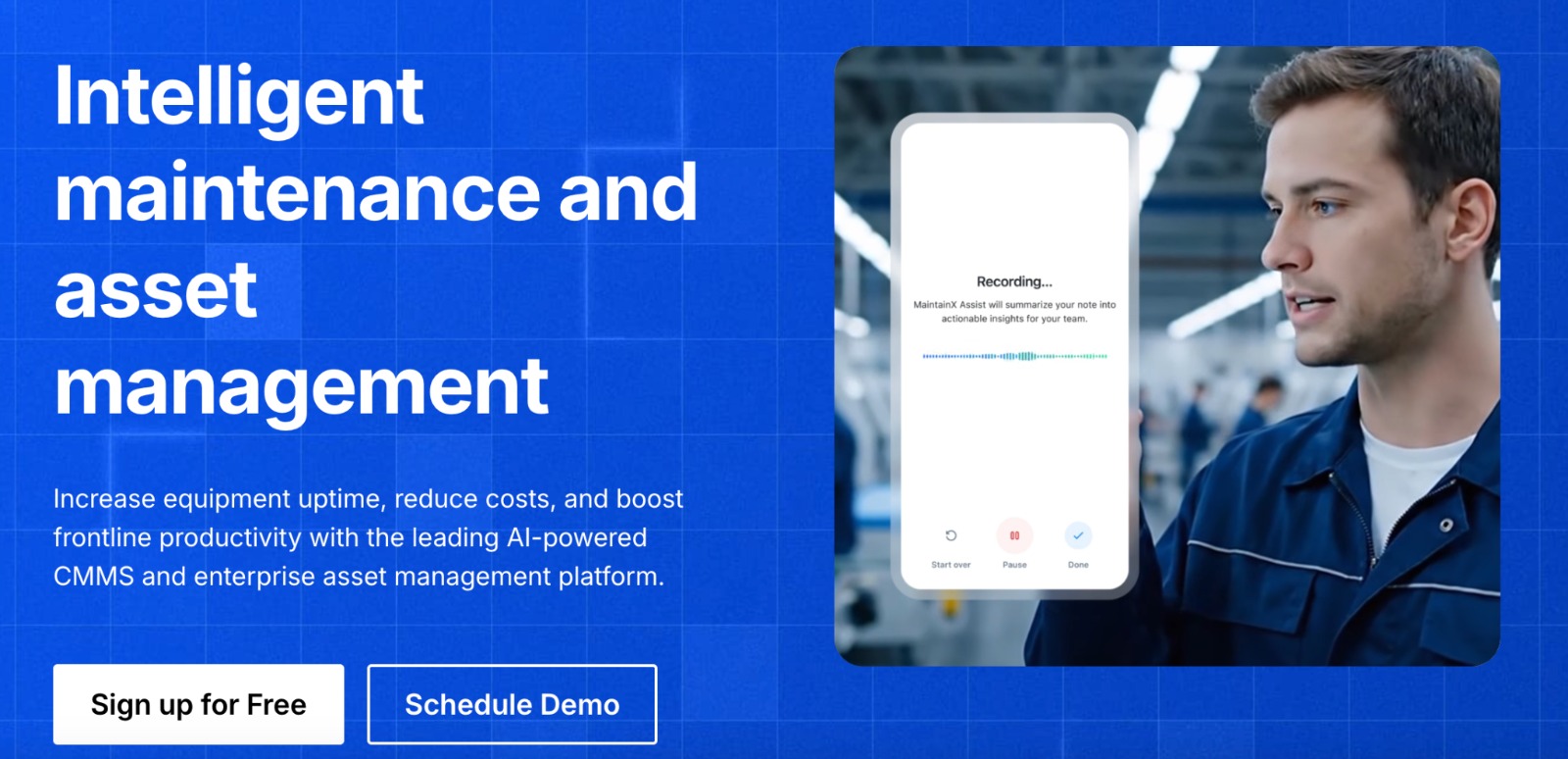
MaintainX is a maintenance and asset management software that teams can use to enhance frontline productivity. This tool works as a computerized maintenance management system (CMMS); therefore, it tracks each job against the equipment. It suits teams that need preventive work, parts, asset context, and procedures inside work orders.
If you are considering a Poka alternative because your technicians need to complete maintenance jobs and document work against specific assets, MaintainX deserves a close look.
Key Features of MaintainX
- Work order management: You can create, assign, and close maintenance jobs, with a record of who did what. This helps supervisors organize jobs and review their status rather than relying entirely on informal requests or disconnected spreadsheets.
- Preventive maintenance: It allows you to schedule recurring upkeep so it does not depend on someone remembering.
- Asset-related records: With this tool, you can tie each job to the equipment. This information is useful when a technician needs context about the item being maintained and the work associated with it.
- Procedures attached to work orders: You can attach step-by-step instructions to the job itself, so that employees can find information much faster.
- Requester accounts: Individuals outside your maintenance crew can submit requests at no charge.
Pros of MaintainX
- It combines maintenance work orders and related procedures
- MaintainX offers a permanent free Basic plan for smaller maintenance operations
- It supports recurring maintenance workflows
MaintainX Pricing
MaintainX Basic is free and includes unlimited procedures, but only two work orders with attached procedures per month. Essential costs $20 per user per month billed annually or $25 billed monthly, with three work orders with attached procedures per month. Premium costs $65 per user per month billed annually or $75 billed monthly and removes that procedure-work-order limit. Enterprise requires a quote. Match the paid roles and procedure-run allowance to the work you need to schedule.
Pilot question: Before switching, you need to determine if your required maintenance job depends on parts, meters, or asset history, and which plan supports the number of procedure-linked work orders you run each month. Count how many of those jobs you would run in a month before you compare plans.
Augmentir
Augmentir is a connected-worker platform aimed at industrial operations. It combines digital work guidance with workforce-related capabilities, making it ideal for organizations that need more than a procedure library and want to connect the work being performed with skills and broader operational workflows. It includes AI-assisted procedure creation to help your team with the documentation process.
Key Features of Augmentir
- Digital work instructions: Deliver guided steps to frontline workers on the floor
- Skills data: You can use worker skills to shape which instruction or task a person receives
- Connected workflows: It allows you to link frontline tasks to wider operations rather than leaving them in a standalone document.
- AI-assisted procedure creation: This feature helps draft procedures before sharing them with a team member to edit.
Pros of Augmentir
- Brings work instructions and workforce-related capabilities into a connected-worker environment.
- It’s relevant to organizations with skills-aware operational workflows.
- This tool offers AI-assisted capabilities as part of a broader industrial platform.
Augmentir Pricing
The company’s website doesn’t list any pricing information. You’ll need to book a demo and get a quote from the team.
Pilot question: What workforce data and enterprise integrations must be maintained to make the desired workflow useful? You’ll also need to budget for configuration and ownership based on the company’s quote.
QAD Redzone
QAD Redzone provides a connected-workforce approach for manufacturers. Its Learning offering includes visual instructions, skills matrices, station-based assessments, and training records. Compare the wider productivity, reliability, and quality-related modules when your requirement extends beyond maintaining instructions; confirm which capabilities and services are included in the proposal.
Key Features of QAD Redzone
- Skills matrix: Review skill coverage and training needs for the relevant roles and stations.
- Learning capabilities: Point-of-work assessments and training records help teams manage learning against their work standards.
- Digital work instructions: Give frontline workers visual guidance at the point of work.
- Broader plant-performance modules: QAD Redzone offers a wider connected-workforce approach involving learning, productivity, reliability, and quality-related functions.
Pros of QAD Redzone
- It connects frontline learning with a broader manufacturing context
- This software supports visual instructions and training-related records.
- It’s relevant when the purchase involves more than maintaining written procedures.
QAD Redzone Pricing
Request a current quote for the sites and modules you need. Redzone’s Learning page describes a 90-day deployment with included coaching. This is a vendor-described rollout offer, not a universal implementation guarantee; confirm the scope in your proposal.
Pilot question: Which modules do you need in the first year, and what does the quote look like with only those switched on?
Tulip
Tulip is a configurable frontline operations platform. Your team can use it to build apps that connect human actions, devices, and systems. It’s a good fit for a team that will build and maintain those apps. This flexibility comes with a responsibility to ensure that someone manages the changes, integrations, and devices that run them. Tulip can be used by businesses in aerospace, pharmaceutical, industrial manufacturing, and medical devices.
Key Features of Tulip
- Configurable frontline apps: You can build the screens and steps operators follow, rather than adopting a fixed template.
- Connectivity: This tool can transform your SOPs, videos, and diagrams into connected digital solutions for how your business operates.
- AI agents: You can accelerate authoring using the AI capabilities.
- Tables and analytics: Tulip’s tables and analytics capabilities can help you organize and review operational information.
- Integration options: Professional and higher-level configurations provide additional connectivity options, including HTTP and SQL connectors and the Tulip API.
Pros of Tulip
- It supports configurable applications rather than limiting teams to static instructions.
- Tulip can connect human workflows with devices and operational data
- The prices are published, making it easy to budget upfront
Tulip Pricing
You can choose between the four pricing tiers. The Essentials plan costs $100 per interface per month billed annually, with a 10-interface minimum, while the Professional option goes for $250 per interface per month billed annually, also with a 10-interface minimum. An interface is a device running Tulip Player, such as a mobile phone or screen dashboard.
The Enterprise and Regulated Industry plans require custom quotes. You’ll need to consult the sales team for the prices.
Pilot question: Before choosing Tulip, establish whether your organization has the people and processes to maintain the applications after launch. Start with one narrow workflow. If the first app takes more effort than you can staff, that tells you something real about the fit.
VKS
VKS is a connected worker software that offers visual operator guidance with a path into production and quality data capture. It’s a good alternative if you’re looking for a tool to help with your digital work instructions and reporting. VKS can also be used to track work progress in real time to keep your operations efficient.
Key Features of VKS
- Visual instructions: With this tool, you can publish operator guidance with images, so workers follow a picture rather than a paragraph.
- Version control: You can keep your revised documents organized, so the floor sees the current version.
- Signatures and production reporting: On the Pro plan, you can record sign-offs and report on production activity.
- API connectivity and access controls: Enterprise adds these capabilities for connecting systems and managing access. Confirm the required edition rather than assuming they are included with Lite.
Pros of VKS
- You can collect production data and reporting analytics alongside work instructions.
- If you want to view changes made to your procedure, you can use the version control to check.
- It connects visual guidance with shop-floor information for better collaboration.
VKS Pricing
VKS offers Lite, Pro, and Enterprise editions. Lite covers visual instructions and version control; Pro adds capabilities such as Smart Forms, signatures, and production reporting; Enterprise adds API connectivity and access controls. Contact VKS for current pricing and the edition required for your workflow.
Pilot question: Is your need to publish instructions, capture production values, or connect enterprise systems? Name which of the three is first, then confirm which edition covers it.
L2L
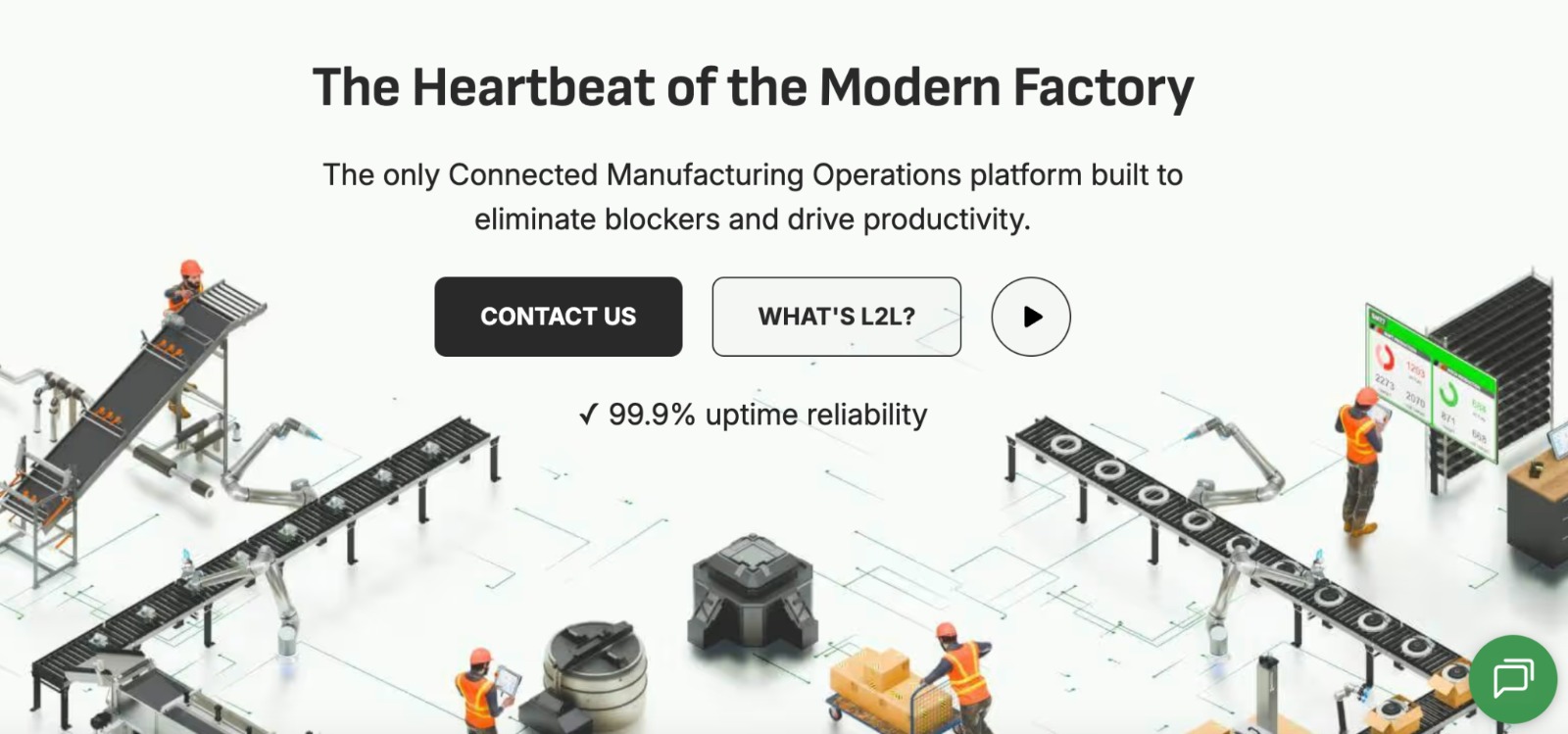
L2L focuses on connected manufacturing operations. It links shop-floor execution, maintenance, production, and skills, making it relevant when a plant wants to connect several operational workflows instead of purchasing a tool for instructions alone. L2L is a good fit if your plant already runs several operational systems and wants employees to record issues and completions in one place.
Key Features of L2L
- Shop-floor execution: This feature enables you to get visibility into what’s happening on every shift and in plant operations.
- Production workflows: It allows you to monitor your production to identify any issues and standardize operations.
- Maintenance connections: You can reduce downtime by proactively managing your equipment and operations.
- Skills management: You can document SOPs that your team can use for skill training to reduce knowledge gaps.
Pros of L2L
- It addresses a broader set of connected manufacturing operations
- This tool brings together production, maintenance, digital work, and skills into the evaluation on one platform
L2L Pricing
L2L licenses its foundational platform by site and prices it by site size. Modules can have additional pricing requirements. Contact the team for a quote covering your site and required modules.
Pilot question: Which existing maintenance or production systems remain, and where will a worker record an issue or a completion? Ask for one scenario that crosses two of its areas, such as an issue raised during production that turns into a maintenance request, and see how the records connect.
Manual.to
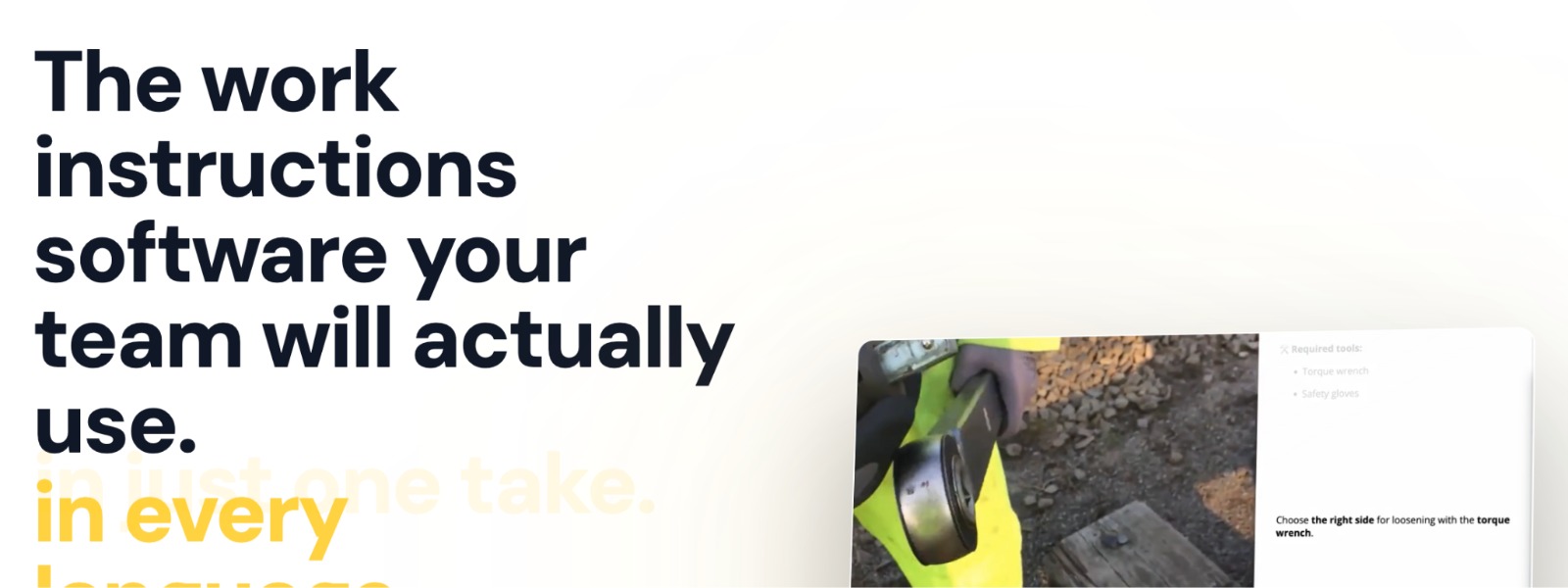
Manual.to is a work instruction software that allows you to capture practical expertise and share it as visual instructions. Your team can upload a video, which this tool transforms into a manual your team can follow as they execute their tasks. Manual.to can be used to create product manuals and retain company knowledge.
Key Features of Manual.to
- Video-to-instruction generation: Turn your recording of the task into a step-by-step manual for the team.
- QR export and link sharing: You can create your instructions and share them with your team through QR codes and links, which can make it easier for workers to access the relevant guidance at the point of work.
- Team workspace: Your team can collaborate and access manuals on the same platform.
- Smart search: Once you document your work instructions, employees can easily find the documentation they need.
Pros of Manual.to
- You can use the 7-day free trial to test the tool and determine if it’s a good fit.
- It supports QR code and link distribution
Manual.to Pricing
The company does not provide the actual costs for using this tool. You can book a demo and get custom pricing for your business.
Pilot question: After a manual is generated from video, does the platform support reviews and approvals before the team can use it? Record one short real task, review the result for gaps, and check what the workspace keeps about access and use.
Knowby
Knowby is an SOP creation software that provides step-based visual instructions. It’s ideal for organizations whose priority is helping employees access practical guidance without introducing a broader manufacturing platform than the workflow requires. You can capture procedures that can be used by maintenance teams, plant operators, AI assistants, and office staff.
Key Features of Knowby
- Step-based visual instructions: You can capture and build visual steps that all employees can follow as they work.
- Version control: This tool allows you to manage instruction revisions so the team can maintain current guidance.
- Web and mobile access: Knowby supports both. It also lists an offline mode; test which reading, editing, and synchronization operations work when connectivity is limited.
Pros of Knowby
- It offers a clear published starting price for private instructions.
- It comes with a 30-day free trial period that you can use to test the tool
Knowby Pricing
Knowby lists private instructions at $5 per user per month. Public instructions cost 2 cents per view on a paid plan. Confirm current volume pricing and any applicable limits in your quote rather than assuming a separate marketing rate applies to your account.
Pilot question: Do approvals, completion tracking, and offline use cover what your floor needs, and what does public sharing cost at your volume?
Poka Alternatives Pricing
All these Poka alternatives use different pricing models. Therefore, when comparing costs, you need to consider the pricing units to determine the best fit. Here are the different billing units to keep in mind as you budget for software:
- Users: Determine which employees and teams require paid accounts. When requesting a quote, ask whether administrators, frontline workers, occasional users, and requesters are billed differently. For instance, SweetProcess bills according to the users on the account.
- Interfaces: Tulip’s Essentials plan costs $100 per interface per month when billed annually, with a 10-interface minimum. The minimum subscription is therefore $1,000 per month equivalent, or $12,000 annually, before applicable add-ons or services.
- Sites and modules: QAD Redzone’s Learning pricing is based on a per-site subscription with a custom quote depending on sites and modules. You’ll need to establish which functions your plant needs and which are included in the proposal.
- Usage limits: MaintainX uses this billing model. The Basic plan is free and includes two work orders with attached procedures per month. The Essential option allows three such work orders per month, while Premium allows unlimited work orders with attached procedures. These limits matter if maintenance jobs routinely require documented procedures.
- Annual commitments: A monthly equivalent may still require an annual contract. Ask whether your quote requires an annual commitment and how payment, renewal, and cancellation work.
- Services and integrations: Ask whether setup, training, hardware, support, connectors, or integration work is included. A published subscription rate does not automatically cover every requirement.
Before making a decision, ask each vendor to quote the exact workflow, user count, sites, interfaces, and services you expect to use.
For tools like MaintainX that have a free Basic plan, they may be ideal for a small team. However, they may not suit a team with a high volume of maintenance jobs. SweetProcess offers a 14-day trial, which you can use to test the tool before paying a subscription.
Ready to try SweetProcess for your work instructions? Sign up for a 14-day free trial here!
Illustrative Pilot: A Packaging-Station Shift Handover
A product tour cannot tell you whether a replacement will preserve the records your operation needs. A small handover pilot can. The following is an illustrative evaluation plan, not a completed product test or a customer result. Use fictional records and an existing, approved site procedure; do not use it to design equipment operation, maintenance, or safety instructions.
Start With the Handover, Not the Software
Choose one packaging station and one shift transition. Ask the outgoing supervisor what the next shift must know: open work, unresolved issues, the responsible role, and the escalation route. Decide where each item belongs. The procedure explains how to hand over; the completed task records a particular handover. Your existing production or maintenance system should remain the authority for records that belong there.
Make the Instruction Usable
Create a short procedure that states the purpose, prerequisites, responsible role, and handover steps. Add a photograph only if it explains something the reader must identify. If the handover includes updating a browser-based system, capture browser steps for that portion. A browser recorder does not observe physical checks or an operator’s judgment. Describe those separately using the site’s approved instructions.
Review Before Asking People to Follow It
Have the appropriate manager review the draft and approve the procedure. Check the actual document state rather than assuming a saved draft is the live version. Then request a read-and-understood sign-off for the people who need the instruction. SweetProcess records the document version and signing time. That acknowledgment is not a practical assessment, a machinery authorization, or proof that a handover occurred.
Assign One Realistic Run
Assign a procedure as a task with an accountable person or role, a due time, and the appropriate repetition schedule. For the pilot, use fictional open items, such as a missing packaging-count entry that needs the supervisor’s attention. Confirm that the person completing the task can record the necessary information and that the incoming shift can find it. Inspect the completed task separately from the procedure: what was recorded, by whom, and when?
Test a Small Change
Change something benign, such as the escalation contact role. Have the manager review the revision and decide whether a new acknowledgment is needed. Check which document version a new task uses and what happens to work already in progress. Do not assume that a revision silently updates every active task or migrates earlier sign-offs.
Decide What the Pilot Proves
A useful result is a readable approved instruction, a distinct acknowledgment record, and a completed handover task with unresolved items visible to the next shift. Record any missing requirement rather than working around it invisibly. If the operation needs live equipment state, lot genealogy, formal qualification, or regulated release evidence, evaluate the system that produces that evidence. A tidy SOP and a checked task do not establish those capabilities.
Migration Checklist: What to Confirm Before Switching
Replacing a connected-worker platform can involve more than copying instructions. Before moving live work, here’s a checklist to follow:
- Inventory the material: List instructions, attachments, images, videos, versions, training history, acknowledgments, task records, permissions, equipment references, and integration dependencies you have on Poka.
- Separate exportable content from history: Determine which material can be exported and which records must remain in the existing system. A PDF copy is not necessarily a complete transfer of version history or evidence.
- Pilot one representative instruction: Select work instructions that involve a manager and frontline teams. You can test permissions, search capabilities, and connectivity conditions.
- Check revision handling: Decide who approves changes and when a new acknowledgment or assessment is needed.
- Review in-progress work: Find out what happens to recurring tasks and open assignments when a procedure changes or the organization migrates to another system.
- Verify integrations: Identify which connections are native, which use APIs or third-party automation, and who will maintain them.
- Set a rollback plan: Keep an authorized copy of required historical records. Do not close the old system until the operational owners accept the replacement’s scope and the relevant records have been checked.
Your migration is ready when the team members responsible for the workflow have verified the new process.
Why Businesses Pick SweetProcess
CFO Services Group, a company that specializes in accounting and bookkeeping services for small and medium businesses, came to SweetProcess because they were struggling to transfer knowledge from vetted experts to new hires.
To create a system that could provide standardized service to all clients, they welcomed our solution to manage workflows and train employees. SweetProcess was able to help them by:
- Providing efficient onboarding for new employees and customers alike.
- Delegating tasks and information to team members based on the projects to which they were assigned.
- Allowing them to share step-by-step processes to improve their workflows.
- Creating a bird’s-eye view for all systems and policies.
Manny Cosme, CEO of CFO Services Group, reported that new employees could train over two weeks by combining shadowing with SweetProcess instructions. This is an accounting firm’s reported onboarding experience, not evidence of a two-week manufacturing qualification program.
Rise25 helps businesses build relationships through podcasting and content marketing. Its team had useful procedures in Google Docs, but the files were scattered and difficult to find.
Combine this issue with the rise in demand they were facing, and the company didn’t know what to do to add structure to their business (especially since the document management solution they were using didn’t help them).
In its published customer story, Rise25 describes using SweetProcess to organize procedures, reference related instructions, and route documents for review. The account illustrates documentation and coordination in a service business, not manufacturing performance or a replacement for operator qualification.
The relevant lesson is to make required instructions easy to find and maintain, rather than leaving their location dependent on one person.
Co-founder Dr. Jeremy Weisz described documenting work so that an absent colleague was no longer the only person who knew how to do it. Treat that as this customer’s experience, not a guaranteed outcome for a new implementation.
Choose the System That Fits the Work
The right Poka alternative depends on the records your team needs and the workflows the software must support. Dozuki, Augmentir, QAD Redzone, VKS, and L2L are worth comparing when manufacturing instructions, skills, or connected operations are central. MaintainX focuses on maintenance, Tulip supports custom frontline applications, and Manual.to and Knowby emphasize visual instructions. Before switching, confirm the full pricing model, required integrations, and records that must survive migration.
SweetProcess is a practical starting point for maintaining procedures, requesting acknowledgments, and assigning recurring work. Pick one real procedure, such as your shift handover, and import it to SweetProcess. Start your 14-day free trial and use this period to evaluate how easy it is to approve, review, and assign it. No credit card is needed.
FAQs
What is Poka software used for?
Poka is connected-worker software for manufacturing. Its current platform covers work instructions, skills, communication, digital forms, issues, analytics, AI, and integrations. Poka is an IFS company. Teams typically use it to keep instructions, training, and shop-floor knowledge in one place that frontline workers can reach on a device.
What is the best Poka alternative?
There is no universal best alternative. SweetProcess is a first place to look for maintained SOPs and assigned work. For manufacturing training, look at Dozuki, Augmentir, QAD Redzone, VKS, or L2L. Choose MaintainX for maintenance, Tulip for custom apps, and Manual.to or Knowby for visual instructions.
Can SweetProcess replace Poka?
SweetProcess may cover a narrower requirement centered on documentation and assigned tasks. It can help teams maintain procedures, request acknowledgments, and record task completion. However, it should not be treated as a full replacement for Poka’s connected-worker capabilities where the workflow depends on formal skills qualification, equipment connections, production data, or manufacturing-specific execution. Test the required records before making a switch.
Is there a free Poka alternative?
MaintainX offers a permanent free Basic plan, but the plan has a limit of two work orders with attached procedures per month. SweetProcess offers a 14-day trial to test out the tool while Manual.to has a free manual-generation entry point.
How much does Poka cost?
You have to contact the Poka team for an actual quote. Poka alternatives like SweetProcess, MaintainX, Tulip, and Knowby publish actual figures, while others require you to contact them.
Is an SOP tool the same as a CMMS or MES?
No. An SOP tool helps document and maintain procedures. A CMMS manages maintenance work and related asset records, while an MES manages production execution and shop-floor information. While some platforms overlap, you should compare the specific functions and records required.
Does signing off an instruction prove someone is qualified?
No. A sign-off records that someone has acknowledged an instruction. A skills qualification requires an appropriate competency process, such as an assessment against defined criteria. If you need proof of skill, look for assessments, a skills matrix, or station-based evaluation.
What should you check before migrating from Poka?
Check current instructions, attachments, media, version history, training records, acknowledgments, tasks, permissions, equipment references, and integrations. Then pilot one representative workflow in the replacement tool. Confirm which records transfer, which must stay in the original system, and who accepts the result before switching.