Last Updated on December 27, 2025 by Owen McGab Enaohwo
Why do some new hires thrive while others start job hunting by month two? More often, it comes down to onboarding.
23% of employees who quit within the first six months say they left because their companies lacked clear guidelines on job responsibilities.
Why does this happen?
In those early days, new hires form lasting impressions about company culture. Therefore, if the employee onboarding process is disorganized, with no clear point of contact and insufficient training, this leads to uncertainty and a lack of motivation.
Organizations that prioritize standard operating procedures (SOPs) can easily solve such issues. SOPs for onboarding provide a structured, step-by-step roadmap. They outline every action that both managers and new hires should take until the employee is fully integrated into the company, such as:
- Sending offer letters and confirming acceptance
- Preparing accounts and tools before the first day
- Conducting orientation sessions
- Providing role-specific training
- Setting performance milestones
When implemented correctly, an onboarding procedure can build an efficient team and set up new hires for success.
Your business needs a tool like SweetProcess that enables you to create interactive SOPs and automate checklists for a streamlined onboarding process. Sign up for a 14-day free trial of SweetProcess here and start building!
Table of Contents
Why Are SOPs Important in Onboarding
How To Create an SOP for Onboarding: A Step-by-Step Guide
Create and Manage Your Onboarding SOPs With SweetProcess
Onboarding SOP Template and Examples
Key Components of an Onboarding SOP
Best Practices & Tips for Creating and Adopting an Onboarding SOP
Create and Manage Your Onboarding SOPs in One Place
Why Are SOPs Important in Onboarding?
Think back to the last time you welcomed a new hire. Was everything ready when they arrived, or did things feel a bit rushed and improvised? The difference between those two experiences comes down to having structured SOPs to get everything started. Here’s why to invest in one:
High Retention and Engagement
When new hires feel unsupported or unsure who to ask for help, their excitement fades, often leading to early turnover.
However, if you have an SOP for your business, you can structure the entire process, outlining the steps to follow and who is responsible for each. Employees will naturally feel more connected with the company if they know exactly what’s expected of them. The steps you take during these early days are crucial for long-term engagement.
Consistent Experience Across Hires and Locations
Here’s a question worth asking: if you hired two people in different departments or even other cities, would they both have the same onboarding experience? Without a defined process, the answer is probably no. If you have a remote or hybrid team, you need a consistent onboarding plan to prevent confusion and tension between teams.
Once you hire the new employees in different locations, they should all receive the same experience as outlined in the SOP. With this form of process standardization, it becomes easier for everyone to follow and understand the company’s culture and values.
Easier Compliance and Auditability
Missing key staff compliance trainings can lead to costly legal issues and financial penalties. An onboarding SOP keeps you on track for every requirement. You can use it to verify employment eligibility or to complete mandatory safety training.
SOPs protect your company from oversight and keep all your documents organized and traceable for such occasions.
Faster Time-to-Productivity
Once you hire a new employee, you expect them to perform their duties. However, for this to happen, you need to onboard and integrate them systematically. Your SOP should cover tasks that should be accomplished even before the report on the first day, and a breakdown of what happens in the first week and the first 30 or 60 days.
Equipping your employees from the start helps them settle in much faster. They can start working as they learn the job and eventually become fully productive.
How To Create an SOP for Onboarding: A Step-by-Step Guide
Now that we understand the importance of onboarding SOPs for your organization, it’s time to develop them. This process doesn’t have to be complicated if you follow this simple guide:
Step 1: Define Your Purpose and Scope
Every SOP needs to solve a problem. You need to start with clarity by defining what this document should achieve. Some of the goals could be:
- Streamline communication between HR, managers, and new hires
- Reduce the time-to-productivity
- Increase employee retention
- Provide consistent training to every new hire
With a clear purpose, you can now add details to your procedure.
Your scope should also outline what the onboarding process will cover, from the time the candidate accepts the offer to the end of their 90-day probation period. This defines the boundaries for your SOP so that it doesn’t overlap with recruitment or ongoing training.
Step 2: Assign Roles and Responsibilities
A lot of companies make the mistake of entrusting the entire onboarding process to the HR team. However, this role should be handled by multiple departments. For instance, a new social media manager can be onboarded by the HR and the marketing team lead. Failing to define who is responsible for this work slows down your process.
As you draft the SOP, you can divide it into the roles in this way:
- The HR handles paperwork and orientation
- The IT team sets up equipment and access
- Managers and team leads oversee training and integration
Additionally, you can assign a point of contact or onboarding buddy to guide the new hire through their first few weeks. This way, the process runs without delays.
Step 3: Draft a Pre-Onboarding Checklist
Let’s say your new hire walks in on day one, but their laptop hasn’t arrived, their email isn’t set up, and no one knows where they should sit. That awkward start could have been avoided with a proper pre-onboarding checklist.
This section of your SOP should list everything that must happen before the employee’s first day. Include tasks such as:
- Sending offer letters
- Preparing contracts
- Creating accounts
- Setting up software and tools
- Ordering equipment
- Sharing the welcome email
Having a clear pre-onboarding checklist ensures new hires feel expected and sets the tone for an organized, professional experience.
Step 4: Draft the First Day and First Week Checklist
First impressions matter. Because of this, your day one and first week onboarding checklists should focus on clarity and connection.
It’s essential to include key tasks like team introductions, orientation sessions, and the company’s early training goals. This approach allows you to balance learning and relationship building. Your new employees will also settle in quickly since they are fully catered to.
Step 5: Plan the 90-Day Probation Plan
While some organizations onboard their employees only for one week, others take over a year. The first 90 days, which coincide with the probation period, are crucial in this journey. You need a road map to help you plan and track progress.
Your SOP should break the 90 days into such milestones:
- 30 days: Introduction and learning company systems, tools, and processes.
- 60 days: Taking ownership of specific tasks or projects.
- 90 days: Demonstrating autonomy and meeting key performance goals.
After each milestone, you can conduct check-ins with the employee and collect feedback on the onboarding process. Implementing this kind of plan keeps you accountable to the new hires. In addition, it gives the employees a sense of direction since they have a proper system.
Step 6: Attach Documentation, Policies, and Resources
As you draft the onboarding SOP, it’s important to link all the relevant documents. For instance, you can attach company policies and training handbooks that new hires need to understand as they join the organization.
To make this effective, you should gather all the information from your email threads, Google Docs, and Word documents, and then import it into an SOP software. This platform centralizes all the information in one system so that employees have access to a self-service knowledge hub with all the answers.
Step 7: Collect Feedback and Review Regularly
Even the best onboarding SOPs can become outdated as teams grow or processes change. For this reason, it’s always good to gather feedback from both new hires and managers after each onboarding cycle. This way, you can understand what worked, what felt repetitive, or what can be automated.
With this feedback, you can refine your SOPs to keep them relevant and aligned with your company culture.
Create and Manage Your Onboarding SOPs With SweetProcess
If your organization has multiple company documents stored and managed by different employees, you are more prone to poor onboarding. This is because it’s hard to make uniform updates and assign similar tasks to new hires. A centralized and intuitive tool like SweetProcess transforms this process.
All your SOPs can be drafted and managed from the same platform. In addition, you can create repeatable workflows that anyone can follow, no matter their department or location. What makes SweetProcess ideal for onboarding is its comprehensive suite of features. Here are the essential ones to get you started:
Manually Create an SOP to Onboard New Hires
Sometimes, you know exactly what your onboarding process should look like. You just need a structured space to bring it to life. With SweetProcess, you can easily create onboarding SOPs from scratch.
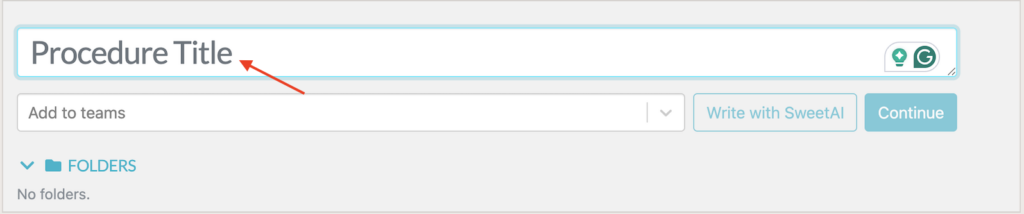
The interface is straightforward from the dashboard.
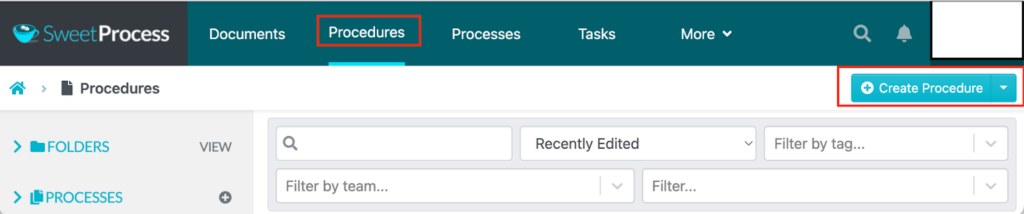
You start by naming your procedure.
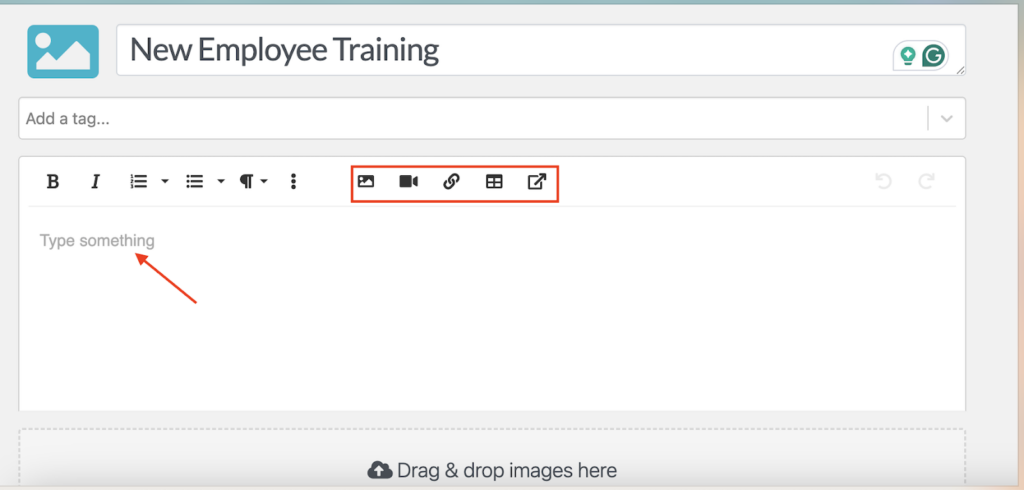
Since you’re drafting the procedure manually, you have to type all the details and add visuals that support this document.
This will generate the steps you need to follow during the onboarding process. These can be converted into a checklist.
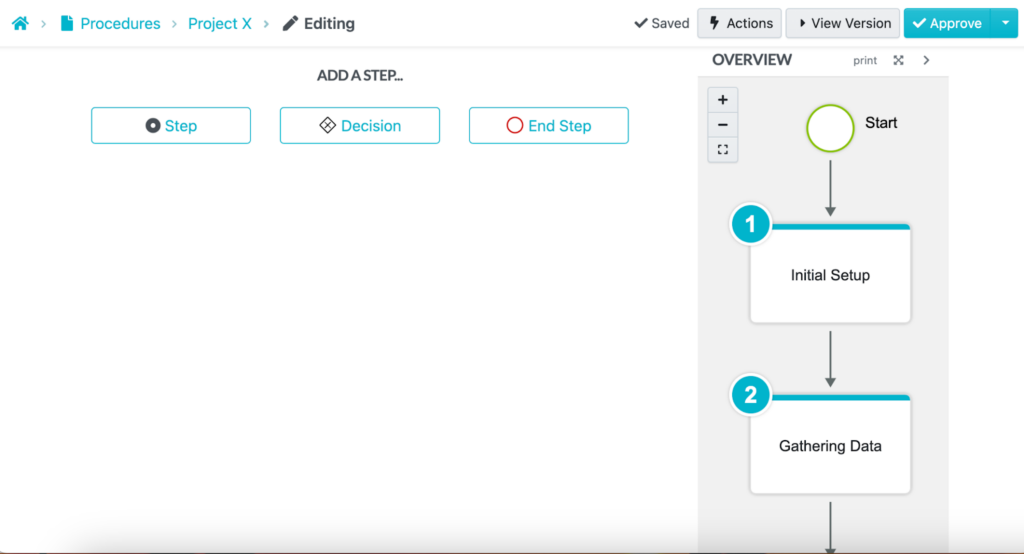
This manual creation feature gives you total control over how your onboarding content looks. It’s perfect for companies that want their onboarding materials to reflect their unique culture and structure.
Generate Your Onboarding SOPs Automatically Using SweetAI
What if you could create an entire onboarding SOP in minutes? SweetProcess makes that possible with SweetAI, the built-in AI-powered document generator.
You simply describe your onboarding goal by adding a title, and SweetAI automatically generates a well-structured SOP.
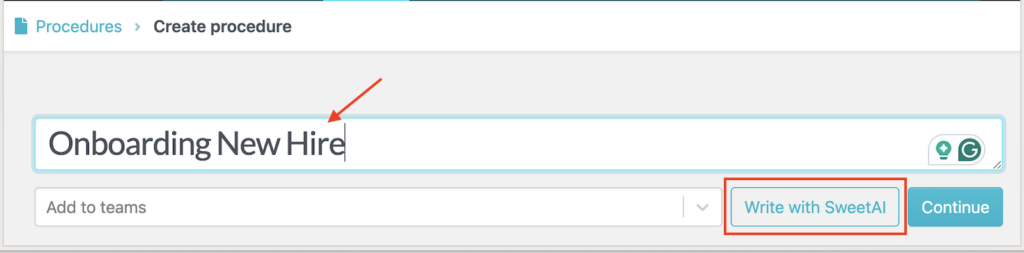
The generated SOP comes complete with steps.
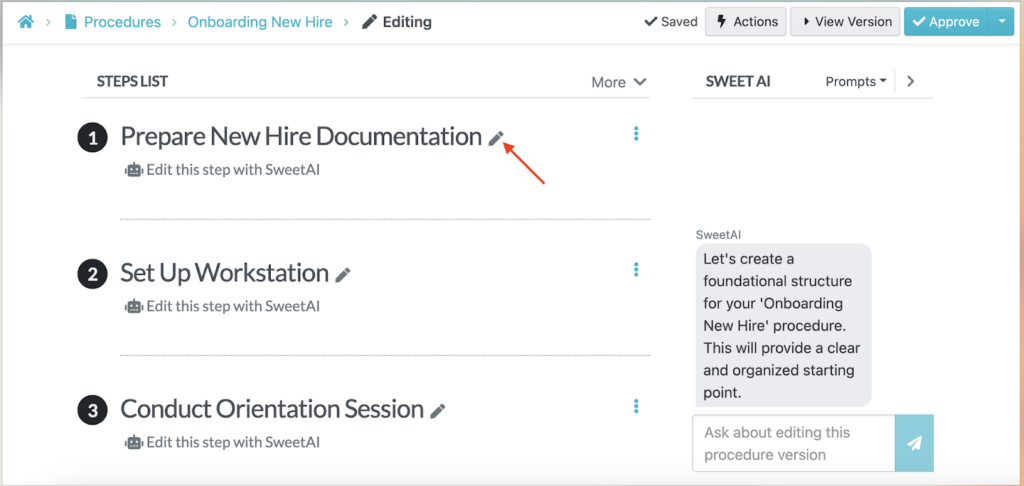
You can refine and edit the AI-generated content to reflect your company’s goals.

The speed and accuracy give you a head start on every new onboarding process.
Assign Tasks and Collaborate With Team Members Seamlessly
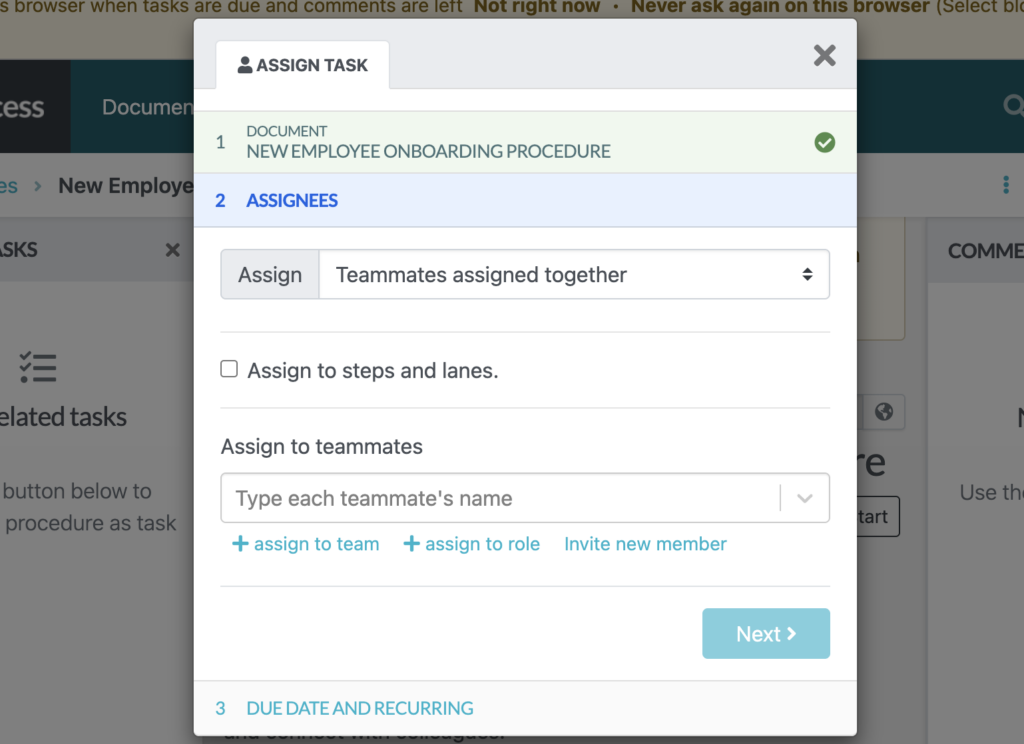
Onboarding is a team effort. As the HR prepares key documents, the managers oversee employee training. With SweetProcess, you can easily collaborate on these documents by assigning direct tasks from the SOP.
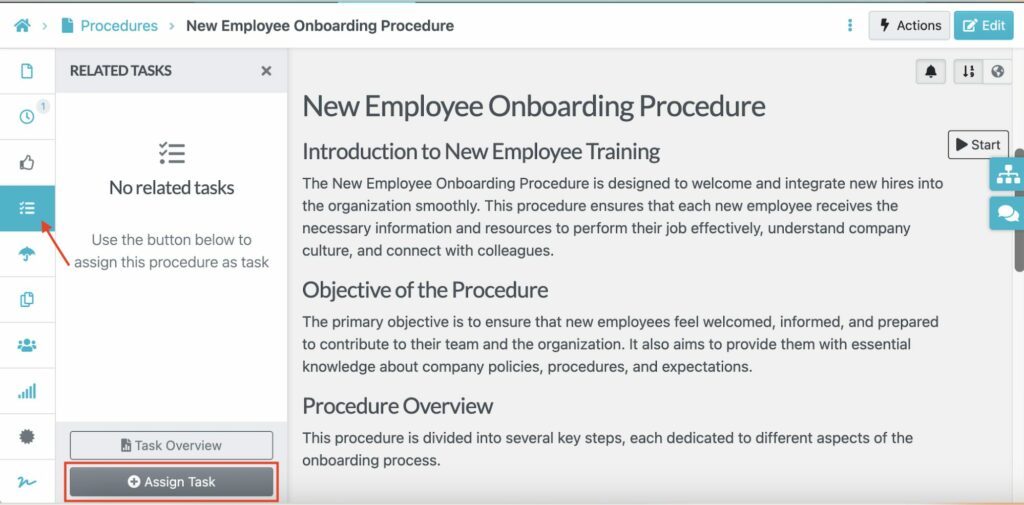
You can select a specific team member and set deadlines directly on the same platform.
As you create the SOP, you can also notify team members about a point of action by tagging them in the comment section.
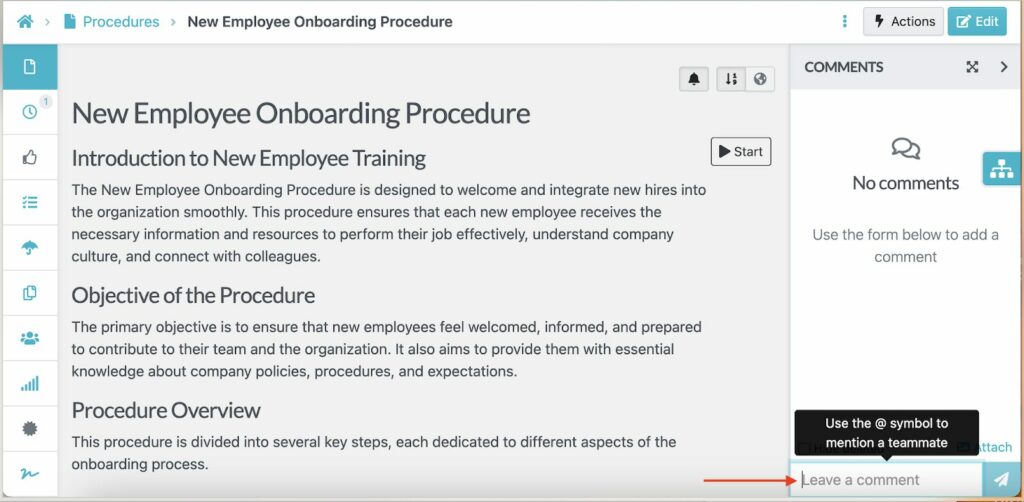
This way, everyone involved knows exactly what they’re responsible for. These SweetProcess features promote accountability and ownership by making every activity visible from the dashboard.
Allow Team Members To Access Training Materials on Mobile
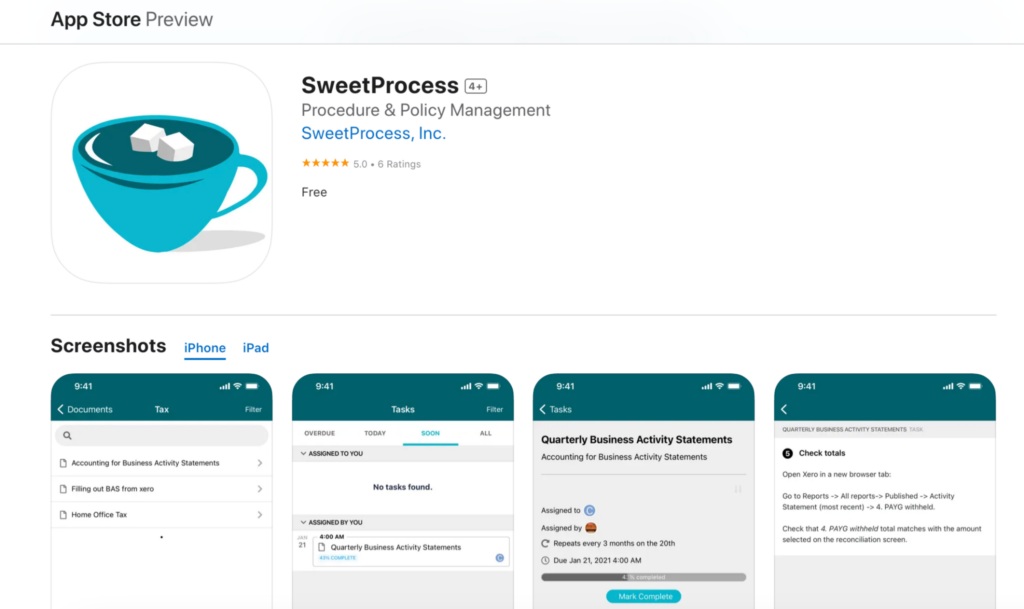
As teams increasingly adopt hybrid and remote systems, you want your new hire to have access to training guides and tutorials from anywhere. SweetProcess makes this possible with its mobile-friendly access.
Every SOP and checklist you create is automatically available on mobile devices, making onboarding flexible.
This mobility ensures that learning doesn’t stop when the new hire leaves their desk. Additionally, when they need to be in the field or away from the desk, they can download the SweetProcess app and access the same procedures.
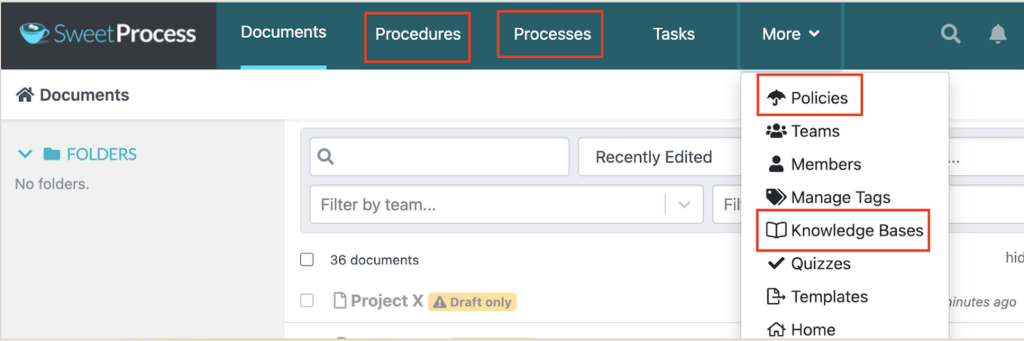
Manage Your Onboarding SOPs, Processes, and Policies in One Place
Juggling multiple tools while training and onboarding your new hire can become tiresome. Constantly switching between tools increases the risk of confusion. SweetProcess centralizes all your SOPs, policies, and processes on one dashboard.
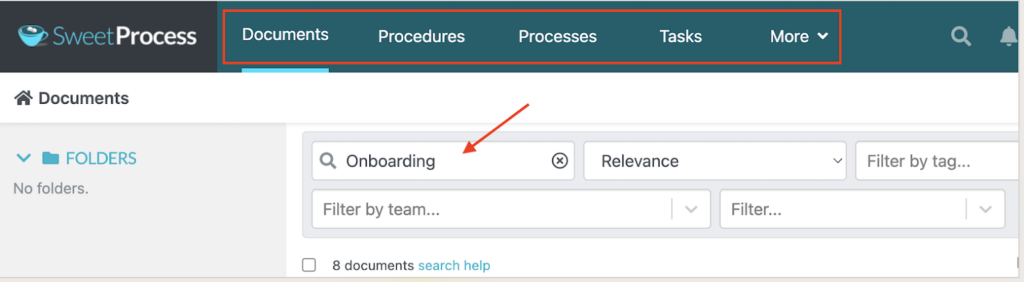
You can easily search for the document you need, using the available filters.
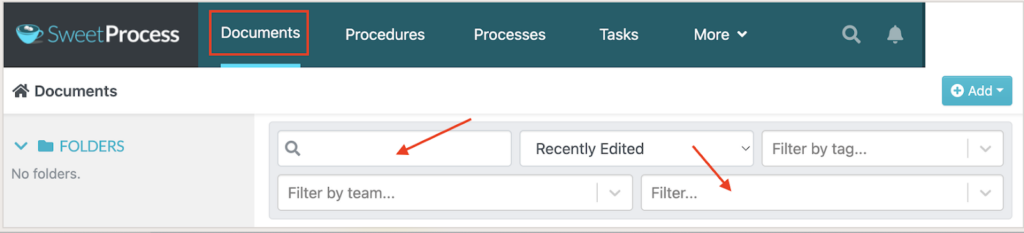
This unified structure eliminates the need to message team members about missing files. All onboarding updates are instant and visible to everyone, ensuring that your team always works with the most current version.
Let’s look at real companies that transformed their employee onboarding and training processes using SweetProcess.
The Life Coach School, a personal development company with 12 full-time remote employees, was facing a serious onboarding challenge. Despite using Basecamp to store training videos and processes, their system lacked structure and efficiency. Most knowledge existed in employees’ heads; therefore, when someone left, their processes left with them.
Due to high turnover, they had to constantly retrain new hires and rebuild documentation from scratch. The Executive Director of Marketing and Customer Support, Kimberly Job, recalls how difficult it was to maintain consistency. “We had video processes for everything, but it wasn’t scalable. Each team member had to sit through multiple videos just to complete a task, and we still had no written documentation for reference.”
As the company grew, this system made onboarding and knowledge transfer increasingly frustrating. The team switched to SweetProcess, which helped them to:
- Organize all video and written SOPs into searchable and clickable processes.
- Create a 30, 60, and 90-day onboarding structure for new hires.
- Enable employees to self-train by following step-by-step documentation instead of waiting for one-on-one guidance.
- Reduce communication overload between departments since everyone could access the same resources.
- Improve consistency and cohesion across the entire remote team.
Wealth management firm, Thimbleberry Financial, is also a beneficiary of SweetProcess. Led by President and Financial Advisor Amy Walls, the team had what seemed like an organized onboarding system, which was mostly Word documents filled with checklists. However, team members struggled to find the necessary information and often skipped steps entirely.
As turnover increased, new hires lacked clear guidance, and Amy found herself constantly retraining staff. When her business coach recommended SweetProcess, she realized how much smoother and more accessible it made everything. Since the switch, the company can now:
- Structure and organized training since every new hire now gets access to SweetProcess on day one, alongside their email and communication tools.
- Standardize training boards for each new employee, covering all essential learning materials.
- Link related procedures and keep all training content in one accessible system.
- Empower the team to fix or update processes themselves and submit them for approval.
Amy sums up her experience best: “By having SweetProcess, all of our team members can fix whatever is broken that they touch. They don’t have to come to me and say, ‘Hey, Amy, fix this.’”
These two organizations show what’s possible when you stop relying on scattered documents and start using a single, reliable system.
Onboarding SOP Template and Examples
If you want to start creating onboarding SOPs for your business but are unsure where to start, you can refer to real-world examples to get an idea. In addition, you can access SOP templates from SweetProcess to get started.
Here are some examples:
Template Example 1
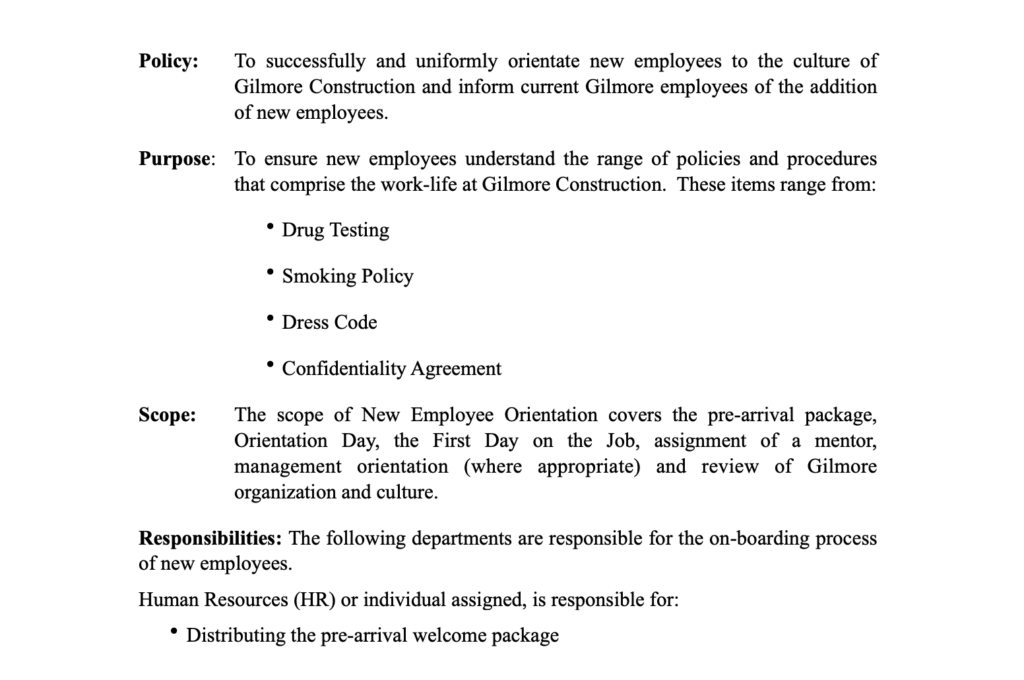
This SOP by Gilmore Construction is a clear example of how a company can create a step-by-step onboarding document tailored to different roles and departments. It breaks down the onboarding journey into three key phases: pre-arrival, orientation day, and follow-up.
Roles such as HR, payroll, supervisors, and safety managers all have defined responsibilities in the document. This SOP document is an excellent example for teams looking to formalize their onboarding without overcomplicating it.
Template Example 2
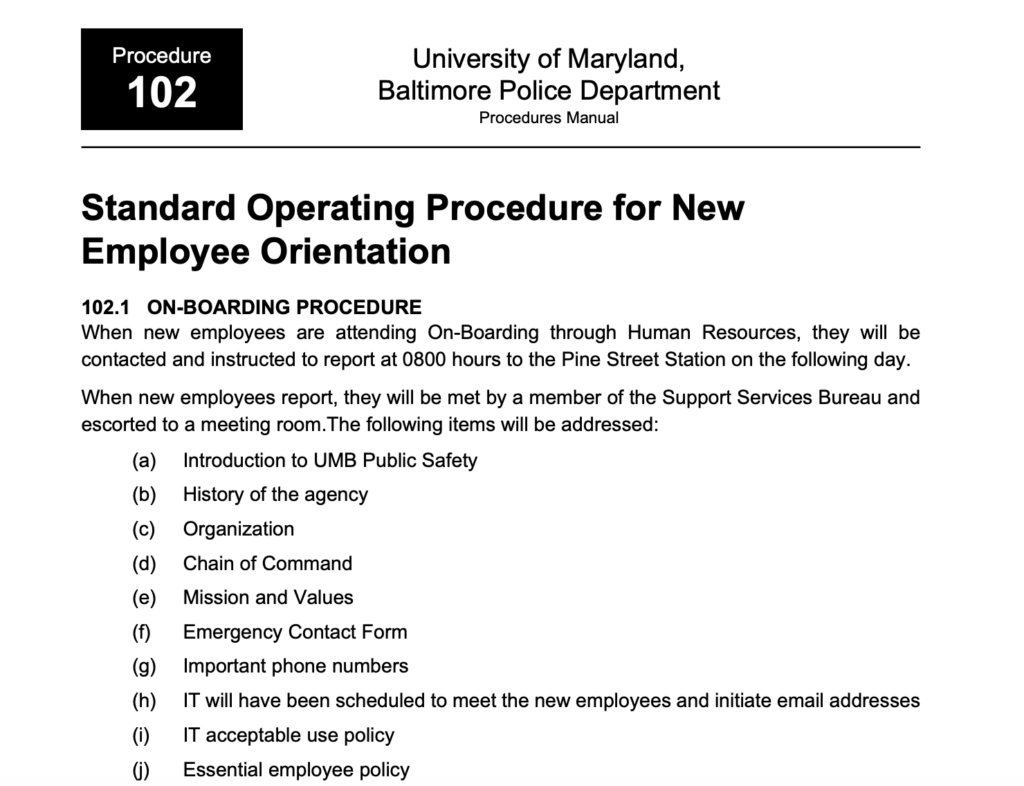
This SOP example from The University of Maryland, Baltimore Police Department breaks down how the public institution welcomes its new staff. There’s a full list of activities that will be executed from the employee’s first day.
It covers key details such as:
- A formal orientation meeting with the department head and HR team.
- Distribution of uniforms, security credentials, and equipment.
- Overview of departmental policies, workplace safety, and reporting structure.
- Follow-up meetings to review employee adjustment and compliance requirements.
This SOP strikes a balance between administrative onboarding and cultural integration to ensure everyone remains aligned.
Template Example 3
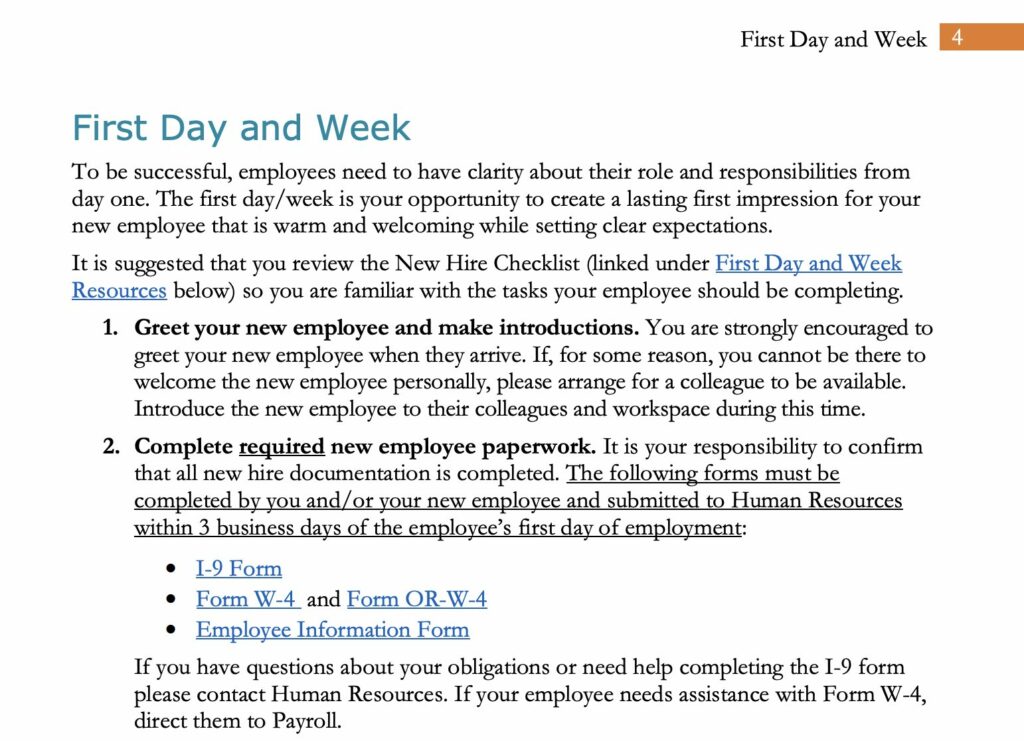
As an onboarding manual, this SOP is quite comprehensive. The specific objectives are assigned to phases: preboarding, first day, first week, and first 90 days. It also outlines the responsible individuals for each stage.
Additionally, the SOP includes links to related processes and resources, such as a conversation guide, employee information form, and questions to ask. With these feedback checkpoints, managers can monitor the progress of new hires.
These real-world examples demonstrate how multiple teams can utilize a well-documented onboarding SOP within a single framework.
Key Components of an Onboarding SOP

When done right, an onboarding SOP keeps the management team and new hires aligned from early on. Here are the key components to add to your document, whether you are creating one for the first time or refining an existing one:
Purpose and Scope
Your onboarding SOP needs a clear purpose to guide you. Defining this prevents confusion and sets expectations for the new employees and trainers. For example, if the SOP covers onboarding for new sales reps, it should specify what will be covered, such as CRM training, sales scripts, and compliance modules.
In addition, you need a defined scope to keep your documentation focused. This prevents your onboarding SOP from drifting into unrelated areas, like performance reviews or advanced technical training.
Preboarding Activities
What access log-ins and tools does your new hire need on the first day? If you work on-site, do they have a designated desk?
Your onboarding SOP is the best place to define how everything will be set up before the employee reports to work. These are the key things that set up the new hire for success. You also need to include the preboarding tasks, such as:
- Sending offer letters
- Scheduling sessions with managers
- Preparing training materials
- Specifying who is responsible for each of these tasks
Providing all these on the first day or first week can make the employee feel more welcome as they start working.
Training and Development
Investing in employee training benefits both the company and employees. The team becomes empowered, contributing their skills to the company, which in turn leads to higher revenues and streamlined operations. This section of your SOP should outline what new hires need to learn and how progress will be measured.
Some of the key things to include are:
- Role-specific training modules
- Soft skill development
- Shadowing opportunities
- Tools to train them on
With an SOP, you standardize the training process so that every employee gets the same foundational knowledge.
Paperwork and Compliance
Although compiling and organizing the company’s paperwork can be a tiring process, it is essential to keep up with it to avoid compliance issues. In this section, you can add all the legal and financial documents that are needed for the onboarding. This includes employee contracts or NDAs.
Apart from listing these important forms, you also should indicate who is responsible for them and when they’re due. A standard operating procedure software gives you a platform to manage all these documents and clearly define the details of your onboarding process, so you don’t have to switch between multiple tools.
Training Delivery
Every individual learns differently. While some people absorb information best through video, others learn better through hands-on practice. That’s why your SOP should describe how training will be delivered. Will it be in-person, virtual, self-paced, or blended? Will new hires have access to a learning portal or mentorship program?
Standardizing training delivery ensures that every employee receives the same level of support and information. You can pair new hires with mentors during week one or provide them access to recorded sessions for review. A consistent training delivery method helps reduce information gaps during those crucial early weeks.
Feedback Mechanisms
How do you know if your onboarding actually works? Establishing feedback loops with your new team and trainers will help you gather information to assess the effectiveness of the onboarding SOP.
You can collect feedback using these methods:
- Post-training surveys
- One-on-one check-ins
- 30-day performance reviews
During these reviews, ensure that you also identify what worked and areas that can be improved. Implementing this standard helps you refine your SOP continuously to ensure that it’s relevant.
Assigning Responsibilities
If you create an onboarding SOP without assigning responsibilities, it could all fall apart. This section of your document outlines the departments or individuals that will handle each part of the onboarding journey, from HR and IT to department heads and mentors.
When you have clarity of ownership, the process moves smoothly and encourages accountability. For example, you can break your SOP down to have the HR handle paperwork, IT sets up key systems, team managers oversee training, and mentors support employee integration.
Best Practices & Tips for Creating and Adopting an Onboarding SOP

Creating an onboarding SOP is only half the journey. You need your team to actually use it. To build the most effective document, here are some best practices to follow:
Write in Simple and Clear Language
Have you ever opened a company manual and felt like you were reading legal jargon instead of practical guidance? Overcomplicated SOPs will confuse your new hires, yet they are supposed to help them. It’s good practice to write in simple conversational language that every team member can follow and understand.
Here are some tips to follow:
- Keep your sentences short
- Replace technical terms with plain alternatives
- Break long steps into numbered lists or checklists
Keep in mind that the goal of your SOP is to guide. If the wording is clear, there will be fewer mistakes.
Clarify Roles and Ownership
Which manager is introducing the new hire to the team? Who will set up their accounts? Who’s sending key company documents? These questions will help you determine whether you’ve established a clear ownership system.
As senior quality and process manager at AT&T, Brooke Hokenson points out that most onboarding problems come from unclear expectations. She says, “But too often, organizations prioritize speed over quality… if procedures aren’t clearly explained, new hires lose confidence. That early uncertainty lingers and reduces engagement.”
When roles are defined, individuals become more accountable because they know what they need to do. In addition, it’s easy to track performance because you know who is responsible for each part of the process and can easily prevent mistakes before they happen.
Focus on Culture and Tasks
To fully integrate a new employee, you need to connect them to your company culture. As you teach about role execution and deliverables, you also need to make them feel like they are part of the company. Your SOP should include culture-related activities, such as team introductions and informal coffee chats.
Balancing these two processes helps new hires build confidence from the start.
Include Milestones
Imagine starting a new job with no clear idea of what success looks like by day 30, 60, or 90. That uncertainty is one of the main reasons new hires disengage early. Adding milestones to your SOP provides structure, enabling employees to measure progress and feel a sense of achievement.
Define milestones for each stage of onboarding. For example, by day 30, they’ve completed the company’s system training; by day 60, they’re handling small projects; by day 90, they’re fully independent. These checkpoints also make it easier for managers to track readiness and step in with support where needed.
Automate Where Possible
If you’re manually reminding managers about onboarding tasks or sending the same checklist over and over, it’s time to automate. Tools like SweetProcess automate repetitive workflows such as task assignment and SOP updates, saving HR teams hours each week.
You can automatically create onboarding checklists with SweetAI, freeing your managers to focus on other core activities. Additionally, with automated systems in place, every new hire receives the same high-quality experience.
Balance Compliance & Engagement
It’s tempting to prioritize employee engagement over managing your compliance needs. As you integrate the employee into the company culture and train them on their expected role, you should also pay attention to administrative tasks.
For instance, employees might need to sign NDAs, or your finance team may need to set up payroll. Schedule all these activities and distribute them evenly during the first week so that employees are not overwhelmed with information.
Encourage Feedback
How do you know your onboarding SOP actually works? You have to ask the people who use it. Gathering feedback from both new hires and managers ensures your SOP stays relevant and effective.
You can achieve this by conducting surveys or even informal chats at the end of the first week or month. Ensure that you ask what made onboarding smooth and what felt unclear or overwhelming. These insights help you spot blind spots and continuously improve.
Human resource specialist and generalist at Centerbase, Scott England, supports this best practice and shares how he makes day one smooth for new hires. He says, “I start before they even walk in the door. Every new hire gets an email outlining what to expect… We’re also rolling out a short survey one week in, not just to gather feedback on the process, but to check on practical things like whether their email signature is set up and they’ve got access to the tools they need.”
Having such a structure builds trust and establishes a strong relationship from early on.
Review Regularly
Just as your company’s environment is changing, your SOPs should reflect this. As the organization grows, new tools and compliance rules also emerge. Therefore, it’s important to schedule regular reviews to update on new changes.
As you conduct these reviews, involve the recent hires and team members involved in the onboarding process. This way, you keep the SOPs accurate and relevant even for the employees you’ll hire in the coming years.
Create and Manage Your Onboarding SOPs in One Place
Every great employee experience starts long before the first task. From the time they accept the offer letter, your onboarding plan becomes their first real impression of your company. When your process is guided by an onboarding SOP, the team moves in sync, and the new hires feel like part of the company from the first day.
SweetProcess makes all this possible with its intuitive platform. You can document your preboarding checklists and training materials to make them accessible to everyone involved. Additionally, this software is simple to use, with no learning curve, so your new hires can start accessing resources on the shared system immediately.
Try SweetProcess and give your team the structured onboarding experience they deserve. Create an account and start your 14-day free trial!