Last Updated on November 20, 2026 by Owen McGab Enaohwo
Start your free 14-day trial of SweetProcess.
No credit card needed. Cancel anytime.
What do you need to improve when you replace Way We Do? Is it the instructions, the work people run, or the proof they read a policy? Each answer points to a different tool. If the instructions are the problem, you need one maintained place for them. If the work is the problem, you need recurring tasks with clear owners. If the proof is the problem, you need acceptance records and controlled documents. That gives you three buying paths when choosing an alternative: SOP execution, employee training, and policy governance.
Way We Do already supports procedure templates and activated checklists. However, if your requirements change as the organization grows, you might need more detailed workflow automation, a stronger training structure, more extensive policy controls, or a different pricing arrangement. This comparison examines 10 Way We Do alternatives, what each product offers, how its pricing works, and what to verify before moving your existing documents and records.
Key Takeaways
- Way We Do supports reusable procedure and checklist templates, plus acceptance requests that can run once, on a schedule, or after a change. If that meets your requirements, staying is a sound decision.
- Trainual and Whale lean toward training. Process Street leans toward structured workflows. ComplianceBridge, NAVEX One Policy & Procedure Management, Bizmanualz OnPolicy, MetaCompliance, DynamicPolicy, and Zavanta lean toward policy governance.
- The pricing of each tool differs based on user blocks, creator seats, and per-plan quotes; therefore, you have to compare each platform on the same basis to determine which is the best fit.
- Before migrating from Way We Do to any of these alternatives, test the new software with one real process. To try SweetProcess, start your 14-day trial here!
Table of Contents
Way We Do Alternatives at a Glance
The right replacement depends on the kind of work you want the software to support. Use this table to narrow your options before exploring the detailed features and pricing.
Software | Best Fit | Pricing | Main decision boundary |
|---|---|---|---|
Maintained procedures, policies, and assigned work | $99 per month for up to 10 users; additional users cost $5 per month | A practical choice when documentation and execution need to work together | |
ComplianceBridge | Policy lifecycle management and distribution | Custom quotes for Silver, Gold, and Platinum | Check workflow features your tier includes |
Trainual | Structured employee training | Core, Pro, Premium, and Enterprise by quote, plus a $1,000 implementation fee | Training paths and version history vary by tier |
Process Street | Structured recurring workflows | Startup, Pro, and Enterprise; contact sales for pricing. | Startup includes five users and 10 guests |
NAVEX One Policy & Procedure Management | Governed policies and controlled distribution | Custom pricing | Best evaluated against your organization’s policy-governance requirements |
Whale | SOP-based training with creator and member roles | Pricing starts at $299 per month, billed yearly | Check creator limits, member allowances, and feature restrictions |
Bizmanualz OnPolicy | Controlled documents and required reading | Request current pricing; confirm user limits. | You have to request a demo to get current pricing |
MetaCompliance | Policy acknowledgment within a wider compliance program | Custom pricing | Evaluate its policy, privacy, and incident-management scope |
DynamicPolicy | Document lifecycle and deployment needs | Custom pricing | Confirm deployment and licensing terms |
Zavanta | Standardized policy and procedure authoring | Custom pricing | Consider it when controlled guidance and evidence records are central requirements |
Competitor details and pricing checked November 20, 2026.
SweetProcess publishes this comparison and is our top pick for teams that need maintained instructions and recurring work in one place. That is why it is listed first. The other options suit different training and policy-governance requirements, and we say where each one fits and where it stops.
How to Narrow Your Shortlist
To evaluate the Way We Do alternatives, start with the work your employees perform. Here are the key things to consider and the tools that fit each job.
SOP Execution
These are the tools to pick if you need employees to follow documented instructions, complete assigned tasks, and repeat processes consistently. SweetProcess and Process Street are the closest options to investigate. While SweetProcess brings documentation and task execution together, Process Street places greater emphasis on configurable workflow execution.
Employee Training
If you want to organize onboarding, assign learning materials, and track employee progress through structured training, Trainual and Whale deserve closer attention. Both connect company knowledge with employee learning, although their plans and role structures differ.
Policy Governance
These are platforms for businesses that need formal review and approval, targeted distribution, acknowledgment records, version control, and evidence for audits. ComplianceBridge, NAVEX One Policy & Procedure Management, Bizmanualz OnPolicy, MetaCompliance, DynamicPolicy, and Zavanta address different parts of this requirement.
Way We Do Today: When to Stay and When to Switch
Before looking at alternatives, establish whether Way We Do is falling short of your requirements.
What Way We Do Does Well
Way We Do is business process management software that supports operational governance. Here are the capabilities you should account for before deciding to migrate:
Reusable Procedure and Checklist Templates
You can create procedure and checklist templates that employees can use repeatedly. This gives your organization a consistent starting point for documenting activities. For example, an operations manager can create a checklist template for opening a location. Employees can then use the activated checklist to complete the work rather than creating a new document every time.
Configurable Acceptance Requests
Way We Do allows administrators to request acceptance once, periodically, or after a change. This is useful when you need employees to acknowledge an updated policy or procedure. When republishing a document, the author can decide whether employees need to accept it again.
Assigned Activities and Reminders
Assigned requests appear in employees’ dashboards. These daily or weekly summaries will help employees keep track of activities that require attention. With this feature, your team can follow a regular schedule such as weekly inspections or quarterly checks.
Entry Pricing for Small Teams
The Entry plan starts at $99 per month for 10 team members. Extra seats are sold in blocks of 10. Way We Do advertises a full refund on the Entry subscription within 30 days of signup.
When Keeping Way We Do Makes Sense
You may not need another system if:
- Your employees can find and follow the existing procedures
- Your reusable templates cover the work your organization performs
- Recurring activities and reminders are working as intended
- Your current team size and pricing arrangement are manageable
- You do not need additional training or policy-governance capabilities
Replacing software has a cost beyond the subscription. You need to transfer documents, rebuild permissions, train employees, and confirm that the new system preserves the records your organization needs.
If your existing system already supports your work, changing it without a clear reason can create unnecessary disruption.
When Switching Makes Sense
A replacement for Way We Do may be worth considering when:
- Your onboarding process requires structured learning paths and knowledge assessments
- Your policy team needs more detailed approval and version-control records
- Your existing software does not fit your new team structure or required user roles
- You need different integrations or deployment arrangements
- The total subscription and implementation costs no longer make sense for your organization
If you are specifically comparing Way We Do with SweetProcess, here’s a Way We Do vs. SweetProcess comparison to help you choose.
10 Way We Do Alternatives
SweetProcess
SweetProcess is business process documentation and management software that helps you document procedures, policies, and processes in one place. You can assign work to employees, track tasks, and maintain an organized record of how your organization operates.
It is a practical Way We Do alternative if you want to connect written instructions with the activities employees perform. Rather than keeping your procedures in one system and managing their execution somewhere else, you can document the work and assign tasks within the same platform.
It’s best for businesses of all sizes that use a cloud-based workflow management system. Works well with task creation, documentation, and productivity tracking.
Key Features of SweetProcess
Real-time Collaboration
Teamwork is the soul of any successful business. Having a rigid SOP system that can only be accessed by the admin will lead to counterproductivity.
With SweetProcess, you don’t need to overwhelm a single person in creating the policies or procedures.
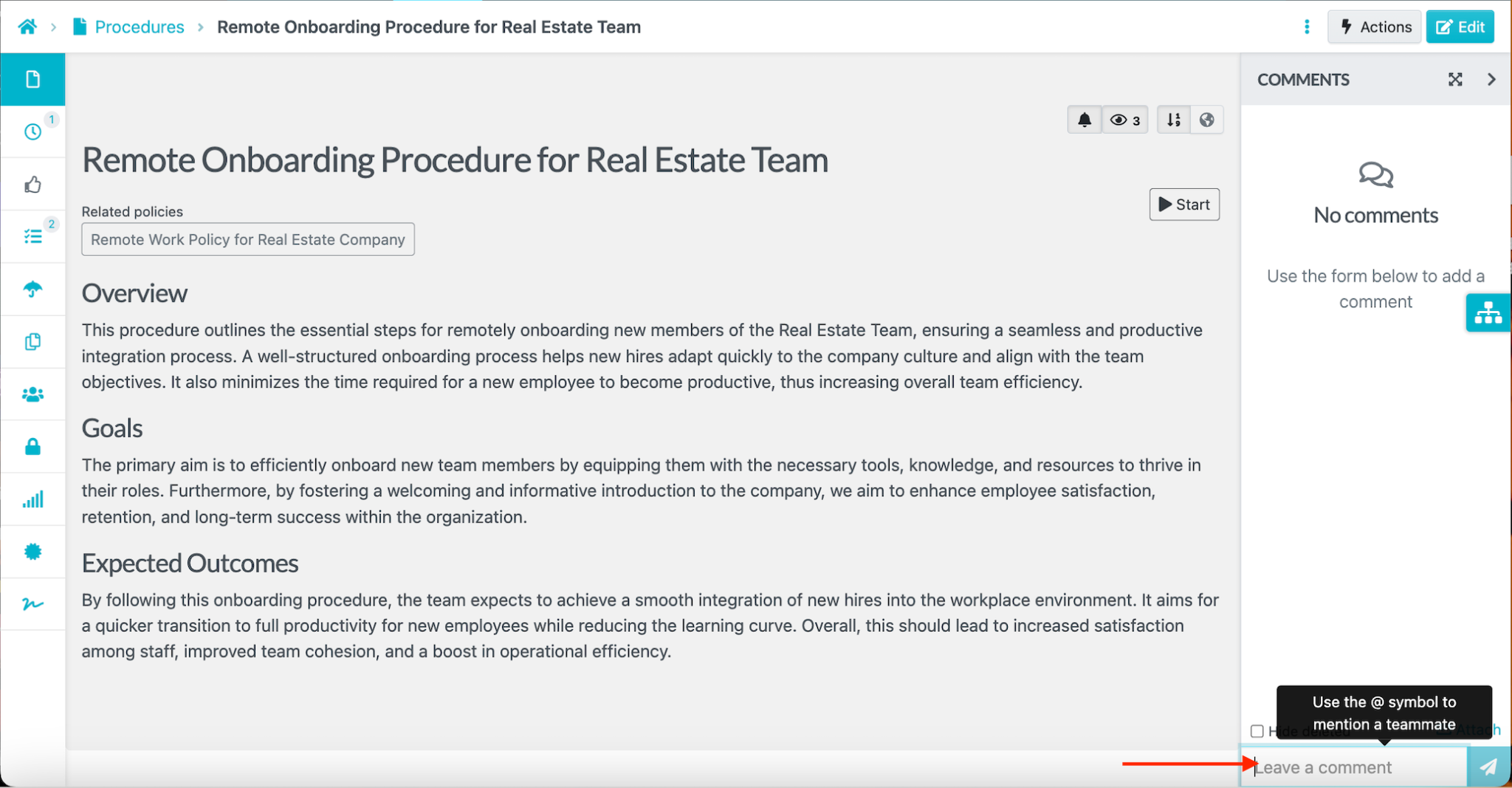
Every concerned team member can easily collaborate in developing your worthwhile policies and procedures. You can comment, collaborate, or leave your feedback on a procedure. You can also use a comment to suggest an improvement to a procedure.
Assign Tasks to Team Members and Guests
If you want to collaborate with team members or a client, you can assign them a task directly from the platform.
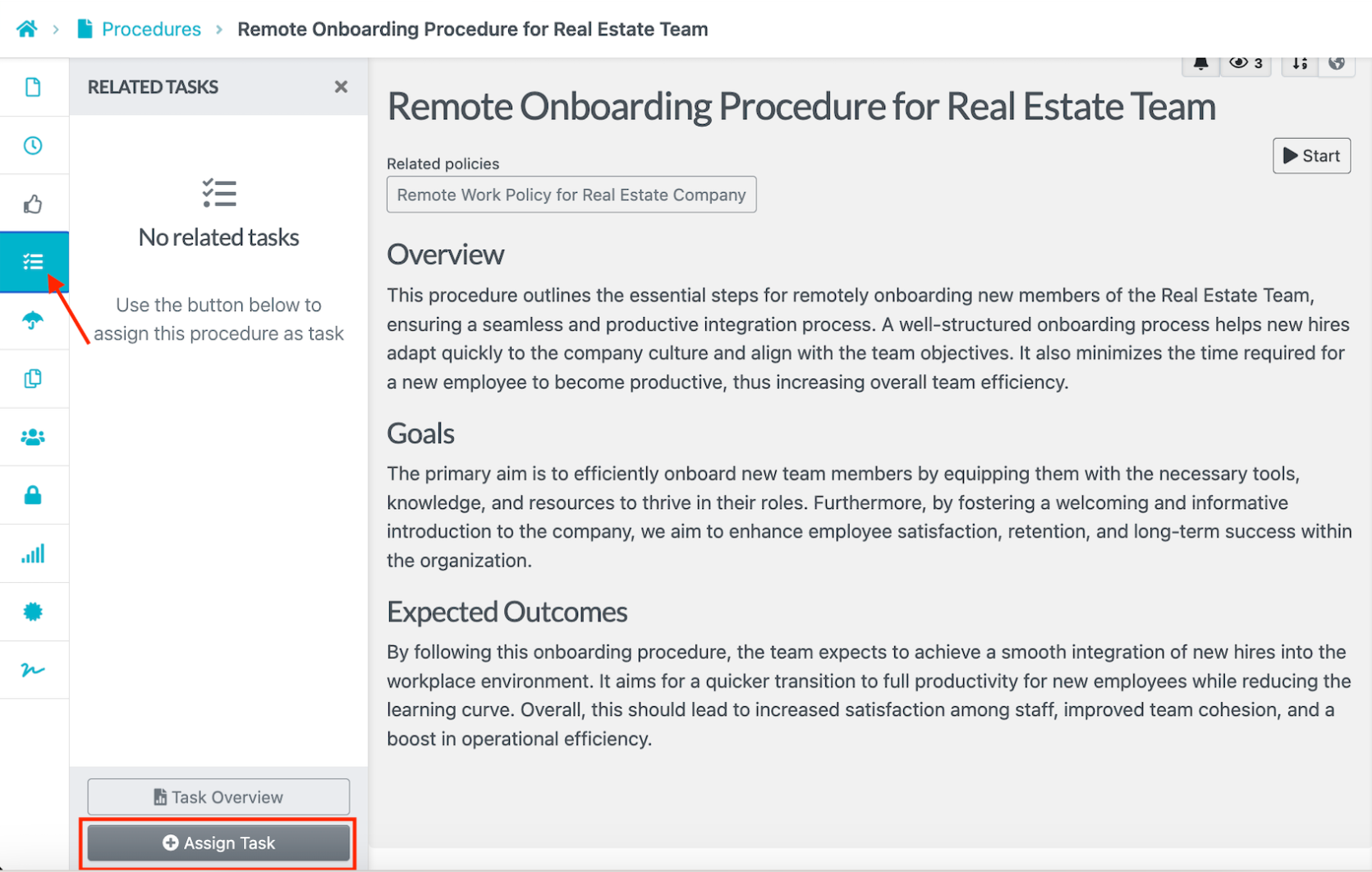
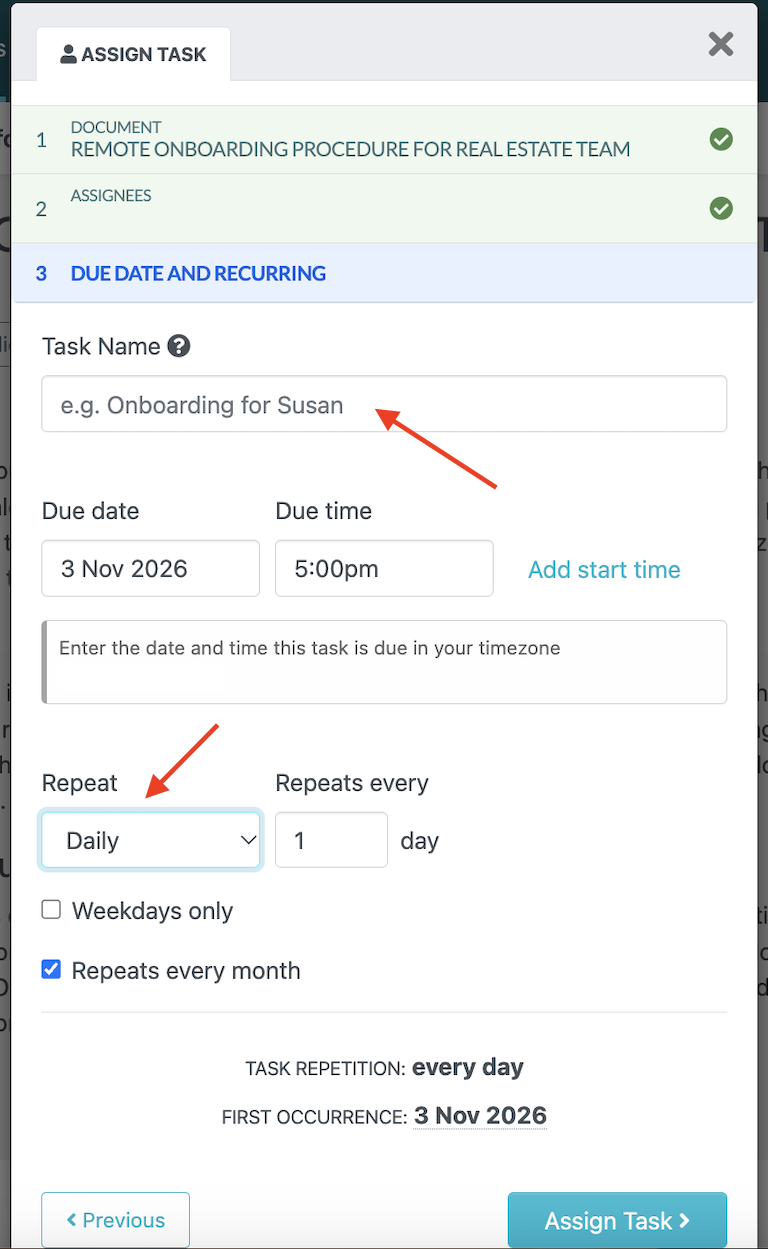
You can add the specific employee’s name, add a due date for the task, and indicate whether it is recurring.
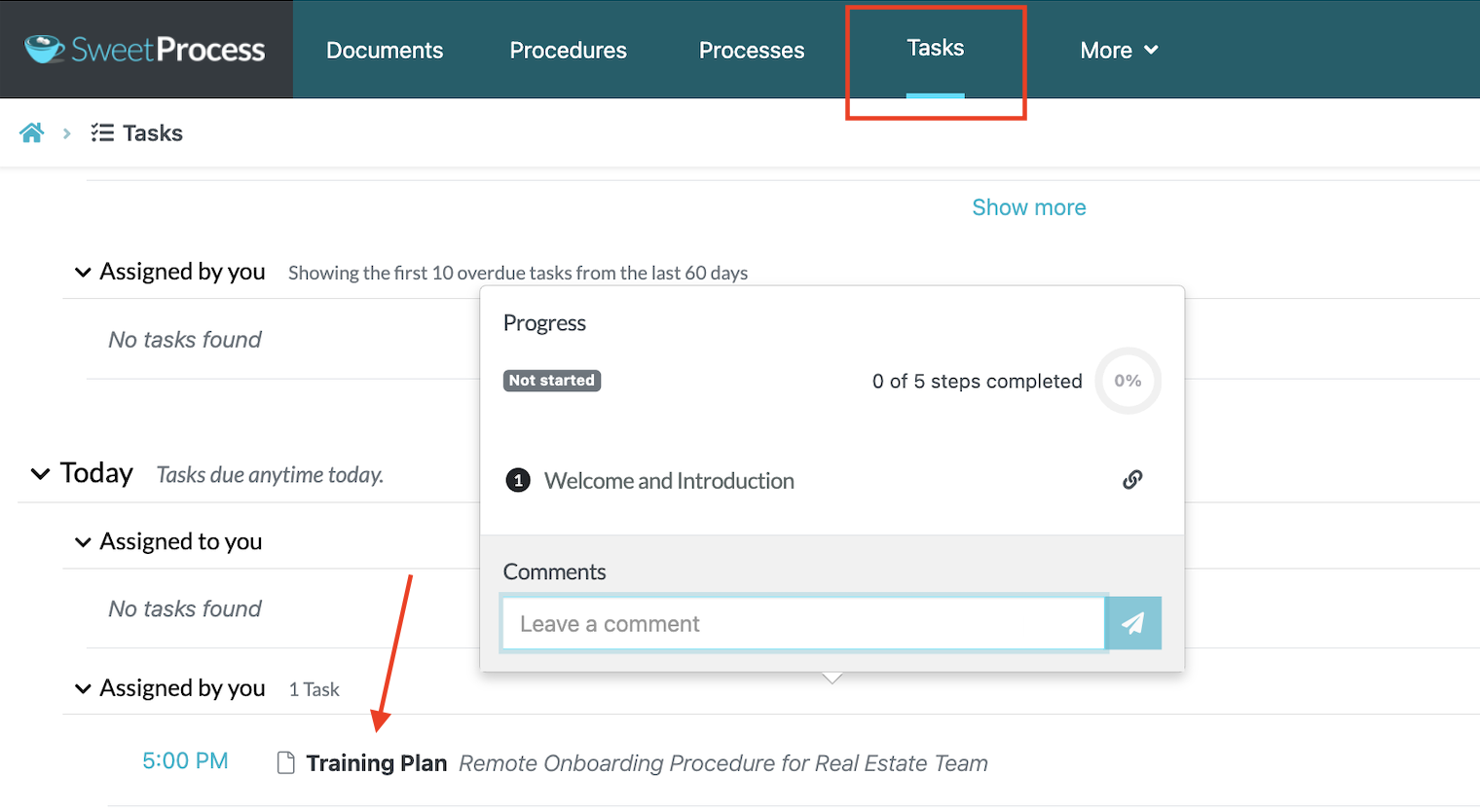
Manage and Monitor Tasks
The manager can assign tasks to the team members and monitor the process. From the “Tasks” tab, you can view what’s completed and pending to keep your team accountable.
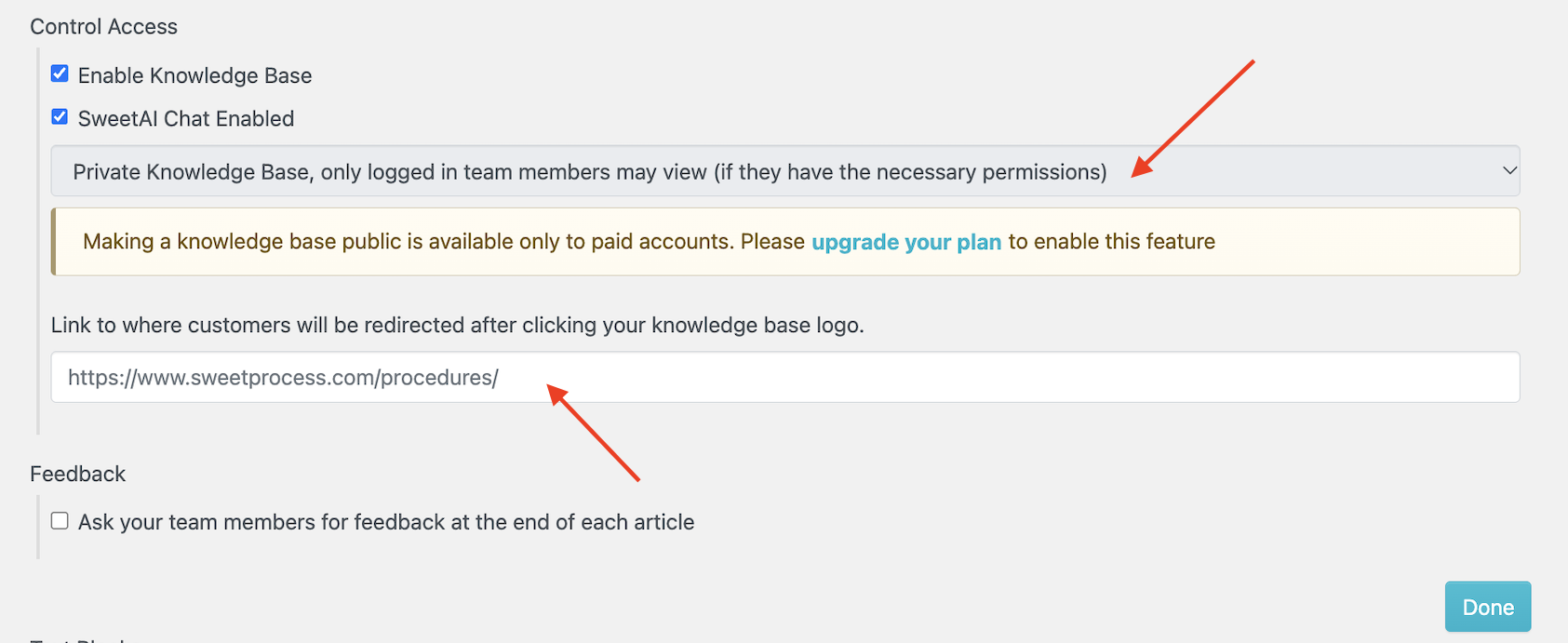
Create Public and Private Knowledge Bases
A public knowledge base is meant for your customers, and a private knowledge base is meant for your team members.
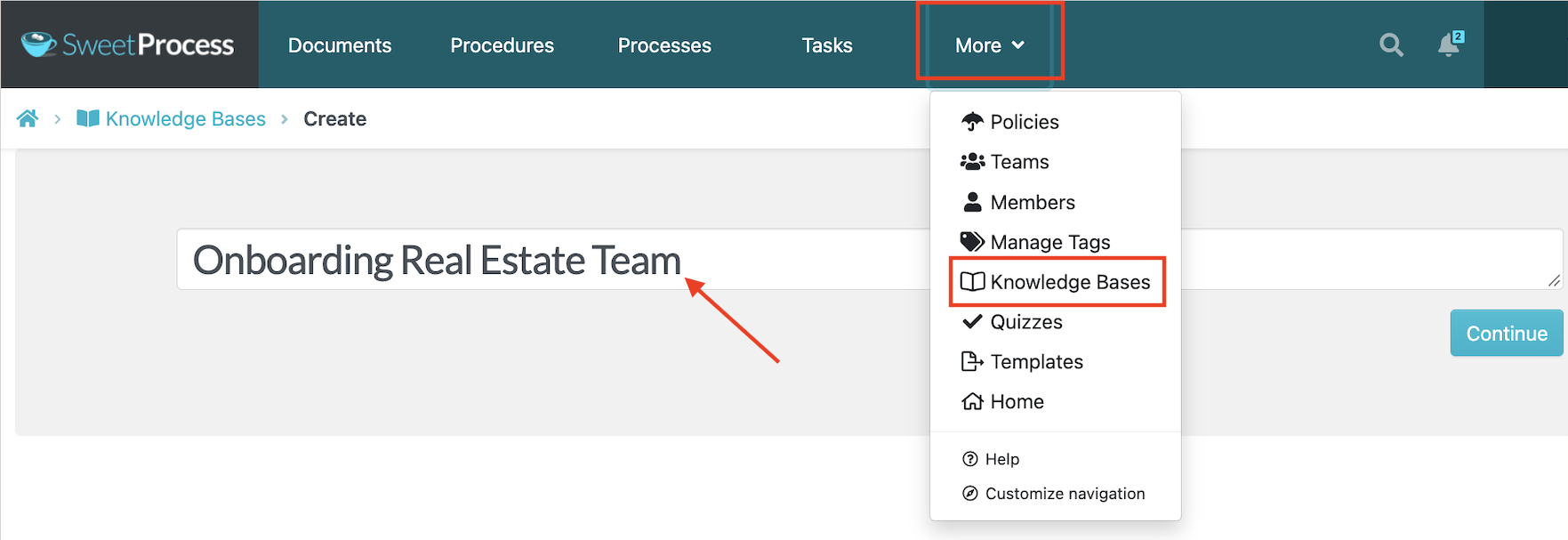
Creating these two knowledge bases will answer their burning questions and serve as a source of truth for all the stakeholders.
Track Changes in Policy and Procedure Improvements
When you create a new procedure, policy, or process for your company, you can monitor the updates on the document. Whether you are the owner, editor, or commenter on a policy or procedure, you will be notified when there’s a new update on the policy.
To check the versions, click on the clock icon to see the current one or revert to an older one.
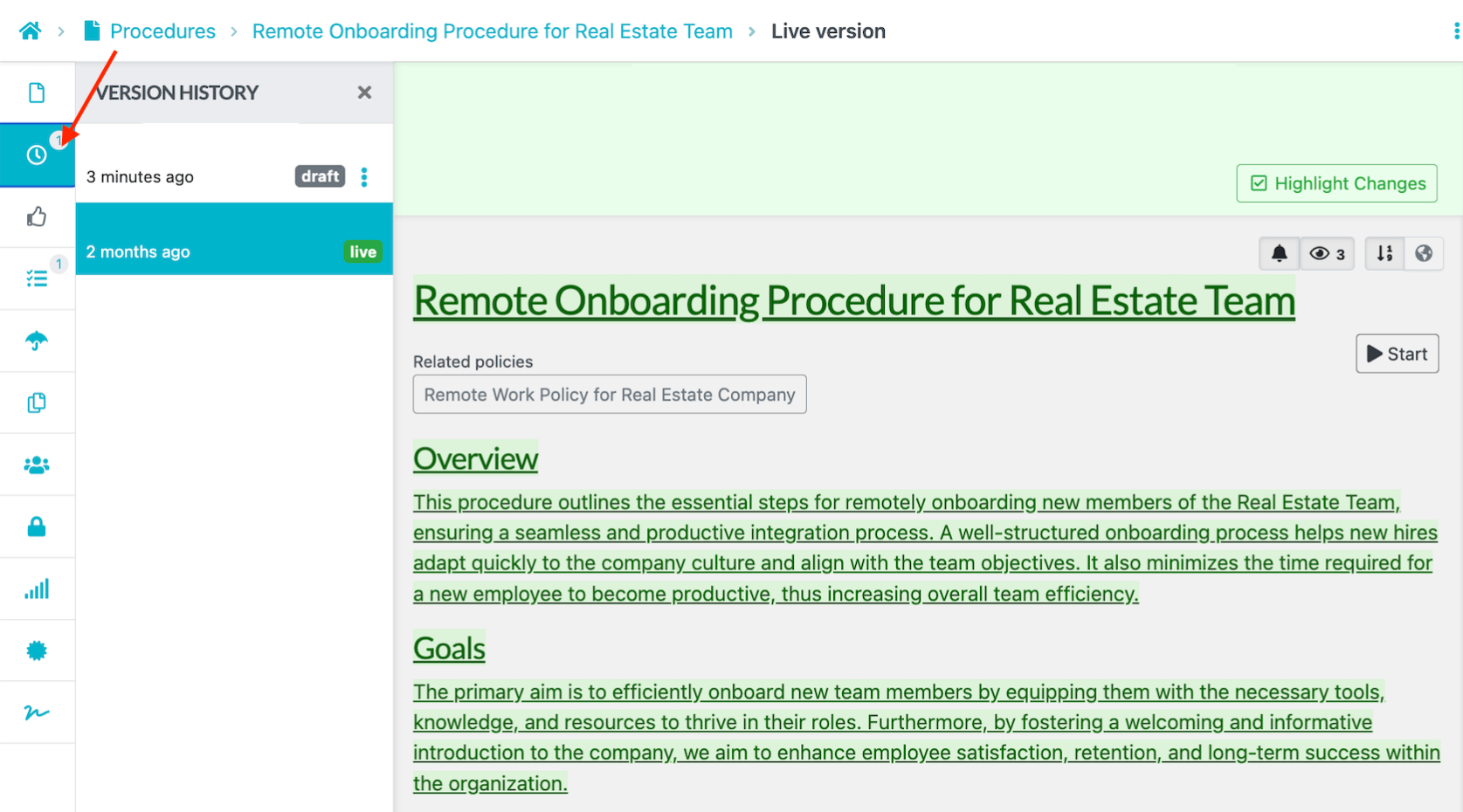
This feature helps to keep all team members on the same page about changes in procedures and policies in the company.
Use Interactive Process Maps
You don’t always have to create your processes with boring blocks of text. With SweetProcess, you can use interactive process maps to describe what a procedure looks like.
Here’s an example of what a company’s remote onboarding procedure looks like and how you can simplify it with the automatically generated flow chart in SweetProcess.

Download Procedures and Policies in Different File Formats
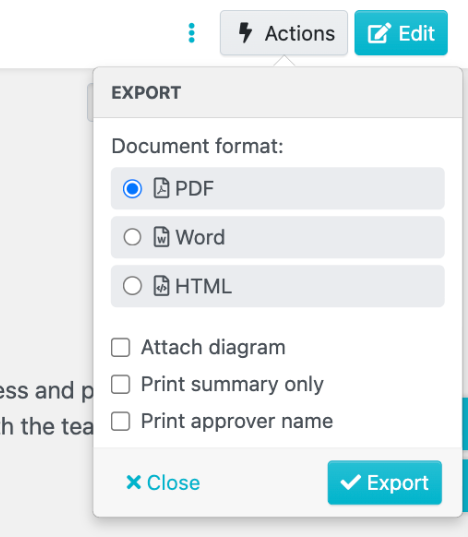
Even though your data is well backed up on the SweetProcess system, you also have the opportunity to download your procedures, processes, and policies in PDF and Word formats.
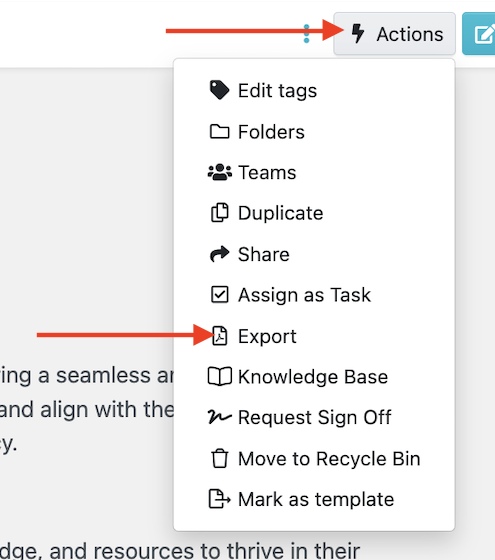
This way, you don’t need to start writing from scratch. You can add diagrams and even the approver’s name.
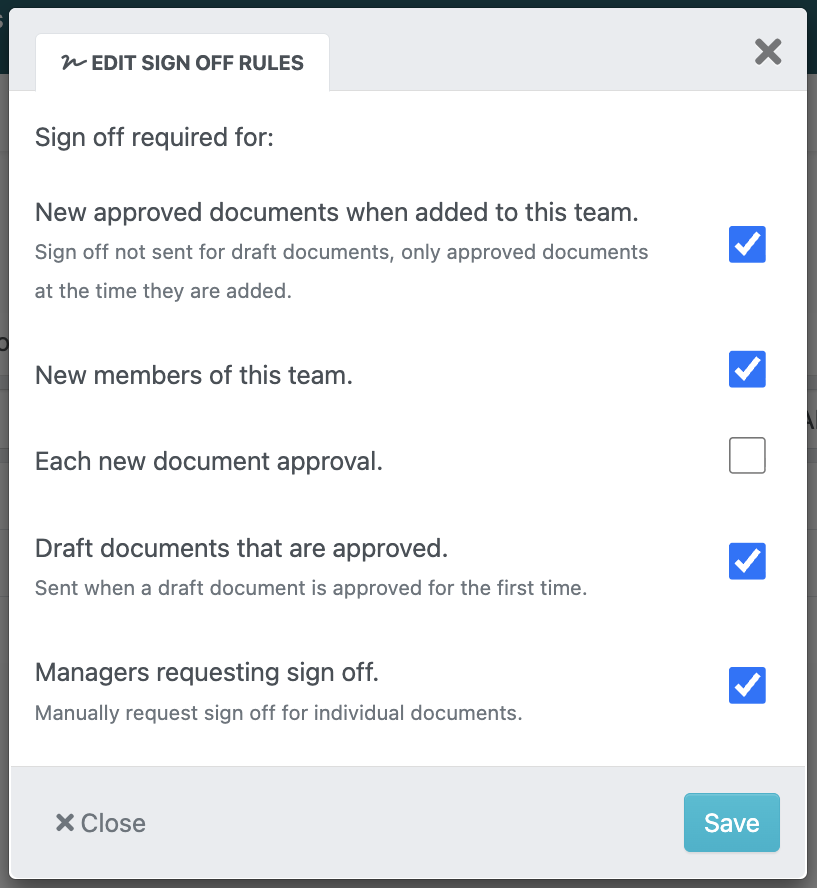
Create Sign-off Rules
The sign-off feature is a way of ensuring that your team members read and understand procedures, processes, and policies. This can include new process creation or updates to existing ones.
You can require every team member to read and sign to show that they understand the procedures, processes, and policies within the team. You can access the specific team and open the “Signoff rules.”

You can edit the rules. SweetProcess will keep track of who has signed off and who has not yet done so. This will ensure that every team member is collaborating.
Pros of SweetProcess
- Connects documentation with assigned work: You can create a procedure and assign related tasks without relying on a separate documentation repository. This is helpful when employees need instructions while completing their daily responsibilities.
- Supports collaboration: You can assign work and track it from the same platform to keep everyone on the team aligned.
- Provides a central location for company knowledge: Procedures, policies, and processes can be organized in one system. Employees have a reference point when they need to understand how to perform a task or handle a particular situation.
- Helps maintain current instructions: You can document updates and send notifications that help relevant employees stay aware of changes. Sign-off rules also provide a record of policy and procedure acknowledgment.
SweetProcess Pricing
SweetProcess costs $99 per month or $990 per year for up to 10 users. Each additional user costs $5 per month or $50 per year. The annual-only Small Team plan costs $495 per year for up to five users, plus $50 per year for each additional user. All plans include all features. Billing is based on users in the account, whether or not they have logged in. Removing a user provides a prorated credit for the next billing cycle.
SweetProcess offers a 14-day free trial and 30-day money-back guarantee options.
Without giving out your credit card or billing details, you can try out SweetProcess for 14 full days. Also, if you’re ever unsatisfied along the way, you can ask to refund your billing within 30 days.
It’s easy to check and try out all the features offered by SweetProcess without losing a dime. Try SweetProcess for free for 14 days. No credit card required.
ComplianceBridge
Image source: ComplianceBridge
ComplianceBridge is policy and procedure management software designed to help organizations manage the policy lifecycle. It supports creating, revising, approving, distributing, and tracking controlled documents. The platform is particularly relevant if you need formal processes for policy administration. Instead of treating a policy as a document that is uploaded and shared once, ComplianceBridge helps manage its review, approval, distribution, and acknowledgment.
Key Features of ComplianceBridge
- Policy workflow: You can create, revise, approve, distribute, and report on policies from one place, using built-in templates.
- Real-time dashboard: You can view real-time data from assessments to determine whether your team understands processes.
- Acknowledgment and attestation: This platform allows you to request acknowledgment of new policies, keep records of who read and signed off, and set automated reminders.
- Review and expiration dates: The automated review dates, expiration dates, and reminders help keep policies from going stale.
- Collaboration on one document: Several employees can work on the same document before it goes out for approval.
Pros of ComplianceBridge
- Workflow automation: Like SweetProcess, ComplianceBridge allows you to create, revise, update, and distribute policies and procedures within your company. It also allows you to use built-in templates and collaborate on a document in real-time.
- Selective distribution: ComplianceBridge allows you to send new and updated policies and procedures to the exact team members who need to see them. This will avoid getting all team members worked up on issues that don’t need their attention while the important ones slip through the cracks.
- Includes templates: Teams can use templates and collaborate on policy documents. This helps establish consistent document structures and supports contributions from multiple stakeholders.
- Acknowledgment: This feature is also similar to SweetProcess, where you can track user activities on new and updated policies and procedures. It helps to keep records of who has read, taken tests on, and signed off on documents. It also sets automated reminders to ensure that all targeted team members review and acknowledge the updates.
ComplianceBridge Pricing
ComplianceBridge offers three policy-management subscription tiers:
- Silver: The entry-level policy-management tier
- Gold: Adds capabilities such as testing and questionnaires
- Platinum: Includes additional advanced capabilities, including automated reporting and staged workflow templates
However, the company does not publish fixed subscription prices for these tiers on their website. You must request a custom quote.
Trainual
Image source: Trainual
Trainual is training-first software. You build a company playbook of subjects, topics, and steps, assign it by role, and track who has finished. It suits teams that spend most of their documentation effort getting new people up to speed. This tool provides a central place for company policies, procedures, role expectations, and onboarding materials. Managers can organize information into learning experiences so employees understand what they need to know when joining the organization or moving into a new role.
Key Features of Trainual
- Company playbook: You can use Trainual to organize policies, processes, and procedures into subjects, topics, and steps so training follows one structure.
- Training paths: Trainual allows you to group content into a sequence for a role, so a new hire follows a defined route.
- Quizzes and tracking: You can easily implement knowledge checks to confirm understanding, and use completion tracking to see who has finished what.
- Templates: The library of templates gives you a starting point for handbooks and SOPs.
- Video-based learning: Trainual supports video uploading and hosting, with video storage and related features varying by tier. This feature is useful when employees need to see a demonstration of a task.
Pros of Trainual
- Simple process management interface: Trainual is a go-to tool for staff training and orientation.
- Knowledge testing interface: Knowledge testing of users is achievable with Trainual. It helps to assess assimilation and knowledge transfer among team members.
- It offers additional accountability features: Depending on the plan, Trainual provides electronic signatures, completion nudges, version history, and organizational charts. These features help connect training with employee responsibilities.
Trainual Pricing
Trainual offers Core, Pro, Premium, and Enterprise plans. The Core plan provides the starting set of company training and knowledge-management features, while Pro adds individual training paths, video hosting, and 90-day version history. Once you upgrade to Premium, you can access unlimited video storage, unlimited version history, unlimited electronic signatures, custom branding, and single sign-on. Enterprise adds extended implementation and migration support, and API access.
The subscription prices are not publicly listed; contact Trainual for a quote. A one-time implementation fee of $1,000 applies.
Process Street
Image source: Process Street
Process Street is built for structured, recurring workflows. You turn a template into a workflow, run it for each new hire or client, and track every run. It suits onboarding, client setup, and approval-heavy work where steps must happen in order. As a process management software for teams, it’s relevant if you need more than a collection of written procedures.
Key Features of Process Street
- Integrates with several apps: There are more than 1,000 tools that integrate with Process Street. This makes it easy to harmonize all company tools and systems.
- Workflow runs: You can build a workflow once, then run it for each new hire, client, or request and track each run separately.
- Conditional logic: Use conditional logic to create dynamic workflows with if/then logic that adapts to your team’s changing needs.
- Scheduling: Recurring workflows can be scheduled so routine work starts without someone remembering.
- Collaborative workflows: You can quickly create and assign workflows for your team, track activity from the dashboard, and get notified when tasks are done.
Pros of Process Street
- Simple user interface: Creating processes is easy due to the simple user interface.
- Intuitive workflow: With the template and simple user interface, it is easy to build any kind of process using Process Street.
- Template feature: There are enough templates that will likely fit into any company’s procedures.
- Designed for repeatable work: Process Street focuses on turning recurring activities into workflows that employees can follow. This feature is useful when your organization needs to manage operational work.
- Guest access: If you collaborate with external stakeholders, they can take part in the work without a full seat since the plans allow guests.
Process Street Pricing
Process Street offers Startup, Pro, and Enterprise plans. However, you have to contact the sales team for actual costs. The Startup plan includes five users and 10 guests. It also includes up to 5,000 data-set records, unlimited workflows, unlimited tasks, forms, conditional logic, approvals, and selected integrations.
The Pro plan includes custom user and guest allowances, up to 10,000 data-set records, and a 14-day free trial that you can use to test the tool. With the Enterprise option, you get additional capabilities and custom limits.
NAVEX One Policy & Procedure Management
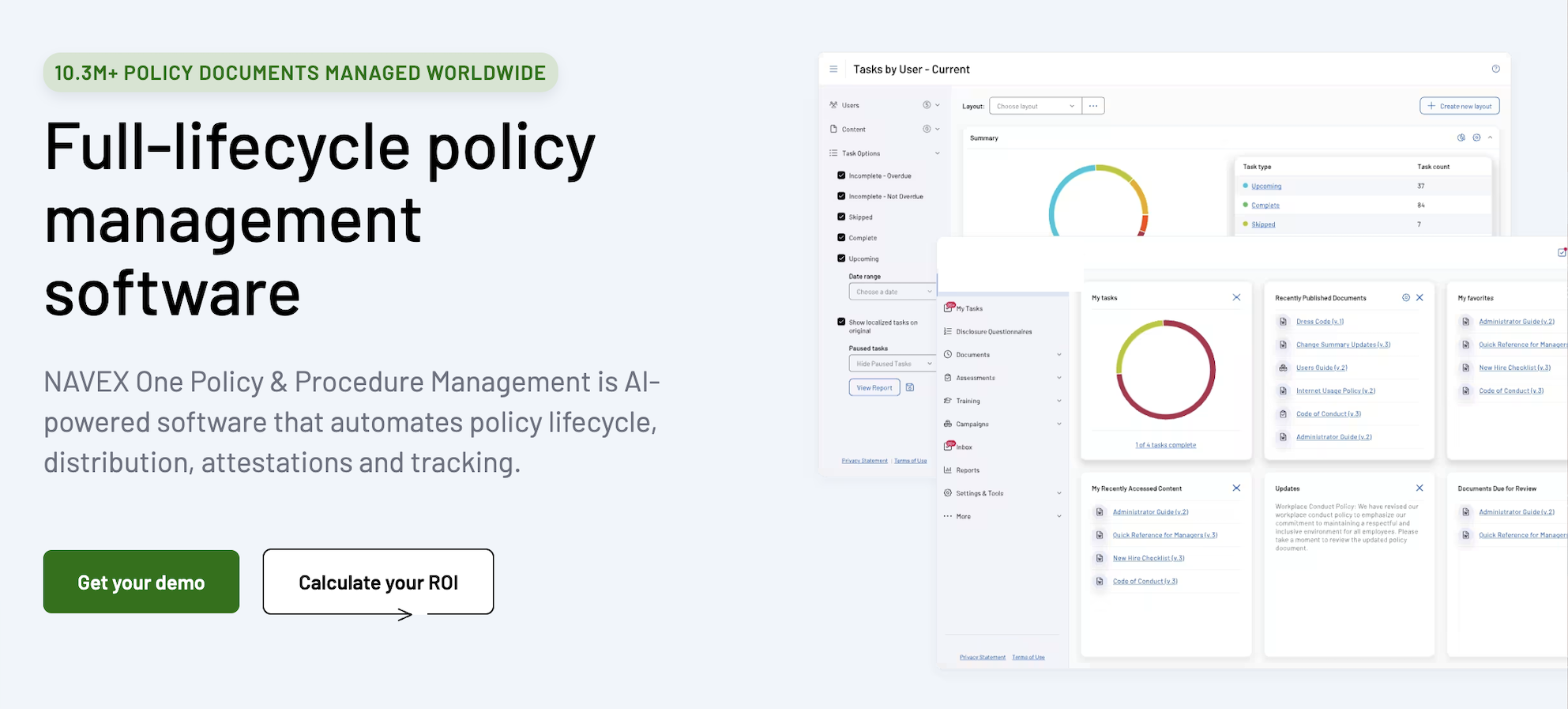
Image source: NAVEX
NAVEX One Policy & Procedure Management, formerly PolicyTech, helps organizations create, review, publish, and distribute policies and track acknowledgments.
Key Features of NAVEX
- Centralized policy repository: NAVEX provides a centralized location for managing policies and procedures, helping organizations establish a source of truth for approved documents.
- Policy lifecycle workflows: Administrators can establish processes for reviewing documents and notifying relevant stakeholders when action is required, which is useful when policies have scheduled review dates.
- Microsoft 365 integration: NAVEX supports integration with Microsoft 365 and provides its own document creation and editing capabilities.
- Audit trails and reporting: The platform records policy distribution, changes, approvals, and employee acknowledgments, which demonstrates which policy version was active and who approved it.
Pros of NAVEX
- Protect the organization with accountability: With PolicyTech, you can create an auditable records database with automated policy alignment and stakeholder attestation. You can also track document access and test users based on the details.
- It supports end-to-end policy management: The platform addresses policy creation, review, approval, distribution, and acknowledgment.
- It connects policy management with wider compliance activities: NAVEX’s broader platform can connect policy information with training, risk, and incident-management activities.
- Efficient notification on procedure updates: Similar to SweetProcess, it’s easy to stay up to date on new and existing policies with the update notification feature.
- Great search interface: The search feature in NAVEX makes it easy to locate existing policies and procedures quickly.
NAVEX Pricing
NAVEX directs buyers to request pricing. Ask which workflows, reporting, and distribution features your quote includes.
Whale
Image source: Whale
Whale is an AI-powered platform for SOPs, process documentation, and employee training. It separates users into creators, who build and edit documents, and members, who read and complete them. That makes it a good fit for teams with a few authors and many readers. Whale is a relevant Way We Do alternative if you want your procedures to play a more direct role in employee onboarding and continuous training.
Key Features of Whale
- AI SOP writer and video-to-guide: You can draft SOPs with AI, or record a screen and convert it into a step-by-step guide.
- PDF and Word import: You can bring existing documents into this tool instead of retyping them.
- Training flows and AI quizzes: Whale allows you to build training sequences and generate quizzes on the Scale plan and above.
- Automated new employee onboarding: You can streamline and automate your new hire onboarding and training. With Whale, knowledge finds the right person at the right time. You can turn processes, SOPs, and guides into training manuals and deliver a consistent and fun learning experience.
- Centralized processes and procedures: Whale makes it easy to create a central source of truth for all processes and procedures to close knowledge gaps so you can ensure everyone is always on the same page.
- Templates: With the Whale templates and editor, it is easy to get knowledge out of your experts’ heads and into a simple and visually attractive hub.
- Conversational AI search: Ask a question in plain language and find the answer in your documentation.
Pros of Whale
- Free plan: The Whale Free plan covers one creator and up to 10 members. You can use this option to test the tool for your business.
- Smart reporting feature: With Whale’s smart reporting feature, it is easy to know what your team lacks, so you can go ahead and fill the gap.
- You can separate content creators from members: The distinction between creators and other members gives organizations a clearer way to plan access and subscription costs.
Whale Pricing
Whale’s Free plan includes one creator and up to 10 members. Scale starts at $299 per month billed annually with three creators; Advance starts at $599 per month billed annually with five creators. Enterprise pricing is available by quote. Confirm monthly rates, additional creator costs, and member limits.
Bizmanualz OnPolicy
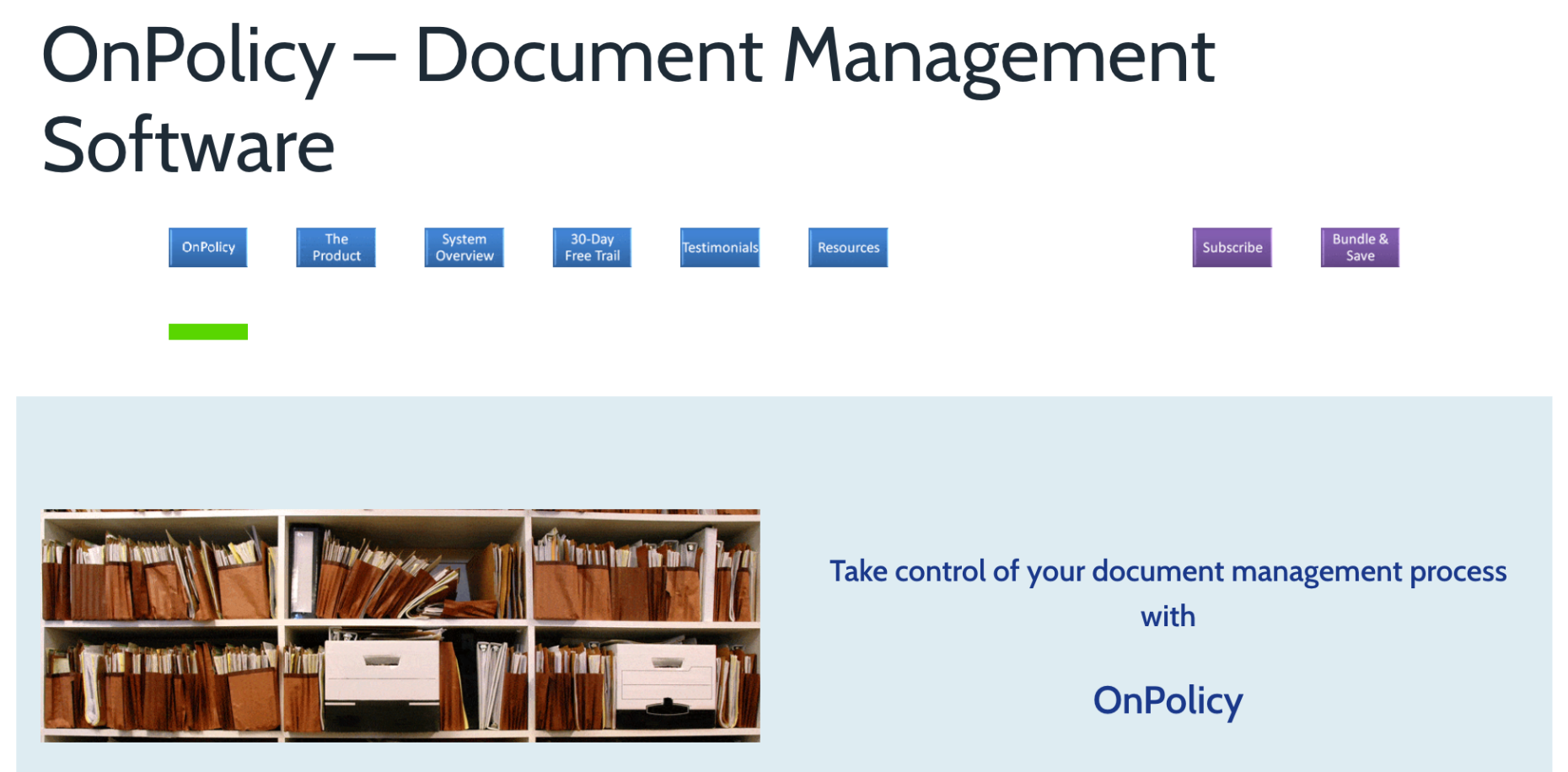
Image source: Bizmanualz OnPolicy
Bizmanualz OnPolicy is document management software for organizations that need to create, control, distribute, and track policies and procedures. It offers downloadable SOP templates in MS Word file formats. With its editable SOP templates, you can edit them to fit your company’s needs and publish them from time to time. With the Bizmanualz downloadable templates, you can roll out processes and procedures to your team members through different communication channels.
Key Features of Bizmanualz OnPolicy
- Controlled documents: You can keep your approved policy versions in one place so people read the current copy.
- Editable templates: With the MS Word policy and procedures template files, it is easy to customize any of these templates for your organizational use.
- Downloadable SOP templates: Policies and procedures manual templates can be downloaded to save time.
- Required-reading tracking: This feature is useful when employees must review certain policies or procedures before performing their duties. Managers can establish which documents require attention and track employee responses.
Pros of Bizmanualz OnPolicy
- Free downloadable templates: Without paying a membership fee or creating an account, you can easily go to the Bizmanualz website and download an editable SOP template for your organization.
- Demo: Ask Bizmanualz which trial or demonstration options are currently available.
Bizmanualz Pricing
Bizmanualz does not publish a current OnPolicy list price on the product page. Ask for a quote and confirm user and document limits, deployment, and implementation.
MetaCompliance
Image source: MetaCompliance
MetaCompliance is a compliance management platform, and its policy tools help you show that people have read and accepted policies. It suits teams that want policy evidence alongside other compliance work. Additionally, this platform works best for enterprise organizations (with above 1,000 users) seeking to automate and overcome the challenges associated with compliance, policy management, and cybersecurity awareness.
Key Features of MetaCompliance
- Audit trails and reporting: The platform provides records and reporting capabilities to help organizations review policy activity.
- Privacy management: MetaCompliance includes privacy-management capabilities that help organizations manage data-protection activities, assessments, and access requests.
- Incident management: The wider platform gives organizations an opportunity to connect policy-related activities with the management of reported issues.
- Policy acknowledgment: You can distribute policies and collect acknowledgment from the people who must read them.
- Knowledge assessment: This platform makes it easy to assess whether people understood a policy.
Pros of MetaCompliance
- Content categorization for easy reporting: Different content can be easily filed and categorized, making it easy to locate any kind of document.
- Non-technical training modules: MetaCompliance’s bite-size training modules covering a range of subjects allow you to build content easily with the needs of end users in mind. The modules have a non-technical feel, which makes it easy for frontline colleagues to understand the key messages.
- Combines policy management with wider compliance activities: The platform extends beyond document storage and connects policy administration with privacy and incident management.
MetaCompliance Pricing
You need to contact the MetaCompliance team for detailed pricing information.
DynamicPolicy
Image source: DynamicPolicy
DynamicPolicy is policy and procedure management software that helps organizations create, revise, distribute, and track controlled documents. The platform supports the document lifecycle, including collaboration, employee training, acceptance, and tracking. It also provides a centralized document repository and options for managing user access. You can also access an on-premises database, where you can keep your repository on your own servers rather than relying on a remote facility.
Key Features of DynamicPolicy
- Streamlined creation: You can import existing documents or create new ones using a web editor or Microsoft Word.
- Centralized document database: You can create, update, and distribute everything in one place.
- Tracking, reports, and compliance: With DynamicPolicy, you can track certification and acceptance, export reports to Excel for further analysis, and send reminders for new and existing documents.
- Teamwork: Collaborate with your team to improve and produce quality policies and procedures.
- Import and authoring: Import existing documents, or create new ones in a web editor or Microsoft Word.
Pros of DynamicPolicy
- Deployment options: The vendor describes on-premises hosting as well as subscription use.
- Ease of use: With Dynamic Policy software, you can achieve workflows with the interaction of different parts in a simple way.
- Provides acceptance and certification records: The platform supports tracking employee acceptance and certification activities, helping administrators monitor outstanding requirements.
- Offers licensing flexibility: DynamicPolicy provides an annual subscription and perpetual licensing options. This way, you can discuss which arrangement fits your budget and deployment requirements.
DynamicPolicy Pricing
DynamicPolicy does not publish a fixed subscription price on the website. However, it offers two licensing approaches: annual subscription and perpetual licensing. You need to request current pricing and licensing terms.
Zavanta
Image source: Zavanta
Zavanta is COMPROSE’s policy and procedure platform. It focuses on standardized authoring, so every policy and SOP follows the same structure. This platform is ideal for teams that want consistent documents and a clear lifecycle, more than assigned tasks. With Zavanta, you can author, review, approve, publish, and receive acknowledgments.
Key Features of Zavanta
- Zavanta’s “smart” knowledge capture wizard: This helps to create user-friendly policies, SOPs, work instructions, job descriptions, and FAQs. It makes it easy to ensure that policies and procedures are consistent, clear, and complete.
- The standardized format feature: This helps to ensure that all procedures and policies follow the same pattern. It also helps to separate content from output format so that content can be repurposed for multiple audiences and uses.
- Read-verify feature: With this feature, employees can sign off that they have read the content and understand it.
- Role-based access: The platform supports role-based access, helping employees find information relevant to their responsibilities.
Pros of Zavanta
- Helpful video tutorials: Zavanta provides you with helpful video tutorials that walk you through the steps of using the platform.
- Easy to personalize documents: There are different ways to personalize your documents, including bulleted lists, tables, and images.
- Encourages consistent documentation: Structured authoring and reusable templates help employees create policies and procedures in a consistent format.
Zavanta Pricing
Zavanta doesn’t provide the actual pricing on the website. When requesting a quote, explain the number of users, the volume of controlled documents, your approval requirements, and the types of acknowledgment records you need.
Choosing, Costs, and Migration Pilot
How to Choose an Alternative for Way We Do
To choose a Way We Do alternative, you need to understand how the software will support your employees, what records it will maintain, and whether it fits the way your organization operates.
Use the following considerations to narrow your shortlist.
Figure Out Your Needs
Now that you are on your journey to pick a tool that will serve you better than Way We Do, you need to do a lot of diligence. The first thing is to know what you wish to achieve with the tool. Once you can outline those needs, you’re one step ahead.
Identify the Work You Need to Manage
Start by listing the activities you currently manage in Way We Do. Separate them into three categories:
- Documented instructions: Policies, procedures, work instructions, and checklists that employees need to access.
- Recurring activities: Tasks that employees must complete daily, weekly, monthly, or at another defined interval.
- Training and policy acknowledgment: Learning activities, required reading, employee acceptance, and approval records.
This exercise helps you identify which capabilities you actually need.
Outline Your Current Challenges
Changing SOP software is like changing houses. You may not have a pleasant experience if it happens too often. To ensure that you don’t keep changing your company’s SOP tool frequently, you need to highlight the challenges you currently face while using Way We Do. This will guide you in choosing a tool that is better and satisfies your needs.
Test Trial Versions
Test a workflow before committing. SweetProcess offers a 14-day trial, and Process Street lists a 14-day trial for its Pro plan.
Test a Representative Process
To evaluate these Way We Do alternatives, choose a process that your employees perform regularly and use the same example in each product.
For instance, you can test employee onboarding by creating the required instructions, assigning the activities, requesting an acknowledgment, and checking the records generated after completion. This approach gives you a practical basis for comparing the products.
How Much Should You Budget for a Way We Do Alternative?
The subscription price is only one part of the cost of replacing your existing software. You also need to account for user limits, creator roles, implementation, integrations, migration, and the billing commitment.
To make the comparison more useful, consider one consistent scenario; for instance, an organization with 20 employees, two authors, one recurring workflow, and policy acknowledgment requirements.
The following breakdown shows what you can establish from the available pricing information:
Tool | Scenario figure | What you need to confirm |
|---|---|---|
SweetProcess | $149/month for 20 users on Standard monthly billing | Implementation requirements and any additional services |
ComplianceBridge | Silver, Gold, and Platinum are quote-based | Required tier, user scope, testing, reporting, and optional services |
Trainual | Core, Pro, Premium, and Enterprise are quote-based | Subscription total, $1,000 implementation fee, and required training features |
Process Street | Startup, Pro, and Enterprise are quote-based | Startup’s five-user and 10-guest limits, or a suitable Pro quotation |
NAVEX | Custom quotation | Required policy modules, implementation, and user scope |
Whale | Scale $299 per month billed annually, includes three creators | Member limits, additional creators, and features required |
Bizmanualz OnPolicy | Request current pricing; confirm user limits. | Current monthly or annual price and any additional services |
MetaCompliance | Custom quotation | Required policy, privacy, incident, and reporting modules |
DynamicPolicy | Custom quotation | Licensing, deployment, infrastructure, and support costs |
Zavanta | Custom quotation | Required modules, user scope, implementation, and support |
As you determine the prices, keep in mind that some of these tools, like SweetProcess, provide a transparent subscription cost, while software such as Whale divides users into creators who can author procedures and members who can read the documentation.
However, for Trainual, ComplianceBridge, Process Street, NAVEX, MetaCompliance, and Zavanta, you’ll need to request a quotation using the same requirements. Here are some of the questions to keep in mind when getting a quote.
- How many users are included?
- Are authors and ordinary members charged differently?
- Are external guests included?
- What’s the annual and monthly billing?
- Are there implementation or onboarding fees?
- Are integrations included or charged separately?
- Is document migration included?
This way, you can get a comparative quote to help you pick the best option.
How to Migrate Your Procedures and Policies
Once you have selected a replacement for Way We Do, you need to plan your migration in a way that preserves the information your organization needs to continue operating.
Step 1: Create an Inventory of Existing Documents
Start by listing the procedures, policies, checklists, and processes currently stored in Way We Do. Ensure you capture the document name, team, document owner, last review date, current version, and employees with access. During your inventory, you can identify what needs to move or be deleted.
Step 2: Review Embedded Media and Attachments
Some procedures contain images, videos, forms, or other supporting documents. You need to check whether the new platform can preserve these elements during import. A document that transfers as a PDF may retain its appearance but lose its editable structure or interactive functionality. This is why you should test a few representative documents before moving the entire library.
Step 3: Recreate Permissions
You also need to list the people who can view, edit, approve, or manage each document. For instance, department managers may need editing permissions for their procedures, while employees may only need permission to view and complete assigned activities.
Step 4: Check Acceptance and Approval History
If employees previously acknowledged a policy, establish whether those records can be exported and transferred. You also need to determine whether you can import historical sign-offs and other relevant information.
Step 5: Test the New System With a Small Group
During the migration, you can start with one department or a small group of employees. Check whether the instructions are accessible, the assignments work, the notifications arrive, and the completion records are accurate. Once the pilot is accepted, you can plan the wider rollout.
Customer Stories: How Businesses Organize Their Processes With SweetProcess
Other than hiring the best talent, it’s important to let them know what they need to do, how they need to do it, and when it needs to be done. No matter an employee’s skill set or experience, without job standardization, they are not likely to perform at maximum efficiency.
Standardizing your workplace is required for both remote and physical teams. It helps to ensure that the right things are done the right way all the time. Adopting SOP tools such as SweetProcess will help put your team on autopilot, and you can take a break from being the bottleneck.
Below are case studies of companies that have adopted SweetProcess to streamline their company procedures.
From Google Docs to SweetProcess: How Rise25 Benefited From an Organized Workflow
Producing podcasts for Rise25 requires a lot of background work, and Jeremy Weisz tried his best to put everything in order with Google Docs. After experiencing consistent flaws that kept reducing their productivity, Jeremy Weisz and John Corcoran sought better productivity and found it in SweetProcess.
Having used a free system for so long, there came the challenge of having to pay a subscription for something to replace what they saw as a bunch of files in a Google Drive folder. Jeremy’s concerns about paying for the tool were resolved when he put it to the test.
Jeremy Weisz said the team was able to find existing instructions and create processes in SweetProcess within the first week or two.
SweetProcess marks the beginning of the productivity journey for Jeremy Weisz at Rise25.
Benchmark Wealth Management: Where Consistency Meets Efficiency
Sarah Beach is the operations manager at Benchmark Wealth Management. She managed a brilliant team of financial experts, and the company was growing at the speed of lightning. Even though things got done by these great brains, consistency was lacking. Since there were no universally accepted processes to follow, every employee handled their tasks differently. This anomaly made them question their readiness for their emerging growth.
The team decided to maximize their growth opportunities and set out to find the most appropriate SOP tool to support their expansion. Finding SweetProcess was their ladder to the top as the productivity of the team skyrocketed by strengthening an already productive team.
Automating the Paper-Based Checklists: All Residential Real Estate
Perry Beebe was satisfied with his paper-based checklist at the onset of All Residential Real Estate. All Residential Real Estate is a property management company based in the Greater Wollongong area in the south of Sydney, Australia. The organization is one of the largest property management companies in the area.
It cost Perry virtually nothing to maintain his paper checklist. However, with the frequent updates and changes in the real estate industry, it became difficult to keep a bunch of paper that offered no value. They were easily outdated, leaving team members with inadequate information that prevented them from working efficiently. Perry also noticed a significant drop in the team’s profitability, and that was when the search began.
In a bid to streamline his business operations for profitability, Perry sought to create paperless documentation with effective software. His choice? SweetProcess!
You can also try SweetProcess for free today.
Conclusion: Which Way We Do Alternative Should You Choose?
The best Way We Do alternative depends on what you need to improve. Trainual and Whale are worth considering for structured employee training, while Process Street is suited to more configurable workflow execution. Zavanta, MetaCompliance, DynamicPolicy, NAVEX, and Bizmanualz offer policy management capabilities and governance.
However, if your goal is to bring procedures, policies, and assigned work together, SweetProcess is a practical place to start. Before selecting a replacement, ensure that you import a test workflow to determine if the tool is the best fit.
Start your free 14-day SweetProcess trial today! Document one recurring process, assign it to an employee, and evaluate whether it gives your team the instructions and accountability it needs.
FAQs
Which Way We Do alternative fits procedures and recurring tasks?
SweetProcess combines written procedures with assigned tasks, so instructions and the work stay together. Process Street is the other close option, with an emphasis on structured workflows, conditional logic, and approvals. Pick SweetProcess if documentation matters as much as execution and Process Street if complex routing is the core need. Either way, run one recurring process through the tool before you decide.
Which option is stronger for employee training?
Trainual and Whale are both training-oriented. Trainual uses a playbook with training paths by role, and its plans are quote-based. Whale offers training flows and AI quizzes on the Scale plan and above, with a limit on creators. However, both can hold SOPs. Choose depending on your budget and the training features you need.
When is a policy-management specialist a better fit?
Choose a specialist when you need approvals, targeted distribution, acknowledgments, and a document lifecycle that auditors can follow. However, you should first check which modules you need. Keep in mind that even if software supports a compliance program, it does not guarantee compliance.
Does Way We Do support templates and acceptance?
Yes. It supports reusable procedure and checklist templates, and acceptance can be requested once, periodically, or after a change. Republishing lets the author decide whether people need to accept again. Test whether the behavior fits your process, especially how a changed checklist reaches the people who already completed it.
How should a growing team compare prices?
You should compare total paid users, authors, required modules, billing term, onboarding, and quote requirements. Look at the annual and monthly prices and then add extra costs such as implementation and migration services.
Can we migrate without losing records?
Not automatically. You should start with a sample transfer and check export formats and history. To maintain your information, keep your original records until you accept the migration. Once you confirm that the tool is a good fit, you can move the rest of your procedures and policies.