Last Updated on October 28, 2026 by Owen McGab Enaohwo
Your team may need a different place to store knowledge, publish help content, or document the steps people follow to complete recurring work. If you’re looking for the right Confluence alternative, your choice depends on which of these jobs matters most. A team wiki organizes shared information, while a knowledge base helps people find answers, and a workflow tool can also assign work and record its completion status.
The comparisons below explain what each tool is designed to do, how its pricing works, and what you should check before committing to a migration.
Disclosure: SweetProcess publishes this comparison and is our first recommendation for maintained procedures and assigned work. That does not make it the right choice for every team. You may prefer a flexible workspace, a specialized knowledge base, or software you can host yourself.
Key Takeaways
- The top Confluence alternatives offer different capabilities, including wikis, knowledge bases, self-hosted setups, and operational procedures.
- Notion and Nuclino provide flexible shared workspaces for organizing documents and connected knowledge, while Slite, Tettra, and Guru focus on helping employees find, maintain, and verify internal knowledge.
- BookStack and XWiki offer community software that can be self-hosted, but hosting, backups, upgrades, and administration still require resources, while Document360 supports structured public or private knowledge bases.
- When choosing a Confluence alternative, keep in mind that a free plan, a free trial, and free self-hosted software are distinctly different options. Compare their limits and the cost of running them before deciding.
- If you want software that turns all documented procedures into assigned work with a record you can check, try SweetProcess free for 14 days!
Confluence Alternatives At A Glance
|
Tool |
Best fit |
Core output |
Hosting |
Free access |
Pricing model |
Trade-off |
|---|---|---|---|---|---|---|
|
Maintained procedures and assigned work |
Procedures, policies, tasks |
Cloud |
14-day trial |
Flat plan up to 10 users, then per user |
Not a self-hosted wiki |
|
|
Notion |
Flexible docs and databases |
Pages and databases |
Cloud |
Free plan with limits |
Per seat per month |
Someone must design the workspace structure |
|
Nuclino |
Light shared workspace |
Linked items and canvases |
Cloud |
Free plan with limits |
Per user, per month |
Advanced paid plans have more features |
|
Slite |
Internal knowledge and verification |
Verified docs |
Cloud |
14-day trial |
Per user, per month |
Retrieval quality depends on the underlying content and permissions |
|
Tettra |
Team knowledge base and Slack |
Internal knowledge, Q&A, and content verification |
Cloud |
30-day trial on Scaling plan |
Per user, per month. 10-user minimum |
Minimum commitment |
|
Guru |
Connected enterprise knowledge |
Knowledge from connected source |
Cloud |
Confirm trial/demo access |
Custom package |
No public prices |
|
Document360 |
Structured public or private knowledge base |
Articles with review steps |
Cloud |
Confirm trial/demo access |
Custom quote |
Some add-ons cost extra |
|
BookStack |
Self-hosted wiki |
Books, chapters, pages |
Self-hosted |
Free software |
Infrastructure and maintenance cost extra |
Your team must operate and maintain the installation |
|
XWiki |
Configurable wiki |
Structured pages and data |
Self-hosted or hosted options |
Free Community software |
Paid hosting and support vary |
Setup and configuration take work |
|
Process Street |
Recurring workflows |
Workflow runs |
Cloud |
14-day trial on Pro plan |
Custom quote |
Confirm billable roles, limits, and the cost of workflow setup |
Selected pricing and feature details checked October 23, 2026. Confirm your chosen plan, user count, billing cycle, and current quote before purchase.
How To Choose a Confluence Alternative
Before moving your team knowledge and SOPs from Confluence, you need to know what your replacement does. Here are the key things to consider when exploring these alternatives:
Identify the Record Your Team Needs
You need to check what output you need from these tools. Are you storing reference information, publishing instructions for customers, documenting an approved way to work, or assigning a task that must be completed? Each of them serves a different purpose.
- A wiki page stores information people can read and edit.
- A knowledge-base article presents information in a structure designed to help readers find an answer.
- A procedure documents the steps someone should follow to complete a task.
- An approval record indicates that a particular draft or version went through a review or approval step.
- A read-and-understood acknowledgment records that a person acknowledged reading a specified document.
- A task record shows an assignment and its recorded completion status.
If your main need is shared knowledge, consider Notion, Nuclino, Slite, Tettra, or Guru. If you publish a structured help center, evaluate Document360. If you need procedures connected to assigned work, start with a knowledge management software like SweetProcess.
Decide Who Will Maintain The Content
Before choosing a tool, decide who owns each procedure and what triggers a review. For instance, if a customer-support manager owns the refund procedure, they can make reviews when the policy changes and keep the knowledge base updated at all times. As you choose a Confluence alternative, look for features that support the maintenance process you intend to follow.
Depending on the tool, these may include version history, verification dates, assigned owners, review workflows, or task reminders.
Check Permissions
Every software offers different sets of permissions. You need to confirm who can create, edit, or read the content. With some tools, a plan may charge for members, guests, or read-only users differently. Another may count every user in the account, even if that person rarely logs in.
For self-hosted software, the licensing model may be free while the work of configuring permissions remains your responsibility. Before moving, create a simple role list before comparing costs to differentiate between content owners, contributors who make changes, employees who read procedures, and managers who review work or check completion.
Hosting Requirements
You also need to decide whether you need cloud hosting or self-hosting. For a cloud-hosted service, your team uses the software without having to run the application infrastructure itself.
With self-hosted software, your organization operates the installation on infrastructure it controls or arranges. That may provide greater control over deployment, but it also creates responsibilities. BookStack and XWiki are worth evaluating if you want self-hosted options.
Total Cost
For each tool, you need to compare the published prices, including the number of users who need access, the minimum seats, required add-ons, and any migration or hosting work. Keep in mind that with self-hosted software, you need to include costs associated with infrastructure, backups, upgrades, and the person responsible for maintenance.
With SweetProcess, you can create a knowledge base, give the right teammates access, and assign a procedure or process as a task. Start your free trial here today to test out the tool!
When Confluence is Still a Good Fit
Confluence may still fit your team if it already supports your shared knowledge structure. This versatile collaborative wiki tool supports collaborative editing, including live docs with up to 40 simultaneous editors.
Managers can review and provide feedback directly within documents. Premium and Enterprise also offer native page approvals, subject to space settings and edit permissions. These approvals apply to pages, not live docs or blog posts; approving content is distinct from acknowledging that you read it or completing an assigned task. On top of that, Confluence lets you set up closed groups for confidentiality and smooth collaboration. The true strength of Confluence lies in its ability to serve as a centralized hub for publishing, organizing, and accessing crucial company information.
Confluence is a good fit if:
- Your team already uses other Atlassian tools, which makes integration much easier
- You want to use a free plan. The Free plan supports up to 10 users and 2 GB.
- Your pages are organized around established team spaces
- The cost of retraining or migration outweighs the benefit of switching
You need to determine if Confluence supports the record and workflow your business needs. If you need collaborative project notes, it may be enough. If you need a process to be assigned repeatedly and its completion tracked, evaluate whether your current setup supports that requirement or whether a dedicated operational tool would be more suitable.
Best Confluence Alternatives & Competitors
Here are the Confluence alternatives to consider:
SweetProcess
Overview
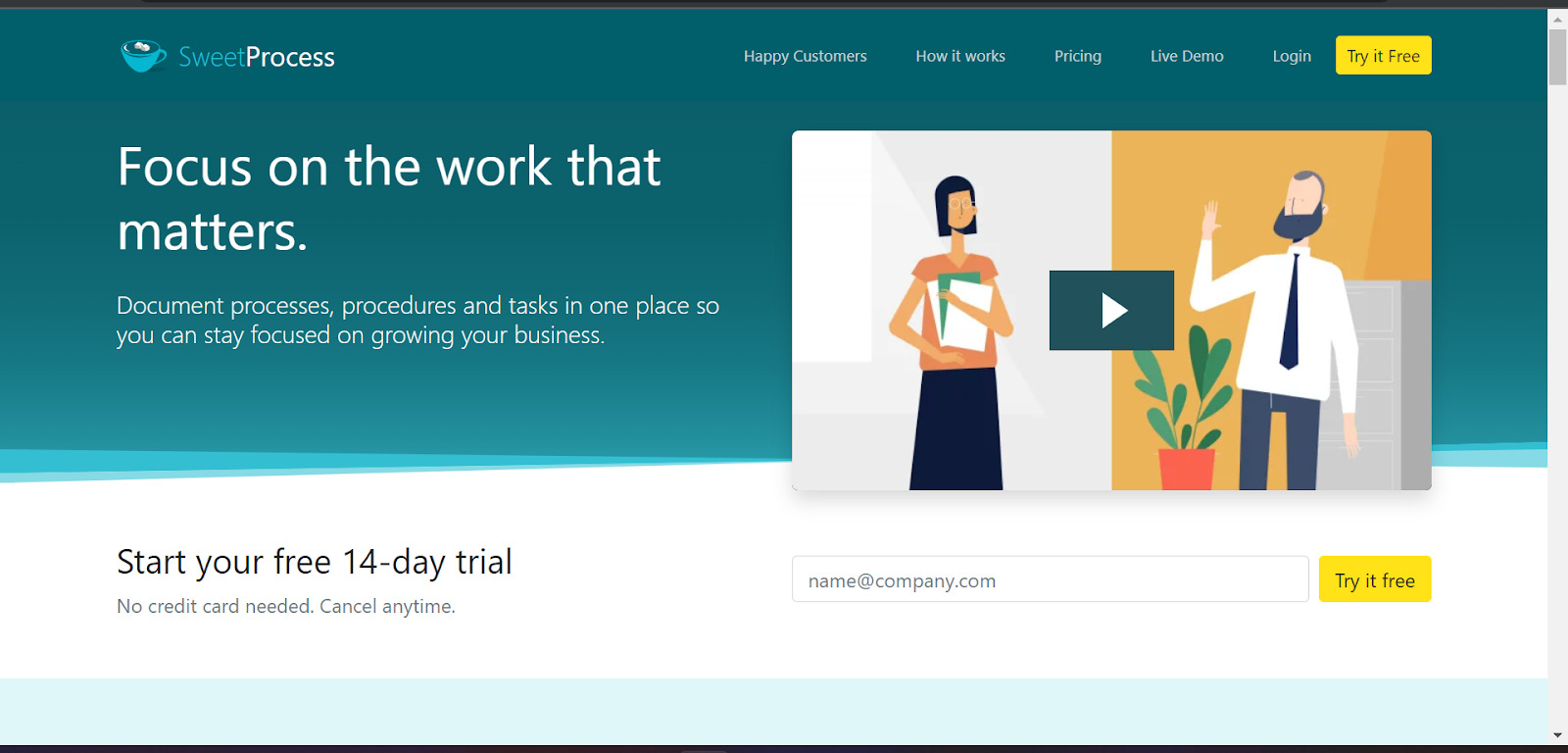
SweetProcess is designed to simplify business process management. It brings standard operating procedures (SOPs), policies, and assigned work into a cloud-based workspace. SweetAI can create a starting draft for a person to review.
SweetProcess stores processes and procedures centrally so employees can find the instructions their team maintains.
SweetProcess also lets you create workflows and collaborate with your team. You can assign documented work and inspect its recorded progress.
Use the available task records to review recorded progress and identify assignments that need attention. For integrations, check the supported API or Zapier connection and any separate service requirements before planning an automation.
Features of SweetProcess
Use the following illustrative new-employee setup example to evaluate SweetProcess. It describes a trial you can run, not a customer result or a completed product test.
Begin with a procedure for giving a new employee access to a shared work tool. Capture the browser-based steps, then add the checks a screenshot cannot explain: Which access level the manager authorized, who can grant it, and what to do if the request is incomplete. Have the procedure owner review the draft before anyone follows it.
Next, keep four questions separate. Which procedure version should the employee follow? Was its draft reviewed or approved? Has the employee acknowledged reading the relevant policy? Was the assigned setup or follow-up task completed? A current document, an approval decision, a read-and-understood acknowledgment, and a task record answer different questions. An acknowledgment alone does not establish that someone completed the work.
Assign the setup task to the responsible person, and use a recurring follow-up to check access after the role changes or at your chosen review interval. Inspect the actual record the product displays: The person, document or task, relevant version where shown, and recorded status or time. Confirm any required approval behavior in the current product rather than assuming the acknowledgment feature provides it.
For a focused pilot, capture three to five useful screens from your own example: The browser capture, the added manager check, the current procedure version, the acknowledgment, and the assigned task’s record. Keep only screens that explain the adjacent step. The screenshots below illustrate separate documentation and setup activities, rather than one completed pilot. Verify the exact UI and records during your trial.
Documenting Procedures
You can write a procedure as a sequence of steps, organize it with your other documentation, and update it as the work changes.
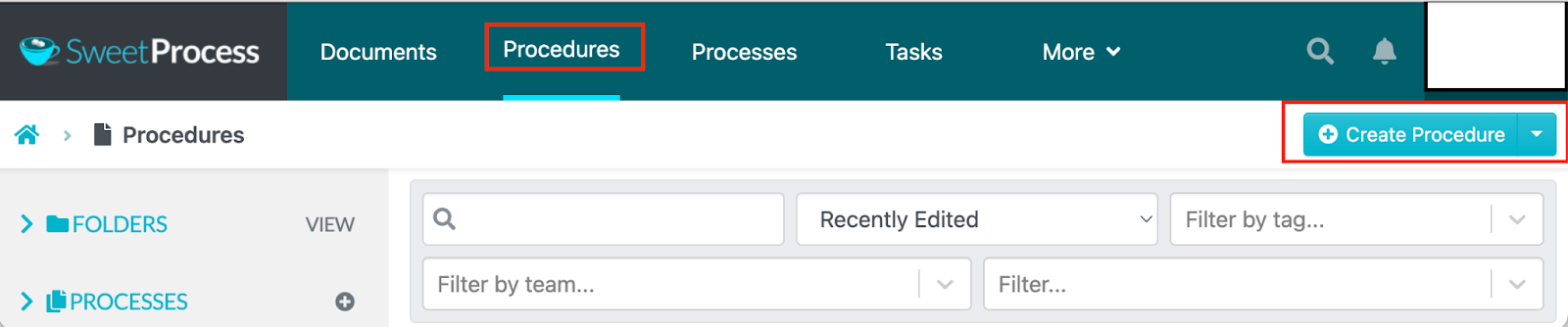
The SweetProcess editor makes it easy to add text as well as visuals such as images and videos.
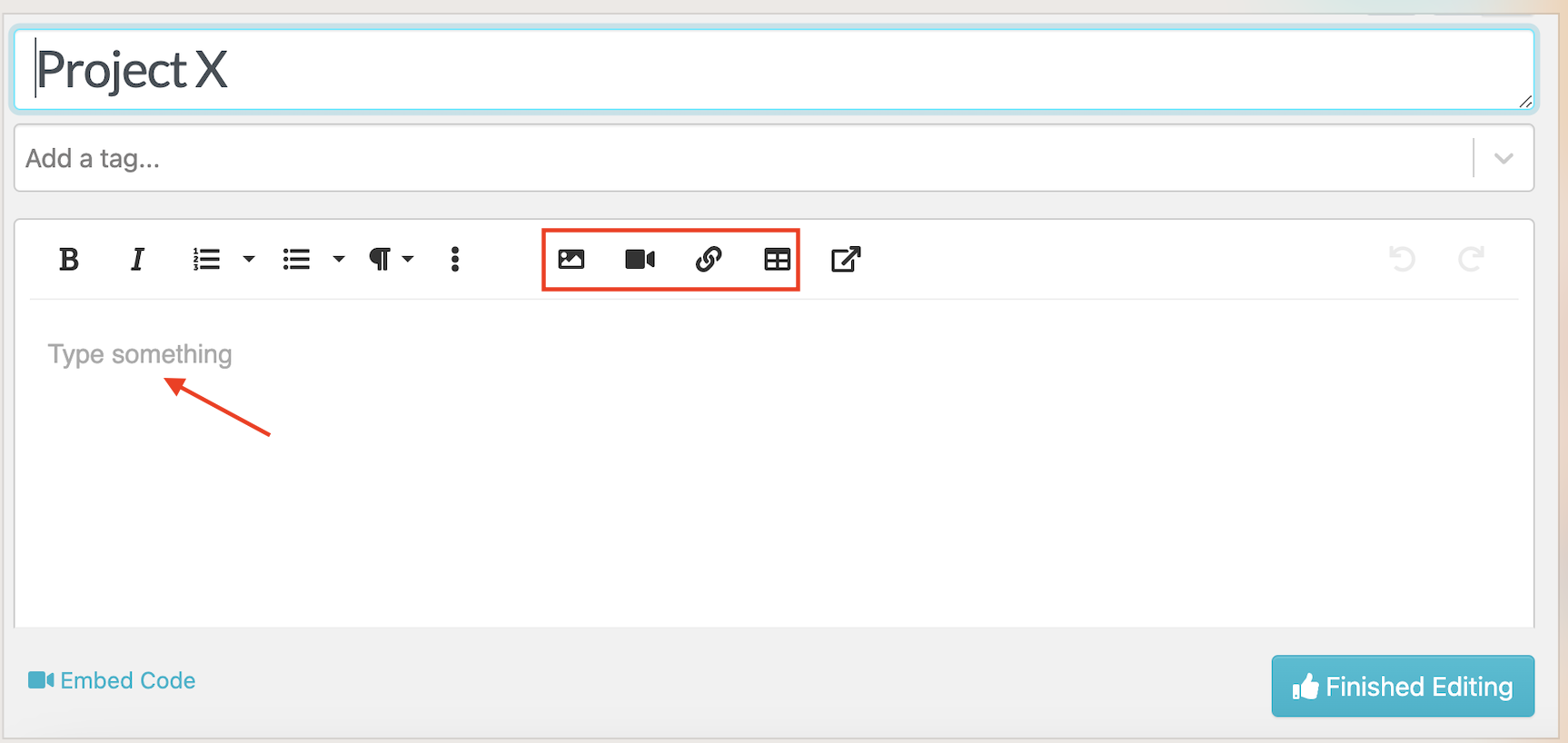
Instead of drafting procedures manually, you can rely on SweetAI to generate a draft quickly.
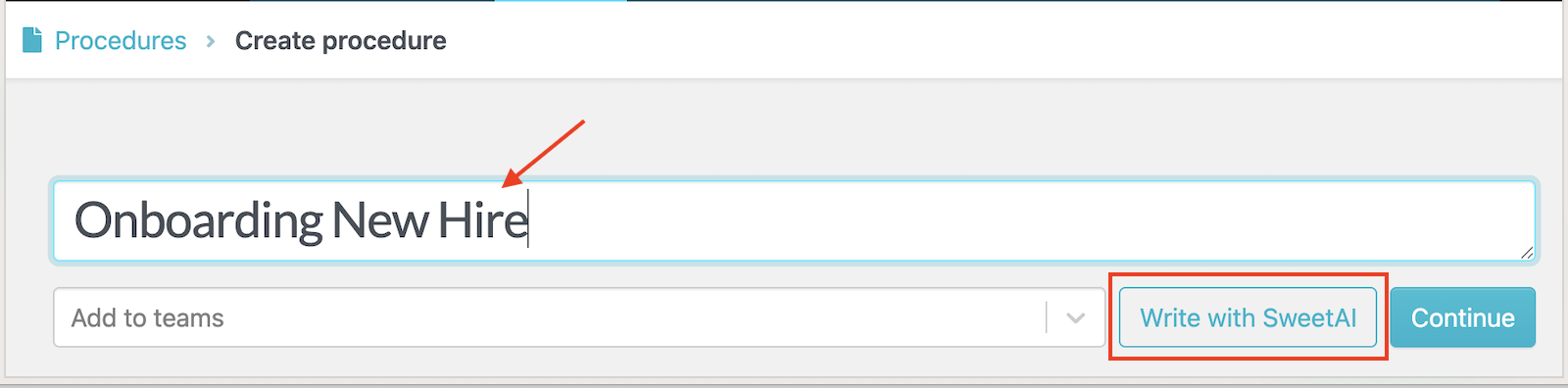
Have a team member edit the draft to ensure that it’s accurate and representative of your business.
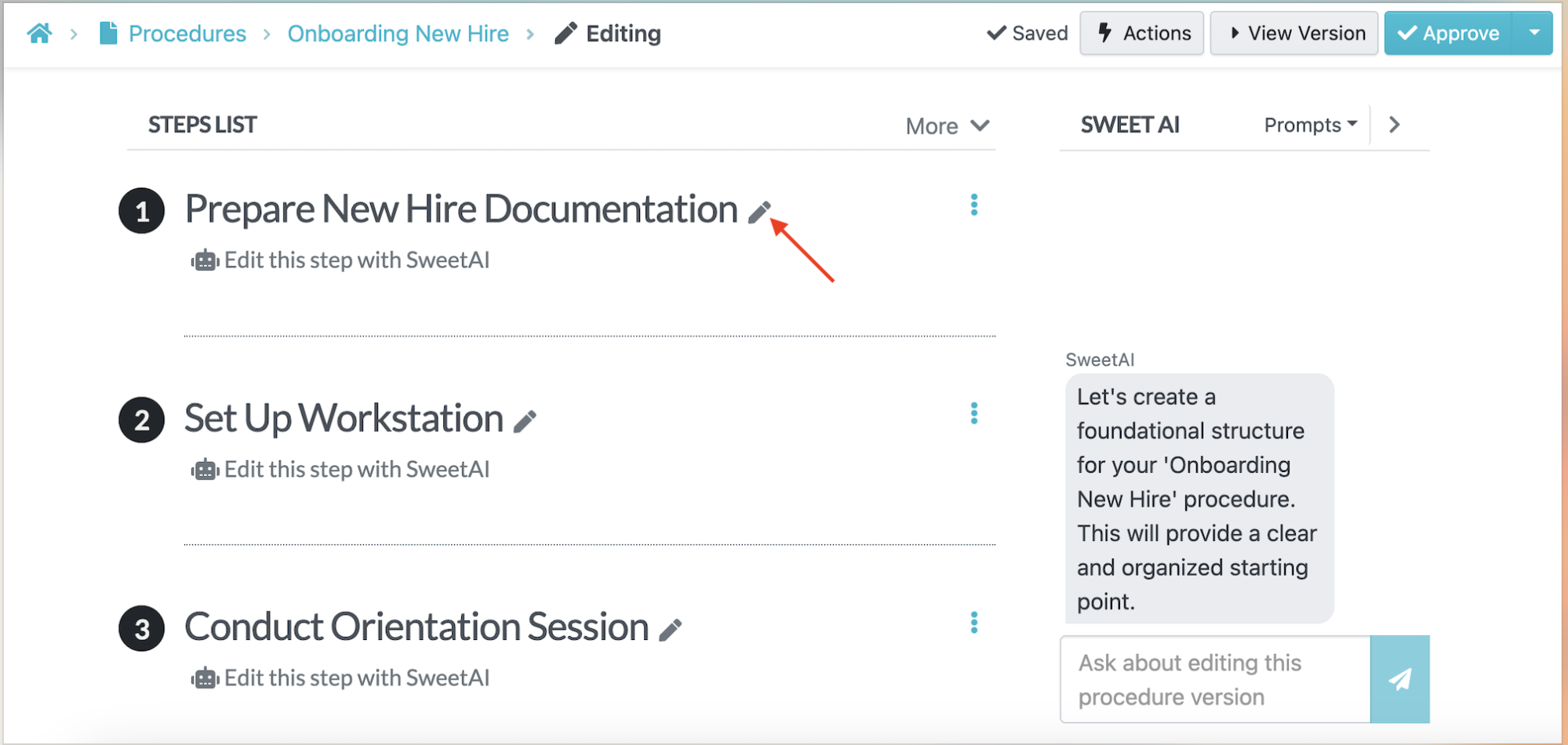
You can also import existing procedure and policy documents, which can help when you are moving material out of shared documents or another system.

Capture Browser-Based Steps
The SweetProcess browser recorder can help you capture steps and screenshots while completing a browser-based task. You’ll need to install the SweetProcess Chrome Extension to capture these steps.
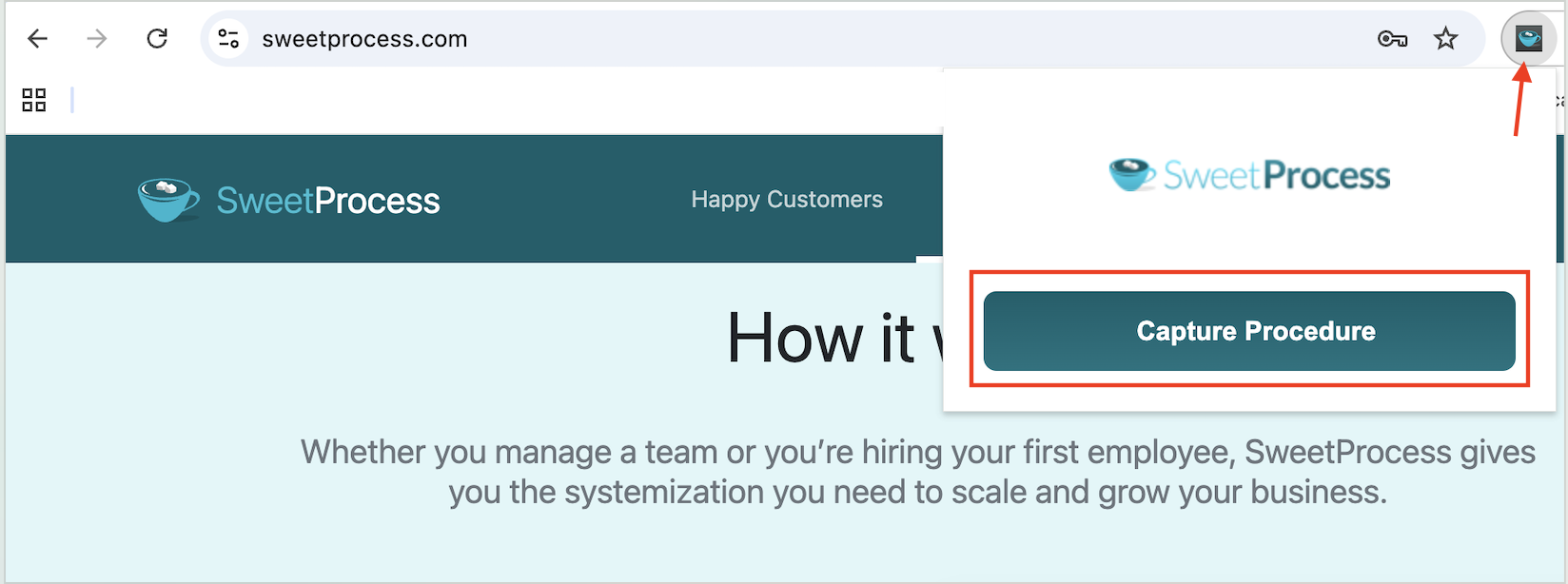
Once you have the captured output, review the steps, add context, and include decisions or checks that are not obvious from the screenshots. The example below shows captured website-navigation steps; use your own operational task for the pilot.
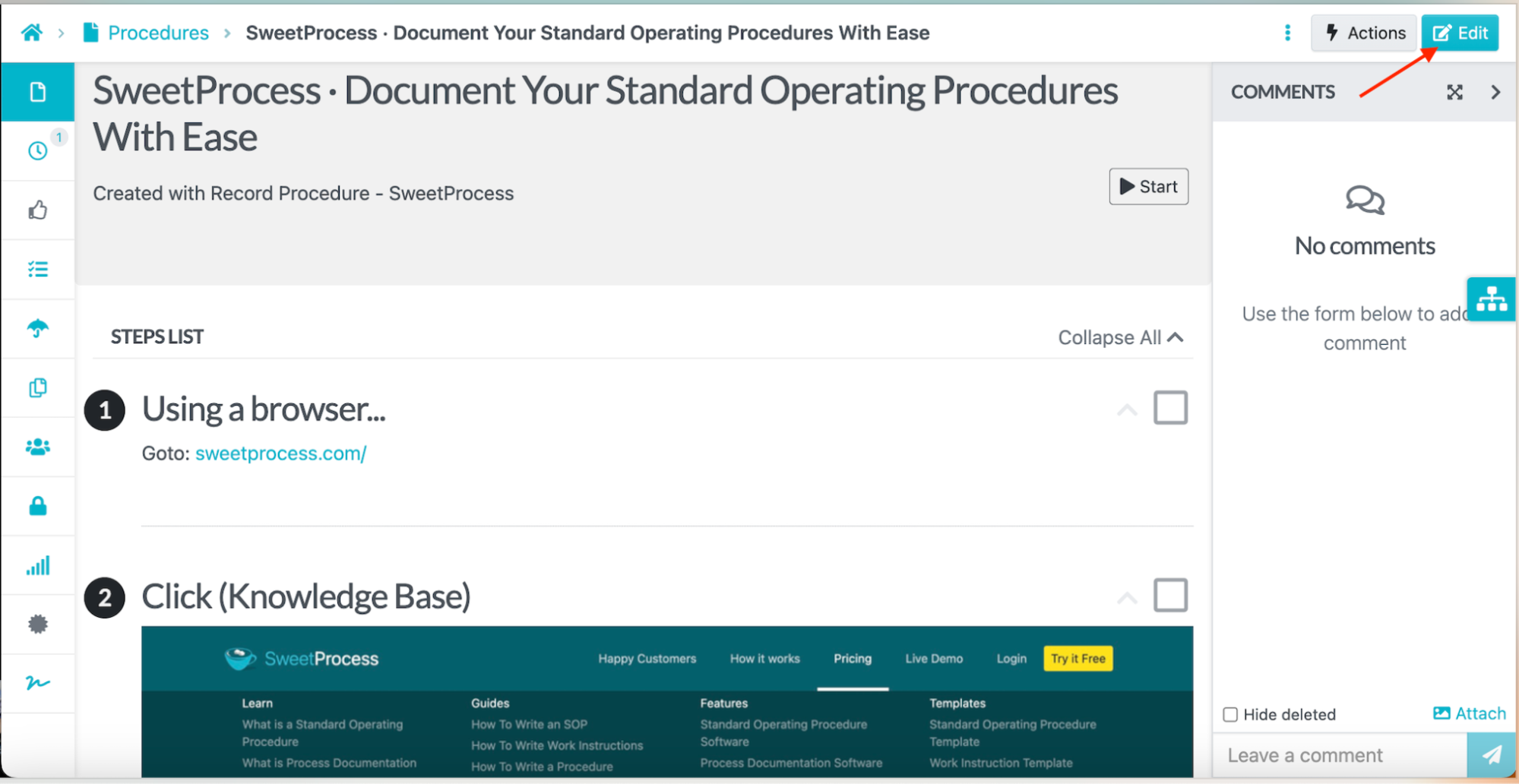
Create Processes and Policies
Apart from SOPs, SweetProcess also allows you to document and manage your processes and policies. These processes connect all your related activities, while the policies communicate the rules people are expected to follow. Just like with procedures, you can use SweetAI to draft your policies.

You can then edit and refine them to align with your goals.
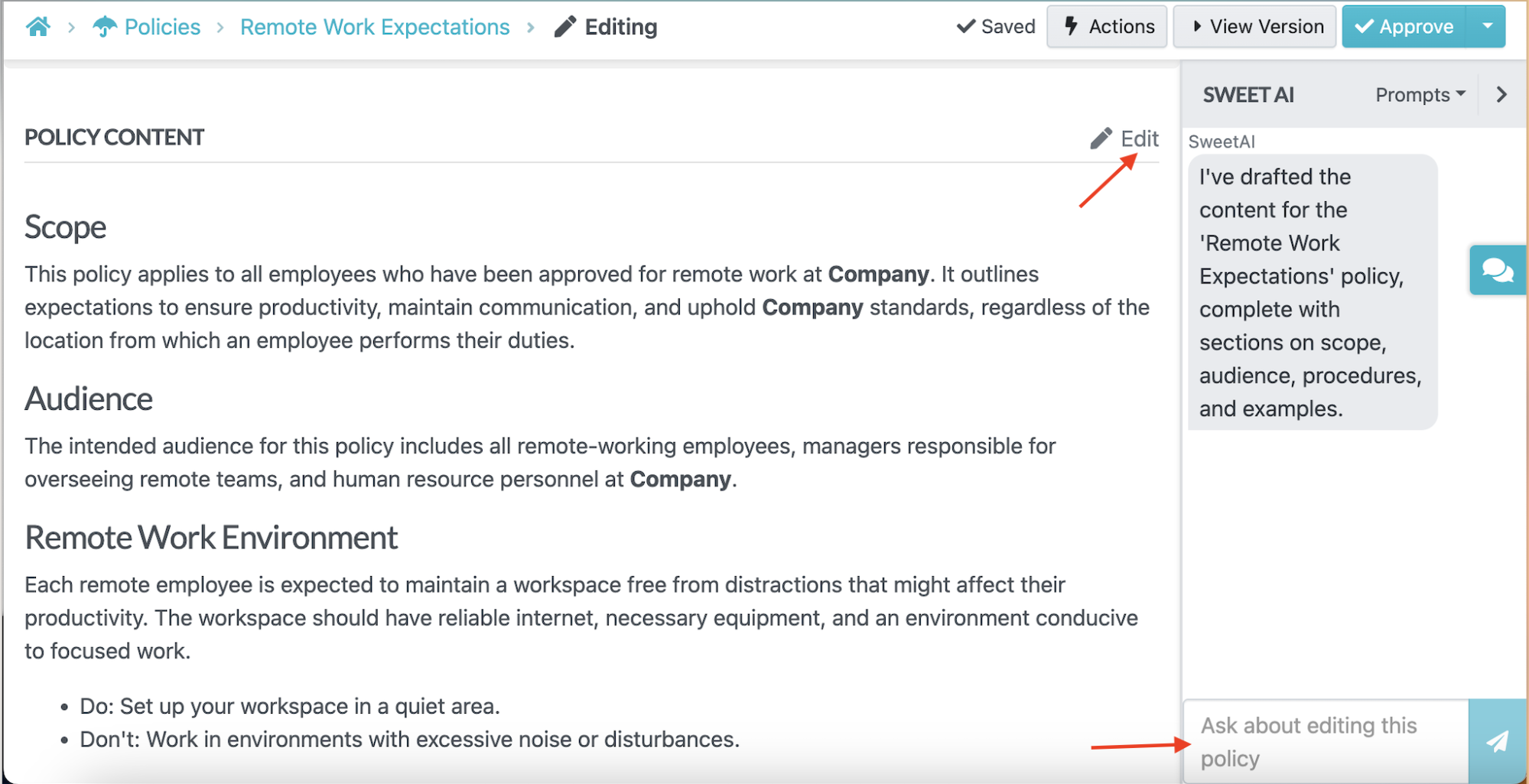
From the same dashboard, you can document your processes. You just need to switch between the tabs to create them.

Generate Flowcharts
SweetProcess can represent the sequence of work as a flowchart. The published demo below shows a Process connecting five procedures, with Yes and No branches at a quality-review decision. Use a Process to show how related procedures fit together.
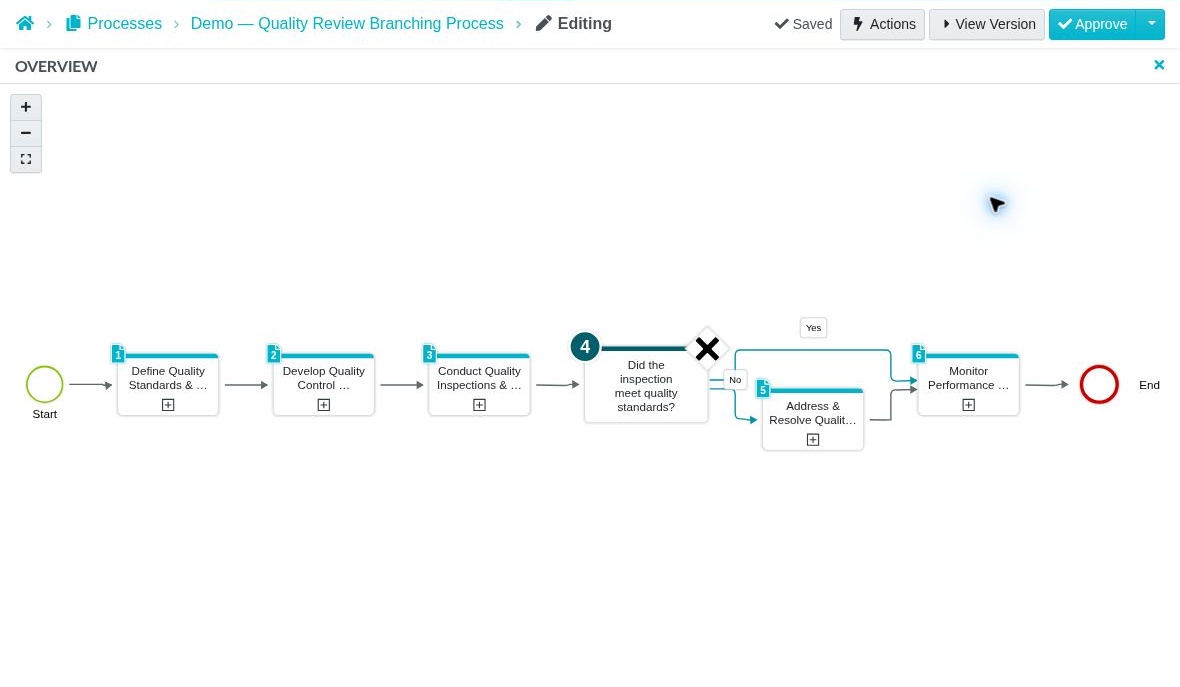
Assign Tasks
You can also assign a procedure or process as a task.
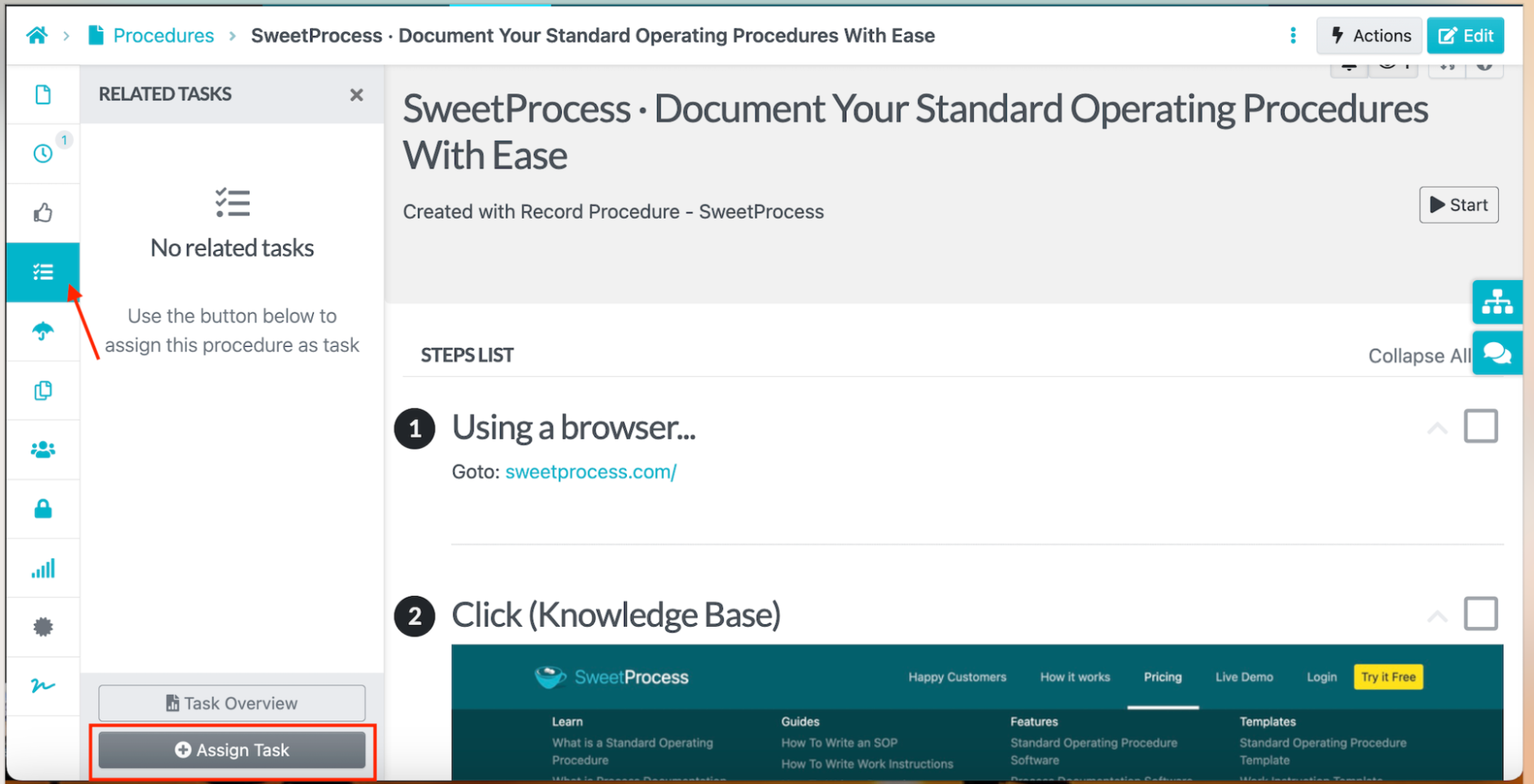
SweetProcess allows you to assign the tasks to a specific employee or team for easier accountability.
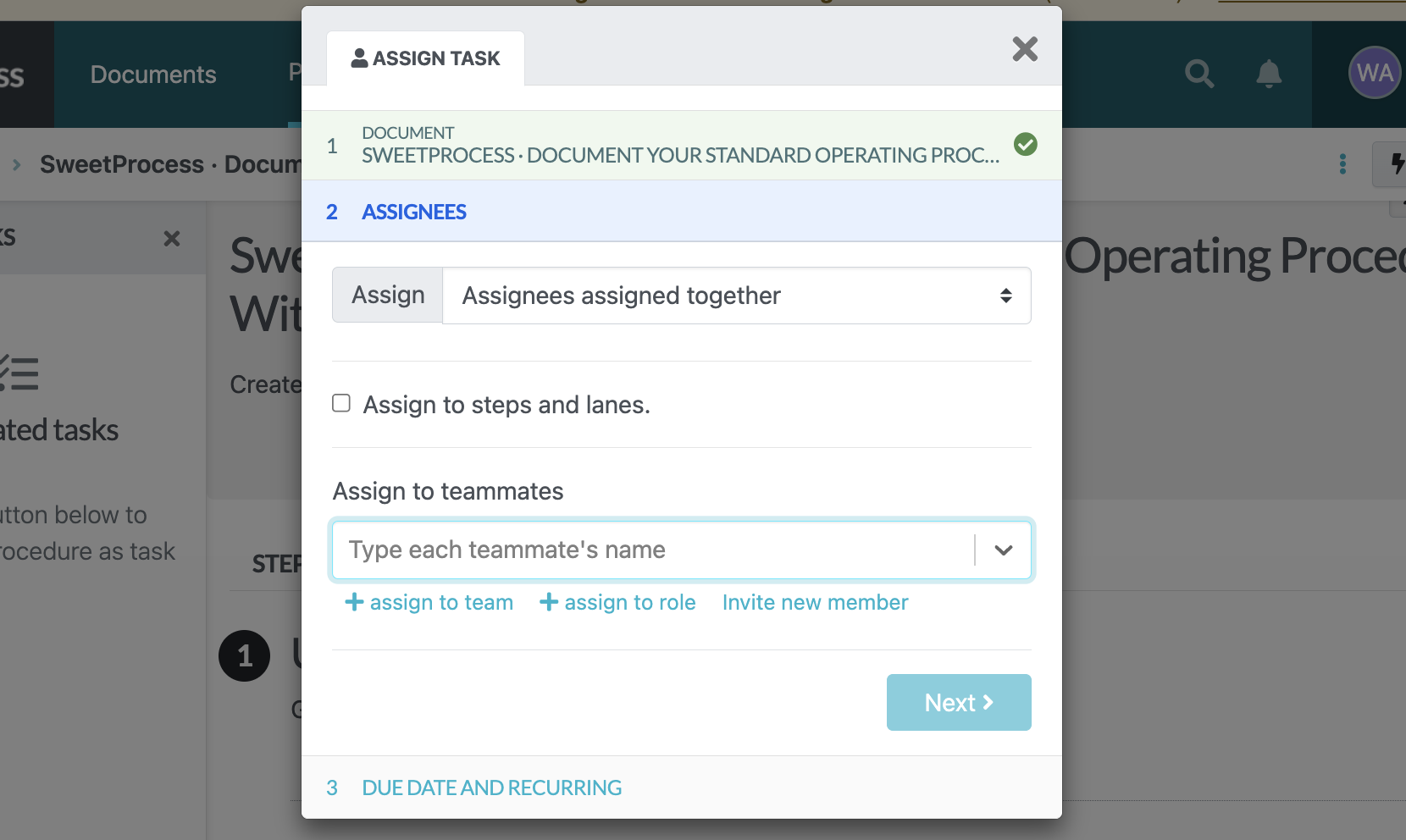
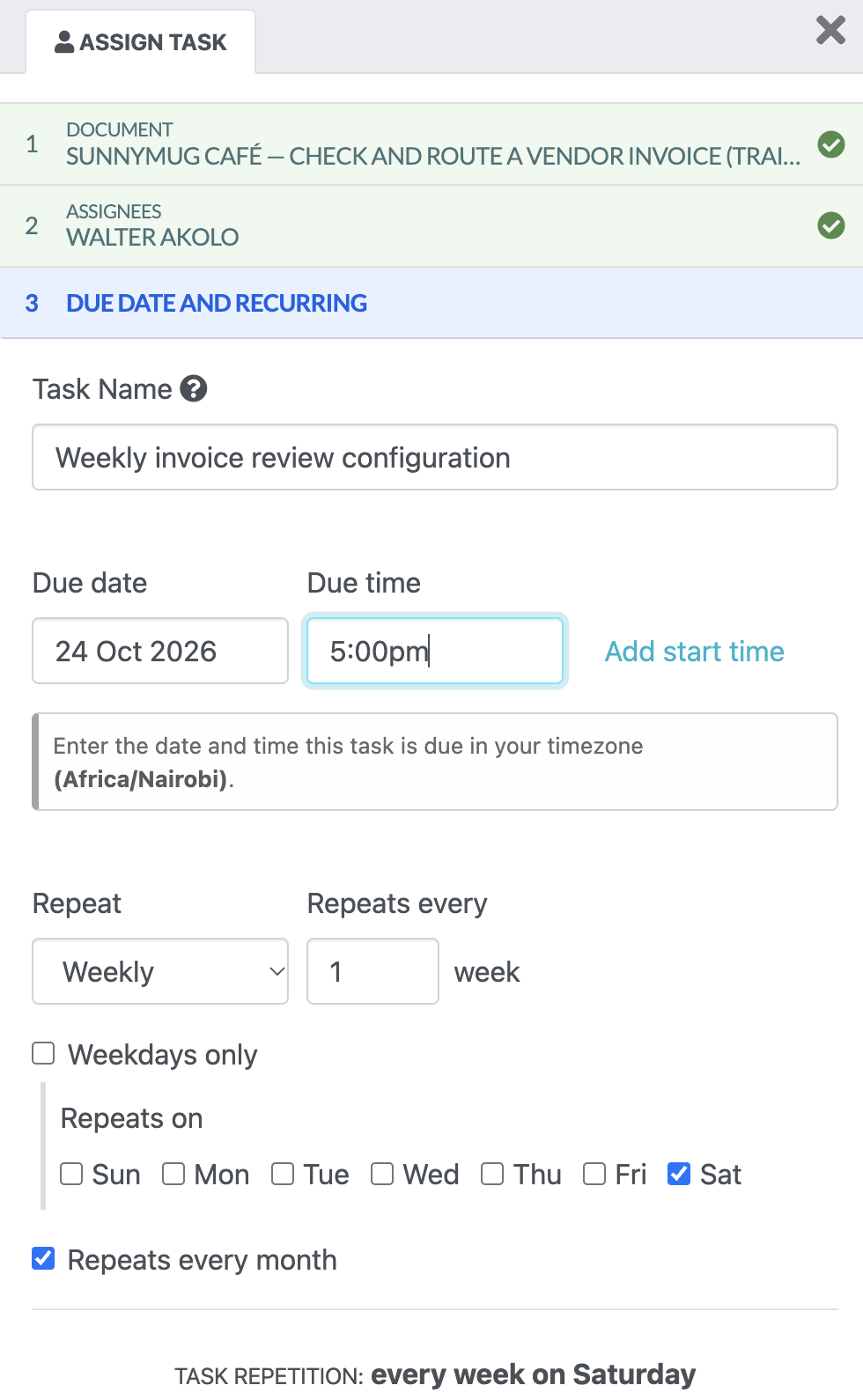
In the assignment form, set the due date and time, then choose the Repeat setting. For a weekly review, select Weekly and the intended day, as shown in this Saturday configuration.
Track Changes
Version history helps you inspect changes to documents. Open a procedure and select the version-history control indicated below to inspect its available versions, editors, and update times.
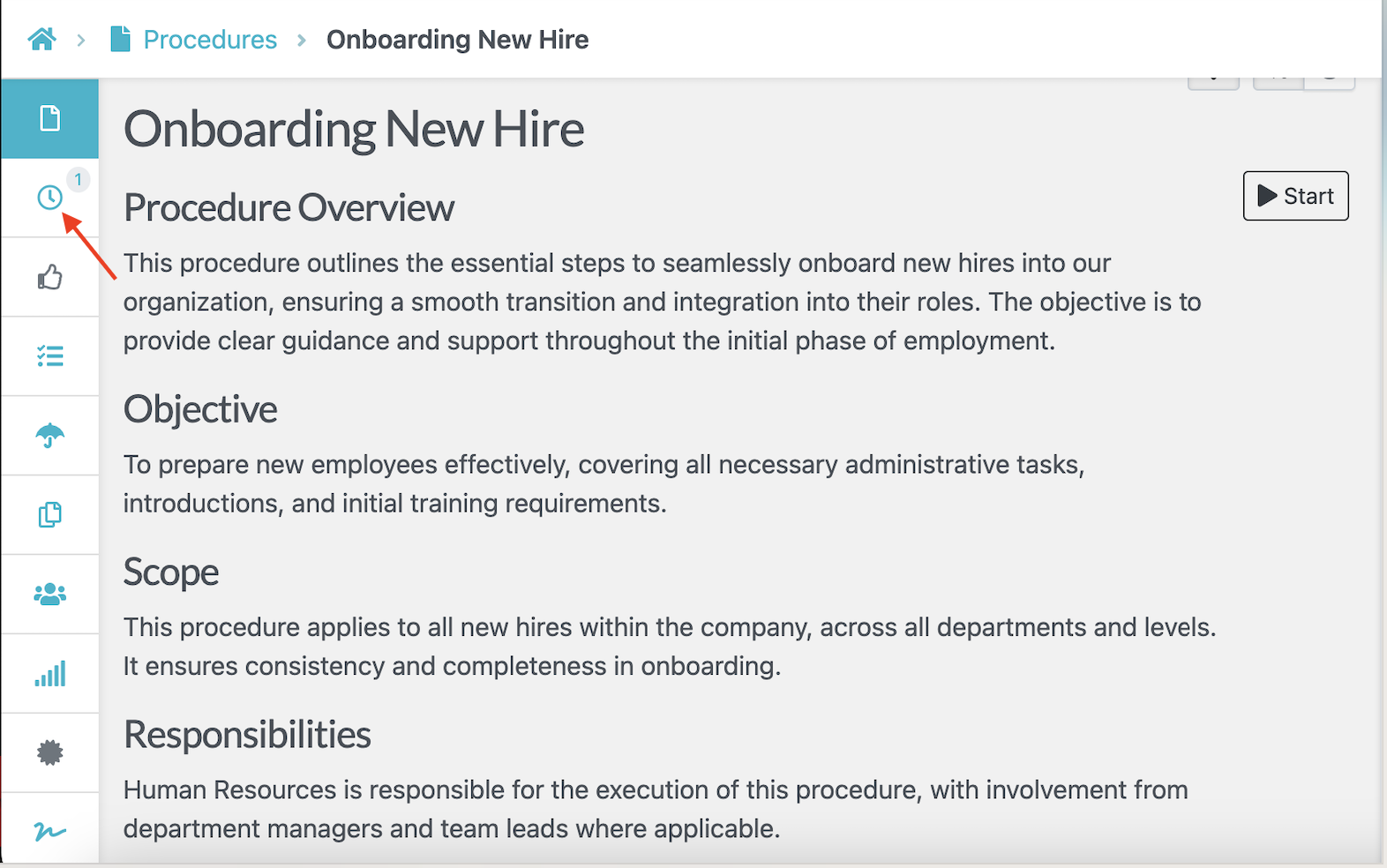
You can then use the current version or revert to an older one if necessary.
Additionally, once you’ve made the changes, you can request an acknowledgment from your employees that they have read and understood the document using the sign-off feature.
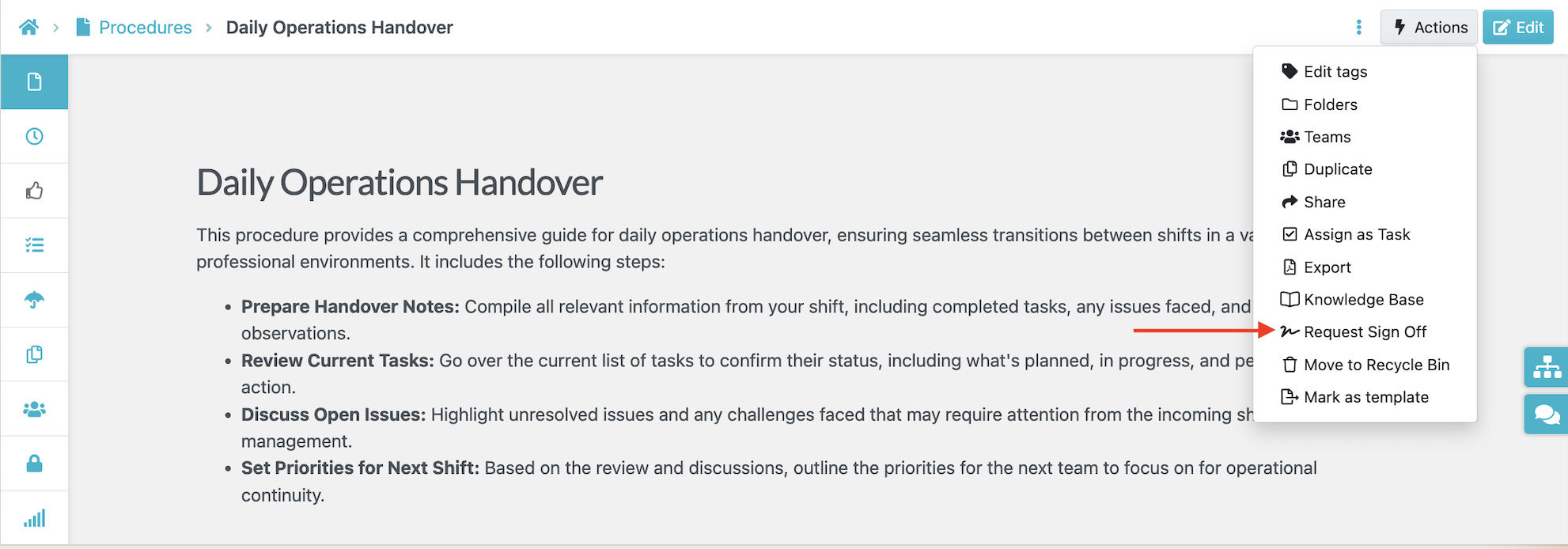
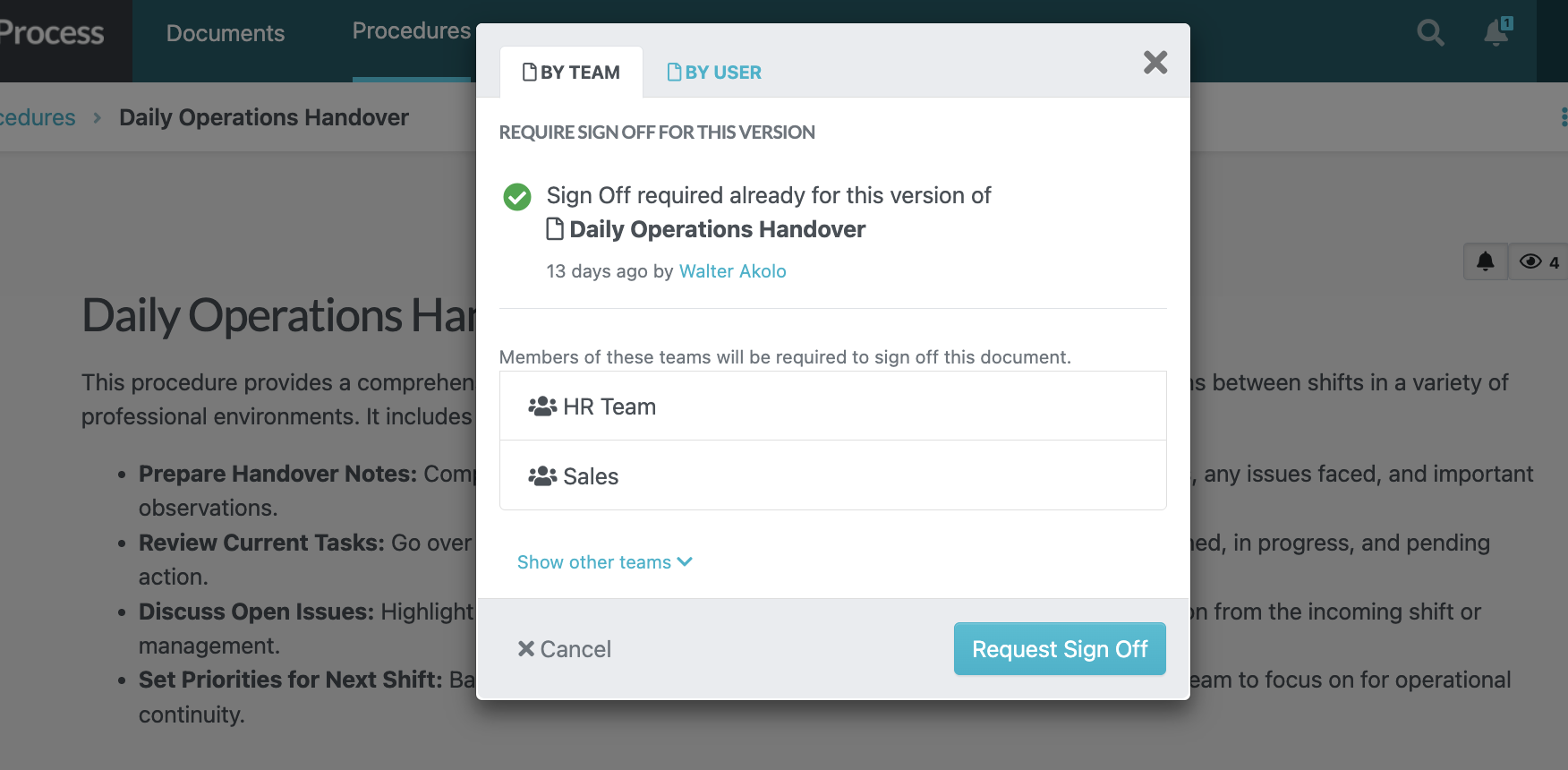
The dialog below lists teams already required to sign off on Daily Operations Handover. Review the existing requirements before adding teams or specific employees.
SweetProcess Pricing
SweetProcess offers flat-tier pricing. For teams with 10 users, you can pay $99 per month and $5 per month for each additional user. You can also pay $990 if you prefer annual payments and $50 per year for every additional user.
If you have a small team of five users, SweetProcess offers a plan that costs $495 per year with an additional $50 per year for each extra user. Every user can access all features. Billing counts the users in your account, not only the people who actively use it. The pricing plans also come with a 30-day money-back guarantee and a 14-day free trial to test out the tool.
Notion

Overview
Notion is a flexible workspace for teams that want documents, databases, and related work in one place. You can create pages and organize them into a workspace, link related information, and use databases to structure content. A team might maintain project briefs, onboarding notes, meeting records, and internal reference material within the same environment.
If your team wants to shape its own knowledge structure rather than adopt a dedicated procedure management model, Notion is worth considering.
Notable Features
- Flexible pages and documents: You can create and organize shared notes, project documentation, and internal reference material.
- Connected databases: Structure information in databases and connect it to related pages and work.
- Customizable workspace: Adapt page structures and organization to different teams and projects.
- Page verification: The Business plan includes page verification, helping teams manage the review of important content.
Notion Pricing
Notion has a Free plan that offers basic features. The Plus plan costs $10 per seat per month when billed annually and comes with unlimited charts, collaborative blocks, and custom forms. The Business plan starts at $20 per seat per month, billed annually. Confirm the current USD quote and billing commitment before purchase. Enterprise pricing is customized.
What to check before choosing Notion: Guests access the pages they are invited to, not every teamspace. Check how Notion counts members and guests before you calculate a full-team cost. Assign someone to maintain the page structure and test how a reviewer identifies the current approved information. Free multi-member workspaces have limits; do not assume they include Business verification features.
Nuclino
Overview
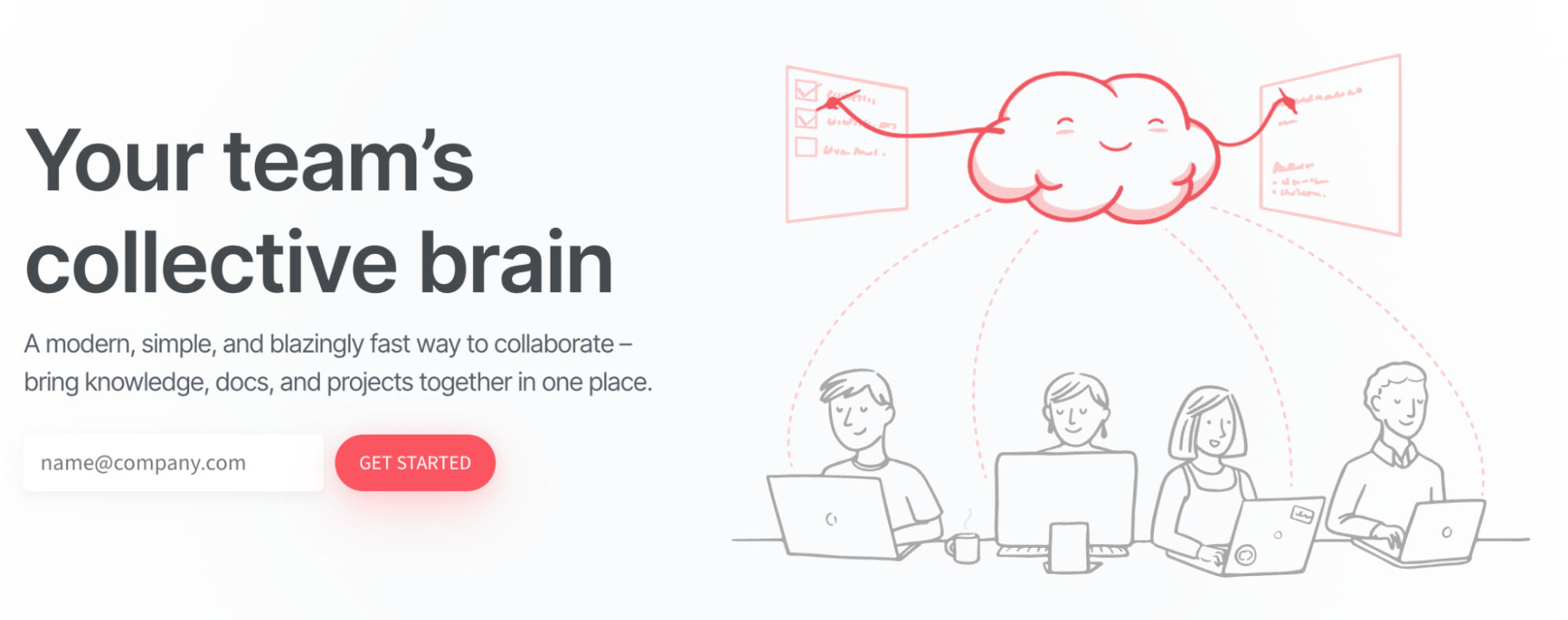
Nuclino is a collaborative workspace for organizing linked items and documents. Your team can create linked knowledge items and organize information around topics or projects. Canvases offer another way to arrange and connect information. This can suit a team that wants to document internal knowledge and give employees a common place to find information.
A shared workspace can make information easier to browse, but it does not automatically create a process for keeping every page current.
Notable Features
- Version and administration controls: Access to history and administrative features varies by plan.
- Sidekick AI: Use Sidekick to ask questions about your content. Review its answers against the source, and confirm that your plan includes the AI features you need.
- Collaborative documents: Create and maintain shared information in one workspace.
- Visual canvases: Arrange and connect information using canvases.
Nuclino Pricing
Nuclino offers three pricing plans. The Free plan includes 50 items and 2 GB of storage, making it ideal for small teams or individuals. Starter adds features such as 30-day version history and more storage. Check the current selected monthly or annual rate before budgeting; an annual equivalent is not a monthly-payment offer.
Business adds AI and administration capabilities. Compare the full annual commitment or monthly subscription for everyone who needs access.
What to check before choosing Nuclino: Confirm the history and administrative controls available in the plan you are considering. Paid plans count guests and read-only members as users. Choose an owner for each workspace, make one sample change, and check what that owner can recover or inspect later.
Slite
Overview
Slite is a knowledge base software that focuses on internal knowledge and helping employees find answers. Its answer-finding workflow can help people locate relevant knowledge without manually opening every document. It can also be a good fit when your team wants to make it easier to identify whether a document has been checked recently.
Notable features
- AI-assisted answer finding: This feature helps employees find information from the team’s knowledge.
- Shared documents: You can create and organize internal knowledge for employees.
- Document verification: Helps identify whether important information has been reviewed.
- Connected-tool search: The Pro plan adds search across connected tools and other controls.
Slite Pricing
Slite offers the Basic plan that costs $10 per user per month, billed yearly. The Pro option costs $20 per user per month, billed yearly, and gives access to the Slite Agent. If you have a bigger team and need more advanced features, you can contact the sales team for a custom quote.
What to check before choosing Slite: Assign an owner to an important document, then check its verification workflow and visible review status. Slite is suited to maintaining and finding internal knowledge. If you need to connect each procedure to assigned recurring work, compare that workflow with SweetProcess.
Tettra
Overview
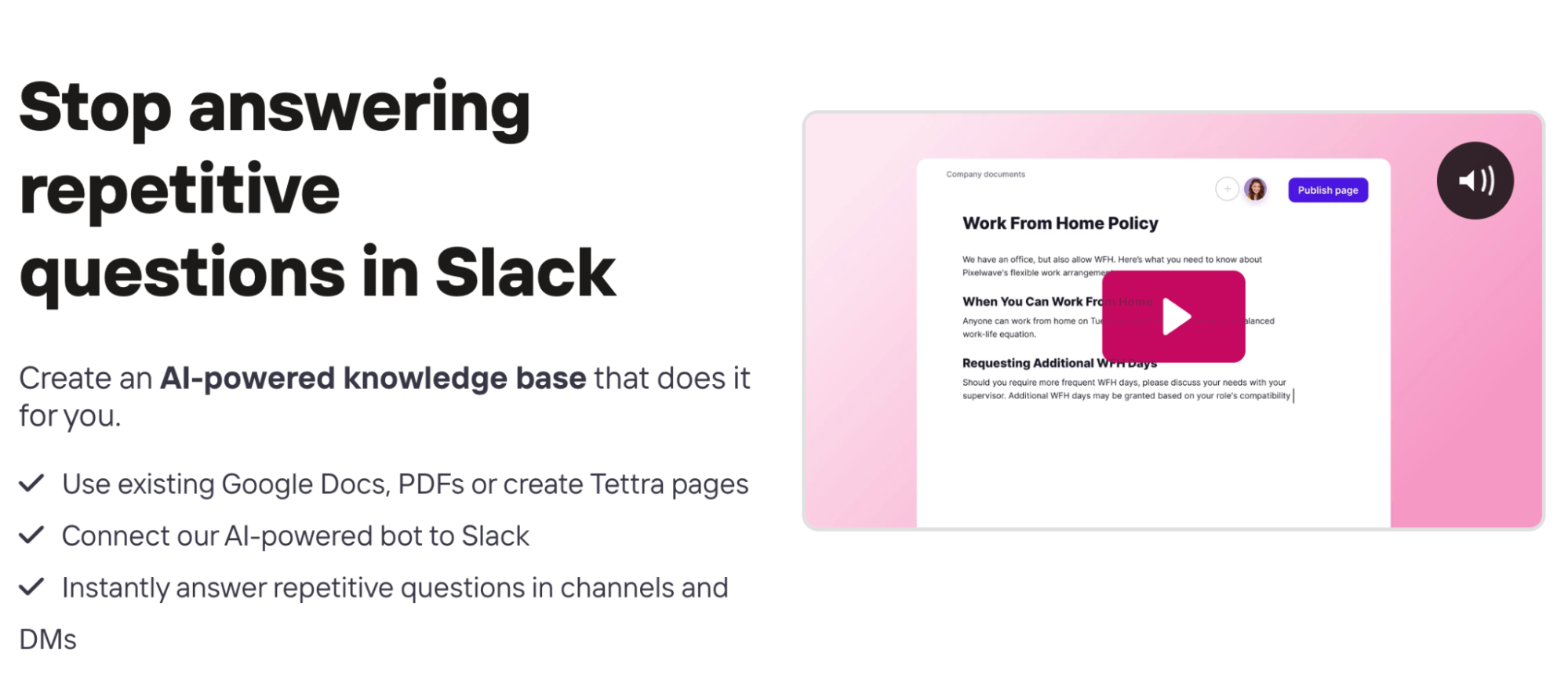
Tettra is an internal knowledge base tool that helps organizations centralize information. It’s an ideal Confluence alternative if your team regularly asks recurring questions in Slack and you want a more organized way to publish answers and maintain knowledge. The AI-assisted answers keep your team on the same page.
Notable Features
- Slack integration: It supports knowledge sharing alongside team conversations.
- Internal Q&A: With this tool, you give employees a place to ask questions and find existing answers.
- Content verification: This feature helps teams review important knowledge and maintain its reliability.
- Stale-content reporting: You can identify information that may need review or a clearly assigned owner.
Tettra Pricing
Tettra has two plans, Scaling and Enterprise. Scaling has a 10-user minimum and monthly or yearly billing options. Confirm the selected billing cycle and total commitment on the pricing page before calculating your team’s cost. With this plan, you can access AI features, analytics, and Google Workspace integration.
The Enterprise plan offers custom onboarding and reporting. You have to contact the sales team for a plan. The Scaling plan comes with a 30-day free trial period that you can use to test whether the tool is a good fit for your business.
What to check before choosing Tettra: Confirm the billing cycle, eligible user roles, and 10-user minimum. Choose an owner for a frequently asked question, update its answer, and check how verification and stale-content reporting help that owner maintain it.
Guru

Overview
Guru is an enterprise AI knowledge platform that helps businesses connect knowledge from different sources. Therefore, if you store knowledge across internal documents, applications, and other repositories, Guru can help bring relevant information into employees’ workflows. If you already have existing business tools, Guru connects to 100+ tools, including Slack, Salesforce, and Microsoft Teams.
Notable Features
- AI-driven content authoring: Guru can draft and update documentation from conversations, meetings, and tickets, then route drafts to subject-matter experts for review before publication.
- Connected knowledge sources: You can bring information from supported sources into a centralized platform.
- Permission-aware retrieval: It allows you to add access permissions for when employees search for information.
- Enterprise knowledge access: This helps employees find relevant information without requiring every source to be moved into one wiki.
Guru Pricing
Guru doesn’t publicly list its prices; you have to talk to the sales team. Its custom package reflects your organization’s scale, knowledge complexity, and AI needs. Ask which users, connected sources, and usage are included.
What to check before choosing Guru: Confirm the connected sources, roles, and usage in your quote. Ask who reviews drafted knowledge, how a source change reaches employees, and which verification record a content owner can inspect. Test retrieval with real permissions rather than assuming every employee sees the same answer.
Document360

Overview
Another alternative to Confluence worth considering is Document360. You can use it to create an online self-service knowledge base for customers or employees. The knowledge base can be accessed publicly or privately, which means you will get instant access to vital information.
Notable Features
- Knowledge-base portal: Editors and reviewers can use the editor, category manager, and analytics tools to maintain articles.
- Versioning and rollback: Review earlier article versions or restore a prior version.
- Analytics: Keep track of your knowledge base traffic sources using this feature. Understand what your visitors seek and how they interact with your created content.
- Category manager: With Document360, you can create up to seven hierarchy levels: One root category and six subcategory levels. You can also organize and display groups of related topics while rearranging your documents.
- Editors: Use the WYSIWYG editor to add text, links, and images to articles.
Document360 Pricing
Document360 doesn’t list its actual costs. The pricing is tailored based on your company’s setup.
What to check before choosing Document360: Assign an author and reviewer, then inspect the article’s revision and publishing workflow. Confirm which add-ons your quote includes. Document360 supports Confluence import, but that does not guarantee preservation of every layout or permission. Test pilot content before committing to a full migration.
BookStack
Overview
BookStack is an open-source wiki tool for storing company information. The books-and-chapters structure gives teams a familiar way to group information. You can organize documentation into a book, divide it into chapters, and create pages for individual topics. BookStack supports WYSIWYG and Markdown editing, search, revisions, and role controls.
Notable features
- Easy page editor: The WYSIWYG interface makes it easy to create content for your team
- Search features: The content is fully searchable, helping users find information across the wiki.
- Free and open source: Anyone can download and install BookStack since it is free for all users.
- Diagrams: BookStack’s page editor has drawing capabilities that you can use to add diagrams in your documentation.
BookStack Pricing
BookStack community software is free under the MIT license. That does not make the complete deployment cost-free. Hosting, backups, upgrades, administration, and any paid support are separate costs.
What to check before choosing BookStack: Self-hosting requires an owner. Your organization must arrange the environment, apply updates, maintain backups, manage access, and plan for recovery if something goes wrong. You should also decide who is responsible for the content itself.
XWiki
Overview
XWiki is a configurable wiki available as community software, with hosted and paid options. This tool supports structured pages and data, version history, permissions, and extensions. These capabilities can help teams adapt the wiki to their information model rather than relying only on a fixed page hierarchy. It is worth considering when you need more flexibility in how information is structured.
Notable Features
- Structured data: You can organize information beyond basic standalone pages.
- Version history: It allows you to review changes made to wiki content.
- Permissions: You can manage access to information.
- Extensions: You can adapt the wiki with extensions to support additional requirements.
XWiki Pricing
XWiki community software is free. Paid hosting and support packages depend on your selected package, user count, and subscription period. Use the current calculator or request a quote for your deployment, and confirm included support, extensions, and any ordering discounts before comparing the total with another tool.
What to check before choosing XWiki: Confirm what is included in the package and which migration tools are available. Identify a content owner and inspect how a sample revision is reviewed and recovered. If you are self-hosting, you’ll need to assign responsibility for upgrades, backups, access, and recovery.
Process Street
Overview
Process Street is workflow software for teams that need to execute repeatable work. It is worth evaluating when a recurring job needs forms, conditional logic, approvals, due dates, and a defined task order. A workflow run records work in progress; a reference page explains information someone may need along the way.
Notable Features
- Document design: Whether you want to create processes or procedures, it’s all possible with Process Street.
- Process repository: Organize the workflows your team uses for recurring work.
- Workflow automation: Connect supported applications and automate selected steps; check the plan’s action limits and integration requirements.
Process Street Pricing
Process Street offers three pricing tiers: Startup, Pro, and Enterprise. You have to contact the sales team for an actual quote for any plan. If you want to test out the tool before migrating, you can use the 14-day free trial on the Pro plan.
What to check before choosing Process Street: Ask which plan includes the workflow features you need, how users are billed, and whether any limits apply to runs or roles. Identify the workflow owner, change one instruction, and check how the current workflow and an existing run relate. Inspect an actual completed-run record before deciding it meets your reporting needs.
All these tools offer key capabilities. If your team needs to maintain procedures and policies alongside assigned work, evaluate SweetProcess with one recurring task.
How Much Do Confluence Alternatives Cost?
Some of the Confluence alternatives offer free trials, while others give you a free plan to test the tool. What would it cost if you have a team of 10 users? Here’s a breakdown based on the published pricing to help you decide.
|
Tool and Scenario |
Published cost and billing commitment |
What the cost means |
|---|---|---|
|
SweetProcess Standard, 10 users |
$99 per month or $990 per year |
The annual plan saves $198 compared with 12 monthly payments, about 16.7 percent |
|
SweetProcess Standard, 20 users |
$149 per month or $1,490 per year |
Base price for 10 users plus 10 additional users |
|
SweetProcess Small Team, up to five users |
$495 per year |
Annual-only plan |
|
Nuclino Starter, 10 users |
Confirm the selected monthly or annual quote |
Count all 10 users, including any guests or read-only members; distinguish the annual total from a monthly equivalent |
|
Slite Basic, 10 users |
$1,200 per year |
Based on $10 per user per month, billed yearly |
|
BookStack or XWiki Community |
Software license: $0 |
Add hosting, backups, upgrades, support, and staff time |
How To Test a Migration Before Switching
If you are planning to switch from Confluence to one of these alternatives, you need to start with a small migration pilot that can reveal formatting issues, permission gaps, and maintenance work while you still have the option to change your plan. Here’s how to go about it
Step 1: Select Representative Content
Start by choosing a small sample that reflects the complexity of your current wiki. Here, you can include a nested page, an image and attachment, a table, a page with internal links, a restricted page, and a macro-heavy page. The purpose of this is to find problems that could affect the wider migration.
Step 2: Import and Recreate the Sample
Use the destination’s supported import method where available. Check whether headings, lists, tables, images, attachments, and links appear as expected. Inspect navigation and ownership, and test an export from the destination. Record unsupported macros, missing history, or changed layout before deciding what to recreate.
Step 3: Test Permissions With Real Roles
Once you have imported your SOPs, set permissions and check who can read, edit, and manage the imported content. This way, you can record any differences and determine if the tool will be a good fit before expanding the migration.
Step 4: Test Content Maintenance
This step allows you to check whether it’s easy to schedule reviews, request acknowledgments, check revision history after changes have been made, or assign SOPs as tasks. With this test, you can determine whether the software will be a good fit for knowledge management moving forward.
Step 5: Estimate The Total Costs
Use a free trial or free plan to test the sample content where the relevant features are available. Some free plans are limited; therefore, you might not access all features. Before purchasing, estimate the paid commitment alongside migration effort, add-ons, and administration. Look out for add-ons that may increase the cost.
Ready to switch? Start with one procedure your team already knows, and check how easily its owner can update it and assign the work. You can sign up for the free 14-day trial to evaluate your sample procedure and the migration work it requires.
Which Confluence Alternative Should You Choose?
The right choice depends on whether your priority is collaborative documentation, internal knowledge sharing, customization, or turning documented procedures into consistent work.
The best Confluence alternatives offer different ways to organize team knowledge, share information, and keep work moving. Notion and Nuclino suit teams that want flexible, collaborative workspaces, while Slite, Tettra, Guru, and Document360 focus on making company knowledge easier to find and share. BookStack and XWiki are worth considering if you prefer open-source or self-hosted options, while Process Street is designed for teams that need structured workflows and repeatable processes.
SweetProcess is a Confluence alternative for teams that need more than a place to store information. It helps you document standard operating procedures, policies, and processes, assign responsibilities, and keep recurring work consistent. Rather than relying on a general-purpose wiki, your team can build a central library of procedures and connect documentation to the work people need to complete.
Start your 14-day free trial, with no credit card required. Document one new-employee setup procedure, assign its follow-up task, and check whether the resulting record answers your manager’s question.
FAQs
What are the best free alternatives to Confluence?
The best option depends on whether you need a hosted workspace or software you can run yourself. Notion and Nuclino have free plans with limits. BookStack and XWiki offer free community software that you can self-host, but you must account for infrastructure and maintenance.
Which Confluence alternatives can you self-host?
BookStack and XWiki are self-hosted options in this shortlist. Both require you to plan for hosting, backups, upgrades, permissions, and administration. Confirm the current requirements and support options for the edition you intend to use.
Is Confluence being discontinued?
Confluence Cloud is not being discontinued. Atlassian has announced an end-of-life date of March 28, 2029, for affected Data Center products. These are different deployment models. Check which version your organization uses before making a migration decision.
Does Microsoft have an alternative to Confluence?
Microsoft offers products that cover some overlapping needs, but they are not identical replacements for every Confluence capability. Microsoft Loop supports shared project workspaces, pages, and components that stay in sync across supported apps, while SharePoint supports intranets, knowledge sites, and document management.
What can be lost when migrating from Confluence?
You could lose links, attachments, page structure, formatting, permissions, and version information during migration from Confluence. You should test these items beforehand since import behavior depends on the source content and the destination’s capabilities. Run a pilot with representative pages, check the results, and document any gaps before moving the full wiki.
How do you keep knowledge accurate after moving it?
Give important content a named owner and define what triggers a review. For example, a policy owner may review a policy whenever the underlying rules change, while a system administrator may update a technical procedure after a software change. Then inspect the record your tool provides, such as the current version, verification status, review record, or assigned task status. The record should match the question you need to answer.